Showing posts with label Mardi Gras. Show all posts

Sunday, February 28, 2021

A Pancake by Any Other Name—with Giveaway By Donna Schlachter


As a child growing up in eastern Canada, the Tuesday before Lent was called “Pancake Day”. Traditionally, we ate pancakes for supper. The batter was prepared as usual, and when my mother spooned the mixture into the frying pan, she tucked an aluminum foil-wrapped coin into each pancake.

You can imagine our excitement as the children endeavored to eat as many pancakes as possible, because then we increased our chances of finding the cakes with a dime or maybe even a quarter inside. Most had a penny or nickel, but that didn’t deter us.

Each year, we’d ask why we ate pancakes for supper just one day a week, and my mother always told us because it was a tradition. She didn’t know the reason. It wasn’t until years later that I discovered the reason.
Dreamstime.com

 
Pancake Day hails from the observance of Lent and marks the beginning of the season. Held on the Tuesday before Lent, it’s also known as Shrove Tuesday. It was a day of confession and self-examination, which has become Mardi Gras in the United States. Because Lent was commonly a time of fasting from favorite foods, Pancake Day was begun as a way to rid the home of eggs, sugar, and fat (usually butter).
Dreamstime.com

Pancakes hold a longstanding place in history, first mentioned by Ancient Greeks around 600 BC. Around 1100 AD, Pancake Day or Shrove Tuesday became a traditional way to adhere to the church’s admonition to self-deny. National Pancake Day originated in the USA in 1985, although depending on one’s country of origin, has been celebrated here much longer than that.

Regardless of which traditions you adhere to regarding Lent, Pancake Day is still a fun way to change up your menu and encourage your kids to eat.

Now, if we could just find a way to hide money inside vegetables.


Giveaway: Leave a comment, and I’ll draw randomly for a free print (US only) copy of “The Pony Express Romance Collection”. Share one of your family traditions, and leave your email address disguised from the bots as name AT email DOT extension (for example: Donna AT HiStoryThruTheAges DOT com)


Resources:

https://www.historic-uk.com/CultureUK/Pancake-Day/

https://www.britannica.com/topic/Shrove-Tuesday

https://holidays-today.com/holidays/national-pancake-day.html


About “The Pony Express Romance Collection”:

Join the race from Missouri, across the plains and mountains to California and back again as brave Pony Express riders and their supporters along the route work to get mail across country in just ten days. It is an outstanding task in the years 1860 to 1861, and only a few are up to the job. Faced with challenges of terrain, weather, hostile natives, sickness, and more, can these adventurous pioneers hold fast, and can they also find lasting love in the midst of daily trials?


About Donna:

Donna writes historical suspense under her own name, and contemporary suspense under her alter ego of Leeann Betts, and has been published more than 30 times in novellas, full-length novels, and non-fiction books. She is a member of ACFW, Writers on the Rock, SinC, Pikes Peak Writers, and CAN; facilitates a critique group; teaches writing classes; ghostwrites; edits; and judges in writing contests. www.HiStoryThruTheAges.com



Friday, November 11, 2016

Galveston Isand

Not Just a Beach
by Martha Rogers


Galveston is another Texas city with a fascinating past. She’s part Southern, part Texas and uniquely her own. She has more history than many cities much larger than she is. Galveston has always been “a town in its own right,” and even today she is often referred to as “The Republic of Galveston Island.”

The first people to land on the island besides the natives were the Spaniards led by Cabeza de Vaca who shipwrecked on the island around 1528. The inhabitants at that time were the Akokisa and Karankawa Indians who camped, fished, and buried their dead there in the marshes.

The explorer lived among them for several years as a medicine man and slave. He died there among the natives. Later, in the late 1600’s, the French came led by La Salle who claimed the area for King Louis. He named the island St. Louis.

In the 1780’s, Bernardo Galvez, a Spanish colonial governor, sent Jose de Evia to map out the area along the Gulf of Mexico from Texas to New Orleans. Evia named the water between the island and the mainland of Texas, Galveston Bay. Later the city took the name but Galvez died before ever seeing the island named for him.

When the settlers came, the first known one was a pirate. The privateer Jean Lafitte established a colony in 1817. When Lafitte was forced to leave, he burned the town behind him. From the ashes, Michel Menard and Samuel Williams with others rebuilt the town, and many of the homes of these early pioneers are still standing.

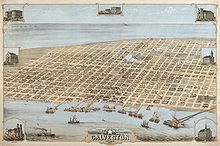
Early map of Galveston: 

 Of course everything is bigger in Texas. After she was incorporated in 1839, Galveston took no time in becoming the most active port west of New Orleans and growing to the largest city in Texas at the time.
By SMU Central University Libraries - Busy Dock Scene, Galveston, Texas. Public Domain, 

Galveston had to be first in a number of things, among them were the first opera house, first hospital, first golf course and the first country club. She was one of the richest cities in the world per capita. All major railroads served the city and over half of Texas’ cotton crop was exported through Galveston. The Strand had become not only the financial center of Galveston and Texas, but much of the Southwest as well.

One of the luxury hotels in the 19th century. 


By 1900, the town had become the fourth largest in Texas following Houston, Dallas and San Antonio with a population around 37,000. Then the 1900 Storm hit the island with one-third of the city destroyed and over 6,000 lives lost.


Those who remained were determined to restore the city and make it safer. They did so by raising the entire level of Galveston by eight feet with 17 feet at the seawall slanting down so water would run off into the bay. It worked when fifteen years later, another storm hit and only eight lives were lost.

Despite their efforts, the city never returned to its former glory. Even her shipping suffered when Houston built a ship channel and the vessels sailed up the channel to larger city. An economic decline in the mid-1960’s caused many of the beautiful old buildings to fall into disrepair and some were demolished.  

Ashton Villa is one of the homes built in 1859 that was restored. 


The 36-block business district was fully restored with the persistence of Cynthia and George Mitchell. Once known as the “Wall Street of the Southwest,” opulent Victorian buildings and residences lined the streets with banks, wholesale houses, shipping companies, auction houses, and sailor boarding houses. The buildings restored by the Mitchells were held to the highest standard of preservation and restoration. They have been recipients of numerous awards. They overhauled the downtown historic Victorian style buildings and it became an historic landmark with 2,000 buildings scattered across Galveston listed in the National Register of Historic Places.

One of the Historical Markers: 


Two huge events occur every year on the island. One is Mardi Gras which turns the town into a carnival with parades and parties down the street spanned by Mardi Gras arches built by world famous architects. This 75 year old tradition was restored in 1985 after it had been lost during WWII.

The second event is Dickens on the Strand which takes place in December and takes the city back to the Victorian times of Charles Dickens for the Christmas season.  


Another event that is well attended is the annual Historic Home Tour held in May before the real heat and humidity of Texas take over. Here is one of the homes featured on the tour. This home was built in 1893.


Taking a stroll through the area and visiting the many shops and eating places along the way is a step back in time. Modern improvements make the time spent in the historic district of Galveston an enjoyable experience.

What historical places have you visited?

Here's my latest novel, just in time for Christmas.

Christmas at Stoney Creek


News reporter Tom Whiteman befriends a homeless man, Joe, and brings him home to Stoney Creek, a town that accepts people for who they are and not how they appear. Tom’s journalistic instincts suggest there’s more to the old man than appearances tell. A carpenter by trade, Joe works at odd jobs around town and makes many new friends including Faith Delmont, a girl who grew up with Tom. Contradictions in the man’s manners and way of speaking whet Tom’s nose for news and raises even more questions. As he and Faith seek the truth, they learn that God’s love can turn tragedy and loss to triumph and true love comes to those who seek it.     


Martha Rogers is a free-lance writer and multi-published author from Realms Fiction of Charisma Media and Winged Publications. She was named Writer of the Year at the Texas Christian Writers Conference in 2009. She is a member of ACFW and writes the weekly Verse of the Week for the ACFW Loop. ACFW awarded her the Volunteer of the Year in 2014. Her first electronic series from Winged Publications, Love in the Bayou City of Texas, debuted in the spring of 2015.  Martha is a frequent speaker for writing workshops and the Texas Christian Writers Conference. She is a retired teacher and lives in Houston with her husband, Rex. Their favorite pastime is spending time with their eleven grandchildren and four great-grandchildren