Showing posts with label Erie Canal. Show all posts

Wednesday, March 27, 2019

Pressing On: Perseverance, Separatists and Canals


Have you seen books or articles about asking God to help you find the perfect word for the new year? This past year my words found me through the research and Bible verses I used for the theme of my latest historical novella, Pressing On, published by Barbour Publishing in The Erie Canal Brides Collection.


“I press toward the mark for the prize of the high calling of God in Christ Jesus.”
Philippians 3:14 (KJV)
"But if we hope for what we do not see, we eagerly wait for it with perseverance." Romans 8:25 (NKJV) 

People of the early nineteenth century certainly had to “press on” and persevere!

A couple of years ago I read an interesting article in a secular magazine about building the canal system in the American Midwest, so I suggested a book about romance along the canals to Rebecca Germany of Barbour. She liked the idea and asked me to get together with my agent, Tamela Hancock Murray, to form a group of writers to set seven stories along the Erie Canal and parts of Ohio. She also mentioned she would love one of the stories to be set near Zoar, Ohio, where the Separatists settled. So I decided to anchor my story there.


At the wash house in Zoar, where my heroine Amanda spent lots of time!

If you went to school in the 1950s and 1960s like I did, you may remember the song lyrics “I’ve got a mule, and her name is Sal…Fifteen miles on the Erie Canal.” This was what most canal boat captains could cover in a day on the water. Canals were built in many locations across the United States as a cheaper, faster means of moving goods from one place to another. The Erie Canal was built near Lake Erie in the state of New York. The building of this canal “from Albany to Buffalo” began in 1817 and finished in 1825, which was very fast considering it covered 363 miles and took literally tons of back-breaking labor, much of it by hand.

Today I want to tell you about a group of people I had never heard of before starting my research for this collection. The German Separatists who settled in Zoar, Ohio, fled the kingdom of Württemberg in southwestern Germany due to religious persecution. Their core beliefs included dedication to a life of moderation and fervent expectation of our Lord’s soon return. They disagreed with the state church over issues such as sacraments and holidays, and they faced imprisonment and the seizure of their property for refusing military service.

The Quakers in America heard about their plight and offered to pay their ship passage from the Old World to the New, and even loaned them money to buy the land in Ohio. They named their new settlement after the Biblical city of Zoar, where Lot landed after he fled Sodom.

When the Separatists came over from Germany, their leaders proposed having everything in common, and the people agreed. In some ways they remind me of the Shakers.

In order to pay off their loan from the Quakers, the Zoar Seperatists contracted to build the canal through their land. They went through a period of years while the canals were being built where the men and women lived in separate housing and were forbidden to marry so the women could labor alongside the men to speed the process. Some of the women developed bald patches on their heads from carrying dirt in heavy baskets.

When they were again allowed to marry within the group, they still had everything in common and still were controlled by the trustees. For their work, they were given food and shelter, although many had to share homes.

The group formed in 1819 and disbanded in 1898 so the movement lasted less than eighty years. The original Separatists emphasized kindness and giving, but they also had strict rules and had to follow the trustees. As they went through the Civil War and as the town built a hotel, people saw how others lived with more freedom and in charge of their own money. The younger people voted to sell the property and divide up the money and land.


Canal Tavern of Zoar
An 1829 hotel and tavern built by the Society of Separatists to serve canal travelers
My husband and I traveled to Zoar last year so I could see it for myself and do more research. Descendants of the Separatists still live in Zoar, and we met several of them on our trip. Like their predecessors, they struck me as kind and giving people.

On a side note, a few years ago, a friend asked me to go to Amish country in Ohio with her, and we rode on a canal boat pulled by a horse. We think this was near Coshocton, Ohio. I remember it as a ride that was peaceful and quiet, similar to Zoar. There is also the village of Roscoe nearby, off Highway 83, which is also quaint and quiet.


Pressing On, by Rose McCauley 


As a child, Amanda Mack loved her life in Zoar, Ohio, where she was born to Separatists who had helped build the canal. Now an adult (1857), she starts to chafe at its many restrictions. After meeting riverboat captain Daniel Jeremiah, they both must make decisions about their futures. Would she give up the way of life she grew up loving?


Pressing On is included in:


The Erie Canal Brides Collection

Seven romance stories take you back to the building of the Erie Canal and the opening of the Midwest to greater development.


Completed in 1825, the Erie Canal connected the Great Lakes to the Hudson River, and soon other states like Ohio created canals linking Lake Erie to the Ohio River. Suddenly the Midwest was open to migration, the harvesting of resources, and even tourism. Join seven couples who live through the rise of the canals and the problems the waterways brought to each community, including land grabs, disease, tourists, racism, and competition. Can these couples hang on to their faith and develop love during times of intense change?


Rose Allen McCauley has been writing since she retired from teaching school and joined American Christian Fiction Writers (ACFW). She is thrilled for this to be her third collection with Barbour and her seventh published work. She and her spouse just celebrated their golden anniversary with their three children and spouses and now six grandchildren! She loves to hear from her readers. Please connect with Rose at:
Website
Amazon Author Page
Facebook
Twitter
Goodreads
Instagram


Thursday, June 7, 2018

The Finger Lakes--historical gem of New York State

Thousands of years ago, when glaciers carved the hand print of God into Central New York State, a perfectly beautiful region was formed known as the Finger Lakes. Growing in popularity only in recent decades, it has long been a hidden paradise known to lucky upstaters like me. World class wineries, picturesque landscapes, orchards, sailing, a NASCAR raceway, and glens and gorges with hiking trails laid by FDR's Works Progress Administration, name only some of the attractions drawing tourists in recent years. History is rich in this region. Come and take a virtual tour with me.


Early in New York's settlement, plentiful native-growing grapevines were discovered, and attempts to cultivate them date back into the 1600's. In the early 1800's two godly men found success in creating a palatable wine. Deacon Samuel Warren and the Reverend William Bostwick had vintner ambitions springing from a desire to produce communion wine as well as a good table wine to compete with the too-plentiful grain alcohol responsible for the rampant over-indulgence of the 1800's. The lake winecountry, with its micro-climate and prolonged seasons has been compared to Germany for growing some of the finest white wines in the world. Early successes in the region involved champagne, including Pleasant Valley Wine Company's award winning vintage that won the coveted medal at the Vienna World Exposition in 1873. It was the first American wine to be so recognized internationally. Prohibition hit many of these vineyards especially hard, but some of the old wineries exist today. 

Seneca Lake, the deepest of the Finger Lakes, holds many distinctions historically. Salt mines supplied table salt since the mid nineteenth century. The long body of water connected the Erie Canal to smaller regional waterways, such as the Chemung Canal, from the early 1800's. At the southernmost tip of the lake is Watkins Glen, which has its own intriguing history. First named for a Mohawk Chieftain's daughter Catherine, it was an early tourist attraction and center of industry. The natural wonders of a glen carved through layers of shale became a travel destination over a century ago. In later years, motor car races attracted a faithful following at Watkins Glen International Raceway. 

On the upper, east side of the lake, a military depot was built in Romulus and trained servicemen since the 1940's. Seneca Army Depot, and a Naval Training Station later converted to Samson Airforce Base, were active military posts in their time. Sonar tests were conducted in the depths of Seneca Lake during World War II, Airmen were trained there for the Korean War, and the base reportedly held underground nuclear silos for a time. In recent years, the closed depot offers a military museum while a nature preserve on the grounds protects the largest herd of wild white Whitetail deer in the world.

Cayuga Lake is the second biggest finger lake. Ithaca, at the southern tip, boasts Cornell University, the first Ivy League college to admit women.
Another claim to historical fame, along the northern shore of Cayuga Lake was the birthplace of the women's suffrage movement at Seneca Falls. Lucretia Mott and Elizabeth Cady Stanton were two abolitionist women who had been spurned from taking part in a London anti-slavery convention, so they organized a meeting for women near Stanton's home in Seneca Falls in 1848. Two hundred women met at the Wesleyan church on July 19 over social, civil, and religious concerns, launching the women's rights movement in earnest, and ultimately leading to the female vote. 

Like Seneca, the geography near Cayuga Lake is full of gorges and glens surrounding the lake, including one of my favorite summer places, Robert Treman State Park. It has spectacular waterfalls, natural swimming holes, and hiking trails like Watkins Glen State Park which were both built during the Works Progress Administration, building infrastructure and putting Americans to work during hard times. Hiking paths with slate pathsascend miles of trails, and have weathered the decades beautifully, making it a tourist draw for nature lovers and photographers as well as camping enthusiasts the world over.


From the rolling farmland to the world-class vineyards and wineries, to sports and recreation, to historical landmarks, Upstate New York's Finger Lakes region challenges all rivals for beauty and romance. Cruising the crystal waters, or picking apples in the orchards, horseback riding, touring the wineries, or hiking the glens, can't you just imagine the stories begging to be told here? I sure can! Thank you for visiting. I hoped you enjoyed your tour of the beautiful and historic Finger Lakes.


 Kathleen L. Maher’s first literary crush was Peter Rabbit, and she’s had an infatuation with books and fictional heroes ever since. She has a novella releasing with Barbour in the 2018 Victorian Christmas Brides collection, featuring her hometown of Elmira, NY. Her debut historical “Bachelor Buttons” was released in 2013, and incorporates her Irish heritage and love of the American Civil War. She won the American Christian Fiction Writers' Genesis Contest for unpublished writers, historical category, in 2012. 
Kathleen and her husband raised their three children in an old farmhouse in upstate NY, along with a small zoo of rescued dogs, cats, and birds. They run an art business in their spare time and enjoy spoiling their grandchildren on the weekends.

Find Kathleen on facebook: https://www.facebook.com/mahereenie
And on Amazon: https://www.amazon.com/author/kathleenlmaher

(photo credits to Kathleen L. Maher and Nancy Carmichael)

Friday, August 7, 2015

The Great Fire of New York City plus giveaway

 by Debbie Lynne Costello

Be sure to read all the way down to see how to enter to win Sword of Forgiveness.

Ever wonder why some cities just explode while a neighboring town barely grows as it struggles along? 

New York City is a perfect example of some of the things that can cause a city to grow.

How did New York City grow to over eight and a half million people?

The opening of the Erie Canal in 1825 led to a boom that made for a thriving New York City. It made way for increased exportation and importation that spurred the building of factories and warehouses. But the financial growth of the city also drew investment firms, insurance companies, and wealthy entrepreneurs. 

By 1835 New York City's population was approximately 250,000 people, a huge leap from the 160,000 residents in 1825, only 10 short years. Life was good and people were living the American dream.   

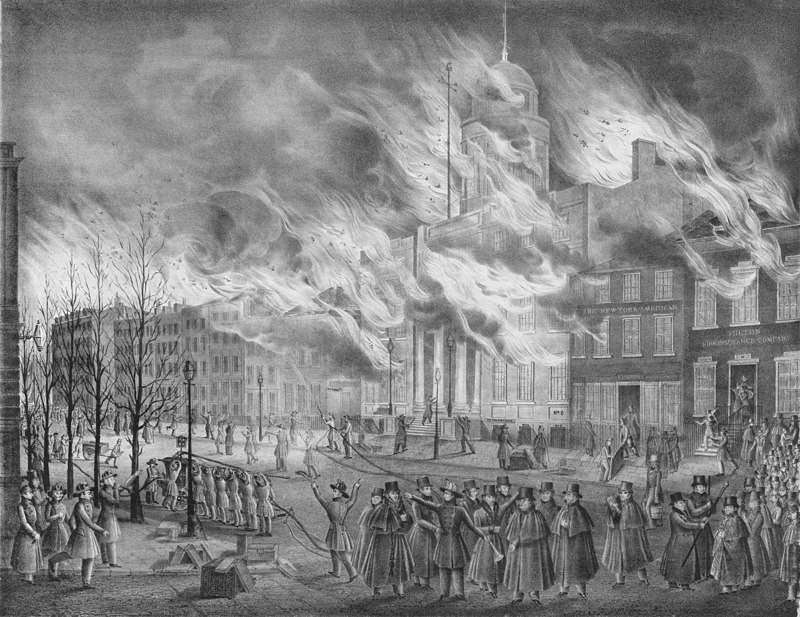
But on December 16th, 1835 that changed for many New York City people. It was a cold night, temperatures were down as low as -17 and the East River was frozen like a brick. One of the city's watchmen was making his rounds when he detected smoke. (This is just a side note here, but I find it very interesting that when homes were heated with fires that this man was able to detect the difference between a fireplace fire and a building on fire. A real hero!)

April 1836 image of the Great Fire of New York
City in flames
public domain wiki 
By Robinson (publisher 1836); drawn by Hoffy, printed and colored by J. T. Bow[er?] - 

The fire was in a warehouse on Merchant Street. When the doors were broke down the watchmen discovered a raging fire out of control. With high winds fanning the flames within fifteen minutes fifty buildings were on fire. 

New York City had grown so quickly that their water source hadn't kept up with the growth, nor had their fire department. One thousand and five hundred fire fighters, many volunteer, came out to battle the blaze that was consuming their city. There was a lack of water in the cisterns due to two other previous large fires that had destroyed over a dozen buildings. Add to that the freezing temperatures causing the water to freeze in the hoses and you have mounting disasters. It is said the fireman had to stomp on the hose to break the freezing water in them. They eventually had to go to the East River and chop holes in the ice to bring water to the inferno. But they were fighting a losing battle. Philadelphia firefighters came to help and said they could see the glow of the fire from there. 

View of the Great Fire in New York, December 16–17, 1835, as seen from Williamsburg, Nicolino Calyo
View from Williamsburg 
public domain wiki 
By Nicolino Calyo - http://luceweb.nyhistory.org/III/mimages/Images/Objects/Main/1926_78.jpg, Public Domain, https://commons.wikimedia.org/w/index.php?curid=268188
 
By midnight the business district was a flaming inferno. New York City stock exchange, the merchant exchange, warehouses, post office, churches, and banks were burning out of control.

Early in the morning the Marines brought gunpowder from the Navy stockyard and blew up buildings in the path of the fire to make a fire wall. When it was all said and done, only two lives were lost. That is attributed to the fact that the downtown area was business and not residential, and the workers had gone home for the night. Seven hundred buildings were destroyed.

Ocatowerirvingtonplow.jpg
The old Croton Aqueduct
By The original uploader was Jpgarland at English Wikipedia - Transferred from en.wikipedia to Commons by Matthiasb using CommonsHelper., CC BY-SA 2.5, https://commons.wikimedia.org/w/index.php?curid=6840442
The great fire left only 3 of the 26 insurance companies in business. The others had to file bankruptcy.

Despite the devastation that New Yorkers faced, they showed their American resilience and bounced back. One year later all the fire ravaged blocks had been rebuilt with buildings that could make New Yorkers proud. The devastation that tore through the city that cold night taught New York that changes need to be made in the safety of their city. It spurred on building codes, and ways that fires were managed, but most of all brought the Croton Water System. The system brought water 41 miles from the Croton River by force of gravity alone.

So something good came from the destruction of that night. Our ancestors were a hardy lot who cut roads through mountains and forests, settled the untame west, and made America prosperous. But most of all they never gave up. When they faced a battle or a tragedy they put on their boots and marched forward.

I'm giving away a copy of Sword of Forgiveness to one lucky winner. Leave a comment and let me know if you've ever experienced a fire along with your email address to enter. Share on FB and Twitter for extra entries! Be sure and let me know you've shared. Ends August 12th.   


When her father died, she had promised herself no man would own her
again, yet who could defy an edict of the king? After the death of her cruel father, Brithwin is determined never again to live under the harsh rule of any man. Independent and resourceful, she longs to be left alone to manage her father’s estate. But she soon discovers a woman has few choices when the king decrees she is to marry Royce, the Lord of Rosencraig. As if the unwelcome marriage isn’t enough, her new husband accuses her of murdering his family, and she is faced with a challenge of either proving her innocence or facing possible execution.
Royce of Hawkwood returns home after setting down a rebellion to find his family brutally murdered. When all fingers point to his betrothed and attempts are made on his life, Royce must wade through murky waters to uncover the truth. Yet Brithwin’s wise and kind nature begin to break down the walls of his heart, and he soon finds himself in a race to discover who is behind the evil plot before Brithwin is the next victim. 


Debbie Lynne Costello has enjoyed writing stories since she was about eight years old. She studied journalism at Heritage University. She raised her family and then embarked on her own career of writing the stories that had been begging to be told. She and her husband have four children and live in upstate South Carolina. She has worked in many capacities in her church and is currently the Children's Director. Debbie Lynne has shown and raised Shetland Sheepdogs for eighteen years and still enjoys litters now and then. In their spare time, she and her husband take pleasure in camping and riding their Arabian and Tennessee Walking horses.