Showing posts with label fires. Show all posts

Sunday, June 7, 2020

Sparking Fire on the American Frontier


by 
Misty M. Beller

As a writer of historical fiction, I've always been a little fascinated by how people had to light flame before the invention of the friction match we use today. 

(By the way, the first "matches" were actually invented all the way back in 577 AD using sulphur, and various versions of sulphur and phosphorus to make fire were experimented with for centuries. None were practical, inexpensive, and safe for the general public until the friction match was invented by English chemist John Walker in 1826. But that, my friends, is a blog post for another day.)

There were two main methods of producing fire before matches came into widespread use. Most of the "civilized world" used flint and steel to build their fires, however when Lewis and Clark explored the vast lands of the Louisianna Territory, they found that the natives mostly used various versions of a bow drill to spark flame for campfires. 


Versions of the flint and steel method for starting fire. From the United States National Museum (Smithsonian Institution), Washington D.C.

Regarding the flint and steel method, below is an excerpt Herbert Manchester's book, The Diamond Match Company; a Century of Service, of Progress, and of Growth, 1835-1935, which gives an unfortunately realistic description of how a morning fire was started: 
"known to the Romans and . . . developed in the Dark Ages along with hand-wrought steel for weapons and armor. The steel, which was curved so as to form a handle, was held in the left hand and struck with the sharp edge of the flint. Good tinder was very important and was made by charring lint, or other easily combustible material, and keeping it dry in a tinder box or pouch. The fire maker blew upon the lighted tinder to spread the fire and added shavings, or perhaps so-called matches, which then meant only splints dipped in sulphur. If everything went right, a fire was kindled in a few minutes, but the flint might have lost its sharp edge, the steel might be blunted and the tinder might be damp from rainy weather or merely from fog; moreover, as the fire was usually built in the dark before sunrise, which was the getting-up time in those days, the knuckles might be hit instead of the steel, and the fumes in-haled in ineffectual puffing."
If the fire was being built on the trail, add to the above image the challenges of wind and rain, and the difficulty of securing decent tinder like dried moss or shredded birch bark.


Versions of the bow-drill method for starting fire. From the United States National Museum (Smithsonian Institution), Washington D.C.

As for the bow-drill or other methods of using wood upon wood for the friction to create a spark, there were as many variations as there were people using this method to start fire. Typically a spindle about a foot long would be held upright with one end in a hole in a block of wood that sat on the ground. The base board should be made from spruce, cedar, balsam, tamarack, or similar, non-resinous wood. The string of a bow was wrapped once around the spindle, so that it was tight enough not to slip during operation.
Diagram of a bow drill designed for fire starting


With these two methods as the primary ways to build a fire, no wonder people rarely allowed fires to go out, even in the hot summer months. A fire had to be used for cooking, so banking coals, so they could be re-kindled into flame, became a carefully honed skill.

But for settlers, frontiersmen, or Native Americans on the trail, a new fire would probably need to be built at each stopping point. Especially in the cold winter months, where the campfire would serve for both heat and cooking. If a fire wasn't needed for warmth and they had sufficient cooked food, the groups would certainly not go through the effort. But hunting along the journey was usually the primary source of food, and that meat had to be cooked.

Cooking, of course, required a fire. 


***

Misty M. Beller is a USA Today bestselling author of romantic mountain stories, set on the 1800s frontier and woven with the truth of God’s love.

Her latest release, Hope in the Mountain River, is an epic journey along the path taken by the Lewis and Clark expedition—an epic journey through breathless landscapes and adventure so intense, lives will never be the same.

For a limited time, you can get one of Misty's bestselling novels free here: https://www.subscribepage.com/s8n2o1

Sunday, October 1, 2017

Denver's Union Station


Blogger: Amber Schamel

Union Depot Original Structure
Courtesy of the Denver Public Library - Used by permission
During the late 1800’s, the population of Denver Colorado was exploding. The popularity of railroad travel and the connection of the transcontinental railway to Denver resulting in large amounts of travelers and a rapid rate of growth. But with four different railroad companies now carrying passengers, a problem arose. Transferring passengers and freight between railroad lines required traipsing dirt paths between the four different stations became glaringly inconvenient. To resolve this problem, the four companies came together and agreed to build a joint terminal to combine the operations. Plans for the historic Denver Union Station were underway.

Photo Showing Fire Damage
Courtesy of Denver Public Library - Used by Permission
The companies selected a promising location and hired A. Taylor from Kansas City as the architect. The station was designed in a Romanesque style using rock from quarries around the state. The foundation and walls were built with stone from the Castle Rock area, while the sandstone trip came from areas like Morrison, Colorado. $525,000 dollars later (about what it would cost to build 750 four room houses), the Union Depot opened in June of 1881 as the largest building this side of Kansas City. It turned out to be a great move on the part of the railroad companies, as well as a benefit for Denver. Just a few years after the completion of the station, Denver’s population had grown to be ten times its pre-1881 size.

After Fire.
Courtesy of Denver Public Library - Used by Permission.
Only 13 years after completion, March of 1894, an electrical fire ignited in the ladies’ restroom and destroyed much of the original structure, however they were able to reopen the main areas the following day.
Rebuilding commenced immediately. This time the clock tower was built of stone rather than wood and it was raised 40 feet taller than the original.
In 1906, a metal archway was constructed to welcome travelers. Originally it said ‘welcome’ on both sides, but soon the welcome was replaced with the Hebrew word Mizpah, which means “may the Lord watch between you and I while we are apart.” This arch was dismantled during the Great Depression due to financial and safety concerns.

Mizpah Arch
Courtesy of the Denver Public Library - Used by Permission
The station underwent more improvements throughout the years, but it became an icon of the American West, welcoming Presidents, foreign queens, celebrities and millions of people through its doors.

This beautiful station is one of the settings for a pivotal scene in my new release, Solve by Christmas. It was so much fun to incorporate it into the story.


*****


Amber Schamel writes riveting stories that bring HIStory to life. She has a passion for travel, history, books and her Savior. This combination results in what her readers call "historical fiction at its finest".  Her title, Dawn of Liberty, was awarded the 2017 CSPA Book of the Year award in Historical Fiction. She lives in Colorado and spends half her time volunteering in the Ozarks. Amber is a proud member of the American Christian Fiction Writers Association. Visit her online at www.AmberSchamel.com/ and download a FREE story by subscribing to her Newsletter!

Friday, April 28, 2017

Tidbits About Nantucket's Great Fire of 1846

Hi all,
There are no better accounts about an incident in history than what was recorded at the time. Below is an account of the fire that was in the Exeter News Letter. It occurred on July 13, 1846 destroying 300 houses and a financial loss of $800,000.

"Along the path of the flames were stored many thousand barrels of oil, and tons of spermaceti. The casks were burned through, and the liquid ran down Ihe streets, converting them into perfect rivers of fire, driving the appalled inhabitants before it, and washing the buildings that lined the ways with burning waves. So rapid was its approach to some points, that men had barely lime to escape, and even two fire engines were left a prey to the element. It ran out upon the water in the harbour, still blazing, and resembled, in its thousand flashes and spires of light, a gorgeous palace of gold amid the sea. The country about was as li«ht as at noon. For hours the town was a Jake of fire; the moon looked bloody, and the sky glared above, while the noise of the flames was like the roar of the ocean, and the explosions, in blowing up the houses, like the tempest bursts of thunder.

"It was morning before the progress of destruction was checked, but many, who saw the sun go down in affluence, had been reduced, ere its rising, to poverty and destitution.

"Numerous were the thrilling incidents that occurred during the hours of that night. A part of the officers and crew of a Revenue Cutter lying in the harbour, came ashore and rendered valuable assistance. At one time, just as a store was blown up, they lost sight of their commander, and it was feared he was killed. Several minutes of intense anxiety passed, but at length he was found unharmed, and so great was the joy of the seamen, that they opened their arms, and received him with repeated embraces.

Two ladies,strangers in the town, not knowing whither to go, fled to one of the wharves for safety. In a brief period, every building near the head of the wharf was on fire. The burning oil poured into the docks, and they were nearly hemmed in by flames; the wharf was supported by wooden spires, and in momentary danger.—In this frightful situation, they remained more than an hour, but were finally discovered by a boat from the Cutter, and released from their distressing position.

"The fire among the ruins, on the second night, lit up the sky, throwing a wild glare over the remainder of the town."


Lynn A. Coleman is an award winning & best-selling author who makes her home in Keystone Heights, Florida, with her husband of 42 years. Lynn's latest novel is a collection of three. Brides of Kentucky She also released a novella this month The Matchmaker Brides Collection Lynn's novella is titled "The Tinman's Match"

Friday, August 7, 2015

The Great Fire of New York City plus giveaway

 by Debbie Lynne Costello

Be sure to read all the way down to see how to enter to win Sword of Forgiveness.

Ever wonder why some cities just explode while a neighboring town barely grows as it struggles along? 

New York City is a perfect example of some of the things that can cause a city to grow.

How did New York City grow to over eight and a half million people?

The opening of the Erie Canal in 1825 led to a boom that made for a thriving New York City. It made way for increased exportation and importation that spurred the building of factories and warehouses. But the financial growth of the city also drew investment firms, insurance companies, and wealthy entrepreneurs. 

By 1835 New York City's population was approximately 250,000 people, a huge leap from the 160,000 residents in 1825, only 10 short years. Life was good and people were living the American dream.   

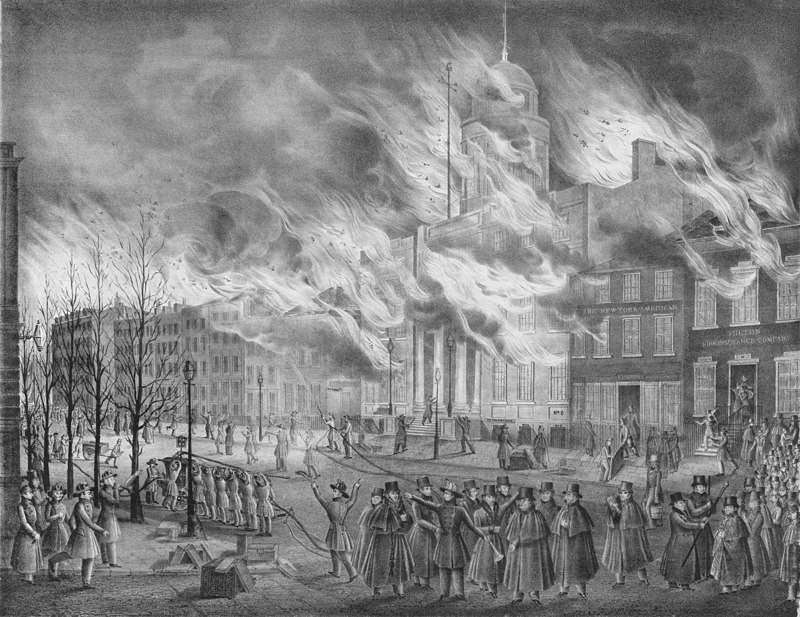
But on December 16th, 1835 that changed for many New York City people. It was a cold night, temperatures were down as low as -17 and the East River was frozen like a brick. One of the city's watchmen was making his rounds when he detected smoke. (This is just a side note here, but I find it very interesting that when homes were heated with fires that this man was able to detect the difference between a fireplace fire and a building on fire. A real hero!)

April 1836 image of the Great Fire of New York
City in flames
public domain wiki 
By Robinson (publisher 1836); drawn by Hoffy, printed and colored by J. T. Bow[er?] - 

The fire was in a warehouse on Merchant Street. When the doors were broke down the watchmen discovered a raging fire out of control. With high winds fanning the flames within fifteen minutes fifty buildings were on fire. 

New York City had grown so quickly that their water source hadn't kept up with the growth, nor had their fire department. One thousand and five hundred fire fighters, many volunteer, came out to battle the blaze that was consuming their city. There was a lack of water in the cisterns due to two other previous large fires that had destroyed over a dozen buildings. Add to that the freezing temperatures causing the water to freeze in the hoses and you have mounting disasters. It is said the fireman had to stomp on the hose to break the freezing water in them. They eventually had to go to the East River and chop holes in the ice to bring water to the inferno. But they were fighting a losing battle. Philadelphia firefighters came to help and said they could see the glow of the fire from there. 

View of the Great Fire in New York, December 16–17, 1835, as seen from Williamsburg, Nicolino Calyo
View from Williamsburg 
public domain wiki 
By Nicolino Calyo - http://luceweb.nyhistory.org/III/mimages/Images/Objects/Main/1926_78.jpg, Public Domain, https://commons.wikimedia.org/w/index.php?curid=268188
 
By midnight the business district was a flaming inferno. New York City stock exchange, the merchant exchange, warehouses, post office, churches, and banks were burning out of control.

Early in the morning the Marines brought gunpowder from the Navy stockyard and blew up buildings in the path of the fire to make a fire wall. When it was all said and done, only two lives were lost. That is attributed to the fact that the downtown area was business and not residential, and the workers had gone home for the night. Seven hundred buildings were destroyed.

Ocatowerirvingtonplow.jpg
The old Croton Aqueduct
By The original uploader was Jpgarland at English Wikipedia - Transferred from en.wikipedia to Commons by Matthiasb using CommonsHelper., CC BY-SA 2.5, https://commons.wikimedia.org/w/index.php?curid=6840442
The great fire left only 3 of the 26 insurance companies in business. The others had to file bankruptcy.

Despite the devastation that New Yorkers faced, they showed their American resilience and bounced back. One year later all the fire ravaged blocks had been rebuilt with buildings that could make New Yorkers proud. The devastation that tore through the city that cold night taught New York that changes need to be made in the safety of their city. It spurred on building codes, and ways that fires were managed, but most of all brought the Croton Water System. The system brought water 41 miles from the Croton River by force of gravity alone.

So something good came from the destruction of that night. Our ancestors were a hardy lot who cut roads through mountains and forests, settled the untame west, and made America prosperous. But most of all they never gave up. When they faced a battle or a tragedy they put on their boots and marched forward.

I'm giving away a copy of Sword of Forgiveness to one lucky winner. Leave a comment and let me know if you've ever experienced a fire along with your email address to enter. Share on FB and Twitter for extra entries! Be sure and let me know you've shared. Ends August 12th.   


When her father died, she had promised herself no man would own her
again, yet who could defy an edict of the king? After the death of her cruel father, Brithwin is determined never again to live under the harsh rule of any man. Independent and resourceful, she longs to be left alone to manage her father’s estate. But she soon discovers a woman has few choices when the king decrees she is to marry Royce, the Lord of Rosencraig. As if the unwelcome marriage isn’t enough, her new husband accuses her of murdering his family, and she is faced with a challenge of either proving her innocence or facing possible execution.
Royce of Hawkwood returns home after setting down a rebellion to find his family brutally murdered. When all fingers point to his betrothed and attempts are made on his life, Royce must wade through murky waters to uncover the truth. Yet Brithwin’s wise and kind nature begin to break down the walls of his heart, and he soon finds himself in a race to discover who is behind the evil plot before Brithwin is the next victim. 


Debbie Lynne Costello has enjoyed writing stories since she was about eight years old. She studied journalism at Heritage University. She raised her family and then embarked on her own career of writing the stories that had been begging to be told. She and her husband have four children and live in upstate South Carolina. She has worked in many capacities in her church and is currently the Children's Director. Debbie Lynne has shown and raised Shetland Sheepdogs for eighteen years and still enjoys litters now and then. In their spare time, she and her husband take pleasure in camping and riding their Arabian and Tennessee Walking horses.