Showing posts with label Giveaway. Show all posts

Monday, September 16, 2019

Gold in Them Thar Hills - and a Giveaway!


 by Davalynn Spencer

The Gold Rush isn’t over in Colorado. It resurfaces every year in late September through mid-October as high-country aspen and lower country cottonwoods exchange their summer greens for glimmering gold and fiery reds.


Colorado's aspen groves line highways and mingle
with evergreen forests. - Author's photo
“There’s gold in them thar hills,” people have been known to say, and they flock to the Rocky Mountains like migrating geese for a gander at the scenery.

This coming weekend officially introduces fall to our calendars. Even so, it’s often hard to predict exactly when peak foliage viewing times will be. According to arborists, scientists, and others in the know, catching the colors in their prime is all about chlorophyll and temperatures. And elevation.


Author's photo of Rocky Mountain color in an early fall snowstorm.
The higher the elevation, the earlier autumn swishes her lovely skirts along the Rocky Mountains. A general rule of thumb for viewing fall foliage in colorful Colorado calls for higher-elevation stands and those located farther north to flash sooner than lower, southerly sites.

Colorado’s famous aspen trees and their poorer cousin, the cottonwood (both are in the poplar family), change colors for the same reason other deciduous trees do: photosynthesis decreases as daylight hours lessen in the fall.

Have you noticed in early September that daylight seems to have cut loose and run? That’s because we lose an hour of daylight during the month of August as the earth tilts toward autumn. And we are not the only living beings that feel it.

Technically, the leaves of these trees don’t change from greens to golds – the color range is there all along, like stars in the sky that we can’t see during the day. Yellows, oranges, and reds are merely masked by the green hues until chlorophyll production fades.


Author's photo
The United States National Arboretum says a wet growing season followed by a drier, clear-sky autumn and cool nights generate the brightest colors. In addition, unhealthy trees are less vibrant than healthy trees, much like other growing things, including humans.

Colorado is not the only state to harbor aspen trees, and they thrive in higher, colder regions with cool summers. The trees are often called quaking aspens due to the longer, flatter petiole, or leaf stem, that allows the leaves to flutter in the slightest breeze.


Aspen leaves "quake" due to their longer leaf stem. -Author's photo.
Aspens grow in colonies connected via underground root systems. The oldest known colony is found in the Fishlake National Forest of Utah, where it covers roughly 106 acres.

Comment to be entered in a drawing: I’d love to hear about a trip you took to see the colors – even if it was just around the block. Those who comment below will be entered in a random drawing for an e-copy of my latest release, Mail-order Misfire, Book 2 of the Thanksgiving Books & Blessings Collection.


Wife and mother of professional rodeo bullfighters, Davalynn Spencer writes cowboy romance. She is an ECPA and Publisher’s Weekly bestselling author and winner of the Will Rogers Gold Medallion for Inspirational Western Fiction. And she’s fairly certain that her previous career as a rodeo journalist and crime-beat reporter prepared her for life in Colorado wrangling Blue the Cowdog and mouse detectors Annie and Oakley. Connect with her via her website at www.davalynnspencer.com.

Sunday, September 2, 2018

Inside the White House: The Blue Room...Plus a Giveaway!


With the Yellow Oval Room above it and the Diplomatic Reception Room below, the first floor Blue Room is one of three oval reception rooms in the White House. The Blue Room has functioned as the primary reception room since the White House was built, and was first described as the architect, James Hoban, as the "elliptical saloon."

The Blue Room as refurbished in 1995 during the Clinton Administration. Public Domain.

President John Adams used the chamber for receptions, but also as the house's south entrance hall. This particular use did not last, however, and during the Madison Administration, architect Benjamin Latrobe designed classical-revival furniture to be used here. Sadly, the chairs and other furnishings were destroyed  when the White House was burned in 1814.

President Madison set about redecorating the refurbished White House, and ordered a suite of mahogany furniture in the French Empire style for the oval room from French furniture maker Pierre-Antoine Bellangé. However, the firm sent gilded furniture, insisting mahogany was not appropriate for saloons! The oval Aubusson rug, woven specially for this room, was described as green velvet, and the chairs were upholstered in crimson and two shades of gold--not blue.

The Blue Room was not blue until President Van Buren redecorated in 1837. While the blue theme continued through following presidencies, the furniture did not: in 1860 President Buchanan auctioned off several pieces and replaced them with rococo-revival pieces. In the 1870s, President Johnson's daughter-in-law chose blue wallpaper paneled with black and gold geometric shapes.
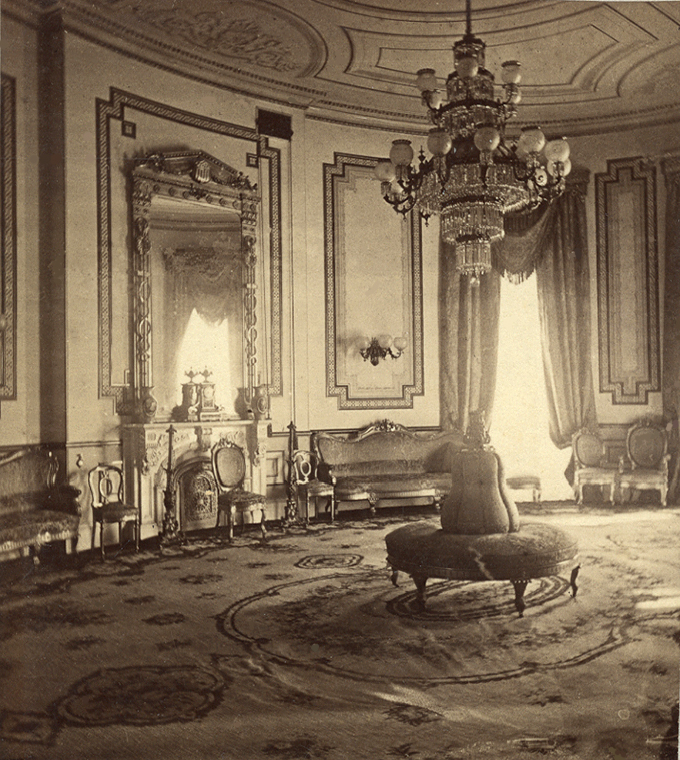
The Blue Room during the Grant Administration, 1870s. Note the paneled wallpaper. Public Domain.
President Cleveland's Administration saw the room decorated by Tiffany, with a shield and star pattern on the ceiling and robin-egg blue wallpaper inlaid with rosettes of colored glass. (For a beautiful painting of the room, imagined by Peter Waddell, click here.) 

It was in this room, with the glass rosettes on the walls, that President Cleveland married his wife, Frances in 1886. 
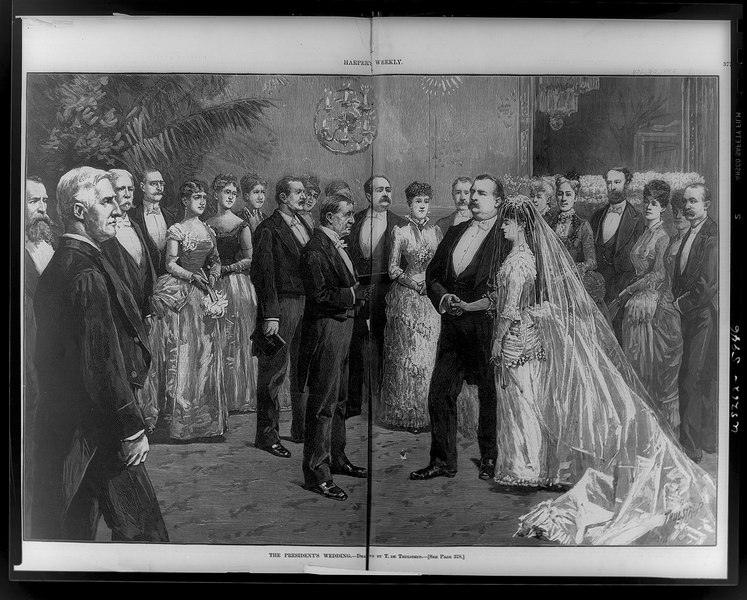
File:The President's wedding - (drawn) by T. de Thulstrup. LCCN96521736.tif
President Cleveland and Frances Folsom's wedding in the Blue Room. Harper's Weekly, Public Domain.
In 1902, during the refurbishment that occurred during President Roosevelt's Administration, the Blue Room's decor was restored to its former Empire style. When Jacqueline Kennedy set about restoring and updating the White House in 1961, she read an article that referenced a suite of French Empire-style gilt wood furniture made in 1817 by French furniture maker Pierre-Antoine Bellangé for use in the Yellow Oval Room--the same designer who created the suite for the Blue Room. Kennedy's staff began to research the lost pieces, and found but one: a pier table. The pier table was acquired, restored, and received a new white marble top. It was placed across from the fireplace, which is where it sat during the Madison Administration. 

Replicas of the lost Bellangé chairs were made (although three originals were acquired by the 1970s). A marble-topped table purchased by Madison in 1817 was reintroduced over the years, and still serves as the room's centerpiece (unless it is the Christmas season, when a Christmas Tree takes its place.
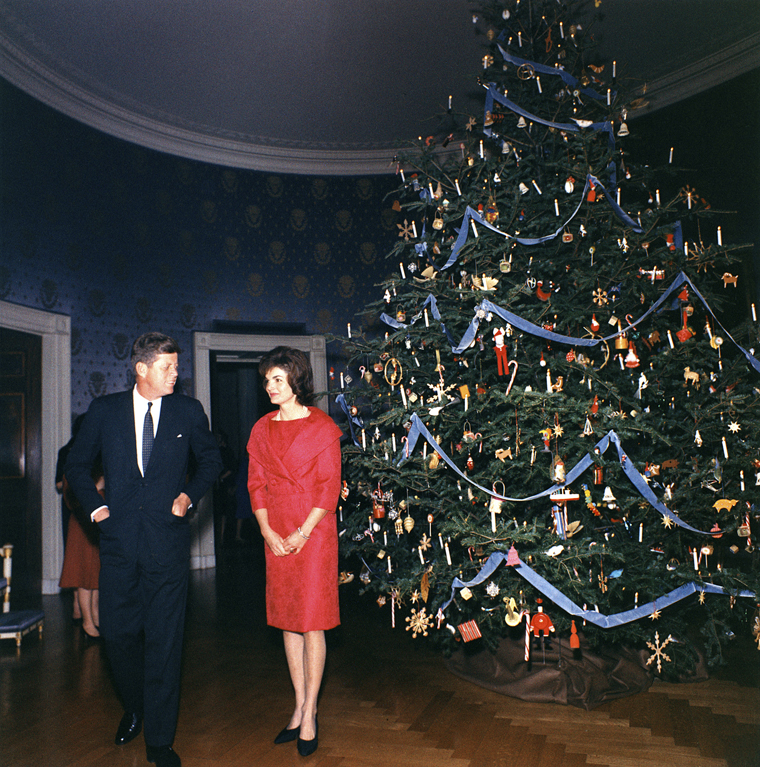
The first themed-Christmas at the White House was 1961, when Mrs. Kennedy chose a Nutcracker theme. Robert Knudsen, White House Collection - The White House, Kennedy Library. Public Domain.
While the room has been updated several times, its last refurbishment was in 1995, under the direction of the Committee for Preservation of the White House, the White House Office of the Curator, paid for by the White House Endowment Trust. It has remained a popular chamber, used to receive diplomats, hold receptions and meetings, for small dinners, and to gather.

File:Four Presidents, Reagan, Carter, Ford, Nixon 1981.jpg
1981, Presidents Nixon, Reagan, Ford and Carter share a toast in the Blue Room. Public Domain.
President Obama meets with Business Council Leadership in 2009. Public Domain
***

Christmas in September?! It sure is! Today I'm giving away a copy of my new release, The Victorian Christmas Brides Collection. To enter to win, please comment below by September 7, 2018, noon Pacific time, and include a way to contact you. 

***

Susanne Dietze is the award-winning author of over a dozen inspirational romances. You can learn more about her at www.susannedietze.com.

Monday, July 16, 2018

Watch Out for Bear Sign! – and a Giveaway


When I was big enough to peek over the edge of my grandmother’s kitchen table and draw a bead on her silver-plated, big-eared sugar bowl, I was old enough to spend the entire drive out to her house with my parents hoping she’d made apple fritters for desert.

By the time I was old enough to make them myself, she was gone.

But I still remember that deep-fried bread sprinkled with powdered sugar and chock full of tasty apple chunks. Maybe that’s why I’m such a fan of Bear Sign, the closest thing I’ve had to Grandma’s fritters.
Not Bear Sign.
Bear Sign is code for cowboy donuts, and any trail Cookie worth his keep knew how to make them.
Nope, still not Bear Sign.
Any cowboy that knew up from down also knew to stay on Cookie’s good side if he wanted his share of those deep-fried, cinnamony hunks of sweet bread.

Of course there are no chopped apples or any other fruit inside bonafide Bear Sign. It’s a pretty basic recipe, simple enough for the trail Cookie to have everything he needed on hand.

In my recent release, An Unexpected Redemption, Elizabeth/Betsy Beaumont/Parker (there’s a whole name-thing going on there) stops by Bozeman’s Café and discovers that Bozeman is a former trail cook and makes a mean batch of Bear Sign.

Elizabeth is a fan because she grew up eating Bear Sign made by Deacon, the older ranch hand, and she doesn’t mind puffing powdered sugar off her lip after biting into a delicious helping. (Hungry yet?)

One recipe is pretty much like the next, but I’ve included what I use when I’m frying up a batch. Mind you, this is half a batch so I don’t end up with too much must-eat goodness. If you want to feed the whole bunk house, just double the ingredients.

Warning: Proceed with caution. These are delicious!

                                              
Cow-camp or trail cooks may have been the most important person on the cattle drive or roundup, and they weren’t always called Cookie. A few of their more colorful handles were Sourdough, Greasy Belly, Biscuit Roller, Old Lady, Pot Russler, and more.

My grandma, well, I just called her Grandma. She was awfully important to our family, too, and fritters weren’t the only thing she did well.

She also gave a mighty fine bear hug.

In An Unexpected Redemption, Elizabeth is a fan of Bear Sign - aptly depicted in this picture
of my cowboy doughnuts.  They may look rough, but I fried all the odd shapes as well as the
round pieces to give them that bear-sign look. And I must warn you, they are delicious.
Excerpt from An Unexpected Redemption:

Snowy powder lifted beneath Elizabeth’s nose as she bit into a sugar-dusted bear sign. Nibbling and chuckling, she made her way back to the boarding house, savoring Hoss Bozeman’s thunderstruck look. He’d thought he was pulling a fast one, but the joke was on him when she flicked not an eyelash at the name he gave his pastries.

She’d grown up eating Deacon’s bear sign on roundups. The best doughnuts she’d ever had.


GIVEAWAY!

I’m giving a reader-choice e-copy of AnUnexpected Redemption, Book 2 


or An Improper Proposal, Book 1 of my “Front Range Brides” series. Enter for a chance to win by sharing today’s post on Facebook, Twitter, Instagram or whatever social media you prefer. Leave a comment below telling me where you shared this post and I’ll toss your name in the skillet. I mean hat.

You can enter a second time by signing up for my quarterly newsletter here. Leave a comment below telling me you signed up, and I’ll enter your name again in the random drawing.


Wife and mother of professional rodeo bullfighters, Davalynn Spencer writes cowboy romance. She is an ECPA and Publisher's Weekly bestselling author and winner of the Will Rogers Gold Medallion for Inspirational Western Fiction. And she’s fairly certain her previous career as a rodeo journalist and crime-beat reporter prepared her for life in Colorado, wrangling Blue the Cowdog and mouse detectors Annie and Oakley. Connect with her at http://davalynnspencer.com/

Wednesday, February 14, 2018

MMM Book Giveaway Blog Party


This month's Mid-Month Madness Party will be on the blog only. To win any of these books, comment below. The drawing will take place on February 16th. Winners will be posted in the comments and contacted by the authors.


The Return
Book 2 of the Northkill Amish Series

by Bob Hostetler and J.M Hochstetler

Jakob Hochstetler’s refusal to take up arms against the Indians who attacked his Amish family’s home on the Pennsylvania frontier during the brutal raids of the French and Indian War cost the lives of his wife, a son, and a daughter. Carried away with his younger sons, Jakob is enslaved by the Seneca, while Joseph and Christian are adopted into different Lenape divisions. As the boys struggle to adapt to new lives, Jakob plots a perilous escape in spite of overwhelming odds against succeeding. Yet even if he gets away, can he survive a harrowing journey over the hundreds of miles of rugged terrain that lie between him and his Northkill community? Are his older son and daughter still alive? And can he find his boys and bring them home?


Red Sky Over America
Ladies of Oberlin, Book 1

by Tamera Lynn Kraft


In 1857, America, the daughter of a slave owner, is an abolitionist and a student at Oberlin College, a school known for its radical ideas. America goes home to Kentucky during school break to confront her father about freeing his slaves.

America's classmate, William, goes to Kentucky to preach abolition to churches that condone slavery. America and William find themselves in the center of the approaching storm sweeping the nation and may not make it home to Ohio or live through the struggle.

"Red Sky Over America tackles the most turbulent time in history with thorough research and fascinating characters. Tamera Lynn Kraft has woven a tale about the evils of slavery that should never be forgotten." -- Mary Ellis, author of The Quaker and the Rebel, The Lady and the Officer, and The Last Heiress.


Bandolero

by Nancy J. Farrier

Yoana Armenta’s reckless behavior results in her being captured by bandoleros, Yoana fears her impulsive nature has caused irreparable disaster. Amado Castro gave a death bed promise that he intends to keep – at all costs - even if he must break a childhood vow. When his choice endangers Yoana’s life, he struggles with the decision to honor his word, or to protect Yoana, whom he has come to care for more than he could have imagined. Now as the bandoleros threaten to sell Yoana and her tía to a fate worse than death, and the rancheros want to hang Amado, they must make choices. Will they trust God, or will they do what seems right to them?

Tuesday, August 15, 2017

5 Interesting things about Indentured Servitude


Most indentures were voluntary, although there were some who were coerced or tricked into servitude. Those who voluntarily entered into a seven year contract did so to increase their odds of a better life. Most were immigrants who had no hope of ever owning land or property in their home countries. But there was a pressing need for labor in the new world, with the opportunity to learn a trade and own property.


As harsh as it sounds to us, it wasn’t uncommon for poor people to indenture their children to give them a chance to learn a trade and to offer them a better life. Sometimes a child was indentured close to home and could still visit their parents on occasion. But there were times a child was sent away to the new world to become an indentured servant, some as young as six and seven years old. I can’t imagine the desperation parents felt when making such a decision. But for the price of their passage, they had the assurance of learning a trade, lodging, food, and clothing for the next seven years. That was probably more than they’d have in an overcrowded tenement with no prospects of bettering themselves.


The reason that they had that assurance was because contracts were drawn giving them certain rights. It was in the best interests of the merchants, landowners, bakers, blacksmiths, coopers, etc., for the system of indentured servitude to work. Their small towns and burbs depended on this system of labor to thrive. The local magistrates didn’t look kindly on one of their own abusing this system. Of course, there were exceptions and situations of abuse, but by-and-large, the system of indentured servitude worked quite well.


At the end of the term (usually 7 years), an indentured servant was free to go his own way. He could stay in the community and become part of the community where he’d been indentured, or he could move to another town and hang out his shingle. He now had a trade that he could offer to others.


For convicted felons, becoming an indentured servant was preferable to going to prison, and since the prisons in London and other European cities were overflowing, convicts were encouraged (and I use that term loosely) to accept the offer to become indentured servants in the new world. Many weren’t criminals by nature, but were forced to steal to simply stay alive. In more than one case, convicts turned their lives around and became upstanding and well-respected citizens in their new locations.


The Promise of Breeze HillAvailable Now

Connor O’Shea in The Promise of Breeze Hill was first forced to become an indentured servant after running afoul of a powerful woman and her father in Ireland. After serving his forced 7 year indenture in the colonies, Connor willingly indentures himself for an additional four years to bring his brothers over from Ireland, and is very specific and concerned that his contract reflects the terms that he’s set forth.

And, yes, he gets his freedom — and so much more — by book’s end.

CBA Bestselling author PAM HILLMAN was born and raised on a dairy farm in Mississippi and spent her teenage years perched on the seat of a tractor raking hay. In those days, her daddy couldn't afford two cab tractors with air conditioning and a radio, so Pam drove an Allis Chalmers 110. Even when her daddy asked her if she wanted to bale hay, she told him she didn't mind raking. Raking hay doesn't take much thought so Pam spent her time working on her tan and making up stories in her head. Now, that's the kind of life every girl should dream of. www.pamhillman.com


To celebrate the release of THE PROMISE OF BREEZE HILL,Tyndale
 is giving away this gorgeous Natchez, Mississippithemed gift basket.
CLICK TO ENTER!

Saturday, February 4, 2017

White House Conservatory: Then and Now and a Giveaway


While researching historical images for my last post, Botanical Conservatories, I came across a photograph of conservatories attached the the west side of the White House.   

The White House Conservatories c. 1858. Courtesy of Library of Congress
Intrigued, I followed its source to the Library of Congress Prints and Photographs Division where I found several interior stereographs of the White House conservatory and greenhouses.

Interior view of White House conservatory with plants and greenhouse glass roof c1873. Courtesy of the Library of Congress


Potted azaleas in the White House conservatory c1897. Courtesy of the Library of Congress


Unknown Woman Examining Plants along Path in a White House Greenhouse c1900. Courtesy of Library of Congress

First Lady Lucy Hayes and children c1879
The stereographs merely whetted my appetite, and I dug into the history of the White House looking for images of first families enjoying the benefits of the conservatory. 

I found this delightful one of Lucy Hayes, wife of President Rutherford B. Hayes, sitting in the conservatory with their children on an archived website of The White House, President George W Bush.

My next search focus was discovering when the conservatories were replaced by the West Wing. For this search, I replaced the word, conservatory, with the phrase, west wing, and stumbled upon the fascinating White House Museum site with its page devoted to the West Wing.

And that's where I found this breathtaking White House illustration circa 1860 with the first greenhouse and people dressed in period clothing on a large expanse of green lawn. Even without the east and west wings the building's architectural details proves it to be the unmistakable mansion of America's First Family.


Illustration of the south face, circa 1860, with the first greenhouse (1857-1867). Courtesy White House Museum
According to the website, White House Historical Association, the first conservatory was added at the urging of James Buchanan's niece and hostess, Harriet Lane. Made of wood, it was built adjacent to the State Dining Room on the roof of the west terrace in 1857 and used primarily for plants and flowers. After it burned in 1867, its iron and wood replacement was built twice as large. 


Green houses, White House, Washington, D.C. c 1889. Courtesy of Library of Congress

Over the next two decades, multiple greenhouses were added which enabled the growing of fresh produce for the kitchen, as well as beautiful plants and flowers to grace the White House rooms, all year round. 


 Oranges growing in White House conservatories, Washington, D.C. c1902. Courtesy of Library of Congress

When President Theodore Roosevelt and his large family moved into the residential quarters of an already crowded White House in 1901, something had to be done. 


President Theodore Roosevelt and family, 1903. Courtesy of Wikipedia

The decision was made to take down the conservatories and greenhouses and put up a temporary executive office structure which would allow the separation of the president's work and family life, as well as allow facilities for state visits and guest accommodations. 


The White House, Executive Offices and Treasury, east from the Navy Dep't., Washington, U.S.A. c1906. Courtesy of the Library of Congress

And here's a final one to show the changes after the 1929 fire and subsequent changes after
 Franklin Roosevelt overtook the third renovation of the new executive wing. Note that the term, West Wing, did not come into usage until this period in the 1930s.


The West Wing around 1938, showing the ground floor courtyard. (Library of Congress - Theodor Horydczak)

I hope you enjoyed this photo essay on the White House Conservatories and Greenhouses and I must send a huge thank you to the Library of Congress Prints and Photographs Division in Washington DC for making these images available to the public.

When you think of the White House, do you think of the politics, or the family who is in residence?
A conservatory is the favorite place of the heroine in my current release, Sweet Love Grows, a novella in The American Heiress Brides Collection. 

In celebration of its release, I'm holding a #Giveaway of one print copy of The American Heiress Brides Collection to one person who leaves a comment on this post before 11:59 pm, Feb 12, 2017. 


~~~~~~~~~~~~~~~~~~~~


Anita Mae Draper's historical romances are woven under the western skies of the Saskatchewan prairie where her love of research and genealogy yield fascinating truths that layer her stories with rich historical details. Her Christian faith is reflected in her stories of forgiveness and redemption as her characters struggle to find their way to that place in our heart we call home. Anita loves to correspond with her readers through any of the social media links found at

Readers can enrich their reading experience by checking out Anita's Pinterest boards for a visual idea of her stories at www.pinterest.com/anitamaedraper.


Wednesday, January 4, 2017

Botanical Conservatories


My fascination with plants began as a teenager when I found the 15 year-old son of a family friend planting petunias in their front flower bed. Seeing a male express love for botany left a deep impression which strengthened years later with the discovery that my father-in-law not only shared the same love, but used it to start his own greenhouse business. When my husband and I retired from our military careers, we bought his father's commercial greenhouse operation. My time was spent between nurturing kids and plants. I loved both jobs. 

And now, years later, with the greenhouses a memory and the children grown, my love for plants has appeared in my newest novella, Sweet Love Grows where I used my botany skills to give my heroine a purpose in life, and the Victorian conservatory as her place of refuge. The following image is the type of conservatory I envisioned, although perhaps double the size for my heiress. I couldn't find a historical source for this abandoned structure, just numerous mentions throughout the web, with some calling it Victorian, and others Edwardian. But this is where I imagined my heroine fulfilling her botany pursuits.


Most 19th century estates contained a conservatory, either free standing like the one I envisioned, or attached to the main house. Orangeries and palm houses were also fashionable. But where a conservatory is glass and iron, an orangery can be described as brick and glass, like the one below. 


Adamson Estate, Library/Orangery, Lakeview, built 1929. Courtesy of Mississauga Library System

This snowy image from the St. Mary's Museum photo collection shows the attached 1907 conservatory and gardens of Westover Park in St. Mary's, Ontario. 


Conservatory and garden at Westover Park, 1907.  Courtesy of St. Marys Museum photo collection.
Conservatories were necessary for the protection of rare and unusual plants from weather and thieves, for out-of-season growing, and for botany experiments that required isolation from other plants and insects that could cause cross-pollination. 

Mill Hill. The Priory.  ca. 1865-ca. 1890.  Courtesy of Cornell University Library.
Attached conservatories like the ones in the above and below images were practical rooms of serenity accessible without going outside to face the elements. However, I wonder how the humidity factor affected natural fabrics, wallpaper, and artwork in the rest of the residence. (From the Flikr photostream of Cornell University Library we find this photograph of a rectangular shaped conservatory.


Foxhill, Reading. Waterhouse's Own Residence  ca. 1867-ca. 1885. Courtesy of Cornell University Library.

The 1884 attached conservatory of the Stephen's residence in Montreal was separated from the sitting area by a half wall which may have contained glass windows, but was unlikely when you look at the plant spikes on the right side of the below photograph which is available courtesy of the wonderful online exhibits of the © McCord Museum


Conservatory, George Stephen's house, Montreal, QC, 1884. Courtesy of © McCord Museum.

The luxurious residence of Toronto business magnate Sir Casmir Gzowski contained an attached conservatory on its six-acre estate known as The Hill. 


Conservatory at The Hall, Toronto, 1896. Courtesy of the Toronto Public Library


The Hill's conservatory doesn't look as elaborate as others of the Victorian era, but a photo of the interior shows potted plants filling the corridor on the way to the domed, or should I say peaked, part of the conservatory.


Conservatory Interior at The Hall, Toronto, 1896. Courtesy of the Toronto Public Library


The luscious setting in the above photograph is what I envisioned while writing Sweet Love Grows. Well, perhaps not the carpet runners as my fictional conservatory is more of a brick walkway footing than a carpeted corridor. 

If you like images of conservatories, orangeries and palm houses, you might like to check out my Conservatory and Greenhouse Pinterest board. 

In celebration of the release of The American Heiress Brides Collection, I'm holding a giveaway for a Sweet Love Grows Prize Pak:


I have several entry sites set up, but if you haven't entered yet, you can enter right here:

a Rafflecopter giveaway


~~~~~~~~~~~~~~~~~~~~


Anita Mae Draper's historical romances are woven under the western skies of the Saskatchewan prairie where her love of research and genealogy yields fascinating truths that layer her stories with rich historical details.  Anita's short story, Here We Come A-Wassailing, was a finalist for the Word Guild's 2015 Word Awards. Her novellas are included in Austen in Austin Volume 1, and The American Heiress Brides Collection. Readers can check out Anita's Pinterest boards for a visual idea of her stories to enrich their reading experience.  Discover more at: