Showing posts with label Guest post. Show all posts

Monday, February 2, 2026

The Battle of Great Bridge - Norfolk, VA December 1775

Guest Blogger: Barbara Blythe

Today we welcome special guest, Barbara Blythe who is celebrating her new historical romance release, Far Grander Than Paradise. Welcome, Barbara!

*****

Picture a sleepy, farming village in December 1775, situated on the edge of the Great Dismal Swamp. Residents aren’t decorating Christmas trees—it’s not yet a custom in colonial Virginia—nor wrapping lavish gifts for Christmas morning as their means are modest. In the village of the Great Bridge, located along the Great Road (Battlefield Blvd. in modern day Chesapeake, Virginia) Lord Dunmore, the royal governor, having forbidden the Burgesses to meet has recently been pushed from Williamsburg by mounting unrest. He has commanded British soldiers to construct a fort along a southern branch of the Elizabeth River, a waterway that leads to the port town of Norfolk. Dunmore has decided to send his troops, composed of those belonging to the 14th Regiment of Foot, emancipated enslaved men belonging to Dunmore’s Ethiopian Regiment, and the Queen’s Loyal Regiment comprised of local loyalists and formerly indentureds, to engage the Patriots. Had you been a witness to those events, you would likely have thought any patriot force foolish enough to confront the British were lacking in sense. But...

For the past two years, I’ve volunteered at the Great Bridge Battlefield and Waterways History Museum as a docent, and I discover something new about this battle nearly every time I step inside the building. I have discovered what many considered untrained, undisciplined though zealous patriots, inferior to highly trained and seasoned British soldiers, surprised everyone. Not in a skirmish or minor ambush, but in an orchestrated attack.

Map of Great Bridge and Fort Murray
After escaping Williamsburg, Dunmore sought refuge on a British naval ship and sailed to Norfolk. The governor knew that many of the town’s residents were loyal Scots (Dunmore was Scottish) and would support his efforts on behalf of King George III. Tensions mounted through the fall of 1775 at which time, the British 14th Regiment summoned from St. Augustine, Florida to assist Dunmore, arrived. Hence, the necessity of a fort built along a navigable strip of the Elizabeth River. The Great Road village had prospered from its location near the river and the fact the area claimed the only passable land route taking one from northeastern North Carolina and terminating in Norfolk—and vice versa—without using a ferry or crossing shallow waterways on horseback or wheeled conveyance.

British Fort

By early December 1775, the British had taken up residence in the hastily constructed fort, having grown in number to approximately 600 men. Dunmore, certain his force would have little trouble subduing the patriots, underestimated the number assembled by the opposing force—nearly 900 in total. He also underestimated the marksmanship and superior rifles the patriots had brought to the battle, of note the Culpepper Minutemen, waving their battle flag proclaiming “Don’t Tread on Me” which bore the image of a snake.

Lord Dunmore

When December 9, 1775 dawned, Lord Dunmore commanded his troops to advance, the 14th Regiment the first line to march toward the Patriots. As they reached the wooden bridge, sentries from the patriot side confronted them, among their number a freed black man, William Flora, from Portsmouth, Virginia, who’d volunteered to fight with the patriots. He and his companions pulled boards from the bridge to restrict the soldiers’ progress. Eventually only Flora remained, firing numerous shots at the advancing British force. But once across the bridge, the British encountered a problem far worse than a sentry shooting at them. The narrow strip that connected the bridge to the village, a causeway, was narrow and limited the progress of the British as they collapsed to six men across to fit within the fourteen feet of width provided by the causeway. Surrounded on all sides by swampy wet lands—marsh, reeds, muck, and mire—the 14th Regiment faced a deadly assault from the riflemen protected by breastworks across the southern end of the causeway.

The battle lasted thirty minutes. The British retreated to the fort and by that evening had marched back to Norfolk. It was a Patriot victory no one expected.

Why was this win a major turning point in the pursuit of freedom from England? News of the victory spread throughout the colonies and across the Atlantic. Throughout the colonies the realization that obtaining independence from Great Britain was more than a dream. And that dream became reality, but not without extreme sacrifice. We should all value the efforts of those 900 men who gathered along the Great Road and the Great Bridge 250 years ago.


*****
ABOUT BARBARA:
   Bitten by the writing bug in sixth grade, Barbara was further encouraged in middle and high school. Upon graduating from college, she was in banking for 25 years and later, was an administrative assistant with a local school system. Life events altered Barbara’s dreams—unfinished manuscripts ended up in a file cabinet for many years. In 2023, after retiring, she joined a local ACFW group and dusted off her unfinished manuscripts with hopes of bringing to life fascinating historical stories. 

     Barbara’s priority is to honor God and share her commitment through her writing. Her stories are faith-driven, entwining actual historical events with her characters who discover love in spite of all that threatens to drive them apart. 

     Previously published novels are: Fire Dragon’s Angel, Ransom for Many, and Dance of Life. Newest release: Far Grander than Paradise. Website: https://www.barbarablythebooks.com/

Sunday, August 25, 2024

Guest Post: The Continuing Saga of the Lost Colony by Shannon McNear

Three years ago, when I was reading/researching for Elinor, my first Lost Colony story, there was so much I still didn’t know about the subject, or all the politics surrounding the expeditions from England to the New World. One nation jockeying for position with another for control of new resources (see my original post here), opposing factions within England herself vying for position and the favor of the queen, even while war brewed with Spain. The Roanoke colonists and their plight were rather lost in the shuffle when it came to national defense and personal conflicts.


The arrival of the Englishmen in Virginia (1590).
Engraving by Theodor De Bry, from a drawing by John White


I suppose, then, that it isn’t much of a surprise, when it comes to the question of what really happened to those colonists, theories and arguments abound.


As far as the most immediate word on what happened, we have exactly one primary source: the word (and fragment of a word) carved into a tree and a palisade post by the colonists themselves. After that is the written report by John White, professional artist turned governor of the colony, sent back to England shortly after their landing to plead on behalf of his people. Roanoke Island was never supposed to be the site of their settlement site, after all, although it isn’t quite clear what their chosen location would have been. The squabble with Simon Fernandez, navigator of the main ship that carried the colonists over, is documented, although no rational reason (in retrospect) is given for his insistence on dumping the colonists at the last-known English fort. Despite the eerie discovery of said fort to be abandoned, Fernandez did not budge on his decision. The colonists, knowing they were short on supplies and that the island had been at best a temporary hunting location for indigenous peoples, panicked and unanimously decided White should return to England to represent them.


White arrived to find his homeland at war with Spain and all the ports locked down tight. Though he managed to finagle the use of two small ships the following spring, this expedition met with disaster in the form of attack by French privateers. Wounded in battle, White returned to England once again, and not until 1590 would he be granted permission to make another attempt to go to the colonists’ aid—and then it was only the briefest of welfare checks, without supplies, additional settlers, or even a personal servant—only the luggage he could carry. Seeing to the English colony ranked low indeed in the priorities of captain and crew, and White details all their doings on the way around the Atlantic Basin.


One can sense the tension—his excitement—in the accounts as they neared what would later be called the Outer Banks of North Carolina. Glimpses of smoke, ashore. No thought of stopping off at Croatoan Island, where the famed Manteo was born (and his mother presumably still led as weroansqua), only pressing toward the last-known location of the colony: Roanoke Island.


We know by his account that they found the town site even more thoroughly abandoned than the fort of 1586. A palisade surrounded the grounds, stripped even of buildings, only the former ship’s guns and chunks of iron (for the making of shot) left behind. Two inscriptions they found, “CRO” carved on a tree and “CROATOAN” on a palisade post, which White rejoiced over because he knew perfectly well what that word referred to. Markedly absent were any crosses, the sign he’d instructed the colony to use if they’d left under duress.
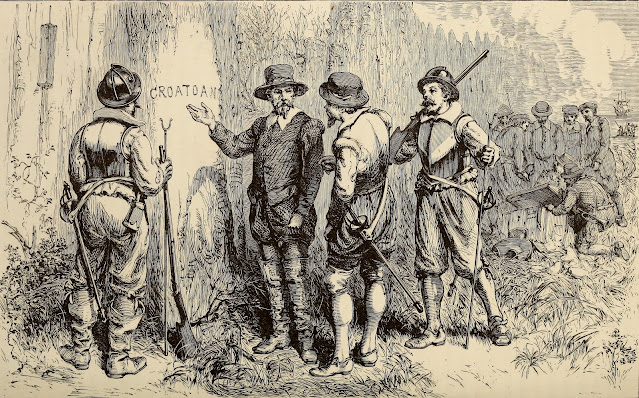
 

The Lost Colony
19th-century illustration depicting the discovery
of the abandoned colony, 1590


His joy was short-lived, however, as a dreaded Atlantic sea storm brewed, preventing the expedition from backtracking to Croatoan Island, damaging the ships and pushing them so far off course they had no choice but limp back to England.


White was never, despite all his efforts, able to persuade anyone to carry him back across the ocean again. He never again saw his daughter, son-in-law, and granddaughter, famous for being the first English child born on American soil.


Efforts were made in successive years, however, to locate the colony. It was in fact one of the directives given the Jamestown explorers and settlers, but by that time (twenty years later), word through the Native grapevine was vague at best and misleading at worst. The Spanish had also been searching, recording that they’d located a landing place, matching the description of the one White’s group used in 1590.


Captain John Smith of Jamestown reported that nothing was known of the English colonists except that men “clothed like him” lived at a particular location to the south, and that a handful of surviving prisoners were held at another location and put to forced labor “beating copper” by another Native chieftain. William Strachey, secretary of the Jamestown colony, makes the claim that Powhatan himself (the formal name of the paramount chieftain Wahunsenecawh) boasted of having slaughtered any remaining colonists.


Less than a hundred years later, however, an explorer named John Lawson reported the discovery of the Hatteras Indians, many of whom had gray or blue eyes and whose oral history stated their descent from “English” people with clothing and devices like the explorers, and who could “talk from a book.” He mentions elsewhere that the Hatteras natives also dressed in a manner reminiscent of the English, unlike other tribes.


This is the account that most often gets dismissed by those following Lost Colony lore, with Strachey’s sensationalist claim receiving the most weight. Why is that?


What really happened?


Recent expert on the Lost Colony, David Beers Quinn, puts forth an array of possibilities. People line up behind one or the other, latching on to favorite theories according to what seems the most sensible to them. 


Enter Scott Dawson, Hatteras native himself, who grew up with various histories and legends passed down through grandparents and great-grands, supporting the idea that at least some of the Roanoke colonists survived by assimilating with the Croatoan people:  


His book The Lost Colony and Hatteras Island is a longer account of his archaeological efforts and summary of the various theories. He cites Samuel Purchas as being the source for the claim that the Powhatan slaughtered at least some of the English colonists, but he likely drew from Strachey’s work—which, in my humble opinion, bears a definite propagandist or at least sensationalist tone. Dawson also mentions that after the death of Queen Elizabeth, there was possibly less motivation on her successor King James’s part to seek out the “lost” colonists because it would validate the New World holdings of Walter Raleigh, who King James imprisoned, accused of treason, and later had executed.


The possibility of the English colonists surviving by assimilation was long dismissed—or suppressed—by those who found it distasteful that those of “pure” English and/or European descent might have intermingled with Indigenous peoples. This seems ridiculous or even alien in our day and time, doesn’t it? Yet it was, historically speaking, an important consideration in the way the accounts and evidence were weighed and interpreted.


I’m not sure much has changed in regards to that, today. ðŸ˜Š


~*~*~

Blurb for VIRGINIA:


The White Doe of the Outer Banks Grows into Womanhood


Return to the “what if” questions surrounding the Lost Colony and explore the possible fate of Virginia Dare--the first English child born in the New World. What happened to her after her grandfather John White returned to England and the colony he established disappeared into the mists of time? Legends abound, but she was indeed a real girl who, if she survived to adulthood, must have also become part of the legacy that is the people of the Outer Banks. In the spring of 1602 by English reckoning, "Ginny," as she is called by family and friends, is fourteen and firmly considered a grown woman by the standards of the People. For her entire life she has watched the beautiful give-and-take of the Kurawoten and other native peoples with the English who came from across the ocean. She's enjoyed being the darling of both English and Kurawoten alike--but a stirring deep inside her will not be put to rest.


One careless decision lands her and fellow “first baby” Henry Harvie, along with their Kurawoten friend Redbud, in enemy hands. Carried away into Mangoac territory, out of the reach of Manteo and the others, she must learn who she truly is—not only the daughter of Elinor and Ananias Dare but also a child of the One True God, who gives her courage to go wherever the path of her life might lead.


AUTHOR BIO:


Transplanted to the far north after more than two decades in the Deep South, Shannon McNear loves losing herself in local history. She’s the author of four novellas and seven full-length novels, with a 2014 RITA® nominee and a 2021 SELAH winner among them. Yet her greatest joy is in being a military wife, mom-of-many, mother-in-law, and grammie. She’s also a contributor to Colonial Quills and a member of American Christian Fiction Writers and Faith-Hope-Love Christian Writers. When not cooking, researching, or leaking story from her fingertips, she enjoys being outdoors, basking in the beauty of the northern prairies.


Thursday, July 25, 2024

GUEST POST--Department Stores: Palaces of Service and Style

 by Guest Blogger Donna Mumma


Imagine walking into a multi-floored palace with marble floors beneath your feet and crystal chandeliers hanging overhead. The smell of freshly baked bread, cookies, and pastries mixes with the fragrance of sweet perfume. Pleasant, relaxing music plays as you journey down a wide marble walkway flanked by fluted columns fit for an ancient Grecian temple. Every person you meet smiles, welcomes you in and immediately offers their help. And everywhere you see the latest fashions in clothes, hats, gloves and cosmetics, with more of whatever your heart desires waiting for you on other floors.

This was the experience shoppers enjoyed in the old department stores that once ruled the heart of a city’s downtown. These stores shaped the culture of their areas while also bringing glamor to the upper-, middle-, and working-class folks who lived there. Going to these stores was a dress-up affair, for family’s and singles alike, and all of them provided a shopping experience for their customers so different from that of today.

Beyond being an emporium of one-stop-shopping, the department stores became a vibrant, active member of the community. Most had an upscale restaurant or tearoom that became “the” place to meet, or a cafeteria where employees and customers could enjoy a reasonably priced meal in a less formal atmosphere. There were also lunch counters, some gaining notoriety during the Civil Rights movements in the 1960s when African Americans staged sit-ins to protest the unfair, exclusionary practices at the department stores. 

Throughout the year, the department stores hosted fashion shows, bridal weeks, and Christmas parades. The annual unveiling of the Christmas window displays became a yearly must-see that kicked off the holiday shopping season. More practical events were also scheduled throughout the year. These included cooking demonstrations and classes, cosmetics seminars, and even charm schools for children during the summer when school was out. And on the sweeter side, many housed bakeries that became famous for their own signature treats such as cookies, cinnamon pastries, or cakes. 

The exceptional services didn’t stop there. Many of the old stores housed doctor’s and dentist’s offices, making it easier and more efficient for customers to take care of their health. In Florida, new residents to the state could visit their store to buy and ship oranges or grapefruit to their northern relatives. These stores worked hard to provide all the goods that their customers might need, including hard to find items like prosthetic limbs. 

Bridal salons became a popular part of the department store experience. These shops were run by elegant, well-informed consultants who stood ready and able to guide a bride through every decision she must make leading up to her marriage. This service went far beyond just finding her wedding gown and bridesmaids’ dresses. The consultants also offered their brides tips on how to furnish and care for their new house, how to cut the cake at the reception plus suggestions on where to go for the honeymoon. Some bridal salons kept collections of white runners for the church aisle, candelabras, crystal punch bowls and cups that brides could borrow for the wedding or reception 

The old stores recognized that women made up the largest percentage of their customer base, giving women power and status that they hadn’t enjoyed in the past. Stores garnered their highest profits in Cosmetics and Ladies Sportswear and prominently displayed these on the first floor. They catered to all the stages of a woman’s life, from her birth, her first Easter dress, prom dress, bridal gown, maternity wear and baby layettes, and finally the Mature Women’s section. Women did most of the buying, and they received the most attention in marketing campaigns.


Women found another level of status in the department stores through employment. Many started as clerks, a prestigious job at the time, and worked their way up to become well-respected clothing buyers who influenced the styles their customers wore. Others held jobs as bookkeepers, and secretaries. The stores provided a natural means of mobility, and women were able to gain success and independence not enjoyed by earlier generations.

The stores focused on a new market that emerged after the Second World War; the American teenager. Young people had money to spend on clothes, records, books, even fun items for the beach or their favorite sports. Department stores gave these new buyers a voice, setting up Teen Advisory Boards who met with the buyers and offered suggestions on modern tastes. Many housed a Young Miss section for high-school aged girls, and Collegiate departments for co-eds on upper floors, giving both groups a feeling of having their own place to shop separate from their parents.

Men were not forgotten by the old stores. Before World War 2, some stores had floors devoted exclusively to men. There, men’s suits, shoes, and other clothing necessities were found as well as other products they might need such as hunting supplies, sporting goods, and work clothes. Some stores even had a cigar room set aside for their gentlemen shoppers to take a break and relax with peers in manly surroundings void of any feminine influences.

The old department stores enjoyed a long-lived heyday, but as America moved to the suburbs the glamor of shopping downtown faded. Many of the old stores were bought by large conglomerates and renamed, while others closed their doors forever. The palatial buildings housing them were repurposed into office buildings. Many were leveled to make way for more modern shopping centers with a variety of big-box stores. In later years consumers saw the rise of indoor shopping malls. 

Time moves on, and the old ways must change. But anyone who follows history knows the old can become new. Maybe future generations will decide they need a little glamor in their shopping and the model of the luxurious downtown department store, dedicated to service with style, could rise to prominence once again.


Donna Mumma perfected storytelling in her first grade classroom, spinning tales exciting enough to settle a roomful of antsy six-year-olds. She is an award winning author of both fiction and nonfiction who loves to blend history, mystery, and a touch of faith in her stories. A native Floridian, she now lives on the Sunshine State’s west coast, sharing life with her family, and her energetic collie, Duke. Her newest book, The Women of Wynton’s, tells the story of four women who work at Wynton’s Departmet Store, and must put their dislike of one another aside to solve the murders of fellow employees. Especially when it seems their beloved boss, Mr. Wynton, seems to be next on the murderer’s list.