Showing posts with label Heroines and History. Show all posts

Saturday, September 21, 2024

Grilled Sow's Womb for Dinner, Anyone?


By Liisa Eyerly

In my book Obedient Unto Death, describing meals eaten two thousand years ago proved enlightening. The womb of a sow was a favorite dish among the ancients and was considered a great delicacy.


I will share some of the more curious recipes in another blog, but if you believe the Roman banquet is about food, you couldn’t be more wrong.

In my previous blog, I discussed the seating chart at a dinner party—the host assigned places based on the order of a guest’s importance or popularity. The menu reinforced the pervasive veneration of social class in Roman society. A high-ranking government official or wealthy patron required more elaborate displays of deference, including painstakingly prepared foreign sauces and spiced meats, like ostrich and flamingo. The more the host tried to impress, the fancier and more expensive the food. Inferior wine was served to the lesser guests, who may also have noticed being served more commonplace courses during the meal.

Robert Smirke - Study of a Roman Banquet scene - Wikimedia.org - Yale Center for British Art

While honoring specific guests, the banquet also highlighted the host’s pedigree, family wealth, education, and, most importantly, status. The slaves laid out the best silver and, if the family was extremely wealthy, crystal goblets. One and two-handled cups made from carved onyx, blown glass, and gem-encrusted bronze, silver, and gold were all in use. However, the more affordable and abundant tableware for those of us reclining on the right-side couch was terracotta pottery.


British Museum London 

The evening was a production of exotic dishes, imported wines, and entertainment. Triclinia (dining rooms) were designed—you guessed it—to show off the family money, education, travel, sophistication, and oratory skills. Walls were painted, floors displayed mosaics, and statues adorned the room, all featuring ancient myths, battles, heroes, heroines, famous poets, politicians, emperors, gods, and goddesses. Like today's media, these cultured decorations inspired thought-provoking debates and stimulating conversation. 

                                                        Triton, aquatic deity
Arno river deity 

Guest recitations of poetry, prose, or song were encouraged as part of the evening's enjoyment and were often accompanied by hired musicians playing the flute, lyre, or pipes. Depending on the guest list, dancing girls or acrobats might be swirling and tumbling to the audience's approval. Mime was a favorite entertainment choice, as were the more expensive gladiatorial contests and wild animal acts. The following jug depicts a female acrobat shooting an arrow with her feet.
Marcus Cyron, CC BY-SA 3.0 <https://creativecommons.org/licenses/by-sa/3.0>, via Wikimedia Commons


Attractive servers and slaves contributed to a delightful dining experience, with the smallest details calculated to underscore the host family’s prominence, wealth, and, most importantly, their status.

Even after two millennia, some customs have not changed.


Liisa Eyerly’s Secrets of Ephesus series adds a Christian twist to first-century Roman Empire mysteries. Her debut novel, Obedient Unto Death (2022), won the Eric Hoffer First Horizon Award and first place in Spiritual Fiction. The second book, Fortunes of Death, launches on October 15th. A lifelong mystery lover, Liisa was inspired by the Apostle Paul’s depiction of early Christians. After careers in teaching, librarianship, and stained glass, she began writing full-time at fifty. Liisa lives in northern Wisconsin with her husband and enjoys pickleball, kayaking, Bible study, and visiting Ancient Roman sites.


Tuesday, February 27, 2024

Did You Know.... Bible Trivia


by Naomi Craig

I love random trivia . In many forms like behind the scenes info about movies (Did you know in the musical Singin' In The Rain where Kathy Seldon does voice overs for the star, Lina Lamont, only the actual movie people thought Debbie Reynolds' (Kathy) voice wasn't mature enough so Jean Hagen (Lina) sang the movie song "Would you?" ----Ending up being Lina covering for Kathy who was covering for Lina)
Singin' in the Rain trailer 5.jpg, wikimedia

Historical tidbits---why I love this blog

And Random Bible Trivia.

I don't know why.

There is a sense of pride when I know the most answers in the American Trivia board game.

So let's get into some interesting Bible trivia.

Did you know the Bible is not only the best-selling book in the world (100 million per year ) but also the most shoplifted.

Wicked Bible - wicked passage.jpg, Wikimedia

Did you know in 1631, a publishing company accidentally omitted the word "not" from the 7th commandment? Around 1,000 copies were distributed before "thou shall commit adultery" was noticed. This version is known as the Sinner's Bible or the Wicked Bible.

How's your trivia inside the Bible?

Did you know about the left-handed assassin and the obese king?

The dead man comes to life at Elisha's sepulchre.jpg, Wikimedia

Did you know a man came back to life after his dead body touched the (very dead) bones of a prophet?

What about an Iron ax head floating in water?

Did you know there is a woman credited with building three cities?

Donkeys talking? Sounds like a cartoon or fantasy movie, but it's actually in the Bible first

Og's Bed (crop).jpg, Wikimedia

Did you know a man had a bed 13 1/2 feet long and 6 feet wide. (I'll give you a hint, it wasn't Goliath)

Or how about the man whose hair weighed 6 1/4 lbs. when it was cut annually.?


Did you know all these? What other random tidbits should be included?


Author of Biblical fiction, avid reader, and pastor's wife, Naomi loves reading the Bible and imagining how things were at the time. When she’s not serving in various areas at church or trying to stay on top of mountains of dishes, you'll most likely find her enjoying a good book and a cup of coffee. Naomi is the founder of Biblical Fiction Aficionados Community on Facebook and co-hosts #BehindTheStory on YouTube. When not writing or trying to wrangle social media, Naomi attempts to get her rescue dogs to be cute on command for the many pics she takes throughout the day.


What was your favorite Biblical Fiction you read that released in 2023?

Come on over to Biblical Fiction Aficionados and vote for the 2023 Readers' Choice Award

Monday, November 27, 2023

Christmas at the Castle PLUS GIVEAWAY!

by Naomi Craig


What's a better way to get in the Christmas mood than with a collection of stories? The common thread?
All take place at a castle😍🏰🏯


In castles far and near, long ago and yesterday, find happily-ever-afters wrapped in love and tied with Christmas joy.


The Lights of Castlebourne (by Cathe Swanson and Chautona Havig):
                             
Out of this collection, I loved that two of my favorite authors, Chautona Havig and Cathe Swanson teamed up to create a memorable book set around Sydney, a landscape designer, who wishes only to create memorable landscape designs at a castle. When you add in a skunk, an electrician, a cousin, a dog, and a grumpy owner of the castle, and The Lights of Castlebourne grabbed my attention, and would not let me put the book down. Both of these authors create books I love reading and this story definitely lived up to my expectations.~ Patti P, Amazon Reviewer


The Girl From Dalarna (by Olivia Talbott):

                                  
The Girl From Dalarna by Olivia Talbott is a historical fiction set in 1833 Sweden. It was a very emotional story, Linnea had to leave her family and home and go to a larger city to try to provide for her mother and sisters after her father’s death. Despite her exceptional beauty she was shy with a stutter and just wanted to be left alone to do her job. It was very interesting to read the story and see how her life changed. I really appreciated Rane and think that everyone should have a Rane in their life.~Donna C, Amazon Reviewer


The Cross at Morioka Castle (by Kathleen J. Robison):


This one was my favorite in the collection, but I have a huge interest in the Japanese culture. This little novella was like visiting with friends of mine who have returned to their home country, one I would dearly love to visit someday. The romance was sweet, and I loved how it illustrated how God puts the exact people in our path that we need at just the time when we need them. The author also did an amazing job of portraying the struggle of Japanese Christians, caught between cultural tradition and faith. ~eLynda, Amazon Reviewer


The Ghost of Christmas... (by Denise L. Barela):

                              
I will admit I am a huge fan of Neuschwanstein Castle so I automatically geeked when I found out that it was the setting for this story. Abbi jumps at a chance to spend Christmas at Neuschwanstein and is swept into the magic of the Castle.This is the second book that I have read by Barela and I can’t wait to see what she writes next. I would love to see a series based on the characters who live and work in the castle.~Donna, Amazon Reviewer


Crystal Clear (by Marguerite Martin Gray):

                              
Probably the closest to what I expected from the collection, this novella has a real focus on Christmas and the miracle Jesus brings to all of us, regardless of the season. I loved the setting, the characters, and the storyline. I could smell the pine in the air, so vivid were the descriptions, and I felt like I was right there with the characters, experiencing the joy of the season, even in a difficult time.~eLynda, Amazon Reviewer


The Weary World Rejoices (by Naomi Craig):

                                 
You may think you’ve heard the Christmas story a million times, but until you see it through Amal’s eyes, you are missing something! My heart rejoiced along with Amal’s by the conclusion of this novella. The Weary World Rejoices by Naomi Craig is Biblical fiction that will make you shiver, review Scripture, cry, cheer, evaluate how you treat Scripture (all while being an unputdownable story)!~ Babbling Becky L, Amazon Reviewer


Grab a mug of something hot and delicious and curl up somewhere comfy. Your literary chariots await to take you on a journey from an early twentieth-century castle overlooking the Mississippi all the way back to the Holy Land at the time of Jesus' birth. These six novellas, all set in castles real and fictional, celebrate the heart and joy of Christmas.


I'm hosting a giveaway! Let me know in the comments which Christmas novella looks most intriguing to you! (if you are still reading in your email, you will need to go online. Also, sometimes our platform doesn't like browsers--Chrome or firefox seem to work better)


All commenters will be entered in a random draw for an ebook of Keeping Christmas vol. 1

Merry Christmas! May the Prince of Peace be with you this season!

                                                  
Author of Biblical fiction, avid reader, pastor's wife, Naomi loves reading the Bible and imagining how things were at the time. When she’s not serving in various areas at church or trying to stay on top of mountains of dishes, you'll most likely find her enjoying a good book and a cup of coffee. Naomi co-hosts #BehindTheStory on YouTube and helps facilitate Biblical Fiction Aficionados Community on Facebook. When not writing or trying to wrangle social media, Naomi attempts to get her rescue dog to be cute on command for the many pics she takes throughout the day.


Keeping Christmas vol 1 is also available on Kindle Unlimited

Sunday, August 27, 2023

Cliff Dwellings Mesa Verde, Colorado

 Well Preserved Ancient Architecture By the Ancestral Pueblo People

By Naomi Craig


Imagine with me that you are a rancher in the 1880's near Cortez, Colorado. You are searching for lost cattle among the vast canyons of the Mesa Verde area, only to look up and find this magnificent cliff dwelling, untouched by humans for nearly 700 years. *
Cliff Palace, Mesa Verde Colorado, Photo by Naomi Craig

Can you imagine being the first one to explore this ancient dwelling? 
Or what about being the ones to engineer this type of dwelling?

Navajo Canyon, Mesa Verde Colorado, Picture by Naomi Craig

I mean, who looks at this landscape and says "Let's build communities in the cliffs?"

 There are over 600 cliff dwellings in Mesa Verde National Parks, and research shows while the Ancestral Pueblo occupied the area from 500 AD, it was only around 1200AD that the cliff dwellings were built and inhabited. For unknown reasons, the cliff dwellings were abandoned around 1300 AD, and the people migrated south into New Mexico and Arizona. 


Spruce Tree House, Mesa Verde Map, National Park Service

The fortitude of these people is undeniable. They would climb the hand-and-toe holds up to the top of the mesa where they would farm and hunt. Thankfully, the Ancestral Pueblo just tossed their trash over the side of the cliff, and archaeologists have been able to learn about their habits and lifestyle.

Mesa Verde Canyons, Picture by Naomi Craig

Just to give a picture of how steep these cliffs are. 🤯🤯🤯Hope the Pueblos weren't afraid of heights!

Did you spot the cliff dwelling?
.
.
.
.
.
.
.
.
.
.
.
.


Cliff Dwelling, Mesa Verde Colorado, Picture by Naomi Craig

I am so amazed by the ingenuity of people! 
What dreamer could see the village unfolding in the cleft of the rock face? Was the architect employed to oversee construction of the 600 other cliff dwelling in the area, or were multiple people gifted with the ability to plan out an environment that would sustain life and safety for their clan?
Square Tower, Mesa Verde Colorado, Picture by Naomi Craig


While the Cliff Dwellings at Mesa Verde were built much later than the Biblical cities of Upper and Lower Beth Horon, it seems the building techniques didn't change much. Just as the Ancestral Pueblo desired to establish a safe, profitable environment where they could enjoy life, She'erah from 1 Chronicles 7:24 must have wanted the same for her people in the hills north of the Aijalon Valley.

Have you ever visited Mesa Verde? 


Author of Biblical fiction, avid reader, pastor's wife, Naomi loves reading the Bible and imagining how things were at the time. When she’s not serving in various areas at church or trying to stay on top of mountains of dishes, you'll most likely find her enjoying a good book and a cup of coffee. Naomi co-hosts #BehindTheStory on YouTube and helps facilitate Biblical Fiction Aficionados Community on Facebook. When not writing or trying to wrangle social media, Naomi attempts to get her rescue dog to be cute on command for the many pics she takes throughout the day.


*According to the pamphlets/information handed out by Mesa Verde National Park, the credit for finding the cliff dwellings is attributed to two brothers-in-law searching for lost cattle. However if you look online, there is other documentation and timelines of discovery, including possible sightings as far back as 1765.
The find of Cliff Palace is credited to the Richard Wetherill and Charles Mason because Richard was the first one to enter the cliff dwelling even though Richard's brother, Al, had sighted this magnificently preserved cliff dwelling the year prior.

Thursday, July 27, 2023

A Woman Architect in Ancient History?

 by Naomi Craig

Ancient Egyptian Women, Wikimedia


Upper and Lower Beth Horon (now Beit Ur el foqa and Beit Ur el tachta) are mentioned several times through the Bible.


Sun looks out of the dark clouds, Wikimedia

Remember when Joshua asked for the sun to stand still so he could defeat the kings of the Amorites, and the Lord threw down rocks from heaven to defeat Israel’s enemies? (Joshua10)? That was on the ascent and descent to Beth Horon.

The Beth Horons were in the Land allotted to the tribe of Ephraim, and one of them was a Levitical city of refuge (Joshua 21:22)

Right after King Saul made that unlawful sacrifice before Samuel could get there, the Philistines encamped and were eventually driven out at the pass of Beth Horon and Aijalon Valley (1 Samuel 13:18, 14:22,31)

Solomon fortified the cities with gates and walls (2 Chronicles 8:5)

Upper and Lower Beth Horon also played into the Jewish revolt of the Maccabees between the Old Testament and the New Testament.

But what about when it was built? Or more specifically, WHO built it.


The student's manual of ancient geography, based upon the Dictionary of Greek and Roman geography (1861)

1 Chronicles 7:20-24 is a brief break from the line of geneaology. In it, the only time mentioned in scripture is “Now his daughter was She’erah, who built Lower and Upper Beth Horon and Uzzen She’erah.”

PikiWiki Israel 64666 upper beth horon village, Wikimedia


And then we are right back to the begats.

Hold on. Back up.

Women aren’t mentioned often in the Bible, so when they are it stands to reason that there was something pretty epic about this lady.

Not to mention the little fact of a woman building three cities. Even more intriguing is that two of the three cities are standing to this day.

According to my research, She’erah was Ephraim’s daughter. His dad was Joseph—you know the guy who went from slave/prisoner to Pharaoh’s vizier in a matter of minutes because the Lord gave him the wisdom to save Egypt from the seven year famine. (Read my post on the Biblical Joseph in Egyptian history here). Ephraim’s mom was Egyptian, making She’erah at least a quarter Egyptian.

I bring that up to point out She’erah would have had access to Egyptian wisdom and resources as she’s building these cities. What would have brought her up out of Egypt to build off the Aijalon Valley?

The Bible doesn’t say, but because all of the nations owed Egypt big time for keeping everybody alive during the famine, and the Bible documents that people eventually gave their land to Pharaoh when all other resources ran out. In my imagination Pharaoh pretty much had the makings of an empire.

Also, while Joseph was still alive, and for many years after, the Hebrews and the Egyptians lived in harmony. It was only much later when Joseph was forgotten that the Hebrews were made into slaves.

So here is a woman, granddaughter to Pharaoh’s vizier, part Egyptian, part Hebrew, trying to establish herself in a man’s world by building cities.

Yeah, that sounds like an easy task.

True, Egyptian women DID have more rights than Hebrew women traditionally. However, I can’t imagine all the men in the clan and camp would have been thrilled working under a woman architect.

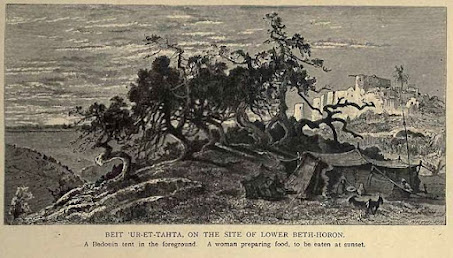
Bethoron Tahton - Lower Bethoron 1880,Wikimedia

Have you noticed the insert about She’erah and her family before?


She'erah's Legacy
As tragedy ravages the camp, can She’erah step up and complete the outpost?
She’erah is a woman trying to leave her mark in a man’s world. Her vision and ability surpasses her father’s, yet she remains second-in-command as they are tasked to build Pharaoh’s outposts in Canaan. She knows she is worthy of the task, but her clan is skeptical.
The last place She’erah expects support is from her charioteer, but Lateef is the lone voice of encouragement. His integrity and steadfastness is a plumb-line in She’erah’s life and she can no longer deny her growing feelings for him.
Acts of sabotage threaten the construction and the shaky foundation of She’erah’s pride. It’s up to She’erah to break generations of rivalry, distrust, and jealousy—if she can learn to rely on the strengths and abilities of those around her to help.

Will she learn to trust God and others before her life’s legacy comes crumbling down around her?


Author of Biblical fiction, avid reader, pastor's wife, Naomi loves reading the Bible and imagining how things were at the time. When she’s not serving in various areas at church or trying to stay on top of mountains of dishes, you'll most likely find her enjoying a good book and a cup of coffee. Naomi co-hosts #BehindTheStory on YouTube and helps facilitate Biblical Fiction Aficionados Community on Facebook. When not writing or trying to wrangle social media, Naomi attempts to get her rescue dog to be cute on command for the many pics she takes throughout the day.


Preorder She'erah's Legacy here

Saturday, May 27, 2023

PTSD Through the Ages


By Naomi Craig

"My past is an armour I cannot take off, no matter how many times you tell me the war is over." ~Unknown

May is Mental Health Awareness Month.
Mental-illness-overview.jpg Wikimedia


Our society currently recognizes the effects trauma can have on our brains and lives and while there have been great advancements in dealing with mental health and healing in the past forty years, but mental illness is not a new concept.

Even with the awareness and advancements in how we care for ourselves mentally, there is still a heavy stigma that is attached with mental illness.

If you broke your leg while training for a marathon, I would not expect you to run the 26 miles with a cast.

But if you are dealing with an invisible illness like Post Traumatic Stress Disorder (PTSD) that one is a bit harder to see from the outside. From the outside you may look absolutely fine and healthy.

Because I don’t see your symptoms, I might not understand your pain.
There is nothing new under the sun, and you can see evidence of PTSD( by varied names) throughout the ages.
Modern depiction of Roman legionaries, Wikimedia


Ancient warriors attributed their version of PTSD as malevolent ghosts or spirits of those who were killed in battle seeking revenge on their killer. According to the Australian Army Resource Centre, each culture had their ritual to welcome the soldiers back into society. What isn't thought of as often is usually soldiers fought a long way from home, so they had time to mourn their comrades and reflect with those who had gone through the same thing. This practice is detailed in Numbers 31 as accommodations were made for warriors coming back from war. They were required to wait seven days outside of the Israelites camp to be purified before reentering the community. Being able to decompress with men who had been through the same experiences, sounds like the Lord took into account the trauma they would have endured.


Authors including Homer (The Illiad), William Shakespeare (King Henry IV), and Charles Dickens (A Tale of Two Cities) wrote about what we would now call PTSD. Trauma was endured and the aftereffects were present for long afterwards.
Josef Leopold Auenbrugger, Wikimedia


According to the U.S. Department of Veteran Affairs, in 1761, Austrian physician, Josef Leopold, gave the term "nostalgia." Men exposed to military trauma reported missing home, feeling sad, sleep problems and anxiety. This line of thought opened eyes to psychological injury even if no physical injury was sustained.


During the American Civil War and the Franco-Prussian War, the medical field began making attempts to understand the problems that accompanied those who had been exposed to military combat.


As knowledge progressed, the terms "Soldier's heart" and "Railway Spine" described the rapid pulse, anxiety, trouble breathing and injury to the central nervous system.
Image from The Great War taken in an Australian Advanced Dressing Station near Ypres in 1917. The wounded soldier in the lower left of the photo has a dazed, thousand-yard stare - a frequent symptom of "shell-shock". Wikimedia


By World War I, the term "shell-shock" became common, and was thought of as the brain's reaction to heavy artillery and explosions. For those who had not been near the explosions and yet had the same symptoms, "War Neuroses" was termed.


World War II brought the term "Combat Stress Reaction" or "Battle Fatigue."


In 1952, "gross stress reaction" was included in the first Diagnostic and Statistical Manual of Mental Disorders (DSM-1). At this time, all symptoms from trauma were expected to dissipate within six months.

UH-1D helicopters in Vietnam 1966.jpg, James K. F. Dung, SFC, Photographer, Wikimedia


In 1980, The American Psychiatric Association included the term Post Traumatic Stress Disorder in DSM-111. This diagnosis included research on returning Vietnam Veterans, Holocaust survivors, sexual trauma victims and others who had dealt with a traumatic experience and still dealt with the aftermath.


The research continues, and by 2013 DSM-5 has classified PTSD in the Trauma-and-Stressor-Related Disorders and is relatively common.


While the knowledge and research has advanced the study of the effects of trauma on the brain, psychological effects of trauma is surely present to the beginning of time.
Early Bronze II period, City walls, 3000 - 2700 BC, Tell Es -Sultan, Jericho, Wikimedia


In the book of Joshua, Rahab went from harlot to heroine.
Whatever led her to her profession, she still had to overcome the trauma of her previous lifestyle.
I can imagine the Hebrews were wary about accepting a harlot as part of their numbers. After all they had lost 24,000 of their number just on the other side of the Jordan river when they got involved with prostitutes.

The social isolation in anyone's healing would be extremely influential in the whole process

As Rahab is learning to assimilate into this new nation, learning the laws and trying to overcome her traumatic experiences, I can imagine that social acceptance was still a struggle.
Yet, despite her struggles and her past, the Lord saw fit for Rahab to be in Jesus's lineage.

Let's flip the coin. What call would the leader of Judah’s tribe (Rahab’s husband is mentioned in the Bible, Salmah) have to marry a Canaanite harlot? Especially when he saw the result of the previous generation dying out in the wilderness due to disobeying the Lord’s commands.

What baggage do you think he would have to overcome as he walked through life with a wife who had a past?


Further study:

https://researchcentre.army.gov.au/library/land-power-forum/how-did-ancient-warriors-deal-post-traumatic-stress-disorder

https://www.ptsd.va.gov/understand/what/history_ptsd.asp#:~:text=In%20World%20War%20II%2C%20the,became%20battle%20weary%20and%20exhausted.


Author of Biblical fiction, avid reader, pastor's wife, Naomi loves reading the Bible and imagining how things were at the time. When she’s not serving in various areas at church or trying to stay on top of mountains of dishes, you'll most likely find her enjoying a good book and a cup of coffee. Naomi co-hosts #BehindTheStory on YouTube and helps facilitate Biblical Fiction Aficionados Community on Facebook. When not writing or trying to wrangle social media, Naomi attempts to get her rescue dog to be cute on command for the many pics she takes throughout the day.


A scarlet cord tethers one ruined woman to the salvation of mankind.

Harboring two fugitives in a city slated for destruction, Rahab has one small chance of escape. In exchange for their safety, she bargains for her own. Their agreement rewards her courage, and she flees Jericho and a life of prostitution for a new life among the people of Israel. Never again will she have to depend on anyone—especially men.

Except Salmah won’t take the hint.

High ranking soldier and leader of the tribe of Judah, Salmah is determined not to repeat his parents’ mistakes. He will keep the Lord’s commandments. Rahab’s growing faith fits right in with phase one of his plans: find a wife who loves the Lord and settle down in the new land.

Rahab finds shelter and meaning in the Lord’s ways until her past comes back to haunt her. As her new faith is put to test, she finds herself alone. Isn’t that what she’d always wanted?

With her courage waning, only the Lord can turn Rahab’s life around again, but will He do it before she loses everyone and everything that really matters to her—to her heart?


Download your free novella, On Desolate Heights, Balaam's Story at https://naomicraig.com

Thursday, September 29, 2016

Autumn Book Extravaganza!


SARAH'S SURRENDER, Book 3 in the Land Rush Dreams series
by Vickie McDonough

CLICK HERE TO PURCHASE


SHATTERED MEMORIES
by Debbie Lynne Costello

CLICK HERE TO PURCHASE 
THE COWBOY'S BRIDE COLLECTION
By Nancy Farrier, Susan Page Davis, Miralee Ferrell,
Vickie McDonough, and More


MOUNTAIN CHRISTMAS BRIDES
by Susan Page Davis and Others


A HOUSE LOVE BUILT
by Martha Rogers


RAILS TO LOVE ROMANCE COLLECTION
by Susanne Dietze and Others


HIS PRARIE SWEETHEART
by Erica Vetsch

CLICK HERE TO PURCHASE  


REBEL LIGHT
by Marilyn Turk

CLICK HERE TO PURCHASE


BEFORE THE SEASON ENDS
by Linore Rose Burkard


DAWN OF LIBERTY

DAWN OF LIBERTY
by Amber Schamel

CLICK HERE TO PURCHASE  


SOFI'S BRIDGE
by Christine Lindsay

CLICK HERE TO PURCHASE


RED IS FOR ROOKIE
By Anne Greene

CLICK HERE TO PURCHASE


http://www.amazon.com/Messenger-Moonlight-Stephanie-Grace-Whitson/dp/1455529087/ref=sr_1_1?ie=UTF8&qid=1462230994&sr=8-1&keywords=Messenger+by+Moonlight

MESSENGER BY MOONLIGHT
by Stephanie Grace Whitson

CLICK HERE TO PURCHASE


VALLEY OF THE SHADOW
by J.M. Hochstetler

CLICK HERE TO PURCHASE


SUMMER'S SURPRISE
by Martha Lou Rogers

CLICK HERE TO PURCHASE 


HIS STEADFAST LOVE
by Golden Keyes Parsons

CLICK HERE TO PURCHASE


RESURRECTION OF HOPE
by Tamera Lynn Kraft

CLICK HERE TO PURCHASE


THE LEGACY LETTERS
by Alanna Radle Rodriguez and others