Showing posts with label ancient history. Show all posts

Thursday, October 29, 2026

Ice Cream? Yes, Please!


I love ice cream, but I never put much thought into its origin story until now. It turns out people all over the world have had a taste for frozen treats since ancient times. I’m talking as early as 400 BC. The Chinese indulged in a dish made of milk poured over cooked rice and flavored with spices, then frozen. The Persians created a treat made of rose water, lime juice and delicate noodles. In India, kulfi came about as a slow-frozen milk dessert with flavoring.

                                                               
              Claudius Ceasar                                Kind Charles I                                 Alexander the Great

 Alexander the Great enjoyed snow and ice flavored with honey and nectar. During the Roman Empire, Claudius Ceasar would send runners into the mountains for snow which was then flavored with fruit and juice. A thousand years later, Marco Polo came back to Italy from the Far East with a recipe that closely resembled what we call sherbet. Historians believe it became “ice cream” in the 16th century. By the 17th century it was called “cream ice” in England and appeared regularly on King Charles I's table. In 1660, a Sicilian, Procopio came up with a recipe using milk, cream, butter and eggs. He sold it at Café Procope, the first café in Paris.

                                      George Washington           Thomas Jefferson                          Dolly Maddison                             
Ice cream was a dessert for the elite. Ice and snow were needed to make it. Someone had to harvest the ice and storage was needed to keep the ice frozen. The wealthy had access to those things. Ice Cream made its way to America through different people. Thomas Jefferson fell in love with it while he was in Europe and brought home a recipe. In New York City, confectioner Philip Lenzi began making ice cream to sell. He put an ad in the New York Gazette on May 12, 1777 announcing it was available “almost” every day. George Washington enjoyed it so much he spent $200 on it during the summer of 1790. That would be thousands of dollars in today’s market. Dolly Madison served a spectacular strawberry ice cream creation for her husband’s second inaugural dinner in 1813.


By 1800, insulated ice houses were invented. In Cambridge, Massachusetts, the Tudor Ice Company harvested ice from Walden Pond, Fresh Pond and other lakes in New England from early 1800s to the 1890s. Later, Cambridge was a natural location for ice cream manufacturing.


We can all be thankful for Nancy M. Johnson, who patented the first ice cream maker in 1843. People could now make ice cream at home. By the late 1800s, soda fountains and ice cream parlors began popping up. They were wonderful gathering places. By 1890, customers just had to keep in mind that they couldn’t have a soda on Sundays. The religious community felt carbonated water was a sinful indulgence, so shop owners invented ice cream Sundays, later renamed “sundaes.” By the mid-1900s, soda shops began to disappear.


We can’t talk about ice cream without mentioning the ice cream cone. It sprang into popularity at the 1904 St. Louis World Fair and never looked back.


If you couldn’t go out to get ice cream, it could come to you. First, by horse-drawn cart, then by motorized vehicle.


I think ice cream has a place in most of our lives, whether it’s a celebration, a consolation, or just because. There’s a flavor for everyone, although vanilla is America’s favorite. In the second book of my "Heart’s Desire" series, "Heart’s Journey," the family has an ice cream maker they use when Julia makes her famous cherry pie.

Since we're in the Autumn season, I thought you might be interested in a recipe for homemade Pumpkin ice cream.


In, 1880, after narrowly escaping an arranged marriage, Julia marries Jacob, the man of her dreams, and they move to Iowa to buy a farm. Upper-class Julia has never been in a kitchen, let alone on a farm. How will she manage? Joys and sorrows find them along the way including a personal loss for Julia which triggers a disagreement leading to estrangement. Can their faith in God bring forgiveness and reconciliation?
Heart's Journey is on sale through October 31st for $1.99.


Linda, a retired librarian, lives in west central Ohio with her husband and grandson. An avid reader and writer since childhood, she began her publishing career writing columns and a middle-grade serial for the South Charleston Spectator. Her desire is to entertain, but more importantly, to encourage readers with God’s faithfulness.

You’re invited to visit her website. Browse the pages to learn more about her and her books. Stay in touch when you sign up for her newsletter. You’ll receive a free novella as a thank you.

Pictures found on Public Domain. Articles researched on Museum of Ice Cream, International Dairy Food Association, History Cambridge

Friday, December 27, 2024

The Gregorian Calendar: Even Better than the Julian Calendar

In last month’s post, I wrote about the Julian Calendar, a huge advance in timekeeping technology that was introduced in 45 B.C. It was far more accurate than its predecessor, the Roman Calendar, which was based on a lunar year with extra days added in whenever a committee decided they were needed. The Julian Calendar wasn’t the first solar calendar ever made, but it was the first to be widely adopted across Europe. It had a standard year of 365 days, with a leap year of 366 days every fourth year.

That sounds an awful lot like the calendar we use today, doesn’t it? Well, almost, but not quite. It turns out that one leap year every four years is just a smidge too much. A tropical year—the time it takes the earth to complete exactly one revolution around the sun—is 365 days, 5 hours, 48 minutes, and 46 seconds. This means that, once standard and leap years have been averaged together, the Julian Calendar year is longer than an actual tropical year by around 0.0077 days, or 11 minutes.

That may not seem like much time, but it adds up. Over the course of a thousand years, the Julian Calendar will drift almost 8 days ahead of the tropical year.

And so it did. By the late 16th century, the calendar used by most of the Western world was 10 days at variance from the actual orbit of the earth.

It was time to make a change to a more accurate solar calendar. The motivating force behind the switch was Pope Gregory XIII, acting on concerns about errors in calculating the date for Easter. A reform commission was assembled, and after considerable study and consultation with expert mathematicians, its members agreed on a new calendar with a small but significant change. Unlike the Julian Calendar, the Gregorian Calendar has a leap year every four years except for years which are divisible by 100 but not by 400. Those years are common years of 365 days.

The reason most people in the Western world today aren’t aware of these centennial common years is that we’ve never experienced one. The most recent centennial common year was in 1900, and the next one will be in 2100. The year 2000 was a leap year, because 2000 is divisible by 400.

The Gregorian Calendar went into effect in October of 1582 by means of a papal bull, which had no authority beyond the Roman Catholic Church and the papal states. That same year, Philip II of Spain decreed that the switch be made in his dominions, comprising not only Spain but also Portugal and much of Italy. The Polish-Lithuanian Commonwealth also adopted the new calendar.
By Aloysius Lilius - Biblioteca del Vaticano


Protestant, Eastern Orthodox, and Oriental Orthodox Churches continued with the Julian Calendar, as did Protestant nations, who resisted what they saw as a Catholic innovation. The British ultimately found a work-around with their Calendar (New Style) Act of 1750, which established a system for the computation of Easter that achieved the same result without referencing Pope Gregory XIII. Britain and the British Empire, which at that time included the eastern part of the future United States, adopted the new calendar in 1752. Sweden followed in 1753.

Alert readers familiar with American history will notice that 1752 was just a little bit before the French and Indian War. If you've done any reading about that conflict, you've probably come across some parenthetical adjustments between the date systems used in different parts of Europe. During this period, the Julian Calendar was 11 days at variance from the Gregorian. So the birthdate of George Washington, who was born under the Julian Calendar, can be written as February 11, 1731/32 (Old Style, depending on whether the writer is using the English or Continental start to the new year), or as February 22, 1732 (New Style).

At various times throughout the following centuries, other nations in Europe and worldwide adopted the Gregorian Calendar, with Saudi Arabia being the most recent addition in 2016. Ethiopia continues to use its own calendar of 13 months, which is 7-8 years behind the Gregorian and has a new year that falls in the Gregorian September. Nepal uses a lunisolar calendar 56-57 years ahead of the Gregorian calendar, with a new year in mid-April.

Today’s world is far more tightly interconnected than that of the sixteenth century. A uniform system of global timekeeping has clear advantages across many sectors, including international finance and trade, transportation and logistics, telecommunications and internet, science and research, military and defense, emergency and disaster response, and education and academia. The Gregorian Calendar didn't altogether unite the world in a global timekeeping standard, but it went a long way toward streamlining operations and ensuring clarity in planning, record-keeping, and communications.


Kit Hawthorne makes her home in south central Texas on her husband’s ancestral farm, which has been in the family for seven generations. When not writing, she can be found reading, drawing, sewing, quilting, reupholstering furniture, playing Irish pennywhistle, refinishing old wood, cooking huge amounts of food for the pressure canner, or wrangling various dogs, cats, horses, and people. Visit her at https://kithawthorne.com/.

Wednesday, November 27, 2024

The Julian Calendar: Technological Breakthrough of the Past

by Kit Hawthorne

We talk a lot about how technology has transformed the modern world, and for good reason. The 20th century saw the rise of automated production, the digital revolution, and global connectivity—and things have only sped up since then. Starting in the 21st century, computational power has doubled approximately every two years, leading to snowballing advances in automation, data analysis, and artificial intelligence.

But a lot of the everyday conventions and devices that we take for granted were huge innovations when they were first introduced (and, of course, provide the foundation for later advancements). Arabic numerals, alphabetic writing, libraries, indexes, concordances, classification systems for living organisms, measurement systems, navigation, cartography, standardized coinage, postal services, mechanical clocks, codified systems of law—these intellectual technologies didn’t just make it easier for people to perform physical tasks. They revolutionized the way people thought. Every one of them has its own complex and fascinating history, often reaching back to the ancient world.

But the intellectual technology that I want to drill down on today is calendars—specifically, the Julian Calendar, which made its first appearance in 45 B.C.

The Tusculum Portrait of Julius Caesar

We deal with calendars in some form or other just about every day but rarely pause to think about how very useful they are or how marvelous it is that we have them at all. Agricultural planning, religious and cultural ceremonies, navigation and timekeeping, economic and administrative coordination, political stability, and the keeping of historical records would be impossible in the absence of an accurate shared calendar.

A 2007 Wall Calendar by Claudio Elias

The Julian Calendar was a big improvement over its predecessor, the Roman Calendar, which was based on a lunar year. It’s easy to see the trouble with a purely lunar calendar. A period of twelve lunar months is roughly 354 days, 11-12 days shorter than a solar year, which meant that the Romans had to keep fiddling with theirs to correct the inevitable drift with respect to astronomical events like vernal equinox and winter solstice. The adding and removing of days was managed by a committee within the College of Pontiffs, a priestly group that had a lot of other duties to attend to.

Julius Caesar decided that Rome could do better. Acting with characteristic pragmatism and dispatch, he consulted an Alexandrian astronomer called Sosigenes and developed a solar calendar with a common year of 365 days. In reality, it takes approximately 365 days, 5 hours, 48 minutes, and 45 seconds for the earth to complete a full orbit around the sun. To make up the difference, the Julian calendar added an extra day every four years.

The Julian calendar was soon adopted throughout the Roman Empire and by various Christian churches. It is still used by the Berber people of North Africa and by some Orthodox churches, which employ it to calculate the dates of movable feasts, but in most of the world it was eventually replaced by the even more accurate Gregorian Calendar, the calendar with which most of us are familiar today.

The monastic community at Mt. Athos still uses the Julian Calendar.
Photo of Agiou Pavlou Monastery by Explorer1940.

At this point, you might be thinking, “Hold on. A calendar with three 365-day common years, followed by one leap year of 366 days—isn’t that what we use now?” Well, almost. The Gregorian Calendar is very similar to the Julian Calendar, with one small but important difference. Getting it adopted as the international standard was a wild ride that took 345 years…and, Lord willing, that’ll be the subject of my December post.


Kit Hawthorne makes her home in south central Texas on her husband’s ancestral farm, which has been in the family for seven generations. When not writing, she can be found reading, drawing, sewing, quilting, reupholstering furniture, playing Irish pennywhistle, refinishing old wood, cooking huge amounts of food for the pressure canner, or wrangling various dogs, cats, horses, and people. Visit her at https://kithawthorne.com/.


Monday, September 2, 2024

Uncovering Ancient Capernaum

Blogger: Amber Lemus


Tucked away on the northwestern shore of the Sea of Galilee lies the ancient town of Capernaum, a site steeped in history and Biblical significance. This humble fishing village was once a hub of activity, hosting some of the most pivotal moments in Jesus' ministry. Today, archaeology has breathed new life into Capernaum's ruins, offering a fascinating glimpse into the past.

Capernaum was first discovered in the 19th century by American explorer Edward Robinson in 1838. Later, French archaeologist Charles William Wilson identified the site as the town of Capernaum around 1866.
Edward Robinson
Public Domain


Initial excavations were conducted between 1894-1926 by the Franciscans, led by Father Girolamo Golzio and Father Gaetano Orfali. They uncovered the remains of a 1st-century synagogue and a 5th-century church.

In the 1960's, major excavations began with Israeli archaeologist Vassilios Tzaferis leading a comprehensive excavation project on the eastern portion of the site, and a team led by Virgilio Corbo and Stanislao Loffreda resumed the excavations of the Franciscans on the western side.

The most prominent discovery unearthed was the remnants of a 1st-century synagogue, its stone foundations and columns still standing. This magnificent structure is believed to be the very synagogue where Jesus taught and healed (Mark 1:21-28, Luke 4:31-36).

Synagogue in Capernaum
Photo By Eddie Gerald - CC BY-SA 3.0


Also on the western side, they discovered the remains of ancient homes, including the "House of Peter," traditionally identified as the dwelling of Jesus' disciple Simon Peter (Matthew 8:14-15). The excavations revealed a complex of rooms, with a central courtyard and a remarkable preservation of 1st-century domestic life.


One of the most striking discoveries is the ancient road that winds its way through Capernaum. This very road would have been trodden by Jesus and his disciples as they traveled through the region. The road's worn stones testify to the countless feet that once walked upon them.


The archaeology of Capernaum has also shed light on the town's economy and daily life. Fishing was a primary industry, with numerous boat anchors and fishing weights found among the ruins. The town's strategic location on the Sea of Galilee made it an important center for trade and commerce.


Olive Press in Capernaum
By David Shankbone - Own work, CC BY-SA 3.0

Today, ongoing excavations have focused on the eastern part of the site, revealing more of the ancient village and its harbor.


As we explore the ruins of Capernaum, we are reminded of the enduring power of faith and the significance of this ancient town in Jesus' ministry. The stones and artifacts unearthed here serve as a tangible connection to the past, inviting us to walk in the footsteps of Jesus and his disciples.


In Capernaum's ancient streets, we find a captivating blend of history, archaeology, and spirituality – a testament to the enduring legacy of Jesus' teachings and the town that played host to some of his most remarkable moments.


You can visit the streets of ancient Capernaum in my Biblical series, Days of Messiah.


*****

Two-time winner of the Christian Indie Award for historical fiction, Amber Lemus inspires hearts through enthralling tales She has a passion for travel, history, books and her Savior. This combination results in what her readers call "historical fiction at its finest".

She lives near the Ozarks in her "casita" with her prince charming. Between enjoying life as a boy mom, and spinning stories out of soap bubbles, Amber loves to connect with readers and hang out on Goodreads with other bookish peoples.

Amber is a proud member of the American Christian Fiction Writers Association. Visit her online at http://www.amberlemus.com/ and download a FREE story by subscribing to her Newsletter!


Friday, October 27, 2023

Heroes of the Early Church: Pt 1 Stephen

Heroes of the Early Church: Stephen 

by Naomi Craig

St-stephenFXD.jpg, Wikimedia

The first we hear about Stephen is in the book of Acts when he is appointed as a deacon to ensure care for the Hellenistic widows.

Where did he come from? 

Hellenistic (or Greek) Jews were those of Jewish descent who had lived in and adapted to Greek culture. Hellenists also held to the belief that God was not bound to the temple as if He needed the structure to be worshipped.

Not surprising, those who were currently living in Jerusalem or in the nearby region, felt superior to those who didn't make it to the temple as frequently, and were offended when Hellenists spoke against the temple. 

TempleMount HolylandModel, wikimedia

If Stephen was trusted to be a part of the church leadership, it's safe to say he's been around for a while. Perhaps he was there when the Holy Spirit was given at Pentecost? Perhaps he was one of the 500+ people the Lord Jesus appeared to after His resurrection?

At any rate we know he was 'full of faith and the Holy Spirit and power' (Acts 6:3, 8) and was well versed in the Hebrew ways.

Stephen comes to center stage after Jesus' ascension, after the church has been functioning for some time. At the end of Acts 4, we see the church were of one heart and in one accord (youth pastor joke, anyone?) and had all things in common. We see the believers giving generously, like Barnabas and the bad example set by Ananias and Sapphira. The Lord is doing mighty things through the hands of the disciples/apostles, and yet some of the widows are being overlooked. 

Juan van der Hamen - Serving Table - WGA11198, Wikimedia

Stephen and 6 other Greek Jews are appointed as Deacons. Not only did he serve the widows in a very tangible way, he also spoke boldly in the Synagogue of the Freedmen. This particular synagogue had representatives from all over the Roman empire, including those from Cilicia, the province that boasted the city Tarsus. Sound familiar? 

The Bible says though they disputed Stephen, they couldn't resist the wisdom and the Spirit by which he spoke. The people brought on men to accuse Stephen of blaspheme, just as they had done for Jesus.

Stephen is brought before the council. Although the false reports keep coming, they can all see his face is like that of an angel.

So Stephen launches into a chapter-long sermon sharing the history of the Jewish people, ending with accusations that they now have betrayed and murdered Jesus. And God Most High does not dwell in the Temple as if He could be contained by man-made constricts.

Angry mob of four. Wikimedia

Just like Peter's audience in Acts 2, those in the council were "cut to the heart."  But, unlike Peter's audience who were convicted and believed, these men gnashed their teeth and shoved Stephen outside the city to stone him. 

This part of the story is almost as familiar as Jesus' death. Stephen asks in his dying breath that these men's sins be forgiven, and he dies. Christianity's first martyr.

Mosan Workshop - The Stoning of St Stephen - Walters 71140, Wikimedia

There are a couple of things about this account that are puzzling to our modern mindset.

Why was it that the Jews could execute Stephen, where they couldn't make the final call to crucify Jesus?

Why did everyone scatter out of Jerusalem except the apostles (the original 11 disciples + Judas' replacement)? Acts 8:1b

According to GotQuestions.org 

The long and short of it is that the Jewish religious leaders did not have the legal right to exact the death penalty. However, Rome’s interest in enforcing that rule was subject to many factors, not the least of which was whether or not the incident was—in Rome’s view—worth pursuing. The stoning of Stephen by the Jews was technically illegal, but the Romans had no vested interest in the matter, and the temple leaders in Jerusalem rightly felt that Rome would not respond. Jesus, on the other hand, had caught the attention of many powerful people, and the Jews would not venture to violate Roman law by executing Jesus on their own.

As for the Apostles not leaving Jerusalem? Some speculate that Saul's target at least at first was the Hellenistic Jews turned followers of The Way, those who believed the temple was not the only place to worship God. 

Acts 8:1 indicates the whole church was at risk of Saul's persecution, and I'm sure the apostles were fully aware and expected the day they would be worthy of being persecuted for the name of Jesus.

I'm convicted reading Stephen's account. I want my life to be noted as one full of Faith and  the Spirit and Power. I want to be willing to share the good news of Christ no matter the cost.

How about you?

Rumors of the risen Christ spread through Jerusalem like a wildfire. Stephen’s brutal stoning accelerates the persecution and sends the faithful fleeing the city.

The Kingdom of God spreads to Damascus, Joppa, Caesarea, Antioch, and Tarsus through the testimonies of Ananias, Tabitha, and Barnabas. While an outraged Saul sets out for Damascus to arrest them all, the followers press on fervently, with the help of the Holy Spirit—though it may cost them their lives.                                                                                                                  

Four disciples whose lives are intertwined, told in four novellas, chronicling the birth pains of the early church


Preorder And Their Numbers Grew


Author of Biblical fiction, avid reader, pastor's wife, Naomi loves reading the Bible and imagining how things were at the time. When she’s not serving in various areas at church or trying to stay on top of mountains of dishes, you'll most likely find her enjoying a good book and a cup of coffee. Naomi co-hosts #BehindTheStory on YouTube and helps facilitate Biblical Fiction Aficionados Community on Facebook. When not writing or trying to wrangle social media, Naomi attempts to get her rescue dog to be cute on command for the many pics she takes throughout the day.

Thursday, July 27, 2023

A Woman Architect in Ancient History?

 by Naomi Craig

Ancient Egyptian Women, Wikimedia


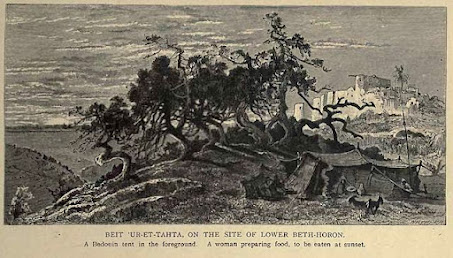
Upper and Lower Beth Horon (now Beit Ur el foqa and Beit Ur el tachta) are mentioned several times through the Bible.


Sun looks out of the dark clouds, Wikimedia

Remember when Joshua asked for the sun to stand still so he could defeat the kings of the Amorites, and the Lord threw down rocks from heaven to defeat Israel’s enemies? (Joshua10)? That was on the ascent and descent to Beth Horon.

The Beth Horons were in the Land allotted to the tribe of Ephraim, and one of them was a Levitical city of refuge (Joshua 21:22)

Right after King Saul made that unlawful sacrifice before Samuel could get there, the Philistines encamped and were eventually driven out at the pass of Beth Horon and Aijalon Valley (1 Samuel 13:18, 14:22,31)

Solomon fortified the cities with gates and walls (2 Chronicles 8:5)

Upper and Lower Beth Horon also played into the Jewish revolt of the Maccabees between the Old Testament and the New Testament.

But what about when it was built? Or more specifically, WHO built it.


The student's manual of ancient geography, based upon the Dictionary of Greek and Roman geography (1861)

1 Chronicles 7:20-24 is a brief break from the line of geneaology. In it, the only time mentioned in scripture is “Now his daughter was She’erah, who built Lower and Upper Beth Horon and Uzzen She’erah.”

PikiWiki Israel 64666 upper beth horon village, Wikimedia


And then we are right back to the begats.

Hold on. Back up.

Women aren’t mentioned often in the Bible, so when they are it stands to reason that there was something pretty epic about this lady.

Not to mention the little fact of a woman building three cities. Even more intriguing is that two of the three cities are standing to this day.

According to my research, She’erah was Ephraim’s daughter. His dad was Joseph—you know the guy who went from slave/prisoner to Pharaoh’s vizier in a matter of minutes because the Lord gave him the wisdom to save Egypt from the seven year famine. (Read my post on the Biblical Joseph in Egyptian history here). Ephraim’s mom was Egyptian, making She’erah at least a quarter Egyptian.

I bring that up to point out She’erah would have had access to Egyptian wisdom and resources as she’s building these cities. What would have brought her up out of Egypt to build off the Aijalon Valley?

The Bible doesn’t say, but because all of the nations owed Egypt big time for keeping everybody alive during the famine, and the Bible documents that people eventually gave their land to Pharaoh when all other resources ran out. In my imagination Pharaoh pretty much had the makings of an empire.

Also, while Joseph was still alive, and for many years after, the Hebrews and the Egyptians lived in harmony. It was only much later when Joseph was forgotten that the Hebrews were made into slaves.

So here is a woman, granddaughter to Pharaoh’s vizier, part Egyptian, part Hebrew, trying to establish herself in a man’s world by building cities.

Yeah, that sounds like an easy task.

True, Egyptian women DID have more rights than Hebrew women traditionally. However, I can’t imagine all the men in the clan and camp would have been thrilled working under a woman architect.

Bethoron Tahton - Lower Bethoron 1880,Wikimedia

Have you noticed the insert about She’erah and her family before?


She'erah's Legacy
As tragedy ravages the camp, can She’erah step up and complete the outpost?
She’erah is a woman trying to leave her mark in a man’s world. Her vision and ability surpasses her father’s, yet she remains second-in-command as they are tasked to build Pharaoh’s outposts in Canaan. She knows she is worthy of the task, but her clan is skeptical.
The last place She’erah expects support is from her charioteer, but Lateef is the lone voice of encouragement. His integrity and steadfastness is a plumb-line in She’erah’s life and she can no longer deny her growing feelings for him.
Acts of sabotage threaten the construction and the shaky foundation of She’erah’s pride. It’s up to She’erah to break generations of rivalry, distrust, and jealousy—if she can learn to rely on the strengths and abilities of those around her to help.

Will she learn to trust God and others before her life’s legacy comes crumbling down around her?


Author of Biblical fiction, avid reader, pastor's wife, Naomi loves reading the Bible and imagining how things were at the time. When she’s not serving in various areas at church or trying to stay on top of mountains of dishes, you'll most likely find her enjoying a good book and a cup of coffee. Naomi co-hosts #BehindTheStory on YouTube and helps facilitate Biblical Fiction Aficionados Community on Facebook. When not writing or trying to wrangle social media, Naomi attempts to get her rescue dog to be cute on command for the many pics she takes throughout the day.


Preorder She'erah's Legacy here

Tuesday, June 27, 2023

Is the Biblical Joseph Documented in Egyptian History?

 By Naomi Craig

Historical Medical Exhibition; cover representing Imhotep Wellcome Wikimedia


Imhotep is listed in Egyptian history as the world's first documented polymath (gifted in many areas). He is known for his contributions in stone carving, architecture, alchemy, astronomy, higher education. He is even deified for his work in medicine centuries later.

What catches my attention with startling accuracy to the Biblical account of Joseph, is how Imhotep saved the nation of Egypt from a seven-year famine by interpreting Pharaoh's dream.


Joseph Interprets Pharaoh's Dream, c. 1896-1902, by James Jacques Joseph Tissot, Wikimedia


A statue of Imhotep, labeled with his many titles, was found in Pharaoh Djoser's step pyramid (architecture attributed to Imhotep) at the Saqqara complex. His wooden coffin faced north--indicating he was a foreigner--and was empty. If you recall in Exodus, the Hebrews took the bones of Joseph as they left Egypt.


The Famine Stele, in the island of Sehel, near Aswan, Egypt, Wikimedia


Many documentations of Imhotep revolve around the seven year famine. The Famine Stele was carved during the Ptolemaic Period (332-30BC) depicting the famine that happened hundreds of years earlier. Interesting enough, it also depicts the land grant the priests had from Djoser and Imhotep making them exempt from the taxes.


Saqqara stone pillars, Ancient Egypt, Wikimedia


On the southern side of the Saqqara complex, there was a narrow entrance. These pillars carved from stone created natural cubbies, large enough for a cashier to collect the money for grain (see the man in the light blue shirt tucked away?). The customer was then taken back to the granaries, where a runner would descend the stairs to collect the allotted grain based on the size of the customer's bag. The customers then filed out, returning as they ran out of grain.

There are so many astounding facts about Imhotep, but I will leave you with this: The primary silo at Saqqara (designed by Imhotep) was fed by eleven other silos in a downward motion. As the level of grain depleted in the main granary, the others filtered grain into it to replenish it. 
One grain superior to the eleven others? Sound familiar?

There is one potential flaw in the theory that Imhotep and Joseph are the same guy. Originally Imhotep and Pharaoh Djoser's timeline was assigned around 2600 BC and that doesn't line up with the Bible timeline. Lately, however, some Egyptologists are beginning to think the timelines they had followed COULD be inaccurate and different Pharaohs/dynasties could have been reigning at the same time.

What do you think? Could Joseph and Imhotep have been the same guy?

For further study visit 

Joseph in Egypt- The Research and Discoveries of Ron Wyatt
and
Joseph the architect of the First Pyramid and How the Pyramids Were Built


As tragedy ravages the camp, can She’erah step up and complete the outpost?

She’erah is a woman trying to leave her mark in a man’s world. Her vision and ability surpasses her father’s, yet she remains second-in-command as they are tasked to build Pharaoh’s outposts in Canaan. She knows she is worthy of the task, but her clan is skeptical.

The last place She’erah expects support is from her charioteer, but Lateef is the lone voice of encouragement. His integrity and steadfastness is a plumb-line in She’erah’s life and she can no longer deny her growing feelings for him.
Acts of sabotage threaten the construction and the shaky foundation of She’erah’s pride. It’s up to She’erah to break generations of rivalry, distrust, and jealousy—if she can learn to rely on the strengths and abilities of those around her to help.

Will she learn to trust God and others before her life’s legacy comes crumbling down around her?


Author of Biblical fiction, avid reader, pastor's wife, Naomi loves reading the Bible and imagining how things were at the time. When she’s not serving in various areas at church or trying to stay on top of mountains of dishes, you'll most likely find her enjoying a good book and a cup of coffee. Naomi co-hosts #BehindTheStory on YouTube and helps facilitate Biblical Fiction Aficionados Community on Facebook. When not writing or trying to wrangle social media, Naomi attempts to get her rescue dog to be cute on command for the many pics she takes throughout the day.

Preorder She'erah's Legacy here 


Saturday, January 2, 2021

History of the Garnet: January's Birthstone


Amber Schamel Christian historical author
Blogger: Amber Schamel


 Happy New Year, everyone! My prayer is that 2021 is a wonderful year for all of us.

Let's kick off the new year with learning about January's birthstone, the garnet. 

We usually think about the garnet being a red stone, however it can actually be a range of different colors including pink, green, yellow, purple, or even brown or black. The stone also has a wide range of history, and thanks to it being so durable, we have artifacts dating back to the bronze age.

The word, "garnet" comes from a Latin word meaning "seed or grain". Most believe that this is probably a reference to the pomegranate seed, which is similar in color, and thus gave the garnet its name.

The garnet has been used by royalty for thousands of years. The ancient Egyptian pharaohs used them in many forms of jewelry, and adored them enough to pack their graves with them as well.  The pectoral pictured here was found in the tomb of Princess Sithathoryunet, and includes many semiprecious stones, including the garnet. 

Egyptian Pectoral found in the tomb of
Princess Sithathorynet.
Public Domain


In ancient Rome, garnets were often carved into the signet rings that stamped some of the most important documents in ancient history. According to Plimy, a Roman scholar, the garnet was one of the most popularly traded gems around 23 to 79 A.D. 

Roman signet made of garnet. 2nd Century AD
Photo courtesy of lot-art.com


In ancient times, red garnets were often referred to as carbuncle. However, that term may have also been used for almost any red stone. According to the Islamic and Jewish legends, red garnet was one of the four stones on the signet given to King Solomon by God. This seal is the predecessor of the modern Star of David.

If carbuncle was indeed referring to the red garnet, it is mentioned several times in the Bible. It would have been one of the stones in Aaron's breastplate, and is also mentioned as one of the stones covering the "anointed cherub" that most scholars believe refers to Satan before his fall. 

Another Jewish tradition says that Noah took the garnet onto the ark as a source of light. During the flood, the sun nor moon was there to provide light, so he used the stone that shone "more brilliantly by night than by day" which was how Noah knew the difference between day and night during that catastrophe. 

garnets
Garnets seem to have a light that comes from within. This is a translucent garnet, backlight by a flashlight. This specimen came from the Red Embers Mine in Erving, Massachusetts, USA. “Fiery Dragon Eyes (Red Embers Garnet),” photo by Mike Beauregard. Licensed under CC By 2.0.


In the middle ages, the garnet was a favorite of clergy and nobility alike. At this time, people believed dragons had eyes made of garnet. The belief that garnets granted protection and healing to the wearer was very widespread, and in fact, during the crusades, the gem was worn by both Christian and Muslim warriors.

When the Bohimian garnet deposits were discovered in central Europe around 1500, the garnet became more widely available.

It is commonly believed, even today, that the garnet can signal coming danger by turning pale. Regardless of whether or not the stone holds any abilities, it still fascinates people, making it a coveted gem in all parts of the world.

*****


Two-time winner of the Christian Indie Award for historical fiction, Amber Schamel writes riveting stories that bring HIStory to life. She has a passion for travel, history, books and her Savior. This combination results in what her readers call "historical fiction at its finest".  

She lives in Colorado Springs near her favorite mountain and between enjoying life as a new mom, and spinning stories out of soap bubbles, Amber loves to connect with readers and hang out on Goodreads with other bookish peoples.

Amber is a proud member of the American Christian Fiction Writers Association. Visit her online at www.AmberSchamel.com/ and download a FREE story by subscribing to her Newsletter!