Showing posts with label Indianapolis. Show all posts

Thursday, May 5, 2016

"Fast Eddie" Rickenbacker

by Ramona K. Cecil

The 29th of this month, in my state of Indiana, the Indianapolis Motor Speedway will host the 100th running of the Indianapolis 500 Mile Race. The Speedway’s important milestone will doubtless spark many conversations about the early years of the track and the pioneers in the sport of automobile racing that have left their mark on the place. Among those pioneers, the name Eddie Rickenbacker stands out; not because he ever won an Indianapolis 500—he didn’t—but because of his amazing life that included a significant contribution to automobile racing and the Indianapolis Motor Speedway.      
Eddie Rickenbacker, race car driver and
WWI flying ace
                                                                                                 

Born in Columbus, Ohio on October 8, 1890 to Swiss immigrant parents, Eddie was, from an early age, a daredevil. By his own count, he survived 135 brushes with death during his lifetime. The first came at age 8 when young Rickenbacker, as the leader of mischievous gang of boys called the Horsehead Gang, slid in a metal cart down a hill into a gravel pit. The cart flipped, slicing his leg to the bone. At age twelve his father died forcing Eddie to quit school and support the family doing an array of jobs from selling eggs and goat milk to working in various local factories.

In 1906 at the age of 16, Eddie found his passion when he went to work for Lee Frayer, a race car driver and head of Frayer-Miller Automobile Company, who let Eddie ride with him as a mechanic in major races. In 1912, Eddie joined car designer Fred Duesenberg and began racing cars on his own. Earning the nickname “Fast Eddie,” he participated in the 1912, 1914, 1915, and 1916 Indianapolis 500 races. Though he never won any of those races, in 1914 he set a world speed record of 134 mph at Daytona. In 1916, while preparing for an automobile race in California, Rickenbacker took his first ride in an airplane and was hooked.

Eddie Rickenbacker in race car


Eddie Rickenbacker at Indianapolis 500


When America entered WWI Eddie joined up, learned to fly airplanes and was assigned to the 94th Aero Squadron, also called the “Hat-in-the-Ring” Squadron. He changed the spelling of his surname from “Rickenbacher” to Rickenbacker, replacing the “h” with a “k” to appear less Germanic. He also adopted the middle name, Vernon, which his parents hadn’t given him, but that he thought sounded classy. Later in his autobiography, he claimed that the change of spelling he made to his last name forced his Rickenbacher relatives to follow suit. Called the “Ace of Aces,” Rickenbacker’s accomplishments as a WWI fighter pilot won him worldwide acclaim as well as a chest full of medals, including the Medal of Honor. Between April 29th and October 30th of 1918, Rickenbacker shot down twenty-six enemy planes and survived; an amazing feat considering WWI aviators were three times more likely to die than any other combat forces.


Eddie Rickenbacker and 94th "Hat-in-the-Ring Squadron


After the war, in 1920, Rickenbacker started the Rickenbacker Motor Company. Though the company eventually went bankrupt, Rickenbacker helped develop the four-wheel brake system. Interesting that he kept the same "Hat-in-the-Ring logo used by his old squadron.             


Two years later Eddie, who’d vowed to eschew marriage, married Adelaide Frost Durant, ex-wife of a former rival race car driver. The couple adopted two sons.

Eddie Rickenbacker and family


In 1927 Rickenbacker bought the Indianapolis Motor Speedway and operated it until 1941, closing it at the entrance of WWII before finally selling it in 1945. During the 1920s and 1930s Rickenbacker worked for General Motors and several air line companies, finally taking the helm of Eastern Airlines in 1935. Three years later, he bought the company.


Among Eddie Rickenbacker’s less known accomplishments was the comic strip Ace Drummond, which he wrote from 1935 to 1940.                 


It was in 1942 that Rickenbacker experienced his most famous brush with death. While on a tour of the air bases in the Pacific Theater during WWII, Rickenbacker’s plane was forced to ditch in the Pacific Ocean. For 24 days Rickenbacker, his friend and business partner Army Captain Hans C. Adamson, and their crewmen drifted at sea in life rafts before being rescued by a U.S. Navy float plane, earning Rickenbacker the new nickname of "Lucky" Eddie.  


After cheating death so many times throughout his amazing life, Eddie Rickenbacker died of pneumonia following a stroke in 1973 at the age of 83.  

So should the name Eddie Rickenbacker come up during the celebration of the 100th running of the Indianapolis 500, I will give a mental salute and waggle of wings in honor of the amazing life of “Fast Eddie” Rickenbacker, the American Ace of Aces.


Ramona K. Cecil is a poet and award-winning author of historical fiction for the Christian market. A proud Hoosier, she often sets her stories in her home state of Indiana.


Check out her website at www.ramonakcecil.com  


http://www.christianbook.com/hearts-heritage-ramona-cecil/9781634097123/pd/4097123?product_redirect=1&Ntt=4097123&item_code=&Ntk=keywords&event=ESRCP

Sunday, July 5, 2015

Eli Lilly ~ A Prescription for Better Health


by Ramona K. Cecil


Have you ever taken medicine in the form of a gelatin capsule, or do you or anyone in your family use insulin to treat diabetes? If so, you can thank Col. Eli Lilly and the company he founded in my home state of Indiana.

Colonel Eli Lilly
 

Born in 1838 in Baltimore, Maryland, to Gustavus and Esther Lilly, Eli moved with his family to Indiana at the age of fourteen. Two years later, after an inspirational trip to an apothecary, he served an apprenticeship under a pharmacist in Lafayette, Indiana, then went on to graduate from Indiana Asbury University (later DePauw University) with a degree in pharmacology.


Lilly's war recruitment poster
 
By 1861 he had married, opened a drug store in Greencastle, Indiana, fathered a son, and, at the outbreak of the Civil War, enlisted in the Union Army. There he formed the 18th Battery, Indiana Light Artillery, which distinguished itself during several important battles in the war. Taken prisoner in 1864, he served the rest of the war in a Confederate prisoner-of-war camp. At war’s end, he was awarded the rank of Colonel for his heroism before mustering out.


Lilly's first laboratory building
After the war he attempted an ill-fated cotton plantation venture, but lost interest in it when his wife and unborn son died of malaria. By 1873 he’d remarried and returned to the Midwest. In 1876 he opened a laboratory to manufacture medicines in Indianapolis. With only three employees, including his fourteen-year-old son Josiah, Colonel Lilly committed himself to producing high quality prescription drugs in an era rife with ineffective patent medicines. Among his first innovations were gelatin-coated pills and capsules, fruit-flavoring and sugar-coated pills to make taking medicine easier and more pleasant.


Assortment of Lilly throat lozenges from 1906


One of the first medicines he produced was quinine to treat malaria, the disease that took his first wife and second son. His business boomed, and as it grew, other family members including a brother, cousin, and grandsons Eli and Josiah joined the business. By the 1880s Lilly had expanded to a complex of manufacturing buildings on the south side of Indianapolis with over a hundred employees and annual sales of $200,000., nearly five million dollars in today’s currency.
                                                                     
Lilly's plant on McCarty Street, Indianapolis, 1886
Colonel Eli Lilly on the right, his son Josiah
on the left, and his grandson Eli in the center.


About this time Colonel Lilly handed control of the business to his son and grandsons and focused his energy on philanthropy. He sponsored the forerunner of the United Way, helped to create the Indianapolis Water Company and the Indianapolis Chamber of Commerce. The old soldier also helped raise funds to build the Indiana Soldiers’ and Sailors’ Monument, the iconic statuary that towers over Monument Circle in downtown Indianapolis.

Indiana Soldiers' and Sailors' Monument,
Indianapolis, Indiana


Advertisement for Lilly insulin
At the turn of the 20th Century, the Eli Lilly Company continued to expand and innovate under Josiah Lilly and his son and Colonel Lilly’s namesake, Eli Lilly. In the 1920s Josiah worked with Toronto scientists J.J.R. Macleod, Frederick G. Banting, and Charles H. Best to develop and mass produce insulin. In 1923 insulin sold under the Lilly trade name Lletin became the first commercially available insulin product for the treatment of diabetes in the U.S. The development of Lletin won Banting and Macleod a Nobel Prize and made Lilly one of the major pharmaceutical manufacturers in the world.


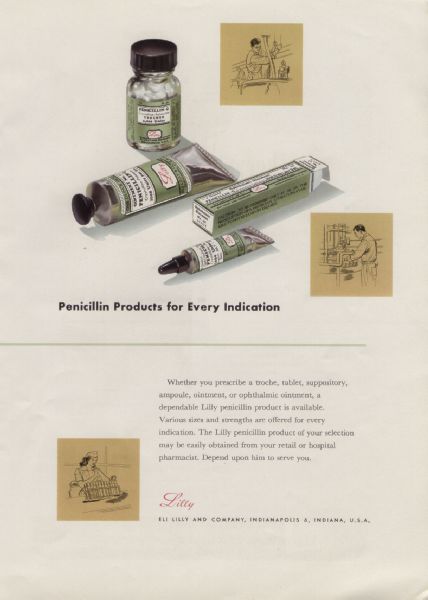
Since then, Eli Lilly has remained on the forefront of groundbreaking drug innovations with mass production of penicillin and Merthiolate, an antiseptic and germicide that became standard issue during WII. In the 1950 Lilly introduced new antibiotics and was heavily involved in production and distribution of Jonas Salk’s polio vaccine.
Lilly penicillin

Lilly Merthiolate


In recent decades Lilly has continued to provide a vast array of innovative new drugs to treat a myriad of ills, keeping the company on the cutting edge of pharmaceutical research.


So when you open up that new prescription, check to see if the word Lilly is printed on the pill or medicine bottle. If it is, you might want to say, before downing your dose, “Here’s to you, Colonel Lilly!”


Ramona K. Cecil is a poet and award-winning author of historical fiction for the Christian market. A proud Hoosier, she often sets her stories in her home state of Indiana.


Check out her website at www.ramonakcecil.com


Coming in 2016


Friday, June 5, 2015

Waverly Electric Car


by Ramona K. Cecil
                                                                                          
Waverly Electric Car


Last year my daughter Kelly bought a Prius. She likes to brag about her hybrid car’s great gas mileage. What she might not know is that electric cars are not a new conception. In fact, electric cars were tooling around the cities and towns of America over one hundred years ago. It might also interest my daughter to know that one of the first electric cars was produced here in our own state of Indiana.


In 1898 the Waverly Company of Indianapolis, which had earlier produced bicycles under the name of The Indiana Bicycle Company, produced its first electric car; the electric Stanhope. Between 1898 and the company's demise in 1914, Waverly produced over a hundred different models of vehicles including wagons (trucks)with prices that ranged from $900 to $3,500.


The Stanhope was actually a two-seater buggy with tiller steering and was powered by an electric battery. The manufacturer bragged that their vehicle could travel up to forty miles at a dizzying top speed of fourteen-miles per hour. The Stanhope was favored by physicians of the time and is said to be the first car driven in the U.S. by a woman when Genevra Delphine Mudge drove her Waverly electric along New York city streets in 1898. While that historic benchmark might appeal to my daughter, I doubt that the Stanhope would work well for her in modern day Indianapolis traffic.


In the late Nineteenth and early Twentieth Centuries, however, the Waverly electric car was a wonder. In a 1912 advertisement for their model Silent Limousine-Five, the company touted the benefits of owning one of their vehicles; no noise, smoke, gasoline odor, or oil spatters, it bragged. Sounds a bit like ads for electric cars today, doesn’t it? In 1912, however, there would have been no mention of cup holders, heated seats, or hands-free bluetooth phone options. Instead, the 1912 ad speaks of passenger comfort as well as the car's gentleness on clothing during a night out on the town: “Delicate Gowns Not Marred In This Roomy Electric. Your party for reception, theater or ball, may number five adults, yet no gown will be marred or even crushed.” Though automobile ads of today often tout ample “leg room,” you'll rarely hear claims of unmarred gowns.


Ad for Waverly Silent Limousine Five


One 1900 model Waverly had a front seat that faced the rear of the vehicle. The driver sat in the front-facing back seat and operated the steering lever, making it easy to converse with passengers. Yikes! And they warn today about the dangers of texting while driving!


By 1901, Waverly Electric had vehicles with three different sized motors to choose from; a two-passenger runabout with a 1.5HP motor, the Phaeton and Stanhope with a 2.5HP motor, and the Brougham with a 3.5HP motor. The Brougham also had an electric heater. Now that’s a feature Kelly would appreciate.


In 1903 Albert Augustus Pope, manufacturer of the Columbia electric car bought Waverly and the Indianapolis company became Pope-Waverly.


 Electric cars of the early 1900s were particularly advertised to women as they claimed to be easy to start, drive, and maintain. One ad enticed potential female buyers with the promise “No complications. Turn on the power and steer.” Despite the compelling ads, I have to wonder how many ladies actually found an electric car under their Christmas tree and how many brides received a Waverly electric as a gift from their grooms.


1906 Advertisement


1915 advertisement


Some of the famous people to own a Waverly electric car were financier Diamond Jim Brady, author Willa Cather, African-American hair care entrepreneur, Madam C.J. Walker, author and Civil War officer, General Lew Wallace, and inventor Thomas Edison, who developed one of the Waverly car batteries.

Madam C.J. Walker driving her daughter and others in her Waverly Electric Car
By 1914 Pope-Waverly could no longer compete with gasoline propelled automobiles and the company went belly-up.


Today, my Prius-owning accountant daughter might consider the Pope-Waverly far ahead of its time. Could I see Kelly tooling around Indianapolis in a Waverly electric dressed in early 1900 garb? Probably not, though everyone in the family agrees she looks great in hats. 


Ramona K. Cecil is a poet and award-winning author of historical fiction for the Christian market. A proud Hoosier, she often sets her stories in her home state of Indiana.


Check out her website at www.ramonakcecil.com