
By Mary Dodge Allen
On December 11, 1941 - four days after the Japanese attack on Pearl Harbor – Hitler declared war on the United States. He then authorized a secret mission to sabotage American factories and transportation infrastructure critical to the American war effort. This mission also included plans to attack civilian targets, in order to create chaos and demoralize American citizens.

German Admiral Wilhelm Canaris (Public Domain)
Years earlier, during WWI, Canaris had successfully organized acts of sabotage on French targets in Morocco. He had also orchestrated a devastating attack on the U.S. munitions depot located on Black Tom Island in New York Harbor. A tremendous blast destroyed the depot on July 30, 1916 – (several months before America formally entered WWI.) The roar of this blast was heard as far away as Maryland and Connecticut. Canaris seemed confident that “Operation Pastorius” would be a similar success.
Operation Pastorius Sabotage Team:
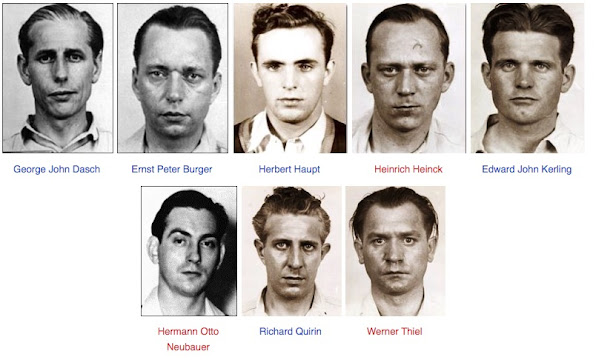
These eight Germans were chosen for this mission because they had lived in the U.S. and had a good command of English. Two of them, Ernst Burger and Herbert Haupt, were U.S. Citizens. George Dasch, age 39, had worked as a waiter in New York for many years and had married an American woman from Pennsylvania. He had also served a short time in the U.S. Army. Because of this, Dasch was selected as the team commander.

"Operation Pastorius" Team (Wikipedia)
L-R Back row: George Dasch, Ernst Burger, Herbert Haupt, Heinrich Heinz, Edward Gerling
L-R Front row: Hermann Neubauer, Richard Quirin, Werner Thiel
These eight Germans were chosen for this mission because they had lived in the U.S. and had a good command of English. Two of them, Ernst Burger and Herbert Haupt, were U.S. Citizens. George Dasch, age 39, had worked as a waiter in New York for many years and had married an American woman from Pennsylvania. He had also served a short time in the U.S. Army. Because of this, Dasch was selected as the team commander.
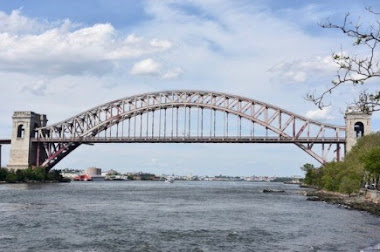
The men received three weeks of intensive training in handling explosives and rigging various types of delay-timing devices. They were given false life histories, counterfeit birth certificates, driver’s licenses, Social Security Cards and a total of nearly $175,000 cash, in American currency. The acts of sabotage were to be conducted over a period of several months. The targets included the hydroelectric plants at Niagara Falls, Newark Penn Station and other large railroad installations in the northeastern U.S., along with bridges, water facilities and aluminum factories.

Hell Gate Bridge, New York - one of the targets (Public Domain)
The eight-member team was split into two groups of four men and taken to the U.S. in two separate U-boats: U-202 and U-584.

WWII German U-boat (Public Domain)
First Landing:
On the night of June 12, 1942, U-202 landed at Amagansett, New York, a beach on Long Island. Dasch, Burger, Quirin and Heinck came ashore on a raft. They were dressed in German Navy uniforms so they would be treated as prisoners of war if they were captured, rather than spies, who would likely face execution.
Dasch’s team began burying their uniforms, explosives and other supplies in the sand dunes, to be retrieved at a later date. As they were doing this, they were discovered by John C. Cullen, a young U.S. Coast Guardsman who was patrolling the beach, unarmed. Dasch gave Cullen a $260 bribe and said, “Take this and have a good time. Forget what you’ve seen here.”
Cullen pretended to play along, but then he raced back to the Coast Guard station to report what had happened. An armed Coast Guard patrol quickly returned. They uncovered the buried supplies, but the men were gone. Dasch and the other three had changed into civilian clothes and purchased tickets on the Long Island Railroad’s 6:57 a.m. commuter train to Manhattan. Then they split into two groups and checked into separate hotels – Dasch with Burger; Quirin with Heinck.
Second Landing:
Four days later, on the night of June 16, 1942, U-584 landed south of Jacksonville, Florida, at Ponte Vedra Beach. Kerling was put in charge of this team, which included Haupt, Neubauer and Thiel. They came ashore wearing bathing suits and German Navy hats. After burying their raft, equipment and hats, they donned civilian clothes and then split into two groups, taking trains to Chicago and Cincinnati.
Second Landing:
Four days later, on the night of June 16, 1942, U-584 landed south of Jacksonville, Florida, at Ponte Vedra Beach. Kerling was put in charge of this team, which included Haupt, Neubauer and Thiel. They came ashore wearing bathing suits and German Navy hats. After burying their raft, equipment and hats, they donned civilian clothes and then split into two groups, taking trains to Chicago and Cincinnati.
All eight team members were scheduled to meet in a Cincinnati hotel on July 4th to discuss plans to begin their sabotage operations.

Sign placed near the landing site at Ponte Vedra Beach, FL
(Univ. of North Florida digital collection)
On June 15, 1942 Dasch placed an anonymous call to the FBI’s New York Office. He explained that a German submarine had taken him and a special team to the U.S., and he wanted to deliver important information about his sabotage mission. The FBI had been receiving hundreds of crank calls, and the agent expressed doubts the call was genuine. Dasch responded, “I’ll be in Washington within the week to deliver this information personally to J. Edgar Hoover.”
When New York’s FBI office received the report about the Coast Guard's discovery of buried explosives on a Long Island beach, they took this anonymous call seriously and alerted the Washington D.C. office.

Vintage photo of the Mayflower Hotel, Washington, D.C. (Wikipedia)
During the next two days, FBI agents interrogated Dasch in his hotel room. He revealed details about the sabotage team, their training in Germany and their potential U.S. targets. He also gave the FBI his team’s portion of American currency, totaling over $82,000 in cash.
Using information Dasch had given them, the FBI made a string of arrests and jailed all eight saboteurs. FBI Director Hoover placed a spin on the press coverage, portraying the arrests as the result of the FBI’s shrewd detective work – rather than a voluntary defection. Dasch’s hope of receiving clemency as a defector was lost as the FBI took full credit for foiling the sabotage operation. In news accounts, Dasch was simply described as cooperating with the FBI.
Using information Dasch had given them, the FBI made a string of arrests and jailed all eight saboteurs. FBI Director Hoover placed a spin on the press coverage, portraying the arrests as the result of the FBI’s shrewd detective work – rather than a voluntary defection. Dasch’s hope of receiving clemency as a defector was lost as the FBI took full credit for foiling the sabotage operation. In news accounts, Dasch was simply described as cooperating with the FBI.
The Military Tribunal:
Two days earlier, President Roosevelt had issued Executive Proclamation 2561, creating a military tribunal to prosecute the sabotage team. On July 8th a seven-member military commission began hearing evidence. The trial, held in the Department of Justice building in Washington D.C., ended on August 1, 1942.

The trial of the Nazi Saboteurs, July 1942 (Wikipedia)
In 1948, President Truman granted executive clemency to Burger and Dasch, on the condition that they be deported to Germany. They returned in disgrace and were considered as traitors, responsible for the execution of their comrades. For many years, Dasch petitioned the U.S. Government for a full pardon, so he and his wife could return to the U.S. But Hoover denied every request. Both men died in Germany - Burger, in 1975, and Dasch, in 1992 at the age of 89.
It has been speculated that if George Dasch hadn’t defected, this sabotage plan might have had some success. Do you agree? What do you think?
____________

Mary Dodge Allen is the winner of a 2022 Christian Indie Award, a 2022 Angel Book Award, and two Royal Palm Literary Awards (Florida Writer's Association). She and her husband live in Central Florida, where she has served as a volunteer with the local police department. Her childhood in Minnesota, land of 10,000 lakes, sparked her lifelong love of the outdoors. She has worked as a Teacher, Counselor and Social Worker. Her quirky sense of humor is energized by a passion for coffee and chocolate. She is a member of the Florida Writer's Association, American Christian Fiction Writers and Faith Hope and Love Christian Writers.
Website: www.marydodgeallen.com
Mary's novel: Hunt for a Hometown Killer won the 2022 Christian Indie Award, First Place - Mystery/Suspense; and the 2022 Angel Book Award - Mystery/Suspense.
Click the link below to buy Hunt for a Hometown Killer at Amazon.com:


