Showing posts with label Pegg Thomas. Show all posts

Monday, March 3, 2025

Sneaking Inside the Walls of Fort Michilimackinac


Welcome back! Last month in Unearthing the Past at Fort Michilimackinac we delved below the surface (literally) and viewed items uncovered from the sand used to recreate the fort, structures, and also exhibits that exist today at this historic site. We discovered a bit about the people who lived in the area before the original fort installation and after. 


I mentioned in the last post that reading Pegg Thomas’ stories of fort life impacted my adventure at Fort Michilmackinac. To enhance your experience, how about if we tiptoe inside the palisade walls? Have no fear, there is no danger of an attack. Though you might be able to gain a better understanding of the inner workings of Colonial life. Shall we enter the water gate where voyageurs would land their vessels and carry their goods to be counted? Or shall we enter by land, perhaps as a settler seeking goods to purchase? Enter through one and exit through the other you say. Excellent. My thoughts exactly. Let’s go! Onward and inward, to the Colonial Fort Michilimackinac.

By water, we pass the artillery platforms and enter near the King’s Storehouse. Here visitors can view a short film previewing life at the height of the fort in the 1770s. Nearly 2,000 people lived and worked in the protection of the palisades. 


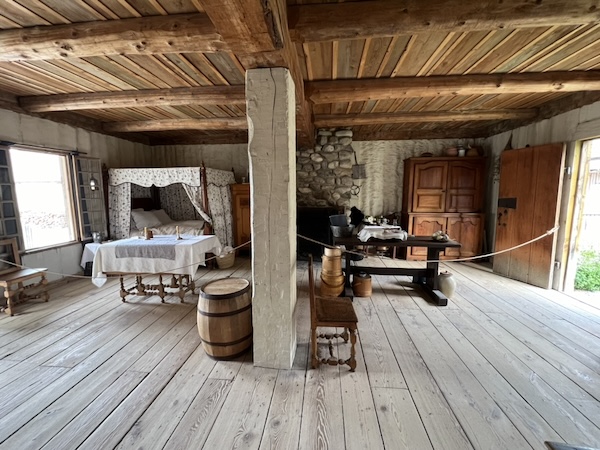
Steps from the King's Storehouse resides the Commander's House. In the photos below, take a moment to absorb the accoutrements of daily life. Harsh Michigan winters necessitated large, crackling fires. Not everyone living at the fort had the luxury of this magnificent stone fireplace. Look at that ceiling. There is something to be said for homes and items created by hand. The intention and time behind the final product cannot be mimicked in mass-produced goods. I wonder at the hours involved in designing, building, and carving the large wardrobe. 
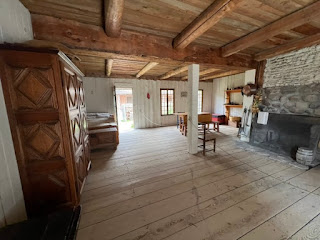

Below, photos show of an example of an enlisted soldier and his wife's rented house. The Army allowed some soldiers to live in these houses with their wives and children. Army-issued and privately purchased items fill the space. When women were not working for the military, they acquired other jobs such as doing laundry for fort residents. The payment for that weekly task rested at eight shillings. The extra income helped as the military only provided basic necessities.


In the last episode, we dug into the archeology at this site. Below is a display of ceramics the archeologists unearthed. The wife living here used these vessels or some similar. Teapots, earthenware cups, stoneware milk jugs, earthenware bowls, and porcelain dishes to name a few. Notice the item at the bottom. Chamber pots were all the rage on freezing nights.


The remaining soldiers, most likely lower in rank, bunked together in the Barracks. Soldiers toiled, slept, ate, and drilled together. They rarely mingled with civilians, other than at church. 

Soldiers earned eight pence daily, six removed to pay for food rations. Since this fort was at the end of the line, the quality was often lacking. The military expected them to amend their diets by fishing and tending gardens for produce. 

A group of men pooled their rations together, called a "mess." Two messes per room of the barracks. In 1776, daily rations consisted of: one ounce of rice, 1/4 pint of peas, eight ounces of salt pork, one ounce of butter, and one pound of flour or bread. The mess combined ingredients and efforts, cooking their own meals.

The day we visited, docents presented history surrounding tea and served samples. A poignant example of added value in visiting historical sites. Shared details expounded on topics I had never heard before or considered. The British Trader's House afforded a backdrop for visitors to sit, listen, and steep.


Associated with health and hospitality, there is an entire culture set around tea. A shared beverage in the same container goes back to ancient times. Representing shared resources, tea is a bridge to build relationships. Time for tea and manner in which it is served varies by people group. 

We learned that originates from one plant: Camelia Seninsis. How the leaves are harvested determines the end product. White leaves are the hardest to process. Green leaves are lighter in flavor. Black leaves are oxidized. Oolong is on the greener side of black tea. Here in 1770s they drank Oolong loose leaf black teas. 

How did tea find a place on the British table?

Catherine of Braganza, born in Vila Viçosa, Portugal, married King Charles II in May of 1662. Her dowery included a chest of tea. At the time, British citizens drank beer/ale. After the union, and by the end of 1800s, most British subjects drank tea.

Another facet to consider are the necessary components to make, serve, and consume tea. A table set included a tea tray, tea pot, strainer, creamer, sugar bowl, spoons, and other specialized equipment. A kettle started the process. The finish - tea cups and saucers. An entire niche for production and consumption. Next time we take a sip of tea, we might better appreciate the rich and long history before it filled our cup. 

Stepping out of the British Trader's House, we walk toward The Church of Ste. Anne. It stands just before the Southwest Rowhouse that contains special exhibits for the public. The Parade Ground is near the archeological site, followed by the remaining rowhouses. Other buildings include the latrine (necessary but thankfully not in current use), blacksmith shop, Priest’s House, Guardhouse, and Powder Magazine.

As we funnel out the Land Gate, we walk through the Native American Encampment. Read more about the Anishinaabek if you would like, in last month's Unearthing the Past at Fort Michilimackinac.

When the fort is open for visitors, interpreters in full regalia provide insights of Colonial Life. Presentations ranging from preparing food, gardening, to cannon fire, are sure to bring the fort to life for young and seasoned alike. Programs and special events plunge into history. Fort Fright in October and A Colonial Christmas in December are a few of the added activities. 

Have you visited a fort? Which one and where is it located? Or might you make plans to visit this fort in the future?

If you have a hankering for more fort life before you are able to make the trek, you will be excited to learn Pegg Thomas’ Her Redcoat is available now and transpires at Fort Michilimackinac! The heroine, Laurette Pettigrew is friends with the Ojibwe.

Here are the four stories by Pegg Thomas mentioned in the post:


Pegg has many more journeys available in her tales. When describing Pegg weaving a yarn, this statement winds twofold. She crafts compelling stories and creates with yarn from start to finish. Visit her website to peruse her books. Join her newsletter to be the first to hear of her adventures in both avenues. Watch videos as she shares the textile process step-by-step. From drafting and carding wool to combining colors, on to the spinning wheel, and designing the final product, Pegg opens a window to long ago processes and precious items made by hand.

For history surrounding Fort Michilimackinac, read these posts by Kathleen Rouser: An Unburied Historical Treasure: Colonial Fort Michilimackinac and The Siege of the Fort at Detroit (Please note, the Giveaway ended.)

As a child, Rebecca loved to write. She nurtured this skill as an educator and later as an editor for an online magazine. Rebecca then joined the Cru Ministry - NBS2GO/Neighbor Bible Studies 2GO, at its inception. She serves as the YouVersion Content Creator, with over 128 Plans, in 44 languages on the Bible.com app.

Rebecca lives near the mountains with her husband and a rescued dog named Ranger. She is a proud mom of an American soldier and a college senior. If it were up to Rebecca, she would be traveling - right now. First up, trips to see their two grown sons. As a member of ACFW and FHLCW, she tackles the craft of fiction while learning from a host of generous writers. Connect with Rebecca: Facebook Goodreads Instagram PinterestX/Twitter

Monday, February 3, 2025

Unearthing the Past at Fort Michilimackinac


The longest running archeology program in the United States resides at Fort Michilimackinac in northern Michigan. Digs started in 1959. The study continues each summer in fairer weather. To date, researchers excavated 65% of the original fort and structures and more than one million artifacts exist from these explorations.


One of the most fascinating components for me at this fort isn't the booming cannons or the demonstrations of the re-enactors, though both are exciting and informative. Rather, capturing my attention and imagination is the extensive archeology exhibit. For those of us who wonder "how" it not only answers, but prods further curiosity. Did you ever wonder how archeologists decide where structures exist and the composition of the subjects? The first interactive display at Michilimackinac shows a mock up of a current building. Pressing a button reveals what exists below. Take a gander.


This demonstration shows how archeologists recreate a site. If they unearth many glass fragments, they might envision windows. If they uncover pottery shards and pot fragments, they perhaps infer the location of a kitchen. Metal/iron parts could hint at a door. Studying where these physical findings rest gives an idea of the structure's segments, walls, doors, chimneys, and more.

The nature of archeology can be a messy business since scientists must dig and disassemble to discover and designate parts of the past. Because this venture is destructive to say the least, they toil in confined areas of 10-foot squares at a time. Maps, drawings, written records, and photographs aid in piecing together what once filled those spots. Exact locations are notated. In later years, computers aided and continue to give insight by employing programs that study patterns. 

In collecting items surrounding specific purposes, archeologists can surmise what types of occupations, domestic functions, and recreational activities subsisted for the colonial residents. Notice the artifacts below representing these four categories: structural, occupational, domestic, and recreational.


Since we've discussed what is under the fort. How about what or who was outside the fort? Who lived at this location before and after installation?

The Anishnaabeck, comprised of Ojibwa, Odawa, and Pottawatomi inhabited the area by 1650. Visitors can tour a model of their encampment to grasp an idea of daily life. The exhibit displays traditional housing sporting angled poles dressed in birchbark, reeds, or cedar. How did they live inside? The door flap of a blanket or other material served as entry and protection from wind. A central fire provided warmth and an area to cook during colder weather. At other times, cooking occurred outside. Men and women slept in separate areas. The area furthest from the door housed the elders.

The women removed the exterior of the dwelling for transport to the next camp at the change of seasons. For the Anishinabek, this method remained through a portion of the 19th century.I always wondered how Native Americans packed up and migrated. Perhaps each people group created the skeleton for the dwellings at subsequent locations using local resources and only transported the outer portions? Do you have any idea? Share in the comments below. 

What drew these nomads to seek this location? The Ojibwa and Odawa (also spelled Ottawa) in the north subsisted by hunting and fishing, both supported by the Great Lakes and its shores. The Pottawatomi of the south farmed corn, beans, and squash (though I did not find reference to the triad; The Three Sisters as termed by the Cherokee and Iroquois). The rivers of southern Michigan allowed for this agriculture. (Enlarged map at right from the display on a placard at the encampment.)

This fort lies near the tip of the lower peninsula resting along Lake Huron and Lake Michigan. In addition, the lakes lead to tributaries, rivers, and creeks, allowing the transportation of people and goods across the continent and beyond. The parcel of land and surrounding vicinity served as a hub of trade for many natives as well as Europeans, before, during and after the fort reigned. 

1715 arrived as Fort Michilimackinac’s walls multiplied, one post at a time. Constant Le Marchand de Lignery built the fort of wood, 360 feet by 380 feet. What you see today is a representation of the original structures. Can you find the guard patrolling the high walls in the photo above left with the flag? What a view they had from the bastions (towers), photo at left.

Incidentally, before this trip to Michigan I finished a novella by Pegg Thomas titled, Henri’s Regret: Forts of Refuge. It is the prequel to Selah Award Finalist, Maggie's Strength. In Henri's story, Frenchman Henri Geroux sets out on an adventure with his Ottawa friend. Danger ensues as he traverses land and water. While his travels did not include the site of this fort, the tale enhanced my overall experience at Michilimackinac. Reading earlier of navigating the water, entering a fort, and tidbits during their waking hours brought the fort to life for me that day. After our trip to Michigan, I read more exploits in and around forts in 2022 Selah Award Winning Sarah’s Choice also by Pegg Thomas. This story from 1763 featured three forts as well as three women who sought to survive amidst the peril. 

Speaking of reading, if you would like to learn about the history of Fort Michilimackinac, there are two detailed entries by Kathleen Rouser, links at the end. As you will learn in reading Kathleen’s, An Unburied Historical Treasure: Colonial Fort Michilimackinac, the British struggled to guard this tenuous location so they moved to Mackinac Island in 1781. There they had the upper hand at a higher elevation and land that was easier to defend surrounded by the lake. They did transfer original structures to the island. The remainder they burned. Below you will see a photo of Ste. Anne's (built by the French) at the original fort and the later constructed St. Ann's Church (built by the British) on the island. When we visited Mackinac Island, we walked past the church during mass. Peering up at the stained glass, we heard sweet voices in song floating out the door. That handle! Do you see the cross? Quite certain a blacksmith fashioned the device in earlier years. How I longed to step inside to view other features. Perhaps another visit one day.


That handle! Do you see the cross? Quite certain a blacksmith fashioned the device in earlier years. How I longed to pass through that door to view other treasures. Perhaps another visit is in order one day?

Next month we will sneak inside the fort walls of Michilimackinac. There is more to see in the Commander and Soldier Houses, the Barracks, and other buildings. Do you wonder how people lived before electricity, indoor plumbing, microwaves, and multitudes of appliances? Can you imagine managing Michigan winters without the benefit of HVAC systems?

If you have a hankering for more fort life before then, you will be excited to learn Pegg Thomas’ Her Redcoat is available now and transpires at Fort Michilimackinac! The heroine, Laurette Pettigrew is friends with the Ojibwe. 

Here are the four stories by Pegg Thomas mentioned in the post:


Pegg has many more journeys available in her tales. When describing Pegg weaving a yarn, this statement winds twofold. She crafts compelling stories and creates with yarn from start to finish. Visit her website to peruse her books. Join her newsletter to be the first to hear of her adventures in both avenues. Watch videos as she shares the textile process step-by-step. From drafting and carding wool to combining colors, on to the spinning wheel, and designing the final product, Pegg opens a window to long ago processes and precious items made by hand.


For history surrounding Fort Michilimackinac, read these posts by Kathleen Rouser: An Unburied Historical Treasure: Colonial Fort Michilimackinac and The Siege of the Fort at Detroit (Please note, the Giveaway ended.)
As a child, Rebecca loved to write. She nurtured this skill as an educator and later as an editor for an online magazine. Rebecca then joined the Cru Ministry - NBS2GO/Neighbor Bible Studies 2GO, at its inception. She serves as the YouVersion Content Creator, with over 128 Plans, in 44 languages on the Bible.com app.

Rebecca lives near the mountains with her husband and a rescued dog named Ranger. She is a proud mom of an American soldier and a college senior. If it were up to Rebecca, she would be traveling - right now. First up, trips to see their two grown sons. As a member of ACFW and FHLCW, she tackles the craft of fiction while learning from a host of generous writers. Connect with Rebecca: Facebook Goodreads Instagram PinterestX/Twitter