Showing posts with label Pennsylvania. Show all posts

Saturday, September 9, 2023

State Name Origins - Part IV

   By Tiffany Amber Stockton


In August, my post focused on the invention and minor evolution of the sewing machine, showcasing how it revolutionized the clothing industry. You can read last month's post if you missed it.

Today, it's time for the next 10 state name history stories. Aren't you excited? Has your state already been covered? If not, there are only 10 more after this group, so it's certain to be covered soon.

STATE NAMES and their ORIGINS

One thing I found interesting with this list is it's almost a 50/50 split of the state names starting with a letter of the alphabet from either the first half or second half of the 26 letters. Montana is the 26th state out of 50 and the last one with an "M." The remaining 24 states come from the latter half of the alphabet. It would have been fun to see 25 of the states start with letters in the first half of the alphabet and the other 25 from the second half, but we're close!


New Mexico is self-explanatory and based on the Spanish Nuevo Mexico. Although, did you know the Aztecs coined the word Mexihco for their ancient capital?

New York was named for the Duke of York and the future King James II.

North Carolina is named after a monarch, King Charles II, as Carolus is the proper Latin version of Charles.

North Dakota describes the northern land of the Dakota people, but it also means friendly or allies.

Ohio comes from a body of water, this time, the Ohio River. The Seneca Native Americans billed it as a good river.


Oklahoma comes from the Choctaw word meaning "red people."

Oregon has an origin where some scholars point to Algonquin as the source.

Pennsylvania was named after Admiral William Penn, under Charles II. It literally means Penn’s Woods.

Rhode Island has multiple name theories, including the idea that Dutch explorer Adrian Block applied the name Roodt Eylandt, meaning red island, to reflect the red cliffs of the region. Alternatively, it may come from the Greek island of Rhodes.

Tennessee comes from the Cherokee village name ta’nasi, but the meaning is unclear.

And that's all for today. If you're like me and LOVE puzzles, download this PDF for some puzzle challenge fun. You might be able to solve it on your own without reading the rest of the blogs in this set, or you can save it and add to it in future months. :)

NOW IT'S YOUR TURN:

* Which one of these states was the most fascinating to you?

* Do you live in any of the 10 featured states this month? If so, do you have any other unique tidbits about your state?

* What do you think might be the origin of any of the final 10 states?


** This note is for our email readers. Please do not reply via email with any comments. View the blog online and scroll down to the comments section.

Leave answers to these questions or any comments you might have on this post in the comment box below. For those of you who have stuck around this far, I'm sending a FREE autographed book to one person every month from the comments left on each of my blog posts. You never know when your comment will be a winner! Subscribe to comments so you'll know if you've won and need to get me your mailing information.

Come back on the 9th of October for my next foray into historical tidbits to share.

For those interested in my "fictional" life as an author and industry news about other authors, subscribe to my quarterly newsletter. Receive a FREE omitted chapter from my book, A Grand Design, just for subscribing!


BIO
Tiffany Amber Stockton has been crafting and embellishing stories since childhood, when she was accused of having a very active imagination and cited with talking entirely too much. Today, she has honed those skills to become an award-winning, best-selling author and speaker who is also a professional copywriter/copyeditor. She loves to share life-changing products and ideas with others to help improve their lives in a variety of ways.

She lives with her husband and fellow author, Stuart Vaughn Stockton, along with their two children and four cats in southeastern Kentucky. In the 20 years she's been a professional writer, she has sold twenty-six (26) books so far and is represented by Tamela Murray of the Steve Laube Agency. You can find her on Facebook and GoodReads.

Tuesday, February 28, 2023

Recipes Through History – by Donna Schlachter --with Giveaway


https://eatwell.healthy.ucla.edu/2021/03/08/the-history-of-cookbooks-and-where-we-are-today/


If your home is anything like mine, you have way too many unfinished knitting (or some other craft) projects, more books than you can read in this lifetime, and cookbooks collecting dust on a shelf because you don’t really like to cook (at least, that’s my excuse for not using them).

With the upcoming release of the first book in a new series about a recipe box and its contents that are handed down through generations of a family, I thought some history about recipes might be interesting.

The first recorded cookbook is on four clay tablets from around 1700 BC in Ancient Mesopotamia. Unlike a few ingredients scribbled on the inside leaf of a notebook or a scrap of paper or even the other side of a grocery list, whoever wanted to save this particular recipe went to a lot of trouble. Dig the dirt, make the mud, write the hieroglyphics, bake it or let it dry in the sun, then carry it around in a sack of some kind and hope you didn’t drop them. These early recipes gave instructions for preparing a series of meaty stews.

For the next 3,000 years or so, recipes were stored on whatever was at hand. As you can imagine, not many remain today in their original form. There are some Egyptian tombs that carry what is thought to be ancient recipes, but that’s about all that we might find where they were “published”. Recipes also survive from Greece, China, and Persia.

Photo source: http://collection.hht.net.au/images_linked/48266.jpg


Recipes were often saved on bits of leather, papyrus, early paper, or perhaps even carved into stone. However, once the printing press came on the scene, collections of recipes were often compiled for kings and royalty. One example is the 1390 edition of The Rules of Cookery, in which southern European ingredients such as saffron, sugar, almonds, and pasta are included. Servants, too poor to purchase these items for their own cooking, instead prepared them into delicious meals for the rich.

If a king could publish a cookbook that demonstrated the luxury of their banquets, this was a challenge to others in the peerage to present similar feasts. Chief stewards often couldn’t memorize all the new recipes coming out, so a cookbook was a great way to keep the recipes close to hand.

the New York Public Library Digital Collections


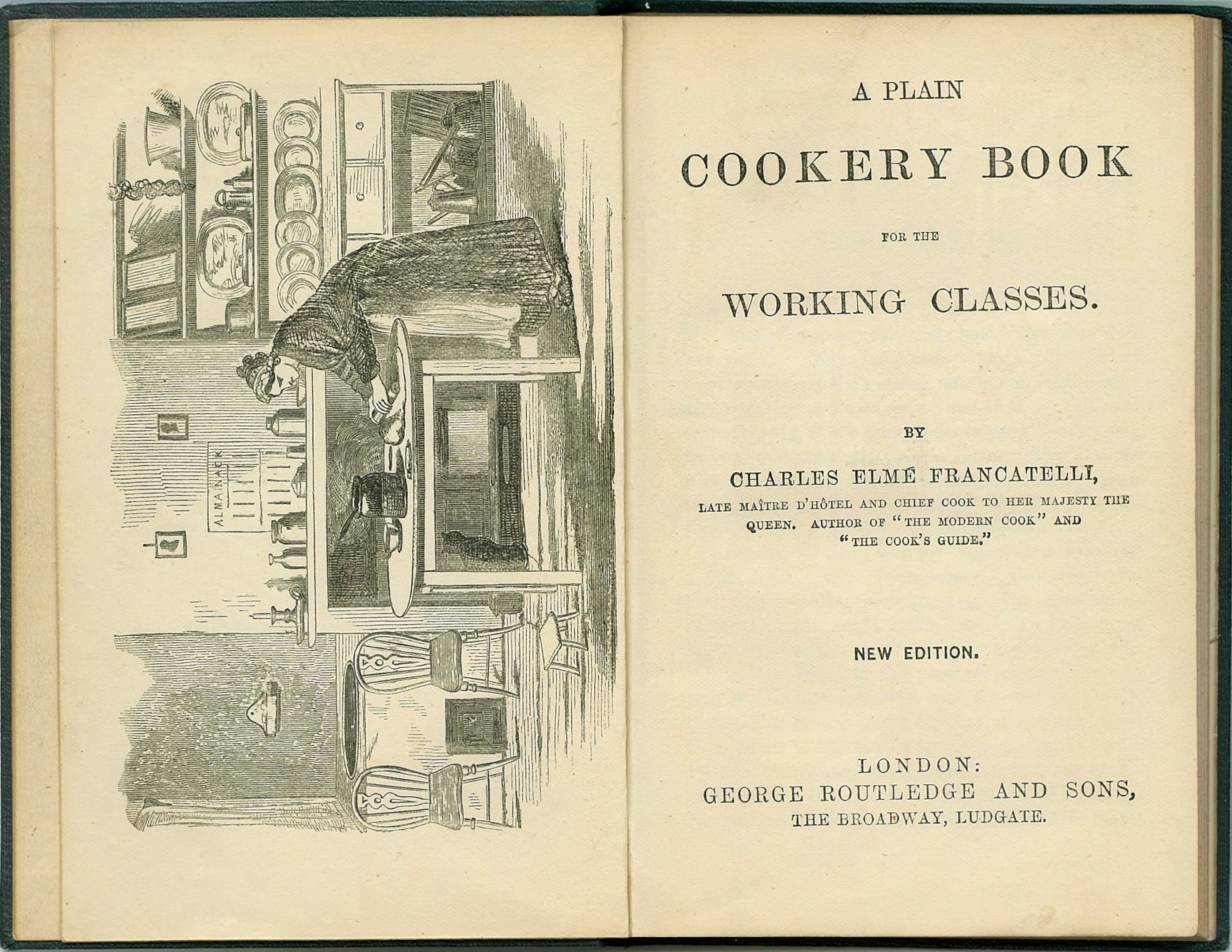
In the 15th century, publishers sought to increase the audience for cookbooks. With public literacy increasing, cookbooks became less of a luxury. However, early on, each social class had its own cookbooks because of the differences in availability and affordability of ingredients. For example, The Poor Man’s Larder and Bourgeois Cooking wouldn’t be found on the same bookshelf. Eventually, new ideas formed about equality and democracy, and presenting certain books as best for rich or poor was no longer considered effective marketing.

In the 17th century, women’s roles within the household changed, with gentlewomen of landed gentry directed much of the activity on their husband’s estates, including cooking, brewing, baking, producing butter and cheese, making wine, dyeing textiles, and management of medicines. Cookbooks afforded them opportunities to use a variety of ingredients in cooking and baking.

However, in the 18th century, with more folks congregating in towns and depending on purchasing their food ingredients already partially processed from merchants in cities and towns, the recipes also needed to accommodate their needs, including differing forms of cooking ranges. Coal replaced wood as fuel, meaning many recipes needed adjustments.

Also in the 18th century, cookbook writers worked hard for greater precision regarding quantities of ingredients, cooking time, and temperature. It was at this time that an entirely new professional group—teachers in cooking schools and home economists—emerged, offering important lessons for housewives.

As recently as the late 1940s, following the second World War, food became about thriftiness, preservation, rationing, and efficiency. When industrialized, canned, and processed food gained popularity, cookbooks became more important. Coming up with cheaper dishes, or recipes with cheaper ingredients, became important, as did finding ways to use leftovers.

Fannie Farmer: Cover of 1919 edition of The Boston Cooking-School Cook Book by Fannie Merritt Farmer Image courtesy of Smithsonian Libraries


In America, one of the first truly American cookbooks was published in 1896—The Fannie Farmer Cookbook. Filled with familiar recipes from a hundred years prior—such as Potted Pigeons, Creamed Vegetables, and Mock Turtle Soup—it also included concoctions that included cheese, chocolate, and ground beef. Cooks were introduced to recipes like Hamburg Steaks and French Fried Potatoes. Fannie Farmer’s methodical approach to cooking were precise, replicable, and perfect for Americans with newfangled gadgets like standardized cup and spoon measures. With families moving away from their families in ever-increasing numbers, there was no grandmother to learn from or mother to ask for advice. Fannie’s cookbook popularized the modern recipe format which we use today. 

Thank heavens for visionaries like Fannie Farmer. Can you imagine trying to figure out how to make a cake using three pinches of salt, four handfuls of cake flour, a thimbleful of baking soda, and a ladle of sugar? 

Nowadays, if you're anything like me, you find it easier to look up a recipe on your phone rather than digging through a book or a box of index cards. Still, there's nothing quite like a recipe on paper--complete with a stain here from butter or a fingerprint in molasses.

Happy cooking and baking!


About Recipe for Disaster: Book 1 The Recipe Box series, 1784

A spinster sister, left behind by her four younger sisters, feels unwanted and unneeded. But when three orphans and a wounded soldier turn up on her doorstep, her life takes on new meaning.

A man in search of his family—has he found them at last? But something isn’t quite right.

Can God weave these five lives into something beautiful for His glory, or will half-truths and missing memories create a recipe for disaster?

Available for Pre-Order: https://www.amazon.com/dp/B0BMGFKVKN

Series: https://www.amazon.com/dp/B0BMM1CTLJ


Giveaway: Leave a comment, and we’ll draw randomly for one winner of an ebook. Remember to leave your email address cleverly disguised so the ‘bots don’t get you, or we can’t contact you. For example, Donna AT livebytheword DOT com


About Donna:


A hybrid author, Donna writes squeaky clean historical and contemporary suspense. She has been published more than 60 times in books; is a member of several writers groups; facilitates a critique group; teaches writing classes; ghostwrites; edits; and judges in writing contests. She loves history and research, traveling extensively for both, and is an avid oil painter.


Connect online:

www.DonnaSchlachter.com Stay connected so you learn about new releases, preorders, and presales, as well as check out featured authors, book reviews, and a little corner of peace. Plus: Receive 2 free ebooks simply for signing up for our free newsletter!

www.DonnaSchlachter.com/blog

Facebook: www.Facebook.com/DonnaschlachterAuthor

Twitter: www.Twitter.com/DonnaSchlachter

Books: Amazon: http://amzn.to/2ci5Xqq

Bookbub: https://www.bookbub.com/authors/donna-schlachter

Goodreads: https://www.goodreads.com/search?utf8=%E2%9C%93&query=donna+schlachter

Resources:

https://eatwell.healthy.ucla.edu/2021/03/08/the-history-of-cookbooks-and-where-we-are-today/

https://www.theatlantic.com/business/archive/2017/10/cookbooks-status-600-years/544164/

Full of great resources: https://www.thefoodhistorian.com/historic-cookbooks.html

https://www.smithsonianmag.com/history/making-modern-american-recipe-180964940/


Thursday, February 20, 2020

Six More Weeks of Winter? The Origins of Groundhog Day


February second was less than three weeks ago, a “holiday” that comes and goes without much fanfare, except perhaps in Punxsutawney, Pennsylvania. Many people associate Groundhog Day with the iconic 1993 film by the same name.


Groundhog, Woodchuck, or Whistle Pig,
Wikimedia Creative commons, {cc} 2007

On that day reporters reveal, tongue-in-cheek, whether or not Punxsutawney Phil has seen his shadow and predicted the length of the remaining winter. Just a few miles west of us at the Howell Nature Center, Woody, Michigan’s official woodchuck, also makes the same prediction.

Surprisingly, Groundhog Day’s roots come from a holy day celebrated from early Christian times of Jesus’s presentation as an infant in the Temple as recorded in Luke 2:22-40. There is evidence of this day going back to the fourth century A.D. in Jerusalem. The commemoration of Mary’s purification was added much later to the feast day. It takes place halfway between the winter solstice and the spring Equinox. Near the end of the 15th century it became known as Candlemas.


Sign in Punxsutawney, PA,
{cc} "Eddie," 2007
On Candlemas, throughout Europe, people would receive much needed candles which were blessed and distributed by the clergy for the cold, dark days of winter. The folklore of Christians in some European countries said that if Candlemas was a sunny day it meant 40 more days of a snowy, cold winter. As an old English saying went:

If Candlemas be fair and bright,
Then winter has another flight.
If Candlemas brings clouds and rain,
Winter will not come again.


The Germans eventually came up with their own tradition of the legend which postulated that if a hedgehog or other small animal came out and saw its shadow on Candlemas, then winter would continue for 40 days. When German immigrants came to settle Pennsylvania in the 18th and 19th centuries, they brought this tradition with them. With the absence of hedgehogs in North America, they chose the native groundhog to forecast the weather for the remaining winter.


Punxsutawney Phil in 2018,
Wikimedia Commons, 
{cc}, Luke Surl, 2019 
In 1887 a newspaper editor by the name of Clymer Freas, talked fellow members of a groundhog-hunting club into the idea of Groundhog Day. The group was called the Punxsutawney Groundhog Club. They gathered at a site called Gobbler’s Knob, where the groundhog, who saw his shadow, was the bearer of disappointing news. They proclaimed that the groundhog they named Punxsutawney Phil was a weather forecaster extraordinaire.

However, Phil is correct less than half the time. Groundhogs, also called woodchucks, are chubby little twelve to fifteen pound creatures who you may see waddling along in your backyard. They are a member of the ground squirrel family and go into hibernation in late autumn. In February, the males arise and start looking for a mate before they come completely out of hibernation in March.

Historic Gobbler's Knob,
Wikimedia Commons, {cc} 2013, Doug Kerr
While Punxsutawney legend has it that Phil is 133 years old due to drinking magical punch during the summer, there have been quite a few of them. Groundhogs usually live up to ten years in captivity. Towns and cities across the country now have their versions of the prognosticating rodent, but thousands of people still gather every year at Gobbler’s Knob to see men in top hats deliver the news as to whether Punxsutawney Phil has predicted six more weeks of winter.

Have you ever attended a Groundhog Day celebration? If not, do you think it would be fun? We love to know what you're thinking.

Kathleen Rouser is the multi-published author of the 2017 Bookvana Award winner, Rumors and Promises, her first novel about the people of fictional Stone Creek, Michigan, and its sequel, Secrets and Wishes. She is a longtime member in good standing of American Christian Fiction Writers. Kathleen wanted to be a writer before she could even read. She longs to create characters who resonate with readers and realize the need for a transforming Savior in their everyday lives. She lives in Michigan with her hero and husband of thirty-some years, and continues on the elusive quest to brew the perfect cup of coffee to enjoy while she is writing. Connect with Kathleen on her website at kathleenrouser.com, on Facebook at https://www.facebook.com/kathleenerouser/, and on Twitter @KathleenRouser.

Bookvana Awards Winner

Sophie Biddle is an heiress on the run with a child in tow. Wary and self-reliant, Sophie is caught off guard when meeting a kind, but meddling and handsome minister at the local mercantile. Believing he has failed God and his former flock, the Reverend Ian McCormick is determined to start anew in Stone Creek, Michigan. While Sophie seeks acceptance for her child and a measure of respect for herself, the rumors swirl about her sordid past. Should Ian show concern for Sophie's plight? If he does, he'll risk losing everything — including his new position as pastor of Stone Creek. Will the scandals of their pasts bind them together, or drive both deeper into a spiral of shame?
 

Tuesday, January 29, 2019

Conestoga Wagons: America's First Trucks


If you watch enough old western movies or TV shows, you’ll likely see covered wagons traveling over prairies and across deserts as Easterners braved the frontier westward. And if you’re like me, you might mistakenly call them a Conestoga Wagon. In actuality, these wagons were updated versions and are referred to as Prairie Schooners as their billowing white covers crossing the prairies resembled the sails on a schooner sailing across the water. 


Prairie Schooner


Conestoga Wagons actually preceded the use of Prairie Schooners and were designed not for transport of humans, but for cargo. In fact, the first known Conestoga wagon was built in 1717, named after the Conestoga Valley in Lancaster County, Pennsylvania in which it was built. 


These early “workhorses of the American Road,” as Conestoga expert Ned Hector calls them, ranged in size from 14 to 26 feet and could weigh up to 3,000 pounds, without freight onboard. They were typically pulled by three teams of horses, although sometimes two teams. There were no seats on these wagons as the teamsters either walked alongside or rode the horse on the left, directly in front of the wagon.

Some wagons had a “lazy board” which was pulled out from behind the front wheels and allowed a teamster to sit. I imagine the lazy board was a relief for sore feet on long hauls.

The horses were fitted with arched harnesses that carried bells—five for the lead team, four for the middle, and the right wheel horse (where the driver did not ride) carried three bells. These sound-makers served the purpose of alerting others on the road that a team was approaching on the narrow highway. If the bells were silenced, another wagon on the opposite side would know the oncoming Conestoga had pulled over to allow them passage. 

If a wagon broke down, protocol dictated that anyone who assisted the teamster to get back on the road would be gifted the bells as payment. So the term, “I’ll be there with bells on” originated with wagons who arrived fully bedecked after a successful drive. 

Conestoga wagons were made from seasoned wood, air dried for three to four years. They were equipped with a feed box, a water bucket for the horses, a tool box, and a tar bucket to grease the wheels. Wheel lock chains were used for going down steep hills so the wagon did not run into the horses.

An authentic Conestoga was generally painted blue on the wagon portion and the wheels painted red. Here is an antique Conestoga: 


Wagons filled with freight generally traveled ten to twelve miles per day. They traveled on the right side of the road since the teamster rode the horse on the left. This began the tradition in the United States of driving on the right side of the road. 


For more information on Conestoga Wagons, check out these websites: 


Elaine Marie Cooper has two new E-book releases: War’s Respite (Prequel novella) and Love’s Kindling. Love's Kindling will soon release in paperback. They are the first two books in the Dawn of America Series set in Revolutionary War Connecticut. Cooper is the award-winning author of Fields of the Fatherless and Bethany’s Calendar. Her 2016 release (Saratoga Letters) was finalist in Historical Romance in both the Selah Awards and Next Generation Indie Book Awards. She penned the three-book Deer Run Saga and has been published in numerous magazines and anthologies. You can visit her website/ blog at www.elainemariecooper.com


Monday, September 25, 2017

Ephrata Cloister

Ephrata Cloister, one of America’s earliest religious communities, was founded by Johann Conrad Beissel. He was born in Eberbach am Neckar, Germany, in March 1691 at the close of a century of religious wars that devastated Europe and was an orphan by the time he was 8. As a young man he learned the baker’s trade. During his travels he encountered and joined a movement called Pietism that aimed to reform the state-supported Protestant churches. Pietists, who met in small, unsanctioned groups to study the Bible and pray, were persecuted by the established church. Banished from Germany in 1715, Beissel immigrated to Pennsylvania in 1720, drawn by William Penn’s offer of freedom of conscience to those who settled in his colony.

Beissel spent a year in Germantown, just outside Philadelphia, before moving to the Conestoga area, where he was appointed leader of the newly formed Conestoga Brethren Church in 1724. His radical views of Saturday worship and celibacy soon caused a split in the congregation. He withdrew from the church in 1728 and in 1732 moved from the Conestoga area to Cocalico Creek in northern Lancaster County to seek the life of a hermit.

Beissel’s charismatic personality attracted like-minded men and women to his teachings, however, which led him to establish Ephrata, which means Camp of the Solitary. Originally a small hermitage, it quickly grew into a thriving community. Between 1735 and 1746 the members built eight major European-style dormitories and meetinghouses and a number of smaller dwellings, workshops, and mills. A married order of families who accepted Beissel’s spiritual leadership lived among the celibate members as well, worshiping with them on the Sabbath and working with them during the week, which enabled the Cloister to become self-sustaining. At its height in the 1740s and 1750s the Ephrata community extended over 250 acres and numbered around 80 celibate men and women, with approximately 200 more composing the married congregation.

Ephrata Hymnal
Besides religious activities, members carried out the typical tasks of a community, farmed and gardened, did carpentry work, made paper, manufactured clothing in a mill, taught children in a German school, and ran a printing press. The Cloister became well-known for its a cappella music, much of which was composed by the members; German-style calligraphy known as Frakturschriften; and a publishing center that included a paper mill, printing press, and book bindery. Ephrata owned the second German printing press in the American colonies and published hymns and books written by Beissel and others.

Beissel served not only as the community’s spiritual leader, but also as its leading composer and devised his own system of composition. The Ephrata hymnal was printed in 1747. At the request of a group of Mennonites, Ephrata also published the Martyrs Mirror, a history of the deaths of Christian martyrs from the time of Christ until 1660.

Prayer Room
Beissel’s theology mixed pietism and mysticism with an emphasis on celibacy; worship on the Saturday Sabbath; Anabaptism; and strict discipline. Celibate Sisters lived in a convent (the Sister House) and Brothers in a monastery (the Brother House). Their beds were narrow wooden benches, with wooden blocks for pillows, and they slept only from 9 p.m. to midnight. Then they took a two-hour break to watch for Christ’s coming, after which they slept again from 2 until 5 a.m. Members partook of one small meal of vegetables a day, only eating meat during communion, when lamb was served. The members of the cloister spent most of their time at work, praying privately, and attending Saturday worship led by Beissel, which often lasted several hours.

The community faced dissention at various times, with its greatest crisis coming from Israel Eckerlin, prior of the brotherhood, who challenged Beissel’s leadership. The controversy came to a head in 1745, with Eckerlin being expelled. Ephrata declined rapidly after Beissel’s death in 1768. By 1813 the last of the celibate members died, and the following year the remaining members of the married congregation formed the German Seventh Day Baptist Church. Poorer members moved into some of the original buildings on Cloister property and remodeled them to suit their needs. In many cases the original 18th-century furniture was given a coat of paint, cut down to fit a space, or repaired with disregard to original construction methods or materials.

Interior of Bissel House
In 1929 the remaining church members living at the Cloister were involved in a lawsuit over disagreements about the disposition of the site and its artifacts. As a result, the charter of the Church at Ephrata was revoked in 1934. A court appointed receiver took charge of the property and in 1941 sold the remaining 28 acres to the Commonwealth of Pennsylvania. Restoration of the nine surviving original buildings was begun immediately under the direction of architect G. Edwin Brumbaugh. When he left the project in 1960, the restoration was completed by architect John Heyl. The last surviving member of Ephrata Cloister, Marie Kachel Bucher, died on July 27, 2008, at the age of 98.

Excavations on the site have revealed that, among other things, the Cloister was used as a hospital during the Revolutionary War. Also, in 1998 archaeologists unearthed the only glass trumpet of its kind in North America. The instrument, which is believed to have come from Germany, was found in excellent condition, which led archaeologists to conclude that it was intentionally buried. The only part missing was the mouthpiece, and it isn’t known whether the trumpet was ever played.

Today Ephrata Cloister is a National Historic Landmark administered by the Pennsylvania Historical and Museum Commission and is open for tours, special programs, and research. Ephrata Cloister maintains a rich collection of original artifacts including furniture, books, manuscripts, baskets, and ceramics. With the exception of paper items, most artifacts are on exhibit in the buildings. To learn more go to Ephrata Cloister’s official website.

This is another historical site that I’d love to visit one day. Is there a historical period, event, or person that you’re especially drawn to? Or do you own an item from an earlier time that has given that period in history a special meaning for you? If so, please share with our readers!
~~~
J. M. Hochstetler is the daughter of Mennonite farmers and a lifelong student of history. She is also an author, editor, and publisher. Her American Patriot Series is the only comprehensive historical fiction series on the American Revolution. Northkill, Book 1 of the Northkill Amish Series coauthored with Bob Hostetler, won Foreword Magazine’s 2014 INDYFAB Book of the Year Bronze Award for historical fiction. Book 2, The Return, releases April 1, 2017. One Holy Night, a contemporary retelling of the Christmas story, was the Christian Small Publishers 2009 Book of the
Year.