Showing posts with label historical mystery. Show all posts

Friday, August 21, 2026

The Most Powerful and Notorious Address on Earth - Domus Augustana Part 2

 by Liisa Eyerly

#1 AI image #2 Domitian I, Sailko, CC BY-SA 3.0 <http://creativecommons.org/licenses/by-sa/3.0/>, via Wikimedia Commons, 

From atop Rome’s Palatine Hill, Roman rulers governed millions of people, from Britain to Egypt for nearly two thousand years. Crowning the famous hill stands the palace Domus Augustana. Power and wealth, control and opulence, radiated from every marble column and gilded hall. Designed to awe foreign ambassadors, military commanders, and senators alike, the palace proclaimed a single message: Rome had one ruler. It was not merely the emperor's home—it was the beating heart of an empire.  

Gone are its elegant courtyards, reflecting pools, audience halls, and lavish dining rooms. Its grand vaulted chambers, stairways, and terraces that cascaded down the hillside are mere skeletons, connected by crumbling colonnades and collapsed balconies. A relic of one of the largest and most extravagant royal residences in the ancient world.

  • The public state palace (Domus Flavia)
  • The private residence (Domus Augustana)
  • The enormous garden-stadium
  • Multiple courtyards, pools, fountains, reception halls, dining rooms, and service areas. 

Cassius Ahenobarbus, CC BY-SA 3.0 <https://creativecommons.org/licenses/by-sa/3.0>, via Wikimedia Commons
You can still see the remains of sunken peristyle courtyards and the famous third peristyle, which still preserves the footprint of its massive rectangular pool. Archaeologists believe the pool occupied most of the courtyard and may have contained a small island shrine, possibly dedicated to Minerva, Domitian's favorite goddess. 

    #1 Cassius Ahenobarbus,CC BY-SA 3.0 <https://creativecommons.org/licenses/by-sa/3.0>, via Wikimedia Commons, #2 AI Image

Despite its grandeur, the palace witnessed one of Rome's most dramatic assassinations. In September of AD 96, Emperor Domitian was lured into a private chamber by conspirators that included palace officials and members of his household. Believing he was receiving routine business, he instead found himself surrounded by assassins. After a violent struggle, he was stabbed repeatedly and killed, an event that launches Powers of Death, the third book in my Secrets of Ephesus series.  Domitian I, Sailko, CC BY-SA 3.0 <http://creativecommons.org/licenses/by-sa/3.0/>, via Wikimedia Commons,

Domitian was hated for many reasons, but especially his heavy taxation and spending. Enormous sums went to...
building forums, temples, roads, aqueducts
chariot races, gladiatorial contests, beast hunts
military campaigns
excessive palace staff, extravagant court entertainment
religious festivals, imported luxuries

#1 AI-generated image, #2 Miguel Hermoso Cuesta, CC BY-SA 3.0 <https://creativecommons.org/licenses/by-sa/3.0>, via Wikimedia Commons


A flashpoint of criticism came when he demolished many of the previous aristocratic houses to construct his Domus Flavia and the Domus Augustana, the first true imperial palace complex on the Palatine Hill. The palace dwarfed the homes of earlier emperors such as Augustus, Tiberius, Caligula, and Nero. Critics viewed the vast palace complex as a symbol of monarchy rather than the unpretentious leadership expected of a Roman princeps. His home asserted that Domitian intended to rule as an absolute monarch. ([Wikipedia][1]) (Cassius Ahenobarbus, CC BY-SA 3.0 <https://creativecommons.org/licenses/by-sa/3.0>, via Wikimedia CommonsAugustus,)

History invites an unsettling question: would Domitian have been assassinated had his ambition and ego not driven him to create one of the largest and most extravagant residential complexes in the Roman world—a sprawling monument of marble, fountains, and gardens? Had Domitian been content with a more modest residence, would his enemies have found fewer reasons to strike? We can never know. But there is a certain irony that the emperor who built a palace the size of seven modern football fields may have also constructed the perfect stage for his own assassination.


Step into the shadowy streets of 96 AD Ephesus, where danger lurks around every corner, and the line between friend and foe is razor-thin. Fortunes of Death, plunges you into a world where faith is tested, alliances are shattered, and one woman's courage could be the difference between life and death.

Sabina, a fierce young Christian widow, is thrust into a deadly game when a wealthy citizen is murdered. With her friend’s life hanging in the balance, Sabina must unravel a web of lies, deceit, and hidden motives. Every clue she uncovers brings her closer to the truth—and closer to becoming the next victim.

This isn't just a murder mystery. It's a gripping tale of faith, resilience, and the power of one woman standing against the darkness. 

Visit me at my website, on my Author Facebook page,

or purchase my books at:


Mystery, murder, and mayhem aren’t your typical Christian themes—but why should secular authors have all the fun solving crimes in ancient Rome? My love of history, scripture, and whodunits led me to blend faith with intrigue, bringing the world of the early Christians to life. Writing from my home in the woods of northern Wisconsin, I also draw inspiration from my travels to Turkey, Greece, and Italy, where I’ve walked the same streets my characters once did. Through historical mysteries, I explore a time when faith was a matter of life and death—literally


Sunday, June 2, 2024

Coral Castle: A Colossal Mystery Inspired by Romance

Blogger: Amber Lemus


Today I am sharing about one of the strangest places I've ever visited. When I first went, I thought it a tragic and romantic tale. But revisiting the story almost ten years later, I feel it might be a little on the creepy side too. Let me know what you think.

Several years back, my family and I took a vacation to Florida. While we were there, we visited a very interesting, but often unheard-of attraction. They call it Coral Castle.

Before I go into the interesting and mysterious parts of the castle itself, there's a story you must know.


Ed Leedskalnin

Romance & Heartbreak

Ed Leedskalnin was born in 1887 in Latvia, a small country in Northern Europe, right next to Russia and Lithuania. He was a stone mason, like his father before him. When he was 26 years old, he met and fell madly in love with a sixteen-year-old girl named Agnes Scuffs. He convinced her to marry him, and a date was set.

Today, a twenty-six-year-old marrying a sixteen-year-old would probably be considered pedophilia, however in those days, girls marrying at such a young age was pretty common. Still, it does feel a little weird.

Just one day before the wedding, Ed's "Sweet Sixteen" called off the wedding. She would never marry him, she said. Ed was crushed. So deep was his grief, that he left his native country of Latvia and journeyed to the United States where he settled near Miami, Florida. Here, he began to build one of the modern world's greatest mysteries, a tribute to his lost love.


Eccentric, NOT crazy. 


Ed was a small man, about five foot tall, and weighing in at less than 100 lbs. His small size didn't keep him from doing big things. He settled in a place where there was a ton (pun intended) of fossilized coral. He excavated this stone by himself and used it to carve out blocks and build his castle. 

He built his first castle around 1923, but later moved to another location that was closer to the population base around 1939.


 Ed was a very interesting fellow, though somewhat strange. But he attested that he was not crazy. Eccentric, yes, but not crazy. At the entrance to the castle, he has a sign that says "You will be seeing an unusual accomplishment." He had a bell, with a sign that instructed the visitor to ring twice if they wanted a tour. If they failed to follow the instructions, he would either ignore them, or yell over the wall: "Go away. You can't follow directions and you might break something."


A Wonder of the Modern World


A map of the Coral Castle sculptures - Click to enlarge

From his background as a stone mason, Ed had great knowledge of stone, leveraging heavy objects and masonry, but that still doesn't account for the amazing sights at Coral Castle. The entire castle is made up of the Coral Stone and scraps that he picked up from junkyards. To start, he created a wall around the castle. Then he erected a tower in one corner for his living quarters and tools, and the rest of the courtyard was somewhat of a playground for him. He built tables, chairs, a sundial, a self-heating bath, rock telescopes, models of the planets, an obelisk and much more.

The Nine-Ton Gate

Ed had two gates to his castle, both made of large stones that were so perfectly balanced that you could push the stones like a revolving door with only one finger. One gate was three tons, the other made of a nine-ton stone. We're talking TONS here.

The entire castle was built with his "Sweet Sixteen" in mind. He always made things in sets of three. One for him, one for Agnes, and one for the child that they would have. Ed dreamed that one day, Agnes would come across the ocean, agree to finally marry him, and they would live happily ever after in his Coral Castle.

Below, we see the Feast of Love table. "We men are forgetful." Ed said, "I may forget to buy her a Valentine, so I built her one out of stone so that she will always have a valentine from me." The flowers at the center were her favorite kind, until they recently died and were replaced. "I am too poor to buy her flowers all the time, so I planted them here so that she will have flowers every day."

I mean, that's pretty sweet...if the object of his affections wasn't a sixteen-year-old who had rejected him and moved on with her life already. 

The Feast of Love Table

Here's something interesting, if your sweetheart proposes to you in front of this table of love, and you accept, they will let you have your wedding at the castle. According to their website, they occasionally do renewal of the vows at the castle for couples.

You might be wondering, did Anges ever know that poor Ed had come out here and built a castle for her with his own hands? The answer, sadly, is yes. Someone once asked her if she knew about the castle, and if she knew that he'd built it all for her. She replied, "Yes, but I didn't want to marry him then. And I don't want to marry him now." 

Ed's Obelisk

To the right is a picture of the obelisk that Ed built. Guess how much it weighs. twenty-eight tons. The heaviest stone in the castle is thirty tons. TONS, people! I was amazed.

How on earth did one man -one very small man- carve and move those rocks by himself? That remains a mystery. He worked only at night, or when people could not see him. If people would show up, he would stop working. "When you leave, I can get back to work." He would say. 

There are many theories about how he built this fantastic castle. Some say Aliens came and told him how to build it, helping him with their anti-gravitation devices. Others say that it was just sheer leverage. I personally find that difficult to believe.

Ed studied a lot about magnets and the magnetic force and had even managed to create a magnetic generator. Some believe that he somehow used his knowledge of magnets to levitate the stones. This seems more probable to me.


Above is the only picture of Ed building the castle. See that little guy down there at the bottom? Ya, that's Ed.

The Tragic End

So how does Ed's story end? His castle became quite an attraction, and folks would pay him for tours. He lived very simply in an upstairs part of the corner tower. He did this until he fell ill in December of 1951. He left a sign on the castle door that said, "going to hospital." He died three days later at the age of 64. 

Ed never married.

Still today, Ed's legacy lives on. The Coral Castle became a National Historic Place in 1984. It is a very impressive, possibly romantic, yet mysterious tribute to his lost love. Kinda reminds me of the Taj Mahal, although that story was a little happier.


So what do you think? Is Ed's tribute to Agnes romantic or creepy? Let me know in the comments below this post. 

(If you're reading this by email, you'll need to visit the blog page to leave a comment.)

*****

Two-time winner of the Christian Indie Award for historical fiction, Amber Lemus inspires hearts through enthralling tales She has a passion for travel, history, books and her Savior. This combination results in what her readers call "historical fiction at its finest".  

She lives near the Ozarks in her "casita" with her prince charming. Between enjoying life as a boy mom, and spinning stories out of soap bubbles, Amber loves to connect with readers and hang out on Goodreads with other bookish peoples.

Amber is a proud member of the American Christian Fiction Writers Association. Visit her online at http://www.amberlemus.com/ and download a FREE story by subscribing to her Newsletter!


Tuesday, February 28, 2023

Recipes Through History – by Donna Schlachter --with Giveaway


https://eatwell.healthy.ucla.edu/2021/03/08/the-history-of-cookbooks-and-where-we-are-today/


If your home is anything like mine, you have way too many unfinished knitting (or some other craft) projects, more books than you can read in this lifetime, and cookbooks collecting dust on a shelf because you don’t really like to cook (at least, that’s my excuse for not using them).

With the upcoming release of the first book in a new series about a recipe box and its contents that are handed down through generations of a family, I thought some history about recipes might be interesting.

The first recorded cookbook is on four clay tablets from around 1700 BC in Ancient Mesopotamia. Unlike a few ingredients scribbled on the inside leaf of a notebook or a scrap of paper or even the other side of a grocery list, whoever wanted to save this particular recipe went to a lot of trouble. Dig the dirt, make the mud, write the hieroglyphics, bake it or let it dry in the sun, then carry it around in a sack of some kind and hope you didn’t drop them. These early recipes gave instructions for preparing a series of meaty stews.

For the next 3,000 years or so, recipes were stored on whatever was at hand. As you can imagine, not many remain today in their original form. There are some Egyptian tombs that carry what is thought to be ancient recipes, but that’s about all that we might find where they were “published”. Recipes also survive from Greece, China, and Persia.

Photo source: http://collection.hht.net.au/images_linked/48266.jpg


Recipes were often saved on bits of leather, papyrus, early paper, or perhaps even carved into stone. However, once the printing press came on the scene, collections of recipes were often compiled for kings and royalty. One example is the 1390 edition of The Rules of Cookery, in which southern European ingredients such as saffron, sugar, almonds, and pasta are included. Servants, too poor to purchase these items for their own cooking, instead prepared them into delicious meals for the rich.

If a king could publish a cookbook that demonstrated the luxury of their banquets, this was a challenge to others in the peerage to present similar feasts. Chief stewards often couldn’t memorize all the new recipes coming out, so a cookbook was a great way to keep the recipes close to hand.

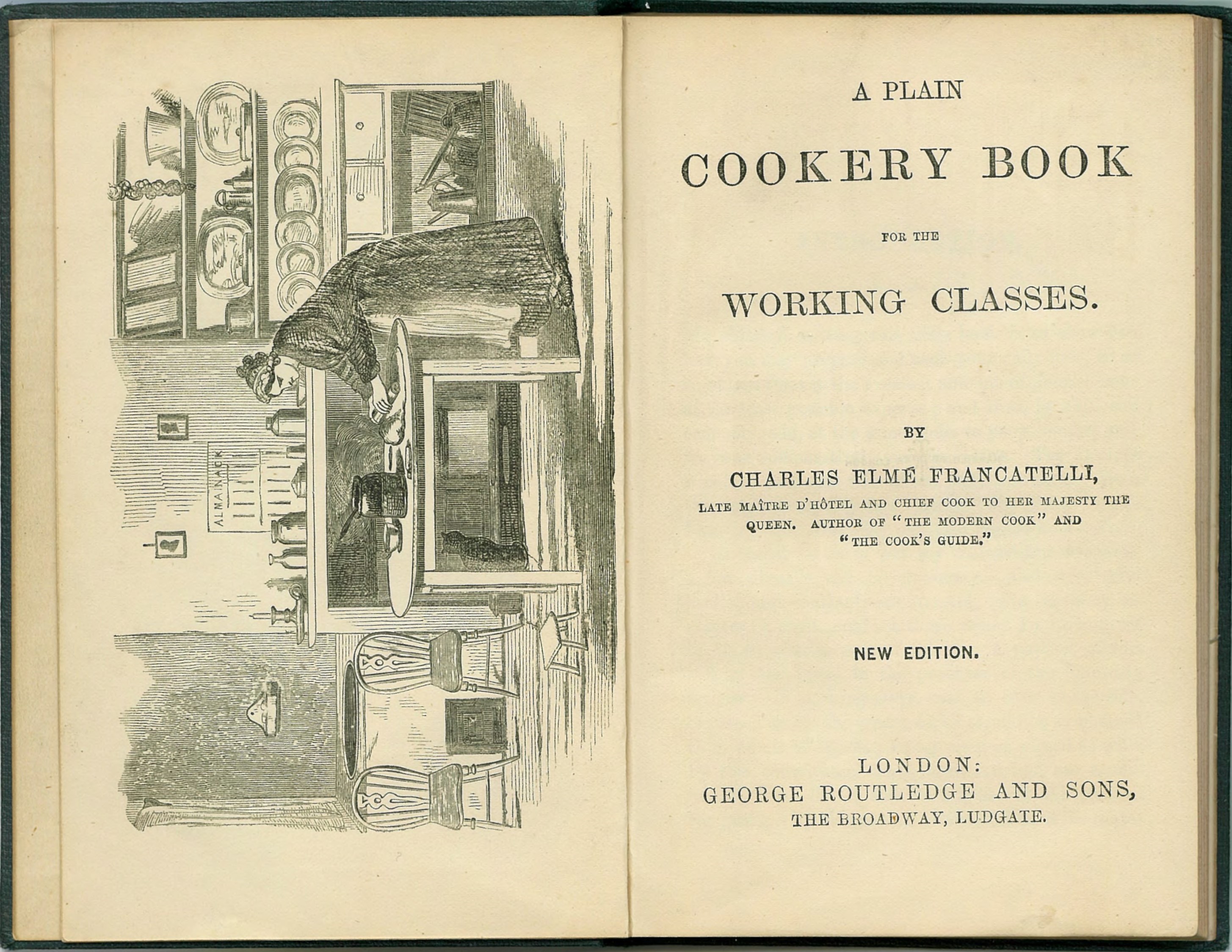
the New York Public Library Digital Collections


In the 15th century, publishers sought to increase the audience for cookbooks. With public literacy increasing, cookbooks became less of a luxury. However, early on, each social class had its own cookbooks because of the differences in availability and affordability of ingredients. For example, The Poor Man’s Larder and Bourgeois Cooking wouldn’t be found on the same bookshelf. Eventually, new ideas formed about equality and democracy, and presenting certain books as best for rich or poor was no longer considered effective marketing.

In the 17th century, women’s roles within the household changed, with gentlewomen of landed gentry directed much of the activity on their husband’s estates, including cooking, brewing, baking, producing butter and cheese, making wine, dyeing textiles, and management of medicines. Cookbooks afforded them opportunities to use a variety of ingredients in cooking and baking.

However, in the 18th century, with more folks congregating in towns and depending on purchasing their food ingredients already partially processed from merchants in cities and towns, the recipes also needed to accommodate their needs, including differing forms of cooking ranges. Coal replaced wood as fuel, meaning many recipes needed adjustments.

Also in the 18th century, cookbook writers worked hard for greater precision regarding quantities of ingredients, cooking time, and temperature. It was at this time that an entirely new professional group—teachers in cooking schools and home economists—emerged, offering important lessons for housewives.

As recently as the late 1940s, following the second World War, food became about thriftiness, preservation, rationing, and efficiency. When industrialized, canned, and processed food gained popularity, cookbooks became more important. Coming up with cheaper dishes, or recipes with cheaper ingredients, became important, as did finding ways to use leftovers.

Fannie Farmer: Cover of 1919 edition of The Boston Cooking-School Cook Book by Fannie Merritt Farmer Image courtesy of Smithsonian Libraries


In America, one of the first truly American cookbooks was published in 1896—The Fannie Farmer Cookbook. Filled with familiar recipes from a hundred years prior—such as Potted Pigeons, Creamed Vegetables, and Mock Turtle Soup—it also included concoctions that included cheese, chocolate, and ground beef. Cooks were introduced to recipes like Hamburg Steaks and French Fried Potatoes. Fannie Farmer’s methodical approach to cooking were precise, replicable, and perfect for Americans with newfangled gadgets like standardized cup and spoon measures. With families moving away from their families in ever-increasing numbers, there was no grandmother to learn from or mother to ask for advice. Fannie’s cookbook popularized the modern recipe format which we use today. 

Thank heavens for visionaries like Fannie Farmer. Can you imagine trying to figure out how to make a cake using three pinches of salt, four handfuls of cake flour, a thimbleful of baking soda, and a ladle of sugar? 

Nowadays, if you're anything like me, you find it easier to look up a recipe on your phone rather than digging through a book or a box of index cards. Still, there's nothing quite like a recipe on paper--complete with a stain here from butter or a fingerprint in molasses.

Happy cooking and baking!


About Recipe for Disaster: Book 1 The Recipe Box series, 1784

A spinster sister, left behind by her four younger sisters, feels unwanted and unneeded. But when three orphans and a wounded soldier turn up on her doorstep, her life takes on new meaning.

A man in search of his family—has he found them at last? But something isn’t quite right.

Can God weave these five lives into something beautiful for His glory, or will half-truths and missing memories create a recipe for disaster?

Available for Pre-Order: https://www.amazon.com/dp/B0BMGFKVKN

Series: https://www.amazon.com/dp/B0BMM1CTLJ


Giveaway: Leave a comment, and we’ll draw randomly for one winner of an ebook. Remember to leave your email address cleverly disguised so the ‘bots don’t get you, or we can’t contact you. For example, Donna AT livebytheword DOT com


About Donna:


A hybrid author, Donna writes squeaky clean historical and contemporary suspense. She has been published more than 60 times in books; is a member of several writers groups; facilitates a critique group; teaches writing classes; ghostwrites; edits; and judges in writing contests. She loves history and research, traveling extensively for both, and is an avid oil painter.


Connect online:

www.DonnaSchlachter.com Stay connected so you learn about new releases, preorders, and presales, as well as check out featured authors, book reviews, and a little corner of peace. Plus: Receive 2 free ebooks simply for signing up for our free newsletter!

www.DonnaSchlachter.com/blog

Facebook: www.Facebook.com/DonnaschlachterAuthor

Twitter: www.Twitter.com/DonnaSchlachter

Books: Amazon: http://amzn.to/2ci5Xqq

Bookbub: https://www.bookbub.com/authors/donna-schlachter

Goodreads: https://www.goodreads.com/search?utf8=%E2%9C%93&query=donna+schlachter

Resources:

https://eatwell.healthy.ucla.edu/2021/03/08/the-history-of-cookbooks-and-where-we-are-today/

https://www.theatlantic.com/business/archive/2017/10/cookbooks-status-600-years/544164/

Full of great resources: https://www.thefoodhistorian.com/historic-cookbooks.html

https://www.smithsonianmag.com/history/making-modern-american-recipe-180964940/