Showing posts with label Seattle. Show all posts

Wednesday, May 10, 2023

Thea Foss – Always Ready

 By Suzanne Norquist

Thea Foss never intended to start a tugboat company. But, despite her fear of water, that's exactly what she did. The company's motto, "Always Ready," describes the personality trait that led her to success. As a fiercely independent young mother, she understood how to meet people's needs. Since she lived with her husband and family on the Tacoma waterway, most of those needs involved boats. This led to the creation of the business known today as the Foss Maritime Company. 

Born in 1857 in Eidsberg, Norway, Thea Christiansen Foss left school at age fourteen to help family members. She met and fell in love with her sister's brother-in-law, Andreas Oleson, who later Americanized his name to Andrew Foss. He worked as a ship's carpenter.

The couple decided to move to America and marry. Andrew went ahead and sent funds for her passage. However, Thea refused to let him pay for her travel. Instead, she earned the money as a housekeeper. The couple married in 1881 when she arrived on her own.

After eight years in Minneapolis, Andrew grew tired of the harsh winters, and he missed the sea, so he decided to move the family of five to Washington State. He went ahead and built a houseboat for them to live in. Thea followed on the train eight months later with three children under the age of five.

She arrived at her floating home, a rough wooden structure with a tarpaper roof and sparse furnishings. Seeing her husband's pride, she accepted the conditions as temporary.

Both of her boys fell into the bay on the first day, adding to her fear of water. A fear that never completely left her.

The family had a rough start, with Thea battling Typhoid-pneumonia for several months and relying on the generosity of a local doctor. Then they moved the houseboat to a new pier when the city diverted the waterway. And Andrew had to leave home for a couple of months to take work as a carpenter.

That's when Thea unintentionally started her business. She was gutting fish on her porch when a man arrived in a rowboat. He wanted to sell it for ten dollars. Being prudent, she talked him down to five.


She rented out the rowboat, netting forty dollars before her husband returned with thirty-two dollars he'd earned from his carpentry work. Thus, her business was born.

She rented, bought, and sold boats. The whole family joined the endeavor. Andrew became a shipbuilder with other relatives from the homeland. Her sons cleaned boats and re-sold bait left in the bottoms. They used telescopes to watch for ships in distress and came to their rescue (for a small fee). They also ran a ship-to-shore delivery service.

Her daughter helped in the kitchen, where Thea was “always ready with a friendly cup of coffee.” Her hospitality connected her to all the people in the harbor. As she understood their needs, she found ways to provide, growing her enterprise.

The boys attended college, each learning to serve the business in a different capacity.

When Thea passed in 1927, her funeral procession was the largest ever seen in Tacoma. The Thea Foss Waterway on Tacoma's Commencement Bay commemorates her legacy.

The movie Tugboat Annie, released in 1933, was loosely based on her life. However, the boisterous main character was very different from the real Thea, who was soft-spoken and reserved. In fact, she has been misrepresented in several movie and television endeavors.

The company was eventually sold by the family but still carries the Foss name and history.

She never intended to start an empire. But being "Always Ready" to meet people's needs allowed her to do just that. Thea Foss is a fine example for the modern woman.


***


 " Mending Sarah's Heart" in the Thimbles and Threads Collection

Four historical romances celebrating the arts of sewing and quilting.

Mending Sarah's Heart by Suzanne Norquist

Rockledge, Colorado, 1884

Sarah seeks a quiet life as a seamstress. She doesn't need anyone, especially her dead husband's partner. If only the Emporium of Fashion would stop stealing her customers, and the local hoodlums would leave her sons alone. When she rejects her husband's share of the mine, his partner Jack seeks to serve her through other means. But will his efforts only push her further away?


Suzanne Norquist is the author of two novellas, "A Song for Rose" in A Bouquet of Brides Collection and "Mending Sarah's Heart" in the Thimbles and Threads Collection. Everything fascinates her. She has worked as a chemist, professor, financial analyst, and even earned a doctorate in economics. Research feeds her curiosity, and she shares the adventure with her readers. She lives in New Mexico with her mining engineer husband and has two grown children. When not writing, she explores the mountains, hikes, and attends kickboxing class.


Monday, February 7, 2022

Author Dawn Kinzer Shares about Seattle's First World's Fair

The Alaska-Yukon-Pacific Exposition—Seattle’s First World’s Fair
By Dawn Kinzer

Many are aware that the Space Needle in Seattle, Washington, was built for Century 21 Exposition held in 1962. But did you know that the city also held the Alaska-Yukon-Pacific Exposition in 1909?

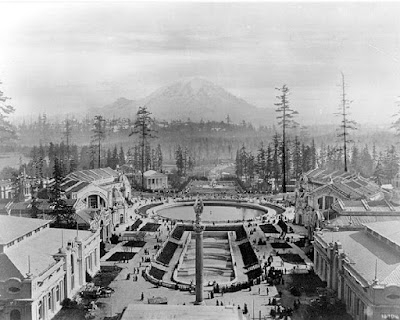
Alaska-Yukon-Pacific Exposition - Rainier Vista
Publica Domain, Wikipedia Commons
Seattle’s first world’s fair ran from June 1 to October 16 on the University of Washington campus, and the school later inherited some of the buildings established for the expo. The event involved participants from all over the world and drew over three million visitors.

The Pay Streak

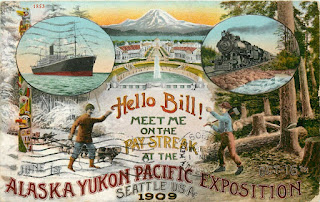
In keeping with the fair’s Klondike theme, the midway was called The Pay Streak. Fairgoers enjoyed a variety of games and thrills, including a Ferris wheel, an “amusement” dubbed the Temple of Mirth, and a ride called the Haunted Swing.

Postcard used to promote the exposition.
Public Domain. Postcard for sale on eBay.


While visiting the Pay Streak, some were shocked by the recreated Igorrote Village, populated by natives from the Philippine island of Luzon. Reputed to be headhunters and dog-eaters, the Igorrotes engaged in dances, spear-throwing contests, and cloth weaving. When the loincloths worn by men and boys became a moral issue, a reverend and a respected judge were assigned to investigate. They determined the loincloths were native dress and not intended to titillate.

There were opportunities to purchase a variety of souvenirs and refreshments. But alcohol was not an option because a state law forbade the sale of liquor on any university campus. If anyone wanted a drink, they had to take a streetcar into downtown Seattle. That law possibly contributed to the low numbers of crime and disturbances reported on the fair grounds.

Some Interesting Sights at the Expo

The California Building was designed in the style of a Spanish mission. It contained a life-size elephant created out of walnuts, an almond cow, and a bear made from raisins. Hawaii showcased a thirty-foot-high pyramid of coconuts and pineapples. The forestry building was built out of wood and actual tree trunks. Alaska’s exhibit awed visitors with a heavily guarded display of gold dust, nuggets, and bricks said to be worth a million dollars. The case descended into an underground vault at night.

Attendees could watch risqué exhibitions at the Streets of Cairo and the Klondike Dance Hall. These two venues were known to be frequently shut down by the morality enforcers at the expo.

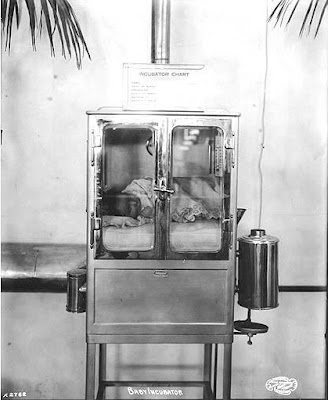
Baby in an incubator, Alaska-Yukon-Pacific expo, Seattle, WA 1909;
Public Domain, Wikipedia Commons

The baby incubator exhibit drew a lot of attention from both fairgoers and the press. News reporters focused on the wide-ranging ethnicities of the infants displayed. By July 18, 1909, The Seattle Daily Times reported American, English, Indian, Italian, Swedish, Syrian, and Russian children had been placed in the expo’s incubators.

But not everyone was convinced that all were premature or orphans as claimed. Although babies were reported to have been adopted during the fair, some of the infants appeared too large to be premature, and a childcare facility was placed next to the exhibit where parents could drop off their children to be cared for by nurses while the adults enjoyed touring the fair.

A Fascinating Event

I first became aware of the Alaska-Yukon-Pacific Expo while watching a PBS special, and I was immediately intrigued. My historical romance, With a Trusting Heart, is the result of traveling back to 1909 through research and imagination. More about this fascinating event is revealed in my story, but I won’t share any spoilers here!

Have you ever attended a world’s fair? If so, what did you find most interesting? If not, what would entice you to go—new technology, amusements and food, the exhibits from around the world, or the entertainment?

Dawn Kinzer writes fiction because she believes in the power of story to comfort, challenge, and inspire. Her work has been published in various devotionals and magazines. Dawn’s historical romance series, The Daughters of Riverton, takes place in the early 1900s. The setting and some of the characters were inspired by her rural Wisconsin hometown. Her two contemporary romances, By All Appearances and A Night Divine, are set in the Seattle area where she currently resides. A mother and grandmother, Dawn lives with her husband in the beautiful Pacific Northwest. Please visit her website at https://www.dawnkinzer.com/ to learn more.


With a Trusting Heart

The 1909 Alaska-Yukon-Pacific Exposition is taking place in Seattle when Lizzie Clark accepts a position at an orphanage in the city. After suffering heartbreak and loss, she's determined to make a life for herself independently. A newborn is left at the orphanage with a note asking Lizzie to take care of him. Why did the woman abandon her child? And why is Jack Butler, a handsome local farmer, so interested in helping Lizzie search for the infant’s mother? When shocking revelations disrupt their plans, Lizzie and Jack are faced with life-changing decisions. Will they open their hearts to trusting again?

This story is inspired by events that took place at the 1909 Alaska-Yukon-Pacific Expo—Seattle’s first world’s fair. The book will be available on February 16 in both ebook and paperback. To pre-order the ebook now, go to:https://www.amazon.com/Trusting-Heart-Dawn-Kinzer-ebook/dp/B09PJTH1HV/


Wednesday, October 13, 2021

The Historic Kubota Garden


When the hero confronts the unlikely villain, she gives him a choice—come quietly or the heroine, a woman he has come to love during their FBI investigation, will die. 


Now I, as the creator of this story, needed to make a decision. Where will the villain, a petite 48-year-old known as the “Doll Woman,” hide the tall, athletic hero? 


You’ll have to read The Cryptographer’s Dilemma to find out what happens. But I am going to tell you where it happens.

Velvalee Dickinson

The Doll Woman, whose name is Velvalee Dickinson, was arrested by the FBI for her espionage activities on behalf of the Japanese during World War II. I’ve written a couple of recent posts about her: The Doll Woman ~ A World War II Traitor and World War II's "Number One Woman Spy.”


Velvalee seems to have had two passions: 1) her reputation as an expert on dolls which she both collected and sold from her shop on Madison Avenue in New York City, and 2) an obsession with Japanese culture dating back to her young adulthood in California.


The confrontation between our fictional hero, FBI agent Phillip Clayton, and Velvalee takes place outside Seattle’s train station. Knowing about Velvalee’s love for the Japanese, I was thrilled to find that an emigrant from Shikohu, Japan named Fujitaro Kubota had established a garden on five acres of Rainier Beach swampland he purchased in 1927. 


Kubota Garden Gate

In the next three years, he added twenty-five more acres to his initial purchase. The Kubota Garden was more than a lovely place to spend an afternoon. The Japanese community in Seattle considered it to be a cultural center. Fujitaro Kubota’s home, office, and nursery were also located on the grounds.


Fujitaro Kubota Trimming a Pine
Sadly, the Kubota family, like many other Japanese, were interned during the war. They were assigned to live at Camp Minidoka in Idaho. During this time, Fujitaro helped to build a community park and a Japanese rock garden in the camp.


After the war, the Kubota family returned to Seattle. Fujitaro’s two sons, Tak and Tom, helped their father rebuild the neglected gardens and nursery business. 


In 1972, Fujitaro was awarded the Fifth Class Order of the Sacred Treasure by the Japanese government “for his achievements in his adopted country, for introducing and building respect for Japanese Gardening in this area” (Wikipedia). He died in 1973, but his legacy lives on in his historic garden.


The Seattle Landmarks Preservation Board declared the original acreage as a City of Seattle historical landmark in 1981 then purchased the entire garden from the Kubota family in 1987. 


Two years later, in 1989, the Kubota Garden Foundation was established to preserve Fujitaro Kubota’s spirit and vision. Over the years, more acreage has been added.


According to a Kubota Garden Self-Guided Tour brochure printed by the Kubota Garden Foundation in July 2012, “Major features of the Kubota Garden include the Kubota Terrace, the Bamboo Grove, the Necklace of Ponds, the Mountainside, and the Tom Kubota Stroll Garden.”


Another feature is the beautiful Heart Bridge that crosses Mapes Creek.


Heart Bridge ~ Kubota Garden
 

The Stroll Garden was opened in the year 2000 and honors Fujitaro’s son, Tom.


We know that the real Velvalee Dickinson spent time in Seattle. With her love of Japanese culture, she no doubt was familiar with the Kubota Garden and perhaps even knew members of the Kubota family. The abandoned garden would be the perfect place for her to hide with her hostage.


A quick excerpt about the garden from The Cryptographer's Dilemma:


Velvalee's brooding anger sharpened with heartache as she and Phillip walked beneath the wooden entrance, which had been stripped of its iron gates. Though many of the gorgeous flowering shrubs and ornamental trees that had brought Velvalee such delight on past visits were thriving, vining weeds overran the border plants and rock gardens. Such a travesty and for no purpose….The water lilies in the narrow stream gathered against the bridge’s column, and thick algae bordered the bank. The odor of dead fish and rotting decay assaulted her nostrils.

…

“This place was a labor of love for a most distinguished gentleman named Fujitaro Kubota. He and his family lived here, worked here, entertained here.” Velvalee momentarily closed her eyes, letting herself return to happier days when she visited this garden refuge. “One could imagine herself in Japan while strolling these paths.”

“Why did you bring me here?” The impatience in Phillip’s tone caused her anger to flare. “Do you know where Fujitaro Kubota is now?...He’s in an internment camp. The man that created all this beauty, who gave us this generous gift, is now a prisoner. His only crime is his Japanese heritage.” She poked Phillip in the shoulder with the revolver. “That’s the government you work for.”


If I ever make it to Seattle, the Kubota Garden will top my list of must-see places. Though I used it for nefarious reasons in my novel, I also wanted to highlight, at least a little bit, the dream of a visionary. Perhaps you’ll put the Kubota Garden on your list of must-see Seattle places, too.


Johnnie Alexander imagines characters you'll want to meet and stories you won’t forget in multiple genres. A fan of classic movies, stacks of books, and road trips, she shares a life of quiet adventure with Griff, her happy-go-lucky collie, and Rugby, her raccoon-treeing papillon. 

Purchase The Cryptographer's Dilemma at http://bit.ly/ja-TCD.


Connect with Johnnie at johnnie-alexander.com.


Photo Credits:

  • Kubota Garden Gate ~ Joe Mabel, GFDL granted by photographer
  • Fujitaro Kubota Trimming a Pine ~ Public Domain
  • Heart Bridge ~ BWorks, Creative Commons


Thursday, September 5, 2013

PICTURING THE SETTING - by Lena Nelson Dooley

One of the things I like most about writing historical novels is finding nuggets of information to make the time period more accurate. While I was writing Maggie's Journey, I was having a hard time picturing Seattle, Washington Territory, in 1885. I had looked for books and computer links, but still not much to go on.

When I quit working full-time and stayed home to write (the first time that happened), I started volunteering in our local library. I'm a real people person, and writing is a solitary endeavor. Imagine my surprise when they put me in the back of the library mending books. Still not much contact with actual people. But I learned a lot about how a library runs.

Every library has a reference librarian. This person will help people find the information they need. Since the advent of cell phones with nationwide free long distance, I have contacted a few of these librarians when I couldn't find information.

I decided to contact the Seattle Public Library. I didn't ask for anyone to do my research for me, just a few suggestions on books about the time period. I hit the Mother Lode.

Seattle Public Library system had digitized literally thousands of historical photos and loaded them on line by decade. I used a number of these pictures to help me construct in my mind the areas of the city that I could use in my book. Also, I found a similar site for San Francisco, which is one of the settings in the book three, Catherine's Pursuit.

At one time in writing Maggie's Journey, I wanted to find the name of a nice hotel in St. Louis, Missouri, in 1885. When I used Google to find the information, a map of St. Louis in 1885 appeared along with photos and text about various buildings and areas of the city. Another valuable moment.

Here are a few of the links I've been using:
http://mappery.com/map-of/Antique-map-of-St-Louis-from-1885
http://foundsf.org/index.php?title=Category:1880s

The use of research enriches all my books, whether historical or contemporary.

If you've read my McKenna's Daughters books and Love Finds You in Golden, New Mexico, please share with us which of the settings you liked best.