Showing posts with label Silver Mines. Show all posts

Saturday, September 26, 2020

Leadville's Crystal Palace


By Vickie McDonough

I visited Leadville, Colorado, when I was on a trip with my good friend, Margaret Daley, and was duly impressed with it’s quaint and colorful Victorian homes, majestic scenery, it’s historic buildings, and fascinating history. At an elevation of 10,430 feet, Leadville was often called “The Two Mile High City” or “Cloud City,” both fitting names. Located at the foot of two of Colorado's highest peaks, Mt. Elbert and Mt. Massive, Leadville is one of America's last remaining authentic mining towns.

Colorfully painted house


Leadville was founded in 1877 by mine owners Horace Austin, Warner Tabor, and August Meyer, setting off the Colorado Silver Boom. By 1880, Leadville was one of the world's largest silver camps, with a population of over 40,000.


In 1881, some of the richest mines began to play out. Miners started to leave, stores and banks failed, and the town was consumed by fires that devoured rows of wooden structures. The depression of 1893 and the repeal of the Sherman Silver Purchase Act further depressed the economy of Leadville and ended the silver era.

A Leadville church with mountains in the background.
The desperate townspeople proposed a mammoth ice castle with the hopes it would draw sightseers, create jobs, and rescue the town's sagging economy. Charles E. Jay, an architect who had designed an ice palace in St. Paul, Minnesota, was hired as the designer, and Tingley S. Wood was hired to build the ice palace. The Leadville Ice Company got the contract to produce the ice.

Leadville's Crystal Palace
Construction began November 1, 1895 with a crew of 250 men working round the clock. The finished palace was more than 58,000 square feet—as big as a football field, and made of 180,000 board feet of lumber and 5,000 tons of ice. The palace was supported by a complex frame work of trusses, girders and timber, with the ice for appearance only. The ice was trimmed to size and placed in forms, then sprayed with water, which served as mortar to bind the blocks together. The towers reached 90 feet high by 40 feet wide.

Over 250,000 people visited the Ice Palace, which boasted a skating rink, a restaurant, a ballroom, a dance floor, gaming rooms, and a carousel house. Admission was 50 cents for adults and 25 cents for children. But despite all, the Ice Palace was a financial disaster for its investors, so they abandoned plans to build one each winter, but it remains a fascinating part of Leadville's history.


When Sarah Marshall’s wagon breaks down near a stage stop on the Santa Fe Trail, marriage proposals fly in faster than the incessant wind, but only one man interests Sarah—and he’s not proposing.

Ethan Harper’s well-ordered life is thrown into turmoil when an uppity city gal is stranded at his family’s stage stop. Now his two brothers and every unmarried male in the county are wooing Miss Priss. When one brother proposes, Ethan is in turmoil. Is it because she’s the wrong woman for his brother —or the right one for Ethan?


Vickie McDonough is an award-winning author of 26 books and novellas. Her novels include the fun and feisty Texas Boardinghouse Brides series and the 3rd & 6th books in the Texas Trails series. Her novel, Long Trail Home, won the Inspirational category of the 2012 Booksellers’ Best Awards. Coming July 1st: Whispers on the Prairie, the first book in an exciting new series set in 1870s Kansas. To learn more about Vickie, visit her website: www.vickiemcdonough.com

Monday, September 12, 2016

Baby Doe Tabor--A Woman Who Refused to Be Made a Fool by Any Man

We have a guest blogger this month, Donna Baier Stein.
Welcome, Donna! Thanks for taking time to visit us here
at HHHistory.com. 

"A Woman Who Refused to Be Made a Fool by Any Man, a Slave by Any Rule, or a Pauper by Any Loss."

By Donna Baier Stein

Colorado’s Baby Doe Tabor was a fiercely independent woman who bucked all her era’s social expectations.
 
Baby Doe Tabor
In 1866, 12-year-old Lizzie McCourt watched a fire consume her father’s tailoring business and home in Oshkosh, Wisconsin. Vowing to rebuild her family’s fortune, she later married Harvey Doe, the mayor’s son, and followed him and her father-in-law to Colorado, where Harvey Doe, Sr., had gifted them a mine called The Fourth of July.

The newlyweds settled into a run-down cabin in Dogwood. Harvey proved to be an unfortunate choice for a husband and succumbed to the lures of opium and brothels. When he failed to do the work required, Lizzie overcame superstition to work side-by-side with the men down in the shafts. It wasn’t an easy task, since many miners believed that even seeing a woman before they descended into a mine was bad luck.

But at only 5’ tall, hard-working Lizzie won the hearts of her fellow miners, who gave her the nickname “Baby Doe.” She was even written up in a local Central City newspaper.


When she discovered Harvey in bed with a prostitute, she divorced him and made her way alone to the booming town of Leadville. There she caught the attention of the much older Horace “Silver King” Tabor. At the time, Tabor was married to Augusta, with whom he had a son Maxey. To everyone’s dismay, Tabor and Lizzie began an affair, with Tabor putting his mistress up in a suite at the Clarendon Hotel. He visited her by crossing a catwalk between the hotel and his eponymous Opera House.

In 1883, Horace was named to finish the term of a Colorado Senator. After he divorced Augusta, he and Lizzie were married in an extraordinarily lavish wedding at the Willard Hotel in Washington, DC. President Chester Arthur and his Cabinet attended, though none of the Cabinet members’ wives deigned to honor the nuptials of two divorced Catholics. At the time of their marriage, Horace Tabor was worth about $24 million. He gave Lizzie a $90,000 necklace that had once belonged to Queen Isabella and a wedding gown that cost $7,000.00.

Horace built Lizzie a square-block villa to live in upon their return to Denver. There, one hundred peacocks roamed among nude statues on the rolling lawns. The Tabors entertained the likes of Sarah Bernhardt, Oscar Wilde, and other famous actors and musicians who performed at the Tabor Opera Houses in Denver and Leadville.

Unfortunately, ten years after the extravagant wedding in DC, the repeal of the Sherman Silver Purchase Act and a devastating stock market crash wiped out Horace’s vast fortune.

The cabin Lizzie lived in during the last 35 years of her life
Despite what the disapproving public had expected, Lizzie refused to abandon Horace as he worked as a day laborer and later Postmaster of Denver in the Post Office built with his funds. Legend has it that on Horace’s deathbed, he asked Lizzie to “Hang on to the Matchless Mine,” reassuring her it would again yield great wealth. She lived the last 35 years of her life in a one-room shack there in Leadville, trying to bring the mine back to life and writing down thousands of her dreams on receipts and paper scraps. She was found frozen to death on March 7, 1935, at the age of 81.

An American opera called 
The Ballad of Baby Doe was written by Douglas Moore. It was recently performed at the Central City Opera House for its sixtieth anniversary. While the opera focuses primarily on the love triangle between Lizzie, Horace, and Augusta, Lizzie’s life reveals she was much more than just a mistress in someone else’s story. 


Donna Baier Stein is the author of The Silver Baron's Wife, Sympathetic People (Iowa Fiction Award Finalist), and Sometimes You Sense the Difference. She founded and publishes Tiferet Journal. She received a scholarship from Bread Loaf, a Fellowship from the Johns Hopkins University Writing Seminars, three Pushcart nominations, and prizes from the Allen Ginsberg Awards and elsewhere. Her writing has appeared in Ascent, Beloit Poetry Journal, Poet Lore, Prairie Schooner, Virginia Quarterly Review, Puerto del Sol, Writer’s Digest, and elsewhere. She is currently completing a new collection of stories based on Thomas Hart Benton’s lithographs. www.donnabaierstein.com


The Silver Baron’s Wife traces the rags-to-riches-to-rags life of Colorado’s Baby Doe Tabor, who was featured in one of the West’s most scandalous love stories. A divorcee shunned by Denver society, Lizzie raised two daughters and after her second husband's death, lived in eccentric isolation at the still-standing Matchless Mine in Leadville. An early draft of this novel won the PEN/New England Discovery Award for Fiction. https://www.amazon.com/Silver-Barons-Donna-Baier-Stein/dp/0997101067

Wednesday, April 8, 2015

Silver Coins Traced to Specific Mines in Colorado

By Tiffany Amber Stockton


Last month, I shared about the Pioneer Museum in Colorado Springs and the wealth of resources available for research. This month, it's a discovery of what mining was like during the mid-1800s.


Living in Colorado, I'm surrounded by so much history from the "old west," and it's difficult to know where to focus my research efforts for my books. Sometimes, I feel like a goldfish with a 5-second memory or a little baby with a 2-minute attention span. :) So many amazing things, so little time, and far too many books to write.

One series I have, though, focuses on a family of siblings whose parents have died and left them a ranch in southwestern Colorado. They owned a silver mine though before the ranch, and although they no longer run it, they are still taking profits from it. The first book features a newspaper reporter who travels from Chicago to investigate some unique coins that originated from their mine.

When I researched the background, I realized that individual mines would often press distinct markings into the silver mined from their claims. This fascinated me, as I always thought the metal was mined then sold to the mints to be turned into money. But it seems this wasn't the case when silver was first discovered.

Silver mining in Colorado has taken place since the 1860s. In the past, Colorado called itself the Silver state. Nevada also calls itself the Silver state; in reality, the US state which has produced the most silver is Idaho. Of course, since Colorado became a state in 1876, it became the Centennial State. :) That's around the setting for my books too, so although silver plays a part, it isn't the driving force.

In fact, the ranch is the primary focus. What keeps things entertaining is the 3-some cast of characters who worked for the Wilde family at the mine and now work at the ranch. Boomer, Shorty and Molly. They provide comedic relief for the tensions throughout the book, but are also full of useful information when this reporter comes investigating.

At first, I thought having the family sell the mine, but then it wouldn't have worked with the plot, as they'd have no claim to the contents in the mine and no rights to investigate or give permission to the reporter to take a closer look into things. So, I had to shift my focus a little and do more research into the silver mines in the area.

Who knows? Perhaps another series will focus on the mining industry instead of it being a sidestory. There is certainly more than enough information out there and enough fascinating characters from history I could use as inspiration.

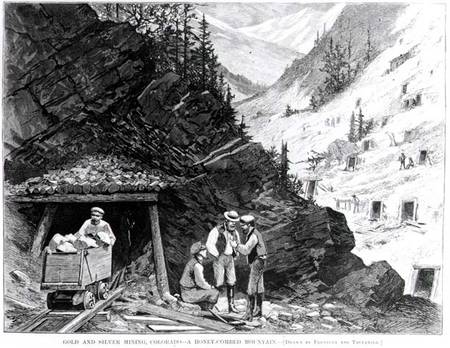
By far, the largest largest silver-producing district in Colorado is Leadville, and it wasn't discovered until 1874. Cumulative production through 1963 was 240 million troy ounces of silver, 3 million troy ounces of gold, 987 million tons of lead, 712 million tons of zinc, and 48 million tons of copper. I caution you if you want to go looking there, though, as it's located at over 9,000 feet above sea level, so the air is quite thin. That didn't seem to hurt the production numbers though.

Today, the largest current source of silver in Colorado is as a byproduct of gold mining at the Cripple Creek & Victor mine, a large open-pit heap leach operation owned by AngloGold Ashanti at Victor, Colorado. In 2006, the mine produced 4.0 tons (130,000 ounces) of silver. That's a LOT of silver! Just imagine how much work it would have taken for some of the original mines to produce that amount. Amazing to think how far we've come from the original strikes.

It's been a lot of fun doing the research. Now, I just need to sell the series, so I can see it in print and get paid for doing the research. :) Work is always far better when you can make money doing it!


* photo copyrights: http://www.myartprints.com, http://www.160knots.com, http://www.littletoncoin.com/


BIO

Tiffany Amber Stockton has been crafting and embellishing stories since childhood, when she was accused of having a very active imagination and cited with talking entirely too much. Today, she has honed those childhood skills to become an award-winning author and speaker who has partnered with Nerium International in the anti-aging skin care industry, helping others look younger and live better.

She lives with her husband and fellow author, Stuart Vaughn Stockton, in Colorado. They have one girl and one boy, a Retriever mix named Roxie and and Australian cattle dog named Timber. She has sold seventeen (17) books so far and is represented by agent Sandra Bishop of the TransAtlantic Agency. You can also find her on Facebook, Twitter, and Pinterest.

Monday, September 1, 2014

A Virtual Paradise

Introducing Heroes, Heroines & History
CFHS blog's new name...September 8th

Silver Peak, NV and Tonopah, NV signs
 "As soon as a peep of light shined, I climbed on my horse and led the burros to the trail that veered up the mountain past some old buildings and a stone oven and prospectors who weren't the friendly sort. All day I watched for signs. A shaggy head shaped boulder. Stubby pines like a miniature forest. The ground turning red. A triple crown from the Silver Peak mountain range. I knew I was close.”
(quote by Seth Stroud, an excerpt from Wind in the Wires, Book 1, A Trails of Reba Cahill Novel, by Janet Chester Bly)

The very first novel research trip I took alone was to the remote, high desert location of Silver Peak, one of the oldest mining communities in Nevada. Several of the characters in the novel I'm working on, Wind in the Wires, take a fateful journey there. A climax of discovery in the story happens in that area.

Cinder Cone at Mt. Lassen, California
Cinder Cone
From Tonopah, I saw a panorama of multiple layered mountain ranges like washboard. Clouds of dust could be seen thirty miles away. Black cows roamed around small, scruffy sage.

Out of Goldfield off Highway 95 on Road 265, I traveled on a road across marsh flats. The route littered with miles of bottles, whole and broken, and beer cans. And water mirages. And open range cattle. I spotted a small herd of camels next to burros. Tiny sage grew barely high enough for a desert rat.

Just outside of town, Alcatraz Island, a marshy area with huge tailings mounded against the base of the mountains. A city sign announced, "Welcome to Silver Peak...A Virtual Paradise.” At least one resident had a sense of humor in the population of 107.

Another on the road warned, “Caution: Minimum Maintenance Only.” Very few side roads exist because a) terrain too rough, and b) no place to go.

A man on a horse with bedroll in back, tarp in front, entered the village ahead of me. Out in the dirt, young men raced pickups like hot rods. Wild horses roam all over. Hearing tales of a "Wild Horse Johnson” in the 1940s and 50s gave me an idea for a character.

From a hill north of town I could see all of the town and the marshy surroundings.

Silver Peak, Nevada
Silver Peak, Nevada
Like most modern mining camps, trailers and single-wide mobile homes in varying degrees of quality and repair replace tents. Residents can still pick up and leave in a hurry. Also, small adobe shacks with sheet metal patched roofs. The desert harshness draws them, them repels them, and sometimes destroys them.
A local told me, “When this place was humming the whole mountain range vibrated.”
Silver Peak has been a mining town off and on since 1863. Remains of at least five mills still are visible among the more recent structures. Olympic Games organizer Avery Brundage once operated one of the mills.

road to Silver Peak, Nevada
The town boasts an elementary school - Grades K-8 - and several children's parks and play areas. There’s an Esmeralda County school bus. A power company substation. A fire department and phone booths. A saloon is a former schoolhouse. There’s also a church.

Silver Peak has a resident deputy and volunteer EMTs. The nearest hospital is in Bishop, California, more than a hundred miles away.

The oldest structure was a store and stage stop in 1864. The original one-room post office still stands next to a modern replacement, a single-wide mobile home. When I was there, I saw four mules lounged in front, tied, tethered, and loaded with bundles. When I first visited in 1991, the postmaster had served since 1939. A wealth of local history.

Out on the marsh they mine for lithium, a soft silver white metal, by extracting it from the brine evaporating in
Lithium operation
the pond system. This is the only lithium recovery process of this type in the U.S. Lime deposits nearby found in 1868. At first, processing difficulties discouraged major silver mining, but high grade horn silver was discovered in 1908. The last silver mine closed down about 1992.
There used to be mineral hot springs and bathtub sized ponds. Springs even ran into houses. But drilling dried it all up. Wood litter at old houses exposes former wooden tubs.

A dark brown-black cinder cone grows sagebrush along the sides. It looks like a huge decaying beast and
Lithium sample
Lithium sample
could be mistaken for a gorilla's head. A memorable climb to the top with quite impressive view. I almost got stuck in the sinking cinders.

Ten miles south a large sand dune area visible. Can hike over it but driving on the soft blow sand not advised. I declined the hike after the cinder cone adventure.

Flash floods can be an extreme problem for the alkali ground. Water stands even a week after rain, leaving a sticky, slimy gumbo. So, of course, a flash flood occurs in Wind in the Wires.

~~~~~~~~~~~
Janet Chester Bly
Janet Chester Bly is the widow of award-winning western author Stephen Bly. Together they published and co-wrote over 120 fiction and nonfiction books. Wind in the Wires will be her first solo adult fiction. For news of its soon release, sign up for the Bly Books Almost Monthly Newsletter: http://www.blybooks.com/contact/stephen-bly-books-newsletter/
And ‘like’ Bly Books on Facebook: https://www.facebook.com/BlyBooks
For more info about the Blys, to read the blog and check out the bookstore: http://BlyBooks.com