Showing posts with label Sybil Ludington. Show all posts

Saturday, April 25, 2026

The Women of the U.S. Postage Stamp—Part 3


By Jennifer Uhlarik


Hello, Readers! Happy April. Wait, what? How are we nearly through FOUR months of this year already? Can you believe it?


I’m back again with Part 3 of my series on the ladies who have been featured on American postage stamps. So far, we’ve seen many interesting figures, from former First Ladies to foreign monarchs, social reformers, and more. So let’s dig in and see who else we might meet from past postage stamps.


This month, we’ll start with Mary Cassatt, who was featured on US postage three separate times—in 1966, 1988, and 2003. Born in 1844, Cassatt was one of seven children born to her stockbroker father and a well-educated mother. As part of her early education, she traveled abroad, learned several foreign languages, and was exposed to drawing and music. By age fifteen, she’d made the decision that art would become her career, and she began studying at the Pennsylvania Academy of Fine Arts against her parents’ wishes. During the years of the Civil War, she went to Europe and studied there. After years of struggle, she did finally find success with her paintings, in part due to a platonic friendship with renowned impressionist painter Edgar Degas. 


This Mary Cassatt Postage Stamp debuted in 1966

The 1988 Mary Cassatt stamp

Here is the 2003 Mary Cassatt stamp,
featuring some of her artwork.


Our next lady is Lucy Stone. Born in Massachusetts in 1818, she went on to become the first woman in the state to earn a college degree, which she attained in 1847. After seeing how she and other female teachers were paid a much lower rate than male teachers, she began fighting for equal pay for herself and other women. She both spoke publicly and published her thoughts on matters of slavery, women’s suffrage, and more, and ultimately influenced the likes of Susan B. Anthony and Elizabeth Cady Stanton—two other well-known abolitionists and suffragists. The three together were known as the “Triumvirate” of Women’s Rights Reformers in the late 1800s. Lucy’s stamp debuted in 1968. 


Lucy Stone's stamp, circa 1968


Next on our list of famous ladies from the postage stamps is Anna Mary Robertson Moses. In 1860, Anna was born, the third of ten children of her farming parents. She attended school only briefly, where she was exposed to art. She’d fallen in love with painting, and her father would sometimes purchase her paper by the sheet so that she could create, using grape or orange juice, grass, and other natural substances as her paints. But by age twelve, Anna went to work for a neighboring farm family and continued to do so until she met and married her husband when she was twenty-seven. The pair had ten children together, five of whom survived past infancy. As a wife and mother, she decorated her home with embroidered or quilted items, as well as made such items as gifts for family and friends. After her husband’s death and her own retirement from farming, she continued with such folk-art activities until arthritis made quilting and embroidery too painful. Upon her sister’s suggestion, seventy-six-year-old Anna took up painting again. For nearly three full decades, she painted and sold her art, creating more than 1500 pieces in that time. When her art debuted to the public, the media dubbed Anna “Grandma Moses” despite the fact she wished to be known as Mrs. Moses. The name stuck. Her inspiring life should show everyone that it’s never too late to reinvent yourself. Her name and artwork was featured on a 6-cent postage stamp in 1969. 


Grandma Moses's stamp
debuted in 1969


The next two ladies are both writers. The first is Emily Dickinson, the prolific poet who wrote nearly 1800 poems in her brief fifty-five years. Dickinson never married and lived a large portion of her later life as a recluse. It was only after her death that her remaining siblings discovered her extensive writings. During her life, ten of her poems were published, but posthumously, her poetry has grown to be world-renowned and greatly respected. Dickinson was featured on her postage stamp in 1971. The second writer in this pair of wordsmiths is Willa Cather, who spent some of her early childhood in Nebraska, where she was exposed to the westward migration of many immigrant families. This inspired her many novels of the American west and the lives of immigrants in the American frontier. Her stamp debuted in 1973.

Poet Emily Dickinson's stamp

Novelist Willa Cather's stamp


The same year, the next lady graced a postage stamp. I have already written a blog post about Elizabeth Blackwell—also known as America’s first female doctor. Check her out here


First female doctor, Elizabeth Blackwell's
stamp.


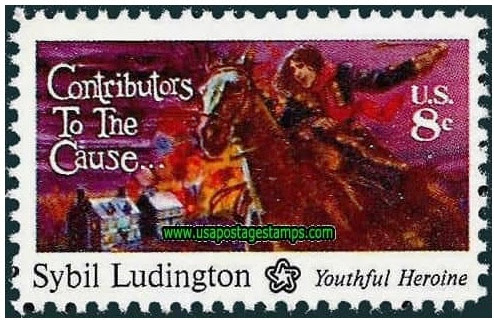
Now let’s drop back in history to the American Revolution, as that’s where the next lady of the postage stamp is from. Sybil Ludington was born in 1761, the daughter of Colonel Henry Ludington. Sybil was honored on a stamp because of a Paul Revere-type ride she supposedly made on April 26, 1777. (I say supposedly, because there are questions whether the ride actually happened, and according to my resources, her descendants have been unable to provide documentation proof of her ride). But as the story goes, sixteen-year-old Sybil rode on horseback some forty miles from her hometown of Fredricksburg, New York (close to Danbury, CT), to alert her father and his 400 militia men that the British had attacked Danbury’s supply depot. Whether the ride actually happened, the United States Postal Service honored Sybil with her own stamp in 1975.


Sixteen-year-old Sybil Ludington rode 40
miles at night to warn her father and the militia
of a British attack.


The story behind our next woman is probably the saddest of the list thus far. Clara Maass was born in 1876 to a poor family and eventually went to nursing school to support herself and her family. After graduating school, she worked in her field, getting promoted to head nurse at Newark German Hospital in 1898. When the Spanish-American War broke out, she volunteered her services but was sent home after contracting dengue fever. She returned later and helped to nurse many soldiers—but not because of injury as much as the many illnesses they contracted, among them Yellow Fever. In 1900, the U.S. Army developed a Yellow Fever Commission to study how the illness was transmitted—whether through mosquito bites or through human contact. The Army asked humans to volunteer for the study, in which they would allow themselves to be bitten by infected mosquitoes in exchange for $100/bite (with inflation, this amount would be in the thousands today). While we don’t know her reasoning for this, Maass agreed and purposely allowed herself to be bitten by infected mosquitoes multiple times in the early part of 1901. The first time, she became mildly ill and recovered. Other times, she didn’t fall sick, leading those conducting the study to hope her first experience had immunized her. However, in mid-August of 1901, she endured her next infected bite and grew extremely ill quickly. She never recovered. Ten days after the fateful bug bite, she died at age 25. After this, human experimentation was discontinued, and on what would’ve been her 100th birthday, Clara was featured on her own postage stamp.


This stamp was issued on what would
have been Clara Maass's 100th
birthday


The last lady of the postage stamp that we’ll look at for today is none other than Harriet Tubman, who was featured twice—once in 1978 and again in 1995. Born into slavery, she was originally named Araminta Ross in 1822. In 1849, she escaped her slave owner via the Underground Railroad and made it safely from Maryland to Philadelphia. However, she was not content, knowing that her family and friends were still enslaved. She quickly returned to Maryland and spirited family members safely away to the North. All told, she returned thirteen times and saved seventy people from enslavement, as well as served the Union Army as a scout and spy during the Civil War and later fought for women’s suffrage. Quite an inspiring woman!


The 1978 stamp commemorates
Harriet Tubman's work to free
slaves via the Underground
Railroad.

This 1995 stamp honors Tubman's 
Civil War service.


That’s it for now, but we’ll continue our look at these honorees next month. Until then…


It’s Your Turn: Which of the women who were honored with their own stamp do you find the most memorable, and why?


Jennifer Uhlarik discovered western novels at twelve when she swiped the only “horse” book from her brother’s bookshelf. Across the next decade, she devoured westerns and fell in love with the genre. While attaining a B.A. in writing from the University of Tampa, she began penning her own story of the Old West. She has finaled in and won numerous writing competitions and appeared on various best-seller lists. Besides writing, she’s been a business owner, a schoolteacher, a marketing director, a historical researcher, a publisher, and a full-time homemaker. She lives near Tampa, Florida, with her husband and fur children.


Available Now:

Love and Order: A Three-Part Old West

Romantic Mystery


Wanted: 

Family, Love, and Justice


One Old West Mystery Solved Throughout Three Short Romantic Stories


Separated as children when they were adopted out to different families from an orphan train, the Braddock siblings have each grown up and taken on various jobs within law enforcement and criminal justice.


Youngest child, Callie, has pushed past her insecurities to pursue a career as a Pinkerton agent. Middle child, Andi, has spent years studying law under her adoptive father’s tutelage. And the eldest and only son, Rion, is a rough-and-tumble bounty hunter. 


When the hunt for a serial killer with a long history of murders reunites the brother and sisters in Cambria Springs, Colorado, they find themselves not only in a fight for justice, but also a fight to keep their newly reunited family intact. How will they navigate these challenges when further complicated by unexpected romances?


Thursday, August 4, 2022

Sybil Ludington's Revolutionary Midnight Ride

 By Mary Dodge Allen


Portrait of Sybil Ludington (Public Domain)


Who was Sybil Ludington?

This sixteen-year-old has been called the “female Paul Revere.” Her 40-mile ride on the night of April 26, 1777 during a driving rainstorm, alerting the countryside that “The British are coming,” was nothing short of amazing. And unlike Paul Revere, Sybil managed to escape capture by British patrols during her long ride.

Sybil was the oldest of twelve children. In 1777, her father, Col. Henry Ludington commanded the militia in Dutchess County, New York. (Later in the war, he served as an aide to Gen. George Washington.) Col. Ludington was such an effective militia commander, the British offered a reward of 300 English guineas for his capture, dead or alive.

On April 25, 1777, British Gen. William Tryon, former governor of New York, came ashore with 2,000 British troops at Westport, Connecticut and began marching toward Danbury, Connecticut, where a large amount of Continental Army munitions and provisions were stored. The following day they reached Danbury and set fire to the town, destroying houses along with the military stockpiles. When the British troops discovered stores of whiskey, they went on a drunken rampage, looting and raping. A contemporary newspaper described the Danbury attack as, “One of the most brutal and disgraceful performances of the British Army in all the war.” 

Messengers on horseback began spreading the news of the attack throughout the area. One of those messengers arrived at the Ludington home after dark. As soon as Col. Ludington heard the news, he realized that Gen. Tryon might send his British troops west, to attack Gen. Washington’s troops in Peekskill, New York. He knew he needed to muster his militia of 400 men—the only militia near Danbury—but they had just been placed on furlough after serving in the Hudson Highlands. Someone had to raise the alarm so the militia could mount a counterattack against the British troops. But the messenger who had brought the news to him was exhausted after his long ride.

Sybil had been listening, and she volunteered to summon the militia. As the eldest child, she was accustomed to taking on many responsibilities traditionally given to sons. At 9:00 p.m. on the stormy night of April 26, she set out on horseback to spread the word. As Sybil galloped from house to house, she carried a long stick in her hand and used it to bang on shutters and doors, rousing the militiamen and telling them to meet at the Ludington house at daybreak. The brave teenager rode for hours that night throughout Putnam County, traveling in a heavy rain on dark unfamiliar roads patrolled by British troops. She completed the 40-mile circuit and arrived home just before dawn.


Col. Ludington led his militia into Connecticut, and on the way he recruited additional farmer patriots to fight. When they caught up with the British troops, they mounted an attack. The militia continued fighting the troops as they retreated back to their ships at Westport. In one skirmish, Benedict Arnold (at that time, still an American patriot) was nearly killed when his horse was shot out from under him.

The action ended with many British casualties. Alexander Hamilton wrote to Col. Ludington, saying: “I congratulate you on the Danbury expedition. The stores destroyed have been purchased at a high price for the enemy.” And later, Gen. George Washington publicly hailed Sybil for her contribution.


Sybil Ludington statue (Rich Frejomil)


Sybil Ludington’s historic ride faded into obscurity until 1961, when the Daughters of the American Revolution commissioned sculptor Anna Hyatt Huntington to create a bronze statue of Sybil, commemorating her bravery and sacrifice during the American Revolution. It was unveiled on June 3, 1961, at Lake Glenida in Carmel, New York.


(Public Domain)

In 1975, Sybil was honored with a postage stamp for the Bicentennial, as part of the U.S. Postal Service’s Contributors to the Cause series.


Sybil Ludington marker (Public Domain)


Some are skeptical about Sybil Ludington’s midnight ride, pointing to the lack of official records to support her story. But not Vincent T. Dacquino. This retired English teacher from Putnam County, New York became intrigued with Sybil Ludington in the mid-1990’s, after discovering the historical markers mapping the route she’s believed to have ridden. For the next twenty-five years, he did extensive research on her. He’s written two children’s books about Sybil, as well as two books for adults.

Dacquino studied documents in the Ludington family collection at the New York Historical Society in Manhattan. He found letters written in the 19th century by a niece and nephew of Sybil. These letters contain details of her ride, which were passed along by older relatives who were alive at the time.

According to Dacquino, Sybil Ludington married Continental Army veteran Edmund Ogden in 1784, and they had one son named Henry, after her father. After Edmund died of yellow fever in 1799, Sybil successfully ran a tavern as a single businesswoman for many years. In 1811, she moved to Unadilla, New York, where her son Henry opened a law practice. For the next twenty years, she lived with him and helped raise her six grandchildren. After Henry died in 1838, Sybil fell into poverty. She had applied for a Continental Army veteran’s pension in the name of her husband, but her application was rejected because she could not locate her marriage certificate. 

Sybil died at the age of 77, on February 26, 1839. She was buried next to her father in the Presbyterian Cemetery in Patterson, Putnam County. (Sybil was known to have spelled her name in several ways, including ‘Sibbell,’ the way her name is inscribed on her gravestone.)


Sybil Ludington gravestone, Presbyterian Cemetery (Public Domain)


Sybil Ludington’s youthful midnight ride is a shining example of courage, determination and self-sacrifice, serving others in a worthy cause.

After spending years researching Sybil’s life, Vincent Dacquino concluded, “She was an amazing woman, an amazing wife, an amazing grandmother. She is a symbol of a true American woman.”

____________

Mary Dodge Allen is the winner of the 2022 Christian Indie Award from the Christian Indie Publisher's Association, and two Royal Palm Literary Awards from the Florida Writer's Association. She and her husband live in Central Florida, where she has served as a volunteer with the local police department. Her childhood in Minnesota, land of 10,000 lakes, sparked her lifelong love of the outdoors. She has worked as a Teacher, Counselor and Social Worker. Her quirky sense of humor is energized by a passion for coffee and chocolate. She is a member of the Florida Writer's Association, American Christian Fiction Writers and Faith Hope and Love Christian Writers. 

Website: www.marydodgeallen.com

Mary's recent novel: Hunt for a Hometown Killer won the 2022 Christian Indie Awards, First Place - Mystery/Suspense. She will be giving away a copy of this book in the HUGE HHH giveaway!

To celebrate reaching 3 Million views, HHH is hosting a HUGE giveaway of over 60 books in 18 prizes, so there are many chances to win! One grand prize will consist of 10 books, two readers will win a second prize containing 5 books, and there will be 15 winners of a third prize containing 2 books each. There are several ways to earn entries, such as following, or commenting on the HHH blog each day. Thank you for being part of the HHH community, and best wishes in the giveaway!


Click to buy Hunt for a Hometown Killer at Amazon.com:

Link to Mary's Podcast on Sarah Hamaker's show: "The Romantic Side of Suspense"


Saturday, July 10, 2021

A Ride as Daring as That of Paul’s

By Suzanne Norquist

“Listen, my children, and you shall hear
Of a lovely feminine Paul Revere
Who rode an equally famous ride
Through a different part of the countryside,
Where Sybil Ludington’s name recalls
A ride as daring as that of Paul’s.”

This poem by Berton Bradley describes a ride similar to that of Paul Revere; however, few have heard of the poem or the ride.
Sybil Ludington’s famous ride took place on April 26, 1777. No one published anything about it for over a hundred years. The earliest reference surfaced in 1880. A brief vignette appeared later in the account of her father’s life published in 1907.

Her father, the colonel of the local militia, had disbanded the men for planting season. When he learned of British troops heading toward Danbury, Connecticut, he needed to rally his men. Sixteen-year-old Sybil, oldest of twelve children, eagerly accepted the challenge.

Sybil rode all night—forty miles—on horseback, through Carmel, New York on to Mahopac, then to Kent Cliffs and Farmers Mills, knocking on doors with a stick. Meanwhile, as the four-hundred men arrived, her father organized them to march. Unlike Paul Revere, she wasn’t caught.

The American militia wasn’t able to save Danbury, but they did drive the British army to Long Island Sound. Apparently, friends, neighbors, and even George Washington thanked her.

The story never made it into the history books but was passed down through the family and came to light in 1880 when her great-grandson shared it.

Details were limited, but over time, storytellers filled in the holes. Who doesn’t want to cheer for a young female heroine who had been overlooked? Stories and reenactments abound. In 1975, the United States Postal Service published a stamp in her honor. Statues and historical markers celebrate her heroism.

The Daughters of the American Revolution don’t believe there is enough documentation to support claims that she is a war heroine. They don’t sell books about her in their stores.

Sybil married Edward Ogden in 1787 when she was twenty-three years old. The couple had one child, a son, before her husband passed away in 1799. As a tavern owner, she raised her son and helped him become a lawyer. After her son passed away, she applied for a Revolutionary War pension based on her husband’s service. Her application was denied because she had insufficient proof of marriage. At age seventy-seven, she died in poverty.

Her story makes me wonder how many other heroes and heroines live in obscurity. Maybe someday we will celebrate their stories too.

***


"Mending Sarah’s Heart" by Suzanne Norquist
in the Thimbles and Threads Collection
Four historical romances celebrating the arts of sewing and quilting.

Rockledge, Colorado, 1884

Sarah seeks a quiet life as a seamstress. She doesn’t need anyone, especially her dead husband’s partner. If only the Emporium of Fashion would stop stealing her customers, and the local hoodlums would leave her sons alone. When she rejects her husband’s share of the mine, his partner Jack seeks to serve her through other means. But will his efforts only push her further away?

For a Free Preview, click here: http://a.co/1ZtSRkK


Suzanne Norquist is the author of two novellas, “A Song for Rose” in A Bouquet of Brides Collection and “Mending Sarah’s Heart” in the Thimbles and Threads Collection. Everything fascinates her. She has worked as a chemist, professor, financial analyst, and even earned a doctorate in economics. Research feeds her curiosity, and she shares the adventure with her readers. She lives in New Mexico with her mining engineer husband and has two grown children. When not writing, she explores the mountains, hikes, and attends kickboxing class.

She authors a blog entitled, Ponderings of a BBQ Ph.D.