Showing posts with label Texas. Show all posts

Thursday, December 18, 2025

Ho-Ho-Heist


On December 23, 1927, a brazen heist shook Texas. Marshall Ratliff — an ex-convict bent on easy money— enlisted three men to help him rob his hometown bank in Cisco--a town in Eastland County between Abilene and Fort Worth.  


To hide his identity from neighbors who would have recognized him, he pulled on a Santa Claus suit. Thus the Associated Press dubbed it “The Santa Claus Bank Robbery.” 


Ratliff had his men drop him several blocks from the bank. They parked the getaway car in the alley while their disguised leader strolled toward the bank, trailed by children begging for candy and last-minute wishes. He shooed them off and stepped inside. Moments later, his gang followed.


Once inside, the guns came out. Pistols raised, the men ordered the teller to fill a sack with cash and bonds. Customers and employees became hostages—including two fourth-grade girls.


The plan collapsed fast. Armed townspeople surrounded the building, and gunfire cut through the winter air. Using the hostages as shields, the gang fought its way through the alley, bundled the two girls into the car, and roared off. Cisco’s police chief and a deputy lay mortally wounded behind them.


The escape unraveled. Their car was damaged, the tank was nearly dry, and they tried to carjack another vehicle. In the scramble, they unintentionally left the loot behind — $12,400 in cash and $150,000 in securities. Once outside town, the gang ditched their car, leaving the girls unharmed, and fled into the countryside. A week-long manhunt — the largest in Texas history at the time — brought the fugitives in.


Ratliff landed on death row but found ways to keep stalling his execution, even feigning insanity to angle for a transfer to a state asylum. Before that hearing could take place, he tried to break out of the Eastland County Jail and killed a beloved deputy in the process. 


The citizens of Eastland County finally had enough of their ne’er-do-well neighbor. The next night — November 19, 1929 — a mob forced its way into the jail, dragged him out, and hanged him from a telephone pole guywire. 


For years, Eastland, Texas, carried the grim nickname “The Town that Hung Santa Claus.”


What became of the Santa Claus bandit's accomplices? Louis Davis was mortally wounded in the bank shootout and died of his wounds on Christmas Day 1927. Henry Helms went to the electric chair two months before Ratliff was lynched. Robert “Bobby” Hill, the youngest, received a life sentence and spent years attempting escapes from prison work farms.


Then something unexpected happened: Bobby Hill had a Christian conversion. 


His life change was noticeable. The governor granted him a conditional pardon in 1945, and Hill built a quiet, steady life. When Hill died in 1996 in his nineties, he had been a married, churchgoing model citizen for half a century.


In a tale packed with disguises, gunfire, and vigilante vengeance, Hill’s redemption remains the best plot twist of all!


(Thanks to Lightner Creative for the graphic that accompanies this post. It appeared in "From Christmas Robbery to Redemption," an article in the Southern Baptist Texan about my award-winning book based on the true crime.)


Friday, June 7, 2024

Tuberculosis and Children in 1930s Texas by Michelle Shocklee

My husband and I are getting over a virus that produces an annoying cough. We've had it for a week now, with no end to the coughing in sight. I made the comment the other day that our home sounded like a tuberculosis sanatorium.  

As soon as the words were out of my mouth, however, I realized how vastly different an annoying cough is from the cough of a consumptive. With modern medicines, vaccines, and medical care, we don't fear a cough the way people used to less than one hundred years ago. A persistent cough back then may not just be an annoyance. It could be the precursor to a terrible death. 

Pamphlet for The Children's Hospital;
all photos by Michelle Shocklee

My own family was affected by the horrible realities of tuberculosis. My grandfather died from the disease in 1932, and my father, just a boy at the time, was sent to a tuberculosis sanatorium, along with his older sister, for preventative care. While I don't have details about the time my dad and aunt spent at the sanatorium, the information in the pamphlet for the hospital that was given to my grandmother provides enough information to imagine what it must have been like. 

The Children's Hospital, located one mile from San Angelo, Texas, was established in the fall of 1930 and formed in integral part of the State Tuberculosis Sanatorium. The hospital consisted of two large dormitories, one for girls and one for boys, with approximately 16 beds for children in each of the eight large, airy wards. Each dormitory had four spacious screened sun porches, so arranged that the beds in the wards could be easily moved out on them. Lavatories were located conveniently and individual steel lockers were provided for the children's clothing and personal belongings. 

A cafeteria was located between the boys' and girls' wings of the building and provided a well-balanced diet suited to the children's needs. Directly above the cafeteria was a medical clinic where typical childhood illnesses and accidents were treated. 

One of the unique and important features of the children's building were the four school rooms. Located near the dormitory wards, these educational rooms were furnished with desks, chairs, blackboards, maps, charts, and other teaching aids. Three hours in the morning and one hour in the afternoon were dedicated to school. There was also a recreational hall, playground, and a library nearby. 

Who could be admitted to the sanatorium? 

According to the pamphlet: "Children eligible for admission to the Children's Hospital are limited to...(a) sub-standard children of tuberculosis parents; (b) sub-standard children with positive skin tests or children who show definite signs of tuberculosis; (c) children who show tuberculous infection and would otherwise be forced to live in a home with an open case of consumptive."

My grandfather was an itinerate Baptist preacher in Abilene, Texas. He often traveled throughout west Texas and east New Mexico sharing the gospel message, which is no doubt how he contracted tuberculosis. I don't know which of the above descriptions allowed my dad and aunt to be admitted to the hospital, but I suspect it was A, especially if "sub-standard" meant poor.  

Sadly, black children were not eligible for admission on any basis. However, a few years later a sanatorium for African Americans was opened nearby. 


A child admitted to the sanatorium was only allowed to stay for six months. Upon release, they could not be readmitted. I'm not sure how long my dad and aunt remained at the hospital, but I imagine they were very happy to return home. Yet that happiness was followed by extreme grief when my grandfather died from the disease. A sad reality for many, many families during those days. 

It would still be another decade or more before antibiotics were used to treat tuberculosis, and another decade or more before a vaccine was developed against it. Today, the disease still exists in parts of the world. According the the World Health Organization, nearly half a million new cases of multidrug-resistant tuberculosis are reported.

Your turn: Have you ever heard of a tuberculosis sanatorium? Share your thoughts about it with me. 

 
Springhouse at the Walker Sisters Cabin, the setting for
Appalachian Song


Michelle Shocklee 
is the author of several historical novels, including Count the Nights by Stars, winner of the Christianity Today Book Award, and Under the Tulip Tree, a Christy Awards and Selah Awards finalist. Her work has been included in numerous Chicken Soup for the Soul books, magazines, and blogs. Married to her college sweetheart and the mother of two sons and mother-in-law to two beautiful daughters, she makes her home in Tennessee, not far from the historical sites she writes about. Visit her online  at www.MichelleShocklee.com


APPALACHIAN SONG

Forever within the memories of my heart.
Always remember, you are perfectly loved.

Bertie Jenkins has spent forty years serving as a midwife for her community in the Great Smoky Mountains of East Tennessee. Out of all the mothers she’s tended, none affects her more than the young teenager who shows up on her doorstep, injured, afraid, and expecting, one warm June day in 1943. As Bertie and her four sisters tenderly nurture Songbird back to health, the bond between the childless midwife and the motherless teen grows strong. But soon Songbird is forced to make a heartbreaking decision that will tear this little family apart.

Thirty years later, the day after his father’s funeral, Walker Wylie is stunned to learn he was adopted as an infant. The famous country singer enlists the help of adoption advocate Reese Chandler in the hopes of learning why he was abandoned by his birth parents. With the only clue he has in hand, Walker and Reese head deep into the Appalachian Mountains to track down Bertie Jenkins, the midwife who holds the secrets to Walker’s past.

https://www.tyndale.com/p/appalachian-song/9781496472441


Tuesday, January 11, 2022

The best little Creamery around.

Blue Bell Ice Cream: From contented cows.  


By Martha Rogers

Up a little north of Houston in Brenham, Texas on Highway 290, sits a creamery know for its ice cream that comes in some of the best flavors you could ever want. Many states are now familiar with the iconic symbol of Blue Bell Creamery.

Very few people exist who don't like ice cream. Those of us who do like the best with our favorite flavors from Homemade Vanilla to Cookies and Cream, and all kinds of chocolate.

It all began back in the early days of the century when the Brenham Creamery opened in 1907 to purchase extra cream to make butter for the people of Brenham. In 1911 they began to use the cream to also make small quantities of ice cream. 

Eight years later, in 1919, the company came upon hard times and considered closing. The board of directors wanted to keep it open and hired a former school teacher, E.F. Kruse to take over the company. Though only 23 years of age, he would have a profound effect on the company. After he took over on April 1, 1919, he refused to accept a salary for the first few months in order to keep from placing the creamery in further debt. The picture shows some of the early workers and the packaging for the ice cream.


Under his leadership, production of ice cream expanded to the area surrounding the town and soon began making a profit. Krause is the one who suggested the name change to Blue Bell Creameries in 1930. The name came from the state flower Bluebonnet, a wildflower seen all over Texas every spring and especially around the town of Brenham.

In 1936 the creamery went from making ice cream by the batch with a 10 gallon batch every 20 minutes. Then they purchased the first continuous ice cream freezer. The new freezer made 80 US gallons of ice cream every hour. The frozen cream ran through a spigot which allowed it to be poured into any size container. 

Then in 1951, Krause was diagnosed with cancer and died within eight weeks. His sons, Ed and Howard, took over the leadership and soon began expansion to other parts of the state.

By 1960, they no longer made butter, instead they concentrated on ice cream only. The company expanded throughout Texas including Houston and other large cities. By the end of 1970, sales had quadrupled and by 1980, they produced over 10 million gallons of ice cream per year. 

Then the company expanded to Oklahoma and then throughout the South Central and Southern United States. They even built a plant in Broken Arrow, Oklahoma in 1992 and a third one in Sylacauga, Alabama in 1996. It seems that once a creamery is established within a marker, word-of-mouth ensures more sales.

In order to expand like it did, Blue Bell thoroughly researched new market to make sure that all employees in new markets would be fully trained in Blue Bell practices in order to uphold the product quality expected of the company.

In the early days, deliveries were made by small trucks outfitted to keep the ice cream frozen.
Today, semis can be seen on the highways
taking Blue Bell all over the country. One of 
their slogans is they sell all they can and eat the rest.


Tours of the creamery in Brenham are available, and they have a country store on the premises. Here is a picture of that creamery and a sign directing people to the tour. I have been on that tour, and all I can say is that at the end, I had my fill of ice cream, but still bought more to take home.


I would be remiss if I didn't mention the problems and recalls in 2015. The recalls eventually shut down production and resulted in job cuts and furloughs. Because of a contamination by Listeria, they shut down and began a cleanup procedure that followed federal and state guidelines. After three months, the company began production on a limited basis and returned its products to freezers in Texas and Alabama. They were part of a five-phase plan to get back to full production which they ultimately accomplished.

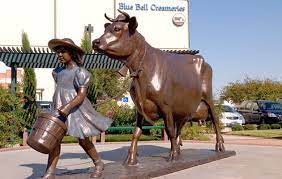
In front of the creamery stands a statue depicting icon seen on all cartons, trucks and signs advertising Blue Bell. 


Children love having their pictures made by the statue, and they are even allowed to climb up on the cow's back for pictures. A lot of children with smiling faces on school tours fill the area every year.

Wouldn't a bowl of your favorite ice cream taste good about now? 


What's your favorite flavor of ice cream? I'll take anything with chocolate in it.😊


Martha Rogers is a multi-published best-selling author of over sixty novels and novellas. She is a member of ACFW, CAN, and AWSA. Martha teaches a Sunday Bible class for senior women and is a retired English and Home Ec. Teacher. She lives in Houston with Rex, her husband of 62 years. 


Monday, October 11, 2021

 Big Bend National Park

by Martha Rogers

As a native Texan, I am always fascinated by the contrasts of climate, vegetation, and land formations that exist in Texas. From the Guadalupe Mountains and Palo Dura Canyon in the west to the pine forests and lakes in the east and from the Red River in the north to the beaches along the coast, visitors to Texas can find great places to visit.

I have traveled all over Texas during my lifetime, but the one place I've missed is Big Bend National Park. It's one of those rare places that attracts campers and hikers of all ages.

Indians occupied the territory and date back to the 1500s. The Chisos Indians were primarily a tribe of hunters and gatherers although they may have practiced limited agriculture on a seasonal basis. Not much is know about their origin, but their language closely resembled that of the Conchos Indians of northern Chihuahua in Mexico called Uto-Aztecan. The mountains are named for them.

Chiso Mountains in Big Bend

At the beginning of the 18th century, historic records indicate that the Mescalero Apaches invaded the Big Bend region and displaced the Chisos Indians. Then the Comanches passed through along the Comanche Trail as they traveled to and from raids into the Mexican interior. These raids continued until the middle of the century. The last of those Native American military leaders remained active until the late 1860's. The land was so barren that there was little if any interest in establishing towns and settlements. Only the Indians had a few places where they lived.

Spanish explorations began as early as 1535 with the first Spanish explorers headed by Alvar Nunez Cabeza de Vaca. Others followed his expeditions with explorers seeking gold and silver or farm and ranch land. Franciscan missionaries hoped to establish centers where they cold evangelize the natives. In order to protect the frontier of New Spain, they established presidios or forts along the Rio Grande. Some of these were soon abandoned because of finances and even the forts couldn't actually stop all the invasions into Mexico. Some partial structures still stand and can be seen in various sections of the area. 


At the beginning of the 18th century, historic records indicate that the Mescalero Apaches invaded the Big Bend region and displaced the Chisos Indians. Then the Comanches passed through along the Comanche Trail as they traveled to and from raids into the Mexican interior. These raids continued until the middle of the century. The last of those Native American military leaders remained active until the late 1860's. The land was so barren that there was little if any interest in establishing towns and settlements. Only the Indians had a few places where they lived. What the Spanish had tried to develop had gone by the wayside.

By the end of the Mexican-American War in 1848, the military had begun to make surveys of he land and established forts and outposts across Trans-Pecos Texas. These were built to protect settlers from Indian attacks. A large number of these soldiers were African Americans and came to be known as "buffalo soldiers", a name given to them by the Native Americans. The first American with African ancestry to graduate from West Point was Lieutenant Henry Flipper and he served in the town of Shafter, Texas at the end of the 19th century.


Because of its vast expanse of land, over 800,000 acres, the area was further explored for mining of silver and gold. Ranchers saw as good land for cattle, sheep, and goats. By 1880 and later, these ranches occupied most of the area, but the delicate environment of the desert was soon overgrazed.

By the late 19th and early 20th centuries, valuable mineral deposits were discovered and settlers flocked to the land to work in the mines or for the mine companies cutting timber for the mines and smelters. The towns of Boquillas and Terlingua were established to serve those mines. At the same time, the flood plain of the Rio Grande was settled by farmers, but they were usually no more than clusters of families living and farming together on one area. Their success depended entirely on the land.

Today, the town of Terlingua is a ghost town, forlorn and abandoned in the middle of the desert area.


This is all that's left of the Mariscal Mine from the late 19th century.

In 1916, a raid on Glenn Springs motivated President Wilson to order mobilization of the Texas National Guard to aid the federal forces. They established a cavalry camp at Glenn Springs where it remained until border situation improved in 1920.

By the 1930s, the people of Texas realized the land was one of stark, unique contrasts and beauty. They wanted to preserve it for future generations to enjoy. In 1933, the Texas Legislature passed legislation to establish the area as Texas Canyons State Park, but a short time later, they renamed it Big Bend State Park. In 1935, the US government became involved, acquired the lands and Texas deeded the land to the federal government. On June 12, 1944, Big Bend National Park became a reality. Covering 801,163 acres, it opened to visitors on July 1, 1944. Approximately 118 miles of the 1000+ mile Rio Grande River in the park forms a boundary between the United States and Mexico. However, because it is an international boundary, it faces certain constraints in enforcing park rules and policies. The Treaty of Guadalupe Hidalgo establishes that the park's territory extends on to the center of the deepest river channel as it flowed in 1848. The other side belongs to Mexico.

Two beautiful canyons, Canon de Santa Elena and Maderas del Carmen border the park in a protected area.  Below is Santa Elena Canyon


Sign for the entrance to the National Park as it is today. Thousands of visitors come to the park to hike, camp, and explore. Modern lodgings are available as well. 


So many unusual rock formations and cliffs and plants abound that it's hard to include them all, but here are a few of them.


Texas is a great state to visit and explore, but then so much of the United States is. What does your state have to offer tourists and to lure them to come to your state?


Martha Rogers is a multi-published author and writes a weekly devotional for ACFW. Martha and her husband Rex live in Houston, Texas where they are active members of First Baptist Church. They are the parents of three sons and grandparents to eleven grandchildren and great-grandparents to six. Martha is a retired teacher with twenty-eight years teaching Home Economics and English at the secondary level and eight years teaching Freshman English at the college level. She is a member of ACFW, ACFW WOTS chapter in Houston, and serves as President of the writers’ group, Inspirational Writers Alive. 

Sunday, February 7, 2021

Guest Blogger Author Allison Pittman: Every Story is a Ghost Story

By Allison Pittman


I love a good ghost story. Does that mean I believe in ghosts? No, not really. At least not in the restless spirit of the dead variety. Ghosts are memories. Stories. When I hear stories about a “haunted” house, I don’t care about the current bumps in the night; I want to know the story of the person behind those bumps. I want to know why the story has lived long after the soul has departed.

Menger looking into historic lobby
The Menger Hotel in San Antonio, Texas, has been deemed one of the most haunted hotels in America by people who determine such things. It is a beautiful place—regal and refined. It is full of art and memorabilia, antique furniture and centuries-old fixtures. Its original structure is completely intact, with a clear line delineating just when a guest has stepped from the modern (1940’s) add-on to the elegant lobby that received its first guest in 1857. Go there today, and you can visit the pool, see the place where Teddy Roosevelt signed up his rough riders, and take an evening stroll to the Alamo, only steps away, to see the holiest ground in Texas.

And, at night, especially if you rent one of the “Petite Suites”—rooms that maintain their original (read: tiny) dimensions, you just might have a bit of an encounter with a woman named Sallie White.

Sallie White was a chamber maid who worked at the Menger Hotel. She was killed by her common-law husband on March 30, 1876, on the sidewalk right across the street from a modern-day Starbucks. Fueled by a jealous rage, he shot her in the street, then chased her as she ran for shelter, and finally killed her with his bare hands, choking her to death. Well, nearly to death. It would take her three days to succumb to his attack. He lit out of town, never to be seen again. As a testament to her value, the Menger Hotel paid for Sallie’s modest funeral.

Menger Petite Suite
It is Sallie who is said to haunt the Menger to this day. Visitors see shadows, unexplained bits of light. They hear soft footsteps or, according to the long-time employee I talked to while conducting research, the signature knock-knock on their door in the middle of the night. Two swift raps followed by silence. A glimpse through the key-hole revealing no one there.

But, like I said, I don’t believe in ghosts. I believe in imagination. I believe in history. And I believe in story. There are other silly tales and sightings reported at the Menger, but this one prevails because there is such a tragic story attached. Sallie White was a woman of color, perhaps even a woman freed from slavery (though I’ve not seen that researched or proven true). She was killed in cold blood by a man who—at some time—must have been seen as a safe haven for her life. She was a hard worker. Without her infamous death, she might have passed into history unknown and forgotten.

That, my friends, is precisely why we need ghost stories. That’s why we need to constantly bring forth tales of not only the recognized heroes of the past, but those of the ordinary men and women whose lives are a testament to everything we value.


Place of Sallie's death outside Menger
I stayed at the Menger Hotel for three days last summer. It was July, and the hotel had just re-opened after a spring of closure due to Covid-19. The place now boasts over 500 rooms, and I was one of exactly 12 guests. Twelve. One employee was working as bartender, room service, and concierge. I had the freedom to stick my nose in every nook and cranny of that beautiful establishment. I took a hundred pictures, a dozen videos. I sat with my laptop in the ancient (and uncomfortable) lobby furniture, listening to the echoes. The host-of-all trades snuck me through a passage to show me the exact spot of Sallie’s murder. Looking up from the sidewalk, I realized it happened directly below my rented room. I decided then that, if I heard a knock, I would open the door wide.

Later that night, I looked out my window, down at the place where a San Antonio ghost tour was gathering, and I heard the guide telling Sallie’s story with an air of grisly entertainment. I felt a little guilty, knowing I was doing the same in my novel The Lady in Residence. Still, we were engaged in the same pursuit: to keep Sallie White alive by keeping her memory alive—the memory of the ordinary, tragic, hard-working woman. 

Whose story do you need to tell?


Allison Pittman is the award-winning author of several historical novels, including The Lady in Residence (Barbour Publishing, 2021). She makes her home in San Antonio, Texas, with her husband Mikey and Snax, the world’s worst dog. Visit her website allisonkpittman.com, to see more photos of the Menger Hotel, and to see what other stories she’s crafted from the pages of history.

Tuesday, September 8, 2020

HHH Blogger Spotlight -- Michelle Shocklee

Hello from Tennessee!

I'm Michelle Shocklee, one of the regular bloggers here on the HHH blog. I'm a Rocky Mountain girl at heart---born and raised in Santa Fe, New Mexico--but I've also lived in Oklahoma and Texas. As empty-nesters, hubby and I moved to Nashville, Tennessee three years ago where we work as Estate Caretakers, a very unique and rewarding career. I enjoy reading, painting, traveling, and being out-of-doors in God's beautiful world, but admittedly, only if the temperature and humidity are just right. Ha!

I come from a family of book lovers. Mom was an elementary school teacher for 25 years, and Dad was an engineer with a love of history. I have fond memories of them relaxing in the evenings, each with a book in hand. 

Yet despite growing up surrounded by books, it never occurred to me to write one of my own until I was in my late 20s. I wrote my first novel longhand in notebooks, scratching out so many words and lines, I eventually couldn't read the thing. I put aside my novel when my sons were born, but the writing bug bit again once they entered school. By then I realized I needed help learning the craft of writing, so I attended writing conferences as time and budget allowed. Publication was still many years away, but I've come to understand God has a plan and a timetable for everything.

Since we lived in Texas, I decided to set my first series, The Women of Rose Hill, on a Texas cotton plantation, before and after the Civil War. You'll remember I'm not a Texas girl, knowing very little about Texas history beyond the Alamo, so I enjoyed diving into the history of the Lone Star state. Imagine how surprised I was to discover that slaves toiled under the hot Texas sun in the very area where I was raising my family. I also read about the early Texas Rangers, slaves escaping to Mexico, and about Juneteenth--the day in June 1865 when the Union Army arrived on Texas' shores at Galveston, bearing a declaration that would ultimately bring freedom to the more than 200,000 slaves still in bondage. I've incorporated much of this fascinating history into Adella's and Natalie's stories.


Researching slavery is a heart-and-gut-wrenching endeavor, but I wanted my books to portray it honestly. I discovered a body of work known as the Slave Narratives--stories told by former slaves to employees of the Federal Writers' Project--that transformed my books. I shared a bit about the narratives yesterday in my post here on the HHH blog, so I won't repeat it now. But suffice it to say, I was so completely captivated by the narratives, I decided to write a novel based on the Federal Writers' Project Slave Narratives of 1936. That book, Under the Tulip Tree, released today--YAY!!--and is now available at your favorite online bookstore and in many brick-and-mortar stores as well. 

I'd love to connect with you over on my website or on any of my social media outlets. If you're interested in purchasing some of my books, pop over to my website for various retailer options or visit my Amazon page

Every blessing,
~Michelle


Thursday, April 2, 2020

German Chocolate Cake's Sweet History


Germany is known for numerous tasty desserts: lebkuchen, Schwarzwälder Kirschtorte (Black Forest cake), Bienenstich (bee sting cake), Rote Grütze (Red Berry Pudding), streusels, linzers, and dozens more.

But ironically, one dessert that did not originate in Germany is German Chocolate Cake.

Image result for german chocolate cake
https://images.app.goo.gl/52Yu6Uki6cdvuotJ9
German Chocolate Cake is a layered chocolate cake, topped and filled with a pecan-coconut frosting. Sometimes, chocolate frosting is used on the sides, and maraschino cherries occasionally appear as a garnish.

It is named not for its country of origin, however, but to honor the man who developed the type of chocolate used.

Samuel "Sammy" German was an Englishman who came to Dorchester, Massachusetts in the mid 19th-century, and found a job at America's first chocolate factory, Baker's Chocolate Company. Baker's was started in 1764 (then known as Hannon's Best Chocolates, although John Hannon and Dr. James Baker were partners.)

For over eighty years, the company produced cakes of chocolate for use as drinking chocolate, and by the California Gold Rush in 1849, Baker's Chocolate (now under the direction of Walter Baker) was found across America.


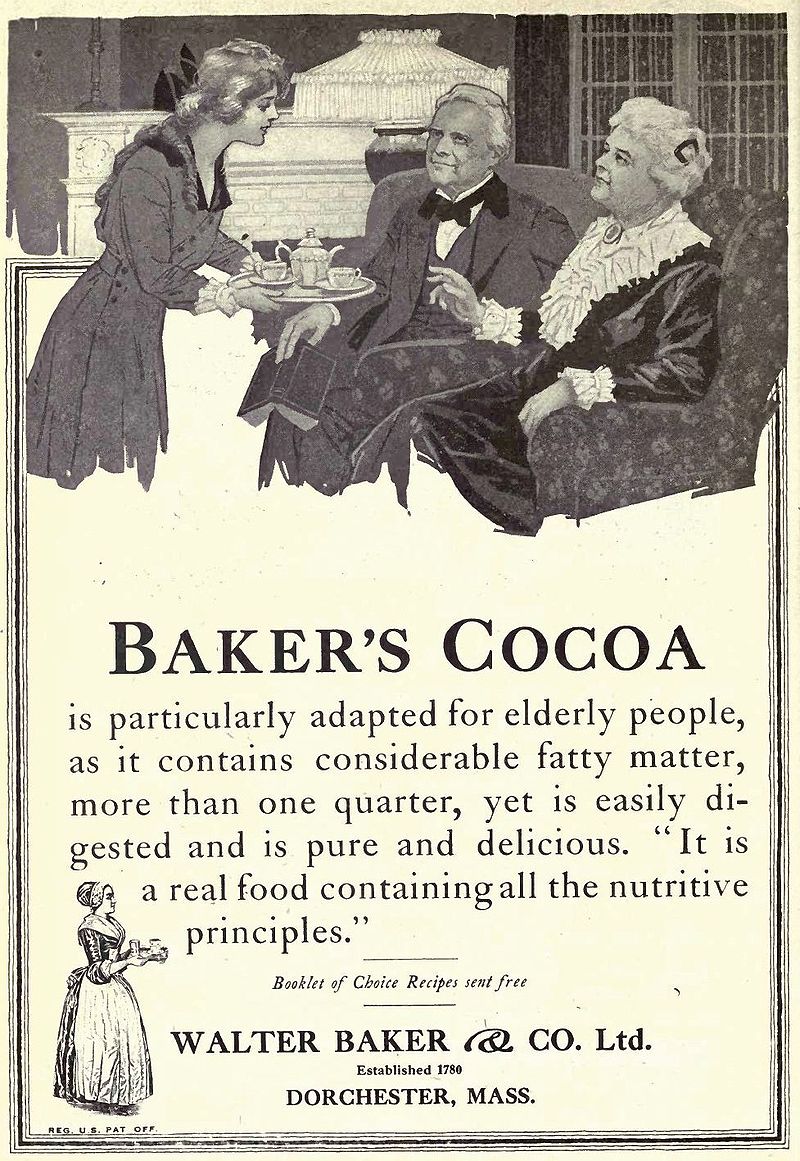
Baker's Cocoa Advertisement, January 1919 Issue of Overland Monthly. Public Domain.
In 1852, however, Sammy German had an idea. He developed a new type of chocolate, one that contained more sugar. This sweeter chocolate could be used for baking, and it's said Walter Baker bought the recipe for a whopping $1000. From that point on, the chocolate was sold as "Baker's German's Sweet Chocolate."

Over a hundred years later, on June 3, 1957, The Dallas Morning News printed a recipe of the day: "German's Chocolate Cake" submitted by Mrs. George Clay. The cake, with the pecan-coconut frosting, became an instant hit. Some sources claim that the recipe was in wider circulation at the time, but Mrs. Clay's recipe has been credited as the one that drew Baker's attention.


General Foods owned Baker's by this time, and they shared Mrs. Clay's recipe with other American newspapers.  Sales of Baker's Chocolate increased by 73%, and the cake became an American favorite.

Still available, even on Amazon!
Along the way, the apostrophe in "German's" was lost, and the cake is now known as German Chocolate Cake. Baker's is now owned by Kraft Heinz, and the recipe is still going strong. In fact, the recipe is usually printed right on the box.

And if you're not a cake person? Don't despair. German Chocolate is available as a flavoring in beverage syrups and coffees, too. 

June 11 is National German Chocolate Cake Day in America. Are you tempted to celebrate it with a slice this year?

***

Susanne Dietze began writing love stories in high school, casting her friends in the starring roles. Today, she's an award-winning, RWA RITA®-nominated author who's seen her work on the ECPA, Amazon, and Publisher's Weekly Bestseller Lists for Inspirational Fiction. To learn more, visit her website, www.susannedietze.com, and sign up for her newsletter: http://eepurl.com/bRldfv

Her latest is novel is The Blizzard Bride.


Saturday, July 6, 2019

After Freedom: How Slaves Searched for Family


By Michelle Shocklee

On January 1, 1863, President Abraham Lincoln issued the Emancipation Proclamation as the nation approached its third year of bloody civil war. The proclamation declared "that all persons held as slaves" within the rebellious states "are, and henceforward shall be free." Yet freedom for most slaves wouldn't come for two more years when the war finally ended in April 1865, and another two months to Juneteenth, the day Union troops arrived in Texas with the proclamation.

While researching my historical novels set on a Texas cotton plantation, I read dozens and dozens of true accounts of what slavery was like. These slave narratives, collected in the 1930s by the Federal Writers Project, are a treasure trove of information about the life of a slave. I wrote about my research in a blog titled I Was Born in Slavery--a Slave's Oral History.  To read and even hear the slaves' own words (there are a few recordings included in the archives!) is truly amazing. 

One heartbreaking theme is found in nearly all the narratives, and that is missing family members. Slave owners regularly split up families, selling off fathers and mothers and children for various (despicable) reasons. Slave traders often transported slaves across state lines, leaving the slaves with no hope of ever seeing their loved ones again. 

Slave auction house in Atlanta, GA, 1864
After the war ended and slavery was abolished, the task of reuniting families was monumental. Records indicate the government began collecting names and pertinent information of the former slaves, creating a sort of data bank to help locate relatives. But without modern-day technology, the endeavor took years and was far from adequate considering the vast number of people searching for their families. At the beginning of the Civil War, there were nearly four million people in bondage in the United States. You can imagine how many of them faced the hopelessness of finding their loved ones. 

As the years passed, some former slaves took to the newspapers, placing ads with information about their missing family members, hoping against all odds that someone somewhere would see it and contact them. I found them very poignant, especially those with updates that include good news. I'll share a few here and let them speak for themselves:


DO YOU KNOW THEM?
Louisville, KY , October 1, 1895.
I desire to know the whereabouts of Edwin Childs, the husband of Lucy Childs. The latter was daughter of old man Carter Page before the war. She belonged to Franklin Guy. She had two brothers, one by the name of William Page, and Archie Page. Edwin Childs belonged to Dr Worthum before the war, and he always hired his own time. His sister Muzinda, and he worked in the tobacco factory together. Edwin Childs' wife, Lucy Childs, was sold to the Negro traders before the war by Franklin Guy. Franklin Guy had two sons, one was named Tommie Guy and the other Warner Guy. 
Oblige,
Bettie Johnson, Louisville, KY

FOUND HER RELATIVES.
Louisville, Ky , October 23, 1895
Mr. Mitchell,
I have heard from my father Edwin Childs. He lives in Washington City. He saw the advertisement in the Richmond Planet. I received the letter from him Tuesday. It has been 36 years since I last saw him. We were sold away from our father in the year of 1859. I received a letter from Philadelphia, Pa , concerning the same matter. My aunt Muzinda lives in Richmond, Va. Through your kindness was the cause of me finding my father and aunt.
From yours,
Bettie Johnson, Louisville, KY


Here is another: 

INFORMATION WANTED OF MY RELATION. My uncle's name is Howard Hightower, his wife's name, Martha Hightower; three sons, Henry, Daniel and John; daughters, Mary, Caroline and Harriet. I have found Henry and Mary, who are living in Greensboro, Ga. We all belonged to William Hightower as late as 1862 '63, and at his death we were divided. Some went to Alabama, Southwestern Georgia and some to Polk county, Ga., while some remained in Green county, Ga., all of us being natives of that county. Uncle's name, Andy Hightower. Aminia and Louisiana Hightower are sisters to Andy. I will inform my uncles and aunts that their mother is living in Greensboro; also two of her sons. Any information will be gladly received by S. M. HIGHTOWER.
Rockmount, Ga.

One must wonder how many families were actually reunited with loved ones, and how many never saw their relatives again. In my historical novel The Widow of Rose Hill, two former slaves, Moses and Harriet, deal with this difficult subject. Without giving away their story, I did my best to keep to the facts of the time period, showing the heartbreak, the challenge, and the difficult decisions so many former slaves had to make. 

Put yourself in their shoes: Had you lived in those days, how would you have gone about searching for your loved ones? How long would you have tried? Would you ever give up?


Michelle Shocklee is the award-winning author of The Planter's Daughter and The Widow of Rose Hill, historical sagas set on a Texas cotton plantation before and after the Civil War. Her historical novella set in the New Mexico Territory is included in The Mail-Order Brides Collection. Michelle and her husband of 32 years make their home in Tennessee. Connect with her at www.MichelleShocklee.com.


THE WIDOW OF ROSE HILL

Widowed during the war, Natalie Ellis finds herself
solely responsible for Rose Hill plantation. When Union troops arrive with a proclamation freeing the slaves, all seems lost. How can she run the plantation without slaves? In order to save her son’s inheritance she strikes a deal with the arrogant, albeit handsome, Colonel Maish. In exchange for use of her family’s property, the army will provide workers to bring in her cotton crop. But as her admiration for the colonel grows, a shocking secret is uncovered. Can she trust him with her heart and her young, fatherless son?

https://www.amazon.com/gp/product/B078CN65FH/ref=dbs_a_def_rwt_bibl_vppi_i0

Tuesday, June 11, 2019

Lawmen of Texas Part 2:

The Rangers Ambush Outlaws
by Martha Rogers

The legacy of the Texas Rangers ranges from heroic stories in battle, capturing or killing of notorious bandits like Sam Bass or Bonnie and Clyde to legends of the Lone Ranger and T.V. shows like Walker: Texas Ranger. Most of the legends and stories contain some elements of truth even if they are embellished with retelling.

For some reason, many history buffs and western writers have chosen these lawmen to be heroes of their stories and novels. One thing is certain; they are one of the longest running law enforcement agencies in the country still in existence today.

Although today they mainly patrol our highways in Texas and assist other law enforcement agencies, they live up to the legacy of all those who have gone before.

Two of their more famous encounters with outlaws and fugitives were the ones with Sam Bass and Bonnie and Clyde. One took place in the 19th century, the other in the 29th, but they both ended the deaths of the criminals. 

Sam Bass, born in Indiana in 1851, ran away from home in 1859 and ended up in Texas. Then he was on the move again and traveled to Deadwood, South Dakota. There he formed his first gang of six men. As the gang robbed banks and trains, all but Sam either were killed or fled the territory, leaving Sam alone.


Jim Murphy, Sam Bass, Seaborne Barnes

He returned to Texas in 1871 and formed another gang. Sam is pictured above with two of his main gang members. After more robberies, many law groups were then on their tail, including the Rangers. Jim Murphy, one of the gang, cut a deal with the law to save his father. He led the group to Round Rock, Texas where a skirmish took place. Sam was wounded but Frank Jackson, a loyal friend of Bass as well as gang member, rescued Sam and took him out of town. The Rangers later found him propped against a tree.

Sam identified himself, but unsure if it was really him, Frank Murphy gave confirmation and Bass was arrested. Who actually fired the shot that wounded Bass and caused his subsequent death has been argued about, but the official ruling was that the fatal blow came from Ranger Dick Ware. At right is the headstone and memorial set up for Sam at Round Rock Cemetery.

More information can be found at: http://www.forttumbleweed.net/historybass.html

One of the most famous confrontations with known criminals is that of Bonnie and Clyde. Frank Hamer, pictured at right, is the man who led the investigation and subsequent ambush of the couple in 1934.

Clyde Barrow, age 21, met Bonnie Parker in January of 1930 in Texas when she was 19. Barrow was single, but Bonnie was married to a man in prison after a murder conviction. Clyde went to jail for burglary, but Bonnie helped him escape by smuggling a gun to him. He was captured and sent back to prison but was paroled in 1932.

He met up with Bonnie again, and they headed into a two year crime spree that included auto theft, burglaries, robberies and at least thirteen murders. The couple quickly became famous for their crimes which included a suspicion of killing two Joplin, Missouri policemen and the kidnapping of a couple in rural Louisiana. They later released the couple in the small town of Waldo, Texas.

Their crimes spread across Texas and into Oklahoma, New Mexico, and Louisiana where they robbed and killed numerous people including law officers.


The Texas Rangers commissioned Frank Hamer as Highway Patrol officer and then as a special investigator charged with tracking down Bonnie and Clyde. Hamer began a study of Barrow’s movements and found pattern of circling the
state and skirting along state borders to elude the law. Four other men, Manny Gault, Bob Alcorn, Ted Hinton and Prentiss Oakley joined Hamer in the final ambush in Louisiana that ended in the deaths of Bonnie and Clyde.

Here's a picture of the car after the ambush:

For more information about this infamous couple and their deaths, visit the website: https://www.thevintagenews.com 

You can always visit the museum in Waco and see the artifacts, pictures, and stories of these men who protected our state.

Although the Rangers do not participate in confrontations today like that of Bonnie and Clyde, they are instrumental in helping to keep Texas’ roads and highways safer. Their patrol cars can be seen along every highway in Texas whether a State or Interstate, and they don’t hesitate in pulling over those who are exceeding the posted speed-limits.

In celebration of my 83rd birthday this month, I am giving away a copy of my novella: Lasso Around Her Heart. In the comment section, tell me about your best birthday so far. I'll announce the winner by the 15th. 

Allie Logan promised her mother to take care of the family after her death, and she’s kept that promise for over five years, but now Jarrod Wright comes into her life and threatens that promise. When she learns her of her father’s attempts to arrange a marriage between her and Jarrod by offering him land, she shuts herself off from Jarrod only to find he’s already lassoed her heart. But how can she forgive her father for offering to pay a man to marry her and Jarrod for accepting the offer? 


Martha Rogers is a free-lance writer and multi-published author from Realms Fiction of Charisma Media and Winged Publications. She was named Writer of the Year at the Texas Christian Writers Conference in 2009. She is a member of ACFW and writes the weekly Verse of the Week for the ACFW Loop. ACFW awarded her the Volunteer of the Year in 2014. Her first electronic series from Winged Publications, Love in the Bayou City of Texas, debuted in the spring of 2015.  Martha is a frequent speaker for writing workshops and the Texas Christian Writers Conference. She is a retired teacher and lives in Houston with her husband, Rex. Their favorite pastime is spending time with their twelve grandchildren and five great-grandchildren