Showing posts with label Women In History. Show all posts

Friday, August 2, 2024

Female Pirates of the Caribbean: A Swashbuckling History

Amber Lemus Christian Author

Pirates of the Caribbean - the mere mention conjures up images of rugged men, billowy sails, and hidden treasure. But, me hearties, there be a lesser-known tale of female buccaneers who sailed the same waters, seeking fortune, freedom, and revenge!

Anne Bonny
Public Domain
Meet Anne Bonny, Mary Read, and Ching Shih - the most feared female pirates to ever hoist the Jolly Roger. These women defied convention, donning breeches, brandishing cutlasses, and commanding crews with a ferocity that rivaled their male counterparts.

Anne Bonny, considered to be an Irish lass, sailed the Caribbean seas with her lover, Calico Jack Rackham. There is very little known about her origin and no birth records found in Ireland for the name she used, but she is believed to be Irish. She disguised herself as a man to join his crew, but soon revealed her true identity, earning the respect of her shipmates. Bonny's fiery spirit and fighting prowess made her a force to be reckoned with. Captured in 1720, Bonny disappeared from historical records, with some speculating she escaped and returned to her father's plantation, while others believe she died in prison.

Mary Read
Public Domain
Mary Read, an Englishwoman, also disguised herself as a man to join the British military. She fell in love with a Finnish soldier and paused her seafaring life to settled down and start a business in the Netherlands. However, her husband died prematurely, which sent her back to work. She boarded a ship bound for the West Indies, however that ship was attacked by pirates. She ended up joining the pirate crew. She fought alongside Anne Bonny and Calico Jack, becoming a trusted member of their gang. Read's bravery and sword-fighting skills earned her a place in pirate legend. She died in prison in 1721, reportedly due to a fever or childbirth complications.

Both Anne and Mary are written about in the 1724 book, A General History of the Pyrates by Captain Charles Johnson, which was one of the first books on the topic and one of the main influences that shaped the perception of pirates. 


A General History of Pyrates by Captain Charles Johnson
Public Domain

Ching Shih, a Chinese pirate queen, commanded a fleet of over 1,500 ships and more than 60,000 pirates! She rose from humble beginnings as a prostitute to become one of the most powerful pirates in history, negotiating with Chinese officials and amassing a vast fortune. She married a prominent pirate, and upon his death, took over his enterprise. Ching Shih retired from piracy in 1810, taking a deal offered by the Chinese government, and opened a brothel and gambling house. She died peacefully in 1844, at the age of 69.

These women pirates lived by their own rules, rebelling against societal norms and gender expectations. They sought adventure, riches, and a sense of freedom that eluded them on land.

So, hoist the sails and raise a toast to these swashbuckling sisters of the Seven Seas! Their tales of bravery, cunning, and defiance continue to intrigue us to this day, reminding us that even in the most unexpected places, women have always been making waves.

*****


Two-time winner of the Christian Indie Award, Amber Lemus writes enthralling non-fiction for children and adults alike. She has a passion for travel, history, books and her Savior, so her writing is centered around faith, family and history.

She lives near the Ozarks in her "casita" with her prince charming. Between enjoying life as a new mom, and spinning stories out of soap bubbles, Amber loves to connect with readers and hang out on Goodreads with other bookish peoples.

Amber is a proud member of the American Christian Fiction Writers Association. Visit her online at www.AmberLemus.com/ and download a FREE story by subscribing to her Newsletter!

Tuesday, September 20, 2022

Amelia Earhart-FIRST WOMAN TO FLY ACROSS THE ATLANTIC


by

Molly Jebber, Author

Amish Romance

Let's talk about Amelia Earhart . . . 


Amelia Earhart was born July 24, 1897 in Atchison, Kansas. She disappeared July 2, 1937 near Howland Island which was near the central Pacific Ocean. Her father was a railroad lawyer, and her mother came from an affluent family. After her grandparents' deaths, her family struggled financially due to her father's alcoholism. The Earhart family had to move often during her life, and she completed high school in Chicago in 1915. After her mother received an inheritance, she sent Amelia to Ogontz School in Rydal, Pennsylvania.

But when Amelia went to visit her sister in Canada, she became interested in caring wounded soldiers in World War I. In 1918, she left college to become a nurse's aid in Toronto. 

After the war, Amelia entered the premed program at Columbia in New York, but left in 1920 due to her parents insisting she live with them in California. While there, she took her first airplane ride and loved it, and she signed up for flying lessons. In 1921, she bought her first airplane, a Kinner Airster. Two years later, she obtained her pilot's license.


In the mid-1920's, Amelia lived in Massachusetts and worked as a social worker and kept her interest in aviation. In 1928, promoters were looking for a woman to fly across the Atlantic. Amelia Earhart expressed interest and they chose her. Much of the publicity was handled by George Palmer, who she later married in 1931, but she kept her maiden name. She became a celebrity as she traveled across the United States sharing details of her flight in a book she had written called, "Twenty Hours and Forty Minutes". 

In May of 1932, Amelia wanted to cross the Atlantic again. She wrote a book about her record time for this trip, the mechanical difficulties and bad weather she experienced in a book called, The Fun of It". This book also included stories about her life and interest in flying.

In 1929, Amelia formed a club of women pilots called, "The Ninety Nines". And in 1933, she designed a clothing line for active women. She made several notable flights from then on until she disappeared on a flight where she radioed she was running out of fuel. She and her co-pilot were never found. 

Do you like flying? 

I hope you enjoyed our giveaway last month to celebrate hhhistory.com's 
large readership. 


Visit me at Molly Jebber's Website for a full list and "mini movies" of my Amish Romance books. Also visit me on Facebook for giveaways and fun!


Friday, May 15, 2015

Who Can Find a Virtuous Woman?


Recently, I participated in a six week series of workshops hosted by my local county Extension Service and Mississippi State University Extension Service. Many (if not all) universities have extension services. They provide education programs in the area of agriculture, nutrition, family, and consumer research.

This particular series of workshops caught my attention because it focused on risk management education for farm and ranch women. Since my husband and I raise beef cattle, and I’m the bookkeeper, I figured I could learn a lot by signing up. The second thing that caught my eye was the list of topics to be covered: record keeping, legal liabilities, estate planning, social media, website design, tax preparation, to name a few.

As a writer, I also am responsible for all of the above (and more!) so the workshops did double duty for me.

In the spirit of the purpose of the Heroes, Heroines, and History blog, though, I’m not going to talk about the nuts and bolts of what I learned in the workshops, but rather the woman behind the movement called “Annie’s Project”.

The mission of Annie’s Project is to empower farm women to be better business partners through networking and by managing and organizing information. The program is based on Annette “Annie” Kohlhagen Fleck (1922-1997), a farmer’s wife from northern Illinois. As my grandmother would say, Annie was a “smart” worker. She was an involved business partner with her farm husband.
Annie

Farming has never has been easy, but in the 1940s on the heels of the Great Depression and during WWII, it was even more difficult for the farm couple and their young family. From all accounts, Annie was a driving force in keeping her family’s farm operational and making it successful. She kept detailed written records of every aspect of her farm. She knew when to plant, when to harvest. She knew when taxes were due, and how much she’d paid the year before, and the year before that. She knew what crops had the best yield on different acreages of her property. She didn’t just go out and plant the seeds and watch them grow. She kept records of how, what, where, when, and how often. Year after year, after year..

But how did all this record-keeping actually translate to bigger and better things for Annie’s family? The following quote might give you an idea.

“When big decisions had to be made, Annie was there with her records. To increase cash flow, Annie sent her husband to work off-farm while she milked cows and kept an egg route in Chicago. Eventually, her records guided them to discontinue an egg laying enterprise, a seasonal turkey enterprise, and a dairy enterprise. Other farmers with larger equipment and more resources could better run the farm. So Annie and her husband became the landowners renting to other farmers. She paid expenses, and marketed corn and soybeans.”

One woman’s determination to work alongside her husband for the betterment of their family didn’t go unnoticed by their daughter, Ruth. Ruth married a farmer as well, but went on to a successful career as a Farm Business Management and Marketing Educator at the University of Illinois.

When Ruth retired, she formed the non-profit organization called Annie’s Project. In all her years as an educator, Ruth had seen the need for educating farm women in business practices. And who better to base her training sessions on than her mother?

Some farm wives have more experience than others on what to do around the farm, but others might find themselves at a loss how to manage and operate a farm. Ruth took that into consideration and the community of women working together helped shape the classes that are taking place at extension offices all across the country.

As I put this piece together, another woman came to mind, a woman who finds wool, and flax, and works it with her hands, a woman who considers a field and buys it, and with the labor or her hands, plants a vineyard. This woman rises early; stays up late. She cooks, she cleans, she gives to the poor. Her children call her blessed, her husband praises her.

She is a virtuous woman.


Saturday, April 25, 2015

Historic Heroism: Elizabeth Parsons Ware Packard

One Woman’s Fight for Justice and Change

By: Michele Morris

Before the mid-nineteenth century, women’s rights were unheard of. In most of the United States, married women were forbidden to own property, have a bank account, or own a business. A husband could sell, gamble, or give away all of his wife’s possessions without her knowledge or consent. Her husband legally controlled a woman’s children and health care. My goodness, we have come a long way, haven’t we?
Theophilus Packard

Elizabeth Packard
Elizabeth Parsons Ware Packard was born December 28th, 1816, the oldest, and only daughter of the Reverend Samuel and Lucy Ware. 

In 1839, Elizabeth’s father insisted she marry Theophilus Packard. A minister, who was fourteen years Elizabeth's senior, Mr. Packard was a staunch leader of his church. Elizabeth and her new husband appeared to have an amicable life together.

After twenty years of marriage, Elizabeth began to speak out publicly against her husband’s strict religious views. In response, Theophilus declared her “slightly insane” and secretly arranged for Dr. J.W. Brown to evaluate her. 

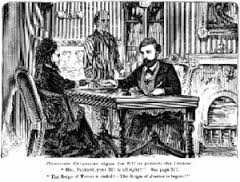
The doctor pretended to be a sewing machine salesman. During his visit, Elizabeth complained of her husband’s religious views and that he had told others she was insane. The "good doctor" gave his report to Mr. Packard, and on June 18th, 1860 the sheriff came to Elizabeth Packard's home and arrested her.
The arrest of Mrs. Packard

Without an official trial, Elizabeth Packard spent the next three years at the Jacksonville Insane Asylum in Jacksonville, Illinois. 
Jacksonville, Illinois Insane Asylum


Finally, after public outcry and pressure from her six children, she was granted a trial. 

The judge and jury declared her falsely imprisoned. The asylum doctors officially (and falsely) recorded her diagnosis as “incurable” and thus, released her.

Upon returning to her family’s home, she found her husband had recently rented it to another family, sold all her furnishings and belongings, and moved her children to another state.

Elizabeth took her husband to court The final witness in Elizabeth's case was Dr. Duncanson, who was both a physician and a theologian. Dr. Duncanson interviewed Elizabeth Packard, and he testified that while not necessarily in agreement with all her religious beliefs—“I do not call people insane because they differ with me. I pronounce her a sane woman and wish we had a nation of such women."

The jury took only seven minutes to find in Elizabeth Packard's favor. She was legally declared sane, and Judge Charles Starr issued an order that “she should not be confined”. Mrs. Packard had won.

Elizabeth never returned to her family, but she did, however, stay close to her children. As far as I can tell, she never legally divorced her husband.

Aware of how close she came to being incarcerated against her will, and that other women suffered the same fate, Elizabeth founded the Anti-Insane Asylum Society. 

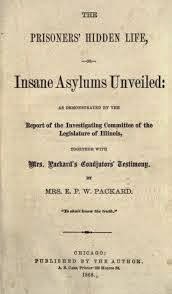
She also published several books about her experience, including Marital Power Exemplified, (or Three Years Imprisonment for Religious Belief) (1864), Great Disclosure of Spiritual Wickedness in High Places (1865), The Mystic Key (or the Asylum Secret Unlocked) (1866), and The Prisoners' Hidden Life, (or Insane Asylums Unveiled) (1868). 

Elizabeth became a champion for the rights of women and people accused of insanity. Thanks to her hard work and persistence, in 1867, the State of Illinois passed a "Bill for the Protection of Personal Liberty". This bill guaranteed all people accused of insanity, including wives, had the right to a public trial. She also saw similar laws passed in three other states.

One woman’s life took a horrific, tragic turn that could have ruined her. But Elizabeth chose to rise above by blazing an early path for women’s rights and fair treatment. Elizabeth Parsons Ware Packard’s achievements deserve to be known and remembered, and I hope that Mrs. Packard’s story might inspire and empower you.

Do you have a story that might have been tragic, but you were able to turn it around to make "lemon-aid from lemons". If you feel comfortable enough to share, please do so in the comments below. I’d love to celebrate your victories with you!   


Wednesday, September 3, 2014

Women and Guns by Cynthia Hickey


Female Sharpshooters


History is full of women who did more than cook on the frontier. Most were quite handy with a gun. I thought it might be fun to point out some of them. Born during a time when women stood in the shadows of their rugged men, these trailblazers proved that they were as good - if not better - than their male counterparts. Some of them became legends as outlaws, shocking society with their ruthless and unladylike behavior. Still, some women became famous without shooting up the countryside.


Annie Oakley, a Quaker, retained her feminine dress, became a star attraction in Buffalo Bill’s Wild West Show. After being the sole provider for her family, and paying off their home at a young age, she became known for her shooting skill. Annie Oakley met Native-American leader Sitting Bull in 1884, and he was so impressed with her manner and abilities that he "adopted" her and bestowed upon her the additional name "Little Sure Shot."


While there was no record of her ever actually having seen combat, Cathay Williams, became the first black woman Buffalo Soldier. It wasn’t until she became ill, that her identity was discovered and she was given an honorable discharge and became an army cook.


Belle Boyd became a spy during the Civil War, despite the notion that espionage was regarded as unhonorable as prostitution. She began spying for the Confederacy when Union troops invaded her Martinsburg, Virginia home in 1861. When one of the Federal soldiers manhandled her mother, Boyd shot and killed him.


Eleanore Dumont, called Madame Moustache, was known for her cool demeanor at the card tables, opening her own establishment in California. Stylish and aloof, she drew the gamblers in droves. Lonely, she finally fell in with a handsome man who turned out to be a con artist who swindled her out of her money. Never a timid woman, legend has it that she went after the cad, tracked him down and opened up on him with a double blast from a shotgun.


These are just a few of the women who carried a gun and stood up for what they perceived was their right, not conforming to the day's standards of typical woman's behavior. In my latest Heartsong release, In A Texas Ranger's Arms, my heroine is quite a good shot. What do you think of America’s pioneer women carrying guns? Leave a comment for a chance to win a copy of In A Texas Ranger's Arms, and other great prizes. <a id="rc-0c1c490d0" class="rafl" href="http://www.rafflecopter.com/rafl/display/0c1c490d0/" rel="nofollow">a Rafflecopter giveaway</a>
<script src="//widget.rafflecopter.com/load.js"></script>


 Multi-published and Best-Selling author Cynthia Hickey had three cozy mysteries and two novellas published through Barbour Publishing. Her first mystery, Fudge-Laced Felonies, won first place in the inspirational category of the Great Expectations contest in 2007. Her third cozy, Chocolate-Covered Crime, received a four-star review from Romantic Times. All three cozies have been re-released as ebooks through the MacGregor Literary Agency, along with a new cozy series, all of which stay in the top 50 of Amazon’s ebooks for their genre. She has several historical romances releasing in 2013, 2014, 2015 through Harlequin’s Heartsong Presents, and has sold more than 200,000 copies of her works. She is active on FB, twitter, and Goodreads. She lives in Arizona with her husband, one of their seven children, two dogs and two cats. She has five grandchildren who keep her busy and tell everyone they know that “Nana is a writer”. Visit her website at www.cynthiahickey.com