Showing posts with label bad fashion choice. Show all posts

Sunday, March 2, 2025

A History of the Worst Fashion Trends

Amber Lemus Christian Author
Blogger: Amber Lemus


Oh, the things that women will do for fashion. From the time we were little girls, the phrase "you must sacrifice comfort for beauty" was drilled into our heads. But it has been that way for quite some time, and not always was it only women who fell prey to the worst fashion trends. Today we will explore several of history's worst, and then you can let me know in the comments which one YOU think is the worst of them all. 


Lotus Shoes - Ancient China

Lotus Shoes circa 1911
Photo by: Daniel Schwen CC

In ancient China, small feet were considered to be a mark of beauty among women. In order to facilitate this look, many extreme measures were taken to make the feet appear, or even be, smaller. These "Lotus Shoes", so named because their shape was supposed to resemble the lotus flower, required women to tightly bind their feet in order to fit in them. This process ended up being torturously painful and ended in broken bones, mobility issues and deformities. However, even with these terrible consequences, it seems women were willing participants in the practice. Anything to look and feel like a beautiful, high class lady. 

Lotus shoes were made of expensive materials such as silk with elaborate designs and embroidery. The designs would even continue onto the sole of the foot, which is interesting, because in modern times, we don't imagine anyone paying attention to the bottoms of our soles. Young women typically wore brighter colors like purple and green, whereas older or middle-aged women would wear blue or blue green. Black was avoided, as it was associated with bruising, and red was only for special occasions such as weddings, new year, etc. 

The foot swaddling process involved forcing the four smaller toes under the big toe and encasing the foot with a high arch. It sounds painful even describing it. This method was often started when the woman was young and took years to complete the re-shaping of the foot. Regardless of the terrible side-effects of such binding, Chinese women continued to use these shoes until the 1950's. But I suppose some could argue that heels are just about as bad!


The Ruff of the 16th -17th Century

Queen Elizabeth I with her Ruff Collar
Public Domain

We all know what a ruff is, because we've seen it in pictures of Queen Elizabeth, Pocahontas, and other historical figures. It's the stiff, white collar that was ruffled and unmistakable. 

The ruff, besides being fashionable for more than a decade, was worn by all, men, women and children. It was intended to be practical in that it could be detached from the clothing and washed separately, thus reducing the need to wash the gown or shirt it was attached to and catch the perspiration that would undoubtedly arise along the neckline. Anyone who has had to launder the neckline of dress shirts can relate. Originally, they were made of linen cambric and more discreet but as time went on, they became bigger and made with more fancy materials. Eventually, you had huge ruffs made of lace. These large ones became even more impractical and even dangerous. The heavy starches used to make them stiff caused discomfort and irritation of the skin. Head movement was restricted. Eating became difficult while wearing them. Some of the more elaborate ones had wire to reinforce the shape which could even lead to breathing difficulties. 


Hobble Skirts of the Early 20th Century

Hobble Skirt Postcard
Public Domain
Some believe this style may have been inspired by the Japanese kimono. Another theory is that it was inspired by the first female to fly in an airplane. As the legend goes, Mrs. Edith Ogilby Berg asked the Wright Brothers for a ride at a demonstration in 1908. She tied a rope around the bottom of her skirt to keep it from flying up during the flight. The Smithsonian Air and Space Museum claims that a French designer was inspired at the way the woman walked away from the aircraft, with her skirts still bound, and designed skirts with a tight loop near the calves or ankles. Some postcards from this era jokingly refer to the skirt as the "speed limit skirt" because it limits the wearer's stride. Some ladies even engaged in hobble skirt races to further this joke. 

However, this trend was rather short-lived as it was popular right at the time that women became more physically active. For obvious reasons, this skirt made that difficult. This skirt was also directly responsible for several deaths, including one where a young lady was walking on a bridge and stumbled, tumbling over the railing into the water below where she drowned. The popularity of the skirt quickly declined, especially as WWI erupted and the restricted movement didn't suit wartime needs. 


Lead-based Makeup

An 1889 Henri de Toulouse-Lautrec painting
of a woman applying facial cosmetics

Public Domain

In ancient times, lead was used as a foundational ingredient in cosmetics. We now know how dangerous this is, but it took centuries before that was discovered. Queen Elizabeth I is considered to have been one of the victims of lead poisoning due to cosmetics, as many of her health problems may have been related. Also Maria Gunning, Countess of Coventry, is considered to have been a death related to lead based cosmetics. However, it wasn't until the early 1900s that lead bases became less common, and unfortunately, we still occasionally encounter lead in cosmetics today. 


Arsenic Dyes

Bright green clothing in the Victorian era was usually accomplished using arsenic. We now understand that is a poison, but at the time, it was used in fabrics, wallpapers, home furnishings and more. Not only were the workers creating these items at risk, but the eventual consumer also suffered from exposure to this toxic material. Even worse, it was sometimes used as a food dye also. In 1858 the deadly Bradford Sweet poisoning killed 21 people with green hard candies. The effects of arsenic are horrific, causing ulcers, vomiting, hair loss and the failure of the liver and kidneys. Yet still women continued to use arsenic base items for a long time.  


Which of these fashion fails do you think is the worst?


*****

Two-time winner of the Christian Indie Award, Amber Lemus writes enthralling non-fiction for children and adults alike. She has a passion for travel, history, books and her Savior, so her writing is centered around faith, family and history.

She lives near the Ozarks in her "casita" with her prince charming. Between enjoying life as a new mom, and spinning stories out of soap bubbles, Amber loves to connect with readers and hang out on Goodreads with other bookish peoples.

Amber is a proud member of the American Christian Fiction Writers Association. Visit her online at www.AmberLemus.com/ and download a FREE story by subscribing to her Newsletter!

Thursday, February 23, 2023

THE HOBBLE SKIRT: A WOBBLY AFFAIR

By Mary Davis

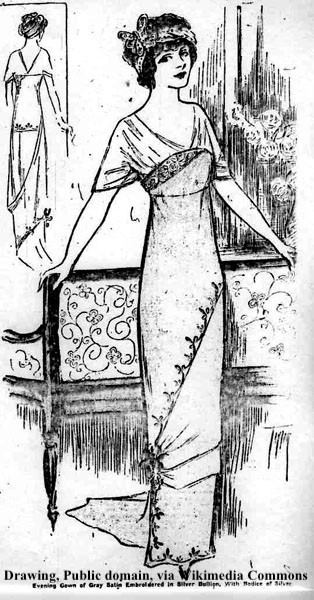
The first time I saw a hobble skirt from the early 1900s, I couldn’t imagine who in the world would think it was a good idea. They were a fashion trend that peaked between 1908 and 1914. Hobble means: to walk in an awkward way; to restrict the activity; to walk in an impeded manner.

Therefore, a Hobble skirt is one with a narrow hemline designed to restrict the wearer’s ability to walk, forcing the person to take tiny steps. Why? Why? Why? This sounds like a bad idea from the get-go. It was nicknamed the “speed-limit skirt” in several comics. I guess sometimes a fashion needs to be tested in order to deem it serviceable or not.

There are various origin stories for this restrictive garment. One claimed it was Katherine Wright when she flew in an early airplane. A similar account was with Edith Ogilby Berg’s first ride. Since these flying machines were basically an open skeleton, the pilot and passenger were windblown from head to toe. This could cause serious modesty issues for a woman in a full skirt that would likely billow up over her head while soaring through the sky. Some measure had to be taken, so a rope (or twine or strip of fabric) was tied around the voluminous skirt at the calves or knees before takeoff. After their flights, these women hobbled away with the rope still attached. Thus, the name stuck.

Katharine Wright

Edith Ogilby Berg
A third origin said that it was simply the way of fashion. The Oriental style of apparel that were narrow at the bottom influenced several designers. These confined hems had been a reoccurring trend in Western women’s fashion wear. French couturier Paul Poiret, credited with the hobble fashion faux pas, had long since used Japanese kimonos, other Oriental designs, and Egyptian clothing as inspirations for his fashions and launched a hobble skirt in 1910. There was also the claim that the circumference of hems fluctuated from narrow to wide and back again throughout the years before and since. Any angle you look at a garment that severely impedes the wearer’s movement isn’t the best idea.

The proof being a few hobble skirt related accidents, resulting in deaths! In 1910, a lady at a racetrack outside of Paris was killed by a loose horse. Another woman, Ida Goyette was strolling along on the Erie Canal Bridge, stumbled, fell over the railing, and drowned.

An additional indicator people should have thought twice before forging ahead with this fashion design was the difficulty it caused when boarding a streetcar. The narrow hemline of these skirts was too restrictive to allow women wearing them to climb aboard. In 1912 and 1913, New York and Los Angeles redesigned some of their streetcars as “hobble-skirt” cars with no step up. That’s a lot of money spent for a poor clothing choice.

Even the New York Times thought this was a bad idea in an article in 1910 where they said, “The Hobble is the Latest Freak in Women’s Fashion.” The New York Times even claimed that the hobble skirt could cause a world-wide depression. Here’s how that thinking went. Hobble skirts didn’t require petticoats, in fact, there was no room for them. Tossing aside the layers of these under garments for this new fashion would cause an economic impact worldwide. It would bring about the decline of the textile industry, a rise in the cost of living, and lower wages. “Think of 10,000 people turned away from their possible means of livelihood, 10,000 families, perhaps, starving just because women persist in following an ungraceful and immodest freak of fashion!” LOL! I didn’t know so much was riding on petticoats.

Some women wore hobble garters under their skirts. These were a length of fabric tied around one knee then the other to keep the lady from taking too long of a stride and tearing the expensive garment.

A short-lived activity from about 1910 to 1915 was the hobble skirt races. Women would line up in their hobble skirts and waddle to the finish line.

I suppose that isn’t much different than a three-legged race or a sack race. A hobble skirt race sounds like it could be fun. How about you? Would you participate in a hobble skirt race if given the chance?

I’m grateful the fashion fad died out. I have enough trouble walking without my knees being lashed together.

READ THIS POST ONLINE TO LEAVE A COMMENT.


The QUILTING CIRCLE Series 

Historical Romance

THE WIDOW’S PLIGHT (Book1) – Will a secret clouding a single mother’s past cost Lily the man she loves?

THE DAUGHTER’S PREDICAMENT (Book2) *2020 Selah Awards Finalist & WRMA Finalist* – As Isabelle’s romance prospects are turning in her favor, a family scandal derails her dreams.

THE DAMSEL’S INTENT (Book3) *2021 Selah Awards Winner& WRMA Finalist*– Nicole heads down the mountain to fetch herself a husband. Can she learn to be enough of a lady to snag the handsome rancher?

THE DÉBUTANTE’S SECRET (Book4) –Complications arise when a fancy French lady, Geneviève, steps off the train and into Deputy Montana’s arms.

THE LADY’S MISSION (Book5) – Will Cordelia abandon her calling for love?

MARY DAVIS, bestselling, award-winning novelist, has over thirty titles in both historical and contemporary themes. Her latest release is THE LADY’S MISSION. Her other novels include MRS. WITHERSPOON GOES TO WAR, THE DÉBUTANTE'S SECRET (Quilting Circle 4) THE DAMSEL’S INTENT (Quilting Circle 3) is a Selah Award Winner. Some of her other recent titles include; The Widow’s Plight, The Daughter's Predicament, “Zola’s Cross-Country Adventure” in The MISSAdventure Brides Collection , Prodigal Daughters Amish series, and "Bygones" in Thimbles and Threads. She is a member of ACFW and active in critique groups.
Mary lives in the Pacific Northwest with her husband of thirty-eight years and one cat. She has three adult children and three incredibly adorable grandchildren. Find her online at:

Sources: https://en.wikipedia.org/wiki/Hobble_skirt
https://www.wright-brothers.org/Information_Desk/Just_the_Facts/Wright_Family/Katharine_Wright/Hobble_Skirt_Sidebar.htm
https://www.mentalfloss.com/article/58897/hundred-year-old-fashion-fad-hobble-skirt
http://www.fashionencyclopedia.com/fashion_costume_culture/Modern-World-1900-1918/Hobble-Skirts.html