Showing posts with label beauty. Show all posts

Thursday, November 10, 2022

I Want a Beautiful Body - 1910

 By Suzanne Norquist

Although beauty standards have varied throughout history, women have always longed for attractive physiques. The chapters on “Developing the Figure” and “Reducing Flesh” in Margaret Mixter’s book, Health and Beauty Hints, published in 1910, provide surprisingly familiar advice.


Apparently, women desired a full, symmetrical figure without extra flesh. Today, fullness in the right areas is still coveted. However, I’ve never heard anyone talk about symmetry. Of course, no one wants extra flesh.

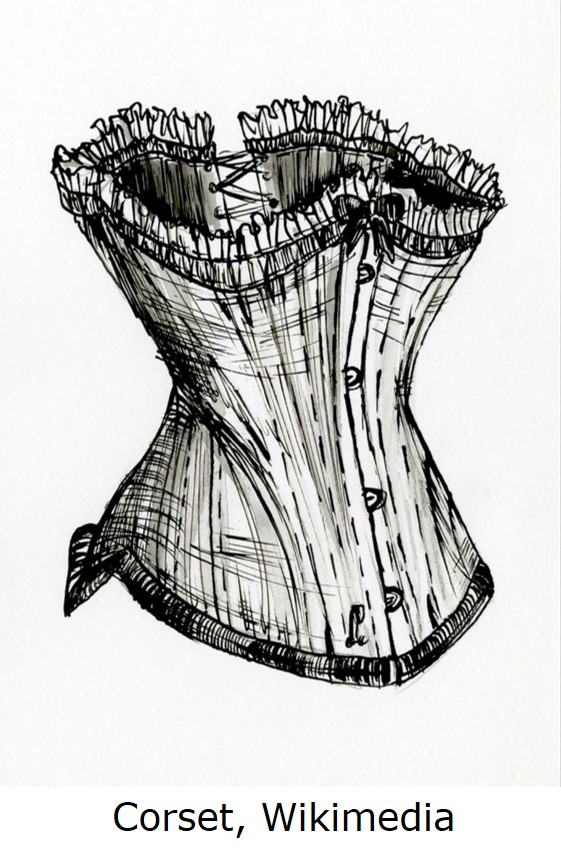
One section in the book is titled “Exercise Improves Figure More Than Corset.” Who can argue with that? Modern women have replaced corsets and stays with shapewear. The easy way never goes out of style, but it can’t provide a long-term solution.
Chair exercises are recommended. “. . . sit astride a chair, facing the back. . . she grasps firmly, and then without moving, she should twist her body around one way just as far as she can make it go before repeating the motion toward the other side.”

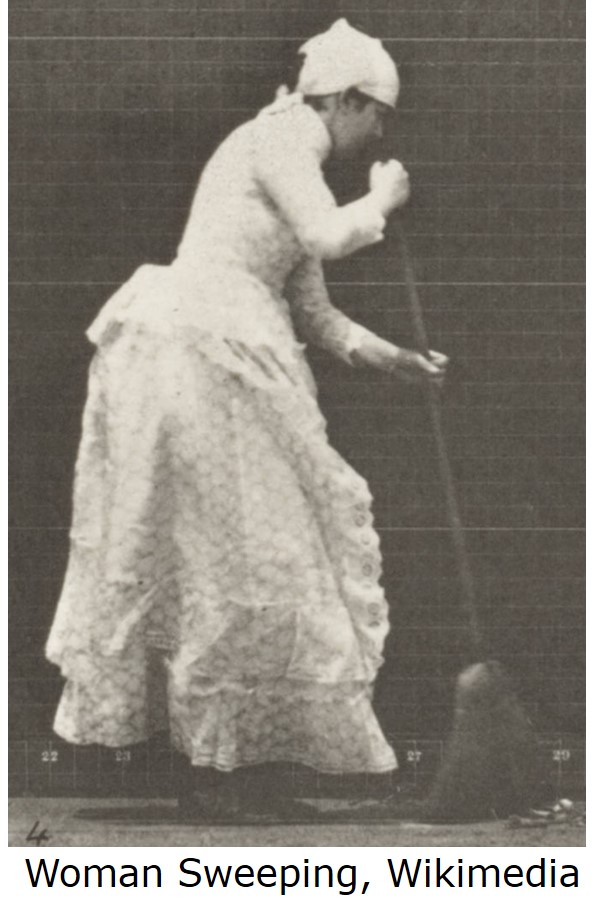
Another section is entitled “Sweeping and Dusting Develop the Figure.” Isn’t this just like the Karate Kid movie? It recommends leaning from the waist to pick things up to keep limber. And there is a proper way to hold a broom for exercise.
I was baffled by the bust developer recipe until I realized it is mostly herbs and essential oils. The concoction is taken internally, which seems a bit odd.

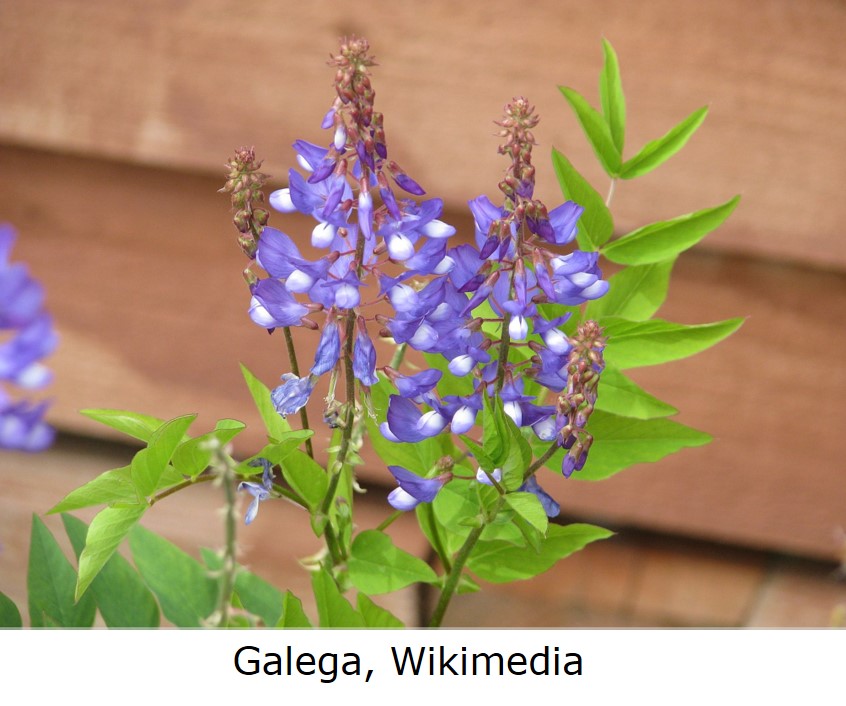
The Vaucaire bust developer, which is an old formula said to be harmless, is made of five grains of liquid extract of imported galega, five grains of lactophosphate of lime, 5 grams of tincture of fennel, and 200 grams of simple syrup.

Take two soupspoonfuls in water before each meal. Drinking malt extract at the same time is also advised by Dr. Vaucaire. It will probably be six weeks before a change is noticed.

Galega is a flowering plant. Lactophosphate of lime is baking powder. And I have fennel in my spice cabinet. I can’t imagine how this would develop the bust, but I could see myself trying it.
Of course, newspapers of the day promised miraculous ways to improve this part of a woman’s figure.

An advertisement in the May 23, 1914, edition of the Denver Weekly Post used the following picture to tout its product. Readers could send for a free book.
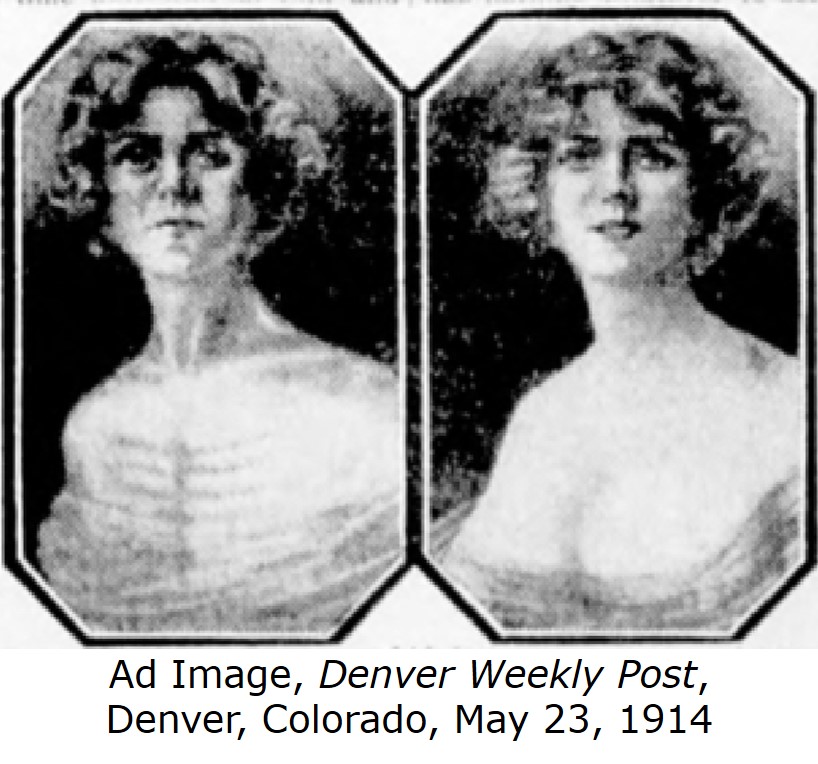
A woman who responded could “develop her bust six inches in thirty days without exercise, massage, prescriptions, or apparatus,” which were all common practices at the time. Notice in the after picture how the woman’s face and smile look better too. Perhaps this product fixes more than just the figure.

The 1910 health and beauty book gave surprisingly modern advice about “reducing flesh.” Moderate exercise and healthy eating are recommended—cut fats and sweets. Sassafras tea could be used as a substitute for a mid-morning snack. I might have to try that.

Of course, newspapers offered concoctions to get rid of fat. They called it fat rather than excess flesh.

The September 21, 1878 edition of the Golden Globe, from Golden, Colorado, carried an advertisement for Allan’s Anti-Fat. This medicine supposedly caused weight loss of two to five pounds per week.

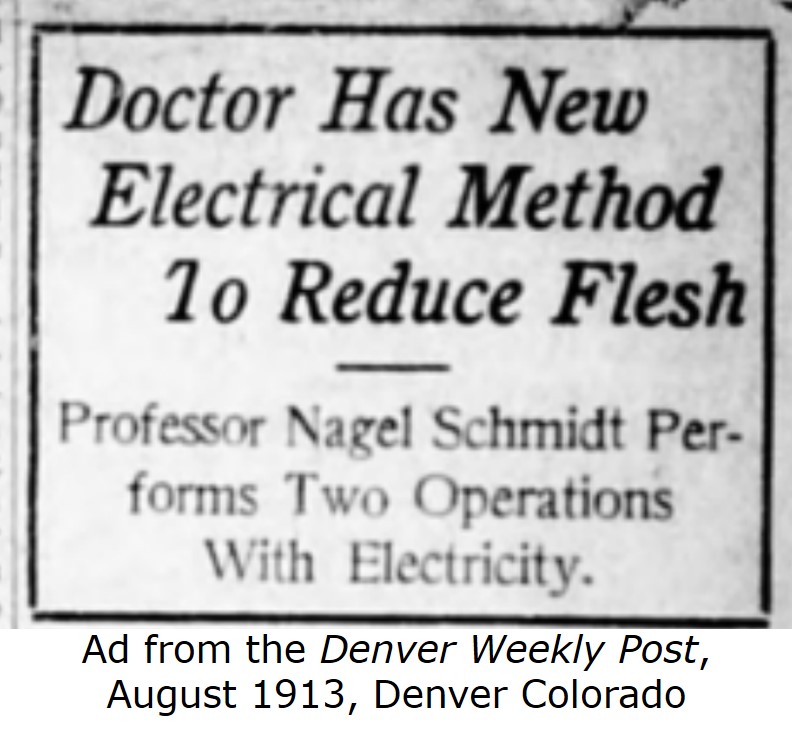
Many advertisements offered booklets of some kind, probably ones that touted medicines. By 1913, shysters promised to reduce flesh with electricity.

Regular articles that didn’t tout quackery also showed up in papers. A “Beauty Chats” section in the July 16, 1920 edition of the Dolores Star, Dolores, Colorado, describes calorie counting. “You can eat as much as you like as long as your food only has a small number of calories of fat.”

Apparently, our technology hasn’t brought us that far in the last hundred years. I guess it’s time to exercise and eat right. 

***


”Mending Sarah’s Heart” in the Thimbles and Threads Collection

Four historical romances celebrating the arts of sewing and quilting.

Mending Sarah’s Heart by Suzanne Norquist

Rockledge, Colorado, 1884

Sarah seeks a quiet life as a seamstress. She doesn’t need anyone, especially her dead husband’s partner. If only the Emporium of Fashion would stop stealing her customers, and the local hoodlums would leave her sons alone. When she rejects her husband’s share of the mine, his partner Jack seeks to serve her through other means. But will his efforts only push her further away?

For a Free Preview, click here: http://a.co/1ZtSRkK

Suzanne Norquist is the author of two novellas, “A Song for Rose” in A Bouquet of Brides Collection and “Mending Sarah’s Heart” in the Thimbles and Threads Collection. Everything fascinates her. She has worked as a chemist, professor, financial analyst, and even earned a doctorate in economics. Research feeds her curiosity, and she shares the adventure with her readers. She lives in New Mexico with her mining engineer husband and has two grown children. When not writing, she explores the mountains, hikes, and attends kickboxing class.

She authors a blog entitled, Ponderings of a BBQ Ph.D.


Sunday, July 10, 2022

“Eye Catching” Beauty Trends — Don’t Cringe

By Suzanne Norquist

When I prepared to make some videos for a project, my twenty-six-year-old daughter said, “Oh, Mom, we need to do something about those eyebrows.”

Not a new concept, but what is considered the perfect brow? Thick? Thin? Arched? Unibrow? And how is perfection achieved?

Answers to these questions have varied throughout history. Ancient Egyptians desired bold, prominent brows—like a god would have. Ancient Greeks and Romans believed unkempt eyebrows showed purity, and unibrows were prized. In the Middle Ages, hairy brows distracted from the natural beauty of the forehead. Therefore, women sculpted and plucked them away.

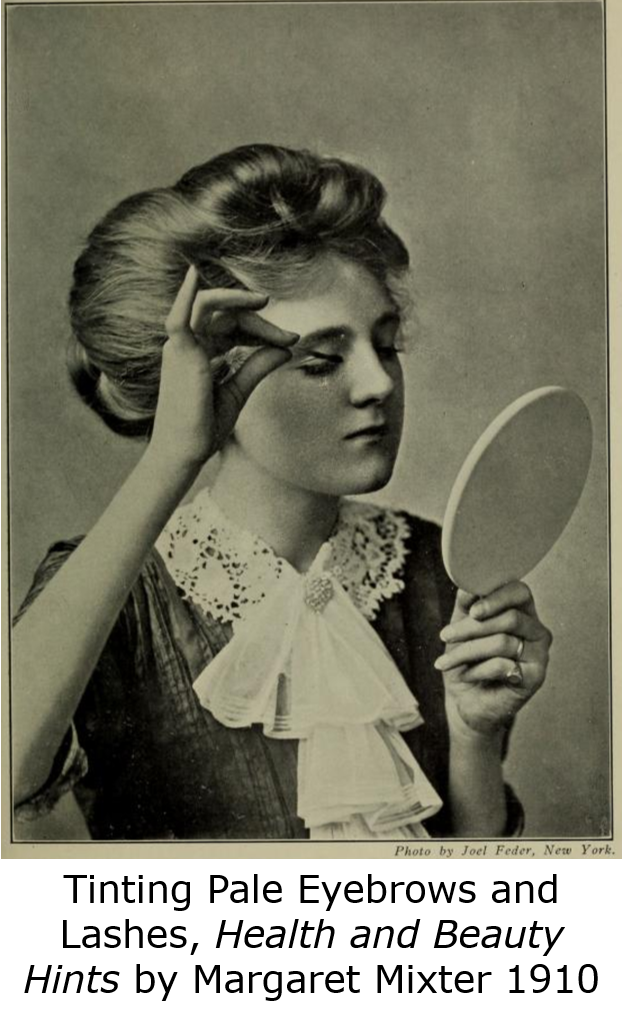
Smaller, more shapely brows persisted into the early 1900s. In her 1910 book, Health and Beauty Hints, Margaret Mixter describes the perfectly shaped brow as “a swallow’s wing, the line long and sweeping, the hair short and thick without being coarse.”

Margaret Mixter recommended conditioning and training. Generally, some kind of oil was used. Here is her recipe for Eyebrow and Lash Tonic:

Red Vaseline, 5 grams; Boric acid, 10 centigrams. Make into a smooth paste, and massage into the brows at night, also rubbing lightly on the lashes at the roots.

Vaseline has been a well-known brand since 1870, and the pink version is still available today. Boric Acid has mild antiseptic, antifungal, and antiviral properties.

Massaging eyebrows every night could improve their health, and a soft brush helped shape them.

Coloring wasn’t encouraged, particularly with permanent colors, which would damage the hair. A blackened piece of burnt cork or some Indian ink could darken them a little if needed.

Trimming the eyebrows was never recommended, as it would create a coarse, unkempt look. Nor was plucking. The 1910 beauty book suggests electrolysis for hair removal.

Early versions of electrolysis would make me nervous. It was invented in 1875, and commercial machines became available in 1900. By the early 1900s, schools of electrolysis and dermatology were popping up.

In this 1898 advertisement, Professor Newby explains the benefits of electrolysis. Not only could he take care of skin blemishes and superfluous hair, but he also specialized in rheumatism, paralysis, tumors, and cancer. He used the latest electrical scientific discoveries.

What women wouldn’t endure in the name of fashion.

Eyebrows are just one aspect of an attractive expression. The beauty book also gives some advice related to eyelashes, mostly a little conditioning and trimming.

In antiquity, long, lush lashes represented youth and fertility. Burnt cork or coal often created the effect. By the Middle Ages, too much hair was viewed as erotic, and lashes were plucked. That trend didn’t last for long. Versions of mascara existed in the 1800s.

Artificial eyelashes made an appearance in the late 1800s when Parisian women sewed hairs on their eyelids for enhancement. And, of course, everyone adopts Paris fashions. An article in an 1897 newspaper in Telluride, Colorado, describes the procedure for sewing human hair to the eyelids to extend the lashes.

Beauticians experimented with different varieties of false lashes. In 1903, the New York Press reported, “In a hair store on Broadway, a novelty item is being sold in the shape of long, luxuriant eyelashes, which can be adjusted in two minutes and will wear for one month. They cost $3 a pair.”

They probably weren't sewn on if they could be adjusted that quickly.

The first patent for glue-on artificial lashes was awarded to Anna Taylor, a Canadian woman, in 1911. However, falsies didn’t really become popular until 1916, when actress Seena Owen wore them in the movie Intolerance.

Crazy enough, I can barely see the eyelashes in the picture above. Perhaps without them, her eyes completely disappeared.

Beauty trends for brows and lashes haven’t changed much in the last hundred years. Most of us don’t cringe anymore, as these treatments have been refined and are commonplace.

And, who am I to criticize? I wear mascara for a day of hiking in the mountains. All women want to put on their best face.

***

”Mending Sarah’s Heart” in the Thimbles and Threads Collection


Four historical romances celebrating the arts of sewing and quilting.

"Mending Sarah’s Heart" by Suzanne Norquist

Rockledge, Colorado, 1884

Sarah seeks a quiet life as a seamstress. She doesn’t need anyone, especially her dead husband’s partner. If only the Emporium of Fashion would stop stealing her customers, and the local hoodlums would leave her sons alone. When she rejects her husband’s share of the mine, his partner Jack seeks to serve her through other means. But will his efforts only push her further away?

For a Free Preview, click here: http://a.co/1ZtSRkK


Suzanne Norquist is the author of two novellas, “A Song for Rose” in A Bouquet of Brides Collection and “Mending Sarah’s Heart” in the Thimbles and Threads Collection. Everything fascinates her. She has worked as a chemist, professor, financial analyst, and even earned a doctorate in economics. Research feeds her curiosity, and she shares the adventure with her readers. She lives in New Mexico with her mining engineer husband and has two grown children. When not writing, she explores the mountains, hikes, and attends kickboxing class.

She authors a blog entitled, Ponderings of a BBQ Ph.D.
 

Tuesday, May 10, 2022

Cover That Gray . . . or Light Colored . . . or Red Hair

 By Suzanne Norquist

I color my hair. When I was thirty-two, I turned gray, but thanks to modern products, no one can tell.

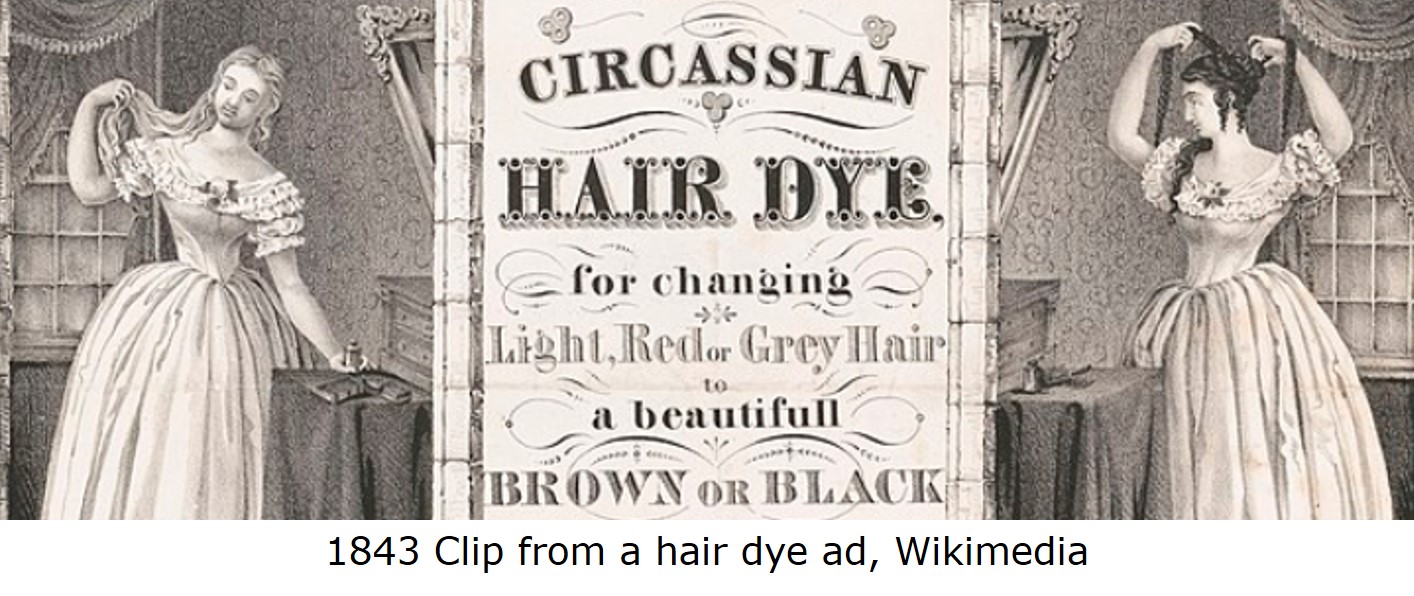
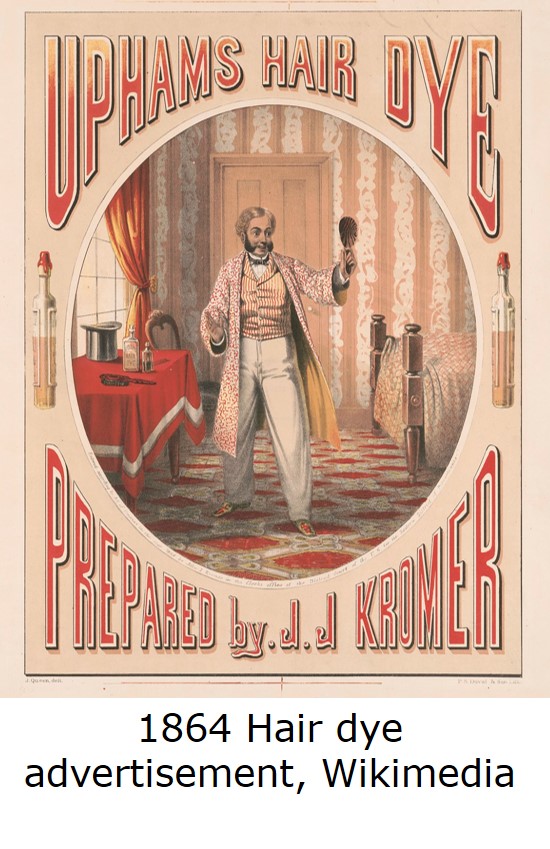
Pink, purple, and blue hair might be new trends, but people have tried to look younger and more beautiful since antiquity. Men and women alike. Natural dyes could darken hair and beards, and that’s what people wanted—darker hair. The dye advertised below promises to change light, red, or gray hair to a beautiful brown or black.


For some men, it could make the difference in getting a job or not. For example, an article in the August 1, 1902 issue of
The Brush Tribune says,

“An official of the American Federation of Labor says he knows for a fact of many men who are using dyes to hide their gray hairs ... to look young enough to be able to hold their positions ... It is every day becoming more difficult for a man past the prime of life to secure employment.”

Natural dyes, similar to those used on wool and fabric, have existed for centuries. However, different techniques are required because our hair can’t be boiled in dye like cloth can.

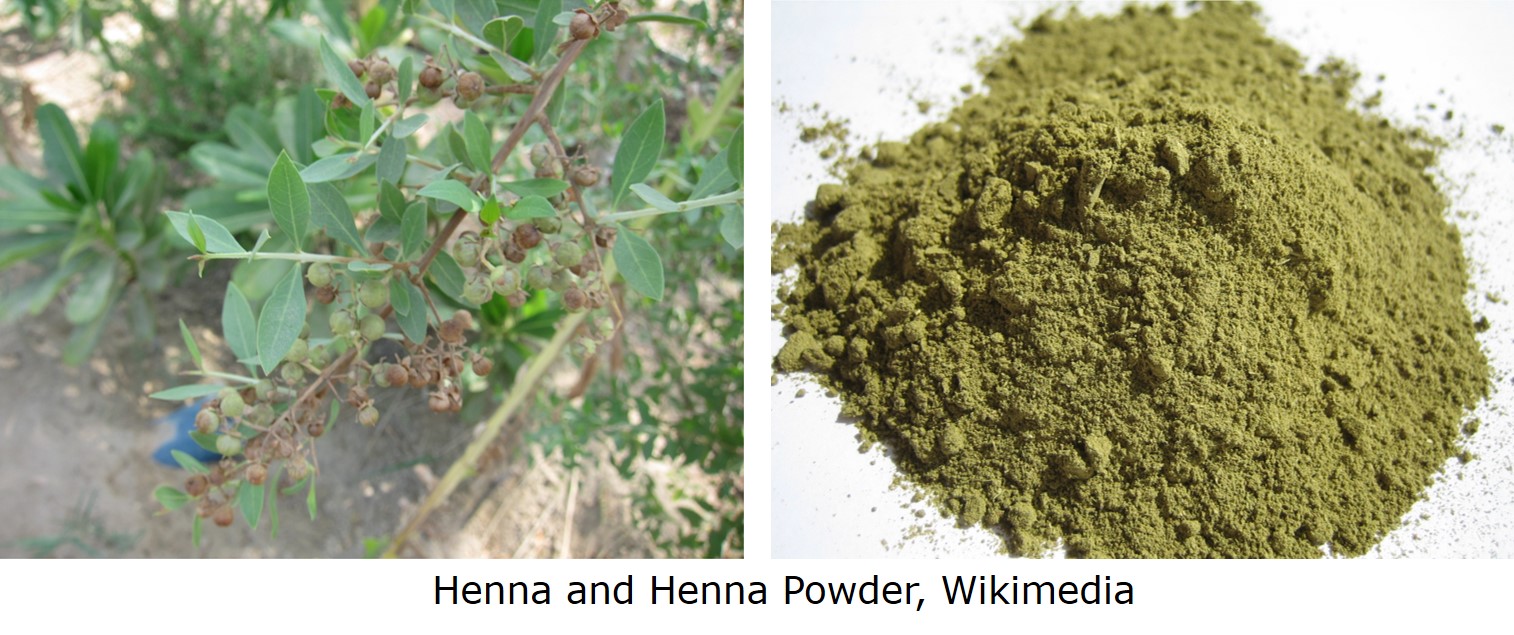
In 1500 BC, Egyptians used henna dye prepared from the plant to darken hair. Greeks and Romans created other dyes, some of which proved too toxic to use.

Although scientific discoveries took place in the 1800’s, not much changed until the early 1900s. It took time for the new technology to be commercialized and even more time for people to start using it.

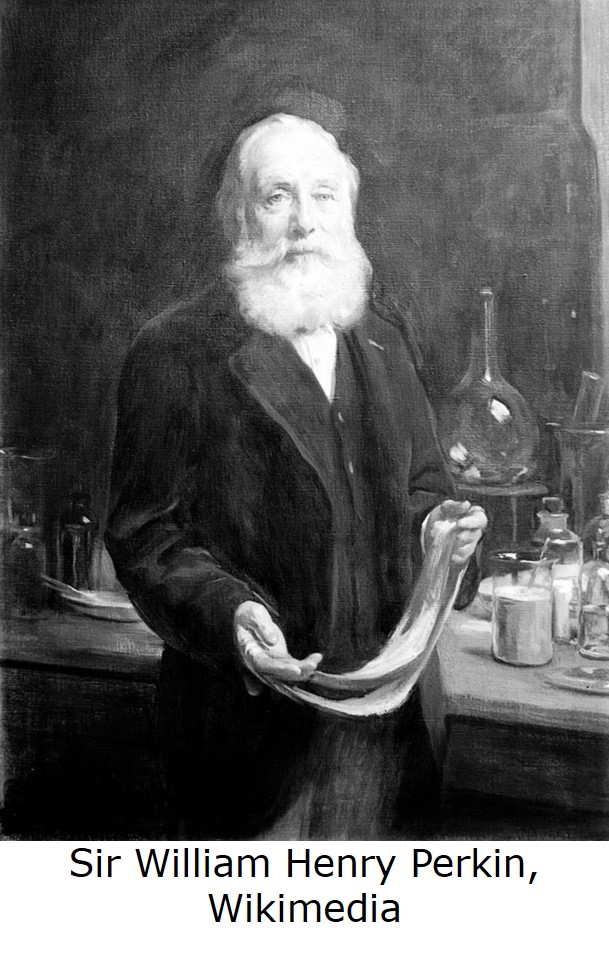
In 1863, English chemist William Henry Perkin accidentally developed the first non-natural dye. He was attempting to use coal tar to produce the malaria drug quinine. This discovery revolutionized the textile industry. The new dye produced a vivid color with staying power.


Soon after, his professor August Hoffman improved on the discovery to create the foundation for most permanent hair dyes today.

The first commercial hair dye wasn’t developed until 1907 by Eugene Schueller. He founded L’Oréal.

Since it took a while for people to adopt these new products, Margaret Mixter’s 1910 book Health and Beauty Hints provides several do-it-yourself recipes for hair dye.

One mixture to color hair black or brown hair included tea and sage. The concoction needed to be applied nightly, and it would stain the pillow. It also didn’t store well for the next day’s use.

Another natural option for brown or black hair included ground walnut shells. This one took more than a week to prepare. And hair needed to be perfectly clean before application. Any oils would ruin the job.

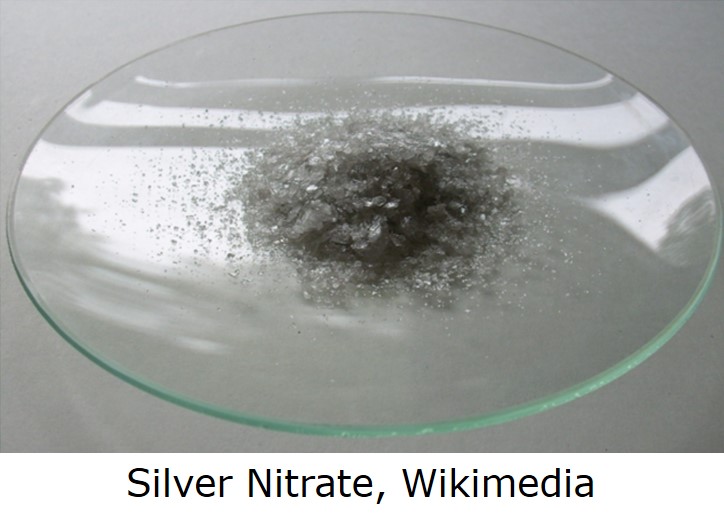
Alternatively, silver nitrate (the main ingredient in photographic negatives) could be used. Before coloring the hair, however, a sort of primer made from potassium sulfate (fertilizer) and other products was applied.


In all cases, another person needed to pull the dye through with a fine-tooth comb.

To lighten hair, bleaching with hydrogen peroxide was possible but not advised.

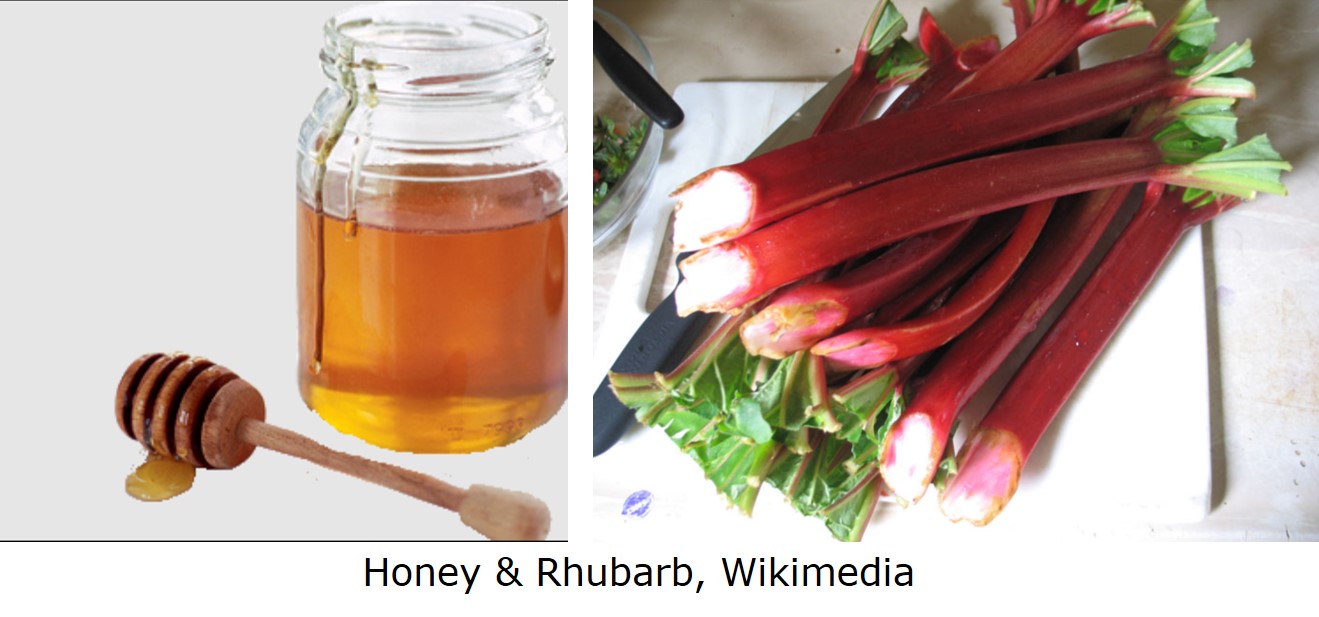
For a beautiful golden tint, henna could be mixed with honey and rhubarb powder. The person coloring their hair would sit in the sun for two hours. Then they would wash the mixture out with ammonia and sit in the sun again.


Like today, there wasn’t a good way to restore bleached or dyed hair to its original color. The
Health and Beauty Hints book says, “Advanced though science is, there is nothing yet known that will bring back the original condition quickly.” It suggests the use of oils and grease until the hair grows out.

Men and women could purchase hair dyes at the pharmacy or the barbershop. I presume these were bottled versions of the do-it-yourself concoctions. Most were designed to turn hair a “beautiful black.”


As much as I dislike spending hours at the salon, I’m glad for modern hair products. And as a redhead, I don’t want “beautiful black” hair.

***


"Mending Sarah’s Heart" in the Thimbles and Threads Collection

Four historical romances celebrating the arts of sewing and quilting.

Mending Sarah’s Heart by Suzanne Norquist

Rockledge, Colorado, 1884

Sarah seeks a quiet life as a seamstress. She doesn’t need anyone, especially her dead husband’s partner. If only the Emporium of Fashion would stop stealing her customers, and the local hoodlums would leave her sons alone. When she rejects her husband’s share of the mine, his partner Jack seeks to serve her through other means. But will his efforts only push her further away?

For a Free Preview, click here: http://a.co/1ZtSRkK


Suzanne Norquist is the author of two novellas, “A Song for Rose” in A Bouquet of Brides Collection and “Mending Sarah’s Heart” in the Thimbles and Threads Collection. Everything fascinates her. She has worked as a chemist, professor, financial analyst, and even earned a doctorate in economics. Research feeds her curiosity, and she shares the adventure with her readers. She lives in New Mexico with her mining engineer husband and has two grown children. When not writing, she explores the mountains, hikes, and attends kickboxing class.

She authors a blog entitled, Ponderings of a BBQ Ph.D.

Thursday, February 10, 2022

Wrinkles Be Gone!


By Suzanne Norquist

For centuries, women have gone to great lengths to be beautiful. No one wants wrinkles to age their face. Or crow’s feet to accent their eyes. Or a double chin. Or a skinny face.

In the early 1900s, massage techniques and creams to solve these problems abounded.

Consider this advertisement for Pompeian Massage Cream. It challenged the reader to find the forty-year-old chaperone among the group of young women. She held onto her youth and beauty through regular massage with this cream.

The 1910 book Health and Beauty Hints by Margaret Mixter devotes an entire chapter to face and neck massage.

A woman could rub gently and use a flesh-making cream to increase the roundness of the cheeks. Alternatively, she could rub vigorously and use an astringent lotion to remove a double chin or extra flesh through friction.

If only it were that easy.

All that friction explains why witch hazel was an ingredient in the massage cream recipe at the beginning of the chapter. It could dull the pain.


A face massage took at least fifteen minutes. Although, a massage to reduce a double chin took half an hour.

“With attention, the homeliest neck may be made pretty.”

One didn’t even need to buy a book to stay up on the latest beauty tips. Newspapers dispensed similar advice.

In 1907, the Las Animas Leader included a Woman’s Realm section. It shared a variety of articles for women, even beauty tips. It recommended a cheerful disposition and a massage with good skin food (which appears to be a skin cream) to reduce wrinkles. It suggested “expert facial specialists” would use electricity. Yikes!

Barber parlors also offered facial massages to beautify the complexion.

An exciting array of creams promised results. In the February 4, 1894 edition of the Pueblo Chieftain, I found an advertisement for Mrs. Harold’s Marshmallow Cream. It would fill in the hollows in the cheeks and around the eyes. “It is magical in its results and so harmless you could eat it.”

My favorite find was a “machine,” which was basically a rubber straw with a suction cup on the end. A lady would put the cup on her face and suck through the straw to create a vacuum, which was a way of massaging the face to get rid of wrinkles.

“The cup is moved from the center of the face outward and upward while sucking.”

Another device for sale was a massage ball because “No woman wants crow’s feet and forehead wrinkles.” It could make all parts of the face beautiful.

As much as I laugh about these old beauty tips, I must remember what we do today in the name of looking young. When I Googled “massage for double chin” for this blog, I found that I could purchase chin straps with massagers from many big box stores.

Nothing much has changed.

***


”Mending Sarah’s Heart” in the Thimbles and Threads Collection

Four historical romances celebrating the arts of sewing and quilting.

Mending Sarah’s Heart by Suzanne Norquist

Rockledge, Colorado, 1884

Sarah seeks a quiet life as a seamstress. She doesn’t need anyone, especially her dead husband’s partner. If only the Emporium of Fashion would stop stealing her customers, and the local hoodlums would leave her sons alone. When she rejects her husband’s share of the mine, his partner Jack seeks to serve her through other means. But will his efforts only push her further away?

For a Free Preview, click here: http://a.co/1ZtSRkK 


Suzanne Norquist is the author of two novellas, “A Song for Rose” in A Bouquet of Brides Collection and “Mending Sarah’s Heart” in the Thimbles and Threads Collection. Everything fascinates her. She has worked as a chemist, professor, financial analyst, and even earned a doctorate in economics. Research feeds her curiosity, and she shares the adventure with her readers. She lives in New Mexico with her mining engineer husband and has two grown children. When not writing, she explores the mountains, hikes, and attends kickboxing class.

She authors a blog entitled, Ponderings of a BBQ Ph.D.

Friday, December 10, 2021

Put Some Color in Your Cheeks - 1910

 By Suzanne Norquist

As I prepare for holiday parties, I appreciate how fortunate I am to have modern cosmetics.

Even in antiquity, people altered their appearance through the use of crude makeup. They put various substances on their cheeks to give them a healthy, pink glow. Many of the chemicals were non-toxic, but some turned out to be poisonous.

Those without access to cosmetics tried to obtain the look naturally. When a gentleman came to call, a young woman might pinch her cheeks to bring out the color.

I recently ran across a 1910 book of health and beauty tips—some of which my great-grandmother would have used.


The book provides several ways to produce pink cheeks. They varied in complexity and materials required. Alternating hot and cold compresses until the skin had a nice glow was one of the more straightforward methods. Then cold cream would be applied to the skin to prevent chapping. I can’t imagine this method producing lasting results. It seems like a variation on cheek pinching.

Grandmothers of the ladies in 1910 mixed beet juice with starch or rice powder. It was dried in the sun and sifted through muslin before use.

A harsher method was to make a paste of glycerin, English mustard, and flour. It was supposed to bring the blood to the surface, coloring the cheeks.

“As soon as there is a sensation of smarting, the paste is washed off, and a few drops of glycerin rubbed into the flesh to prevent irritation.”

If this concoction was left on too long, it could cause blistering. Yikes!

The book contains a recipe for Harmless Rouge. Here are the ingredients:

Carmine, one-quarter dram

Sweet almond oil, one-half dram

Powdered magnesia, one ounce

I wouldn’t begin to know how to make this. Curious, I started by looking up the word dram. It seems to have been used by bartenders to measure whiskey and by apothecaries to measure chemicals. One dram is about 1/8th of an ounce.

Sweet almond oil is available today as a skin moisturizer. But what about carmine and powdered magnesia?

Carmine is a bright red substance extracted from an insect (the cochineal). It has been used as a dye for clothing or paints for centuries. To my surprise, it is still used today, even in foods. You can buy it on e-bay.

Powdered magnesia is another name for magnesium carbonate. Its uses vary from dietary supplements, drying salt, and keeping rock climbers’ hands dry.

Nothing harmful there. Here are the instructions:

To mix, mingle the carmine and powder, and then slowly work into the oil. The preparation should be forced through coarse muslin several times, pressing out the lumps. It will be in powder form, the oil being absorbed.

One could also whip up a rouge with rice powder, carmine, ocher (an orange clay pigment), and maybe some cold cream.

I’m glad I can pick up a pre-made container of blush at any retailer. However, I wonder what people of the future will think when they look back at our methods of keeping our cheeks pink.

***

”Mending Sarah’s Heart” in the Thimbles and Threads Collection


Four historical romances celebrating the arts of sewing and quilting.

Mending Sarah’s Heart by Suzanne Norquist

Rockledge, Colorado, 1884

Sarah seeks a quiet life as a seamstress. She doesn’t need anyone, especially her dead husband’s partner. If only the Emporium of Fashion would stop stealing her customers, and the local hoodlums would leave her sons alone. When she rejects her husband’s share of the mine, his partner Jack seeks to serve her through other means. But will his efforts only push her further away?

For a Free Preview, click here: http://a.co/1ZtSRkK


Suzanne Norquist is the author of two novellas, “A Song for Rose” in A Bouquet of Brides Collection and “Mending Sarah’s Heart” in the Thimbles and Threads Collection. Everything fascinates her. She has worked as a chemist, professor, financial analyst, and even earned a doctorate in economics. Research feeds her curiosity, and she shares the adventure with her readers. She lives in New Mexico with her mining engineer husband and has two grown children. When not writing, she explores the mountains, hikes, and attends kickboxing class.

She authors a blog entitled, Ponderings of a BBQ Ph.D.


Friday, October 3, 2014

BEAUTY THROUGH HISTORY By Cynthia Hickey


Beauty in the 1800s


Women have always cared about their appearance. Here are a couple of shampoos guaranteed to do the job!


Old Time Hair Tonic Recipes from the Early 1800’s:

OIL TONIC TO MAKE HAIR GROW AND CURL
½ Pint olive oil
1/8 oz. each oils of rosemary and origanum
Mix well and apply freely.

Note: Olive oil and rosemary oil are quite common to find. Origanum is easily obtained from any store that sells essential oils and is an oil with antifungal, stimulating tonic properties. Since this mixture would be very oily, the recommendation is for use as a deep conditioning treatment with steam before shampooing.

SHAMPOO TO MAKE HAIR CURL
2 lbs common soap
3 pints spirits of wine
3 oz. potash
Cut the soap in small pieces and melt all ingredients together, stirring it with a clean piece of wood; then add a quarter of an ounce each of essence of amber, vanilla and nervoli and mix well. Use as a shampoo.

Note: These are quite old recipes and difficult to find such ingredients as 'common' soap which could be no more than harsh detergent or lye soap. The name potash comes from the English wording Pot and Ash. Ashes from burned hardwood trees would be used to make lye, which could either be used to make soap or boiled down to produce valuable potash. So you can see this recipe was primarily just soap-and not necessarily good quality soap. Spirits of wine is merely rectified ethyl alcohol or grain alcohol - defined as the intoxicating agent in fermented and distilled liquors; used pure or denatured as a solvent or in medicines and colognes and cleaning solutions and rocket fuel...that doesn't sound good. I don't recommend doing what early Americans did to curl their hair with this recipe.


European noblewomen used to bind their faces, every night on going to bed, with thin slices of raw beef, which is said to keep the skin from wrinkles, while it gives a youthful freshness and brilliancy to the complexion. Others used whale sperm to give them a youthful appearance.


Next time you dry your hair, why not follow this advice from a 1858 book, Dick’s Encyclopedia of Practical Receipts and Processes by William Dick, which recommends a hair drying process that seems perfect for budding arsonists. He said the woman should lie on a couch with her hair falling over one end. Place beneath the hair a pan of burning charcoal bits sprinkled with benzoin powder (benzoin is the fragrant dried sap from Southeast Asian trees). The smoke would dry and perfume the lady’s lovely mane.


Here’s a fun tidbit I found on the internet about the ever-changing female silhouette.


1700s: The pear 

    • Necessity of field work makes a large, muscular physique ideal.
    • Eyebrows are shaven and replaced with press-on mouse-skin brows.
    • The average woman is a mother of eight; large hips are sign of fertility.

Early 1800s: The rectangle

    • “Corset Mecaniques” make corsets more user-friendly.
    • Indoor lifestyle makes women pale and frail.
    • Small feet and rosebud lips accompany prim and reserved personality.

Mid 1800s: The bell

    • Ideal woman is curvy with big hips.
    • Corset becomes controversial because of restrictiveness.
    • Clothing sizes are developed.

Late 1800s: The hourglass

    • Beauty culture develops in the U.S.; first notions of mass-produced beauty.
    • Through early 1900s women have small waists and large updos.

Early 1900’s: The thin rectangle

    • The average woman is 5′ 2″ tall and weighs 129 pounds.
    • The brassiere is patented in 1913.
    • In the 1920s women bind their breasts to gain more boyish figure.
    • “Flappers” show skin and women become more self-conscious.
    • Shaven armpits become popular.
    • Comfort and freedom are priorities; bobbed hairstyle popular.
    • First Miss America pageant is held in 1921.

Mid 1900s: The hourglass

    •   Marilyn Monroe embodies the ideal figure.
    • Pin-up girls make large breasts popular.
    • Large hips come back in style with the baby boom of the 1950s.
    • Shaven legs become popular, sometimes by use of sandpaper.
    • First official weight-loss drug approved by FDA in 1959.
    • The ideal thins out again in the 1970s, repeating trend of the 1920s.


1980s: Muscular and toned

    • Death of Karen Carpenter raises awareness of eating disorders.
    • Excercise tapes become the new trend.
    • Muscular woman is prominent but boyish figure is popular and voluptuous curves gain popularity.

Styles keep changing, some reverting to vintage styles. What will the future hold for women’s beauty? Will it be a combination of all of them from the past?   

What was the craziest thing you’ve ever worn?


   Multi-published and Best-Selling author Cynthia Hickey had three cozy mysteries and two novellas published through Barbour Publishing. Her first mystery, Fudge-Laced Felonies, won first place in the inspirational category of the Great Expectations contest in 2007. Her third cozy, Chocolate-Covered Crime, received a four-star review from Romantic Times. All three cozies have been re-released as ebooks through the MacGregor Literary Agency, along with a new cozy series, all of which stay in the top 50 of Amazon’s ebooks for their genre. She has several historical romances releasing in 2013, 2014, 2015 through Harlequin’s Heartsong Presents, and has sold more than 250,000 copies of her works. She is active on FB, twitter, and Goodreads. She lives in Arizona with her husband, one of their seven children, two dogs and two cats. She has five grandchildren who keep her busy and tell everyone they know that “Nana is a writer”. Visit her website at www.cynthiahickey.com