Showing posts with label bridges. Show all posts

Sunday, November 28, 2021

Historic Bridges in America – with giveaway By Donna Schlachter


photo source: STRUCTURE Magazine


Mention historic bridges, and for many of us, our minds flash to the old covered bridges in the Midwest. And while many have survived, most were replaced by permanent stone structures after the wood rotted or the bridge succumbed to a flood or, worse yet, the ravages of war.

However, there are still plenty of old bridges in America, so let’s take a cross-country tour and check out a few. The list is by no means exhaustive. A bridge included here doesn’t make it more historically important than one not on it. This blog post simply highlights stories and styles of old bridges.

Constructed in 1804, the Union or Waterford Bridge was the first bridge built across the lower part of the Hudson River. It connected the towns of Waterford and Lansingburg. Burr combined a wooden arch with a truss to strengthen Union Bridge and provide stiffness. This was the first time this kind of building technique was used in the US, and Burr later patented his truss/arch pattern. The bridge is still in use.


photo source: Wikimedia Commons


Kingston Bridge is the second oldest bridge in the county after the Old Stone Arch Bridge. The original wooden bridge was destroyed during the Revolutionary War and rebuilt as a stone arch structure in 1798 as part of the King’s Highway near Kingston, NJ. Although the bridge is more than 220 years old, it still retains its original roadway grade and is still being used today.
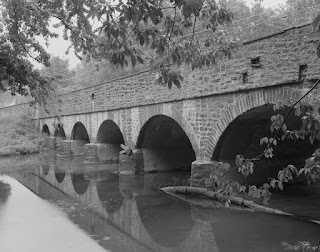


Skippack Bridge is an eight-arch stone bridge built in 1792 in Lower Providence Township, PA, and is thought to be the oldest bridge in the United States that retained its original dimensions. Before the bridge was built, several attempts were made to build a bridge connecting the eastern and western parts of Montgomery County starting in 1762. Funkites, exiled Mennonites who supported the Revolutionary War, sought religious and political refuge in this area. It is still in use today.
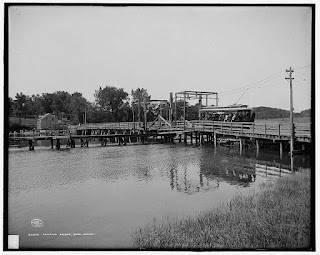


Sewall’s Bridge in York, Maine is one of the oldest wooden bridges in America, and it is the earliest wooden pile-trestle bridges that has an authentic construction record and builder’s drawings still in existence in America. The original was in use for 173 years, before being replaced in 1934 by a modern wooden pile bridge, and is still in use today.

Smithfield-Street-Bridge.jpeg 

The Smithfield Street Bridge is Pittsburgh’s oldest bridge in a city dubbed “City of Bridges”. The iconic lenticular truss bridge officially opened on March 19, 1883, and is the second-oldest steel bridge in the United States.
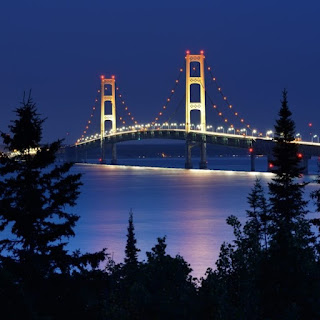

Mackinac Bridge, dubbed the “Mighty Mac,” spans the confluence of Lake Michigan and Lake Huron. This suspension bridge is newer than the others in this post, but still more than 60 years old. Five miles of swaying deck carry drivers over the swirling Straits of Mackinac. First opened in 1957, the bridge offered travelers an alternative to the existing ferry. On a windy day, the bridge can shift more than 30 feet side to side. For a good look at the bridge in real time, check out the official bridge cam.


Beautiful bridges come in all styles, shapes, and sizes. Constructed of stone, wood, or cast iron, these relics of the past call us to adventure. Check out these and other historic bridges, and make plans to stop along the way to learn their histories and their stories.

Giveway: While there are no physical bridges mentioned in Justice for Julia, there are emotional spans to cross. Leave a comment to be entered into a random drawing for a print (US only) or ebook copy.

About Justice for Julia:

 A woman doctor in 1868 is wrongly accused of medical malpractice, and she flees into rural Iowa in search of a new start. A loving father snatches his daughter from her abusive mother, and heads west, hoping to keep her safe and him out of the clutches of the law. Can they really begin a new life? Or will they be forced to return to the  bad situations they both escaped from?

https://www.amazon.com/dp/B09H9RFQX1


Donna writes historical suspense under her own name, and contemporary suspense under her alter ego of Leeann Betts, and has been published almost 50 times in novellas, full-length novels, and non-fiction books. She is a member of several writing communities; facilitates a critique group; teaches writing classes; ghostwrites; edits; blogs regularly; and judges in writing contests.

www.HiStoryThruTheAges.com


Resources:

https://www.oldest.org/structures/bridges-us/

https://www.arcadiapublishing.com/Navigation/Community/Arcadia-and-THP-Blog/December-2017/Best-Historical-Bridges-in-America

https://www.travelawaits.com/2562626/historic-bridges-in-us/


Saturday, March 5, 2016

Covered Bridges ~ Spans to the Past


by Ramona K. Cecil

Few images are more bucolically iconic than the humble covered bridge. A favorite subject for the artist’s canvas, photographer’s camera, and writer’s page, these historic wooden structures span more than rippling streams. They are literal spans to America’s past.

For me, growing up in rural Indiana, covered bridges were a common fixture to which, I gave scant thought. Only when they began to decay and disappear did I begin to look upon the remaining ones with a sentimental eye.

Covered bridges date back hundreds of years and are found all over the world, primarily in the continents of Asia, Europe, and America. The main reason for covering a bridge was to prolong the life of the structure by protecting it from the weather and subsequent rot. The life of a covered bridge can be three times that of an uncovered span. Also, enclosing a bridge and covering it prevented skittishness in horses and other animals when crossing a moving stream, causing the animal to feel it was entering a barn. Another advantage of covering a bridge was to prevent the bridge’s floor planks from becoming slippery in the rain and snow. Besides these obvious advantages, covered bridge provide other benefits like shelter during a sudden storm. As a romance novelist, I like that covered bridges are often called “Kissing Bridges” as they provide a secluded place for courting couples to share a secret kiss. 

Kissing Bridge - Ontario, Canada
World's Longest Covered Bridge: Canada

Below are examples of covered bridges from around the world.


Oldest covered bridge in Europe
Lucerne, Switzerland built in 1333


Xijin Bridge, China


Saya Bridge, Kotohira, Japan


Covered bridge, Thuringia, Germany
At one time, over 12,000 covered bridges existed in the United States. Now only a fraction are left. East Swanzey, New Hampshire claims the site of the oldest covered bridge in America. Their Carlton bridge, built in 1869 that spans the Ashuelot River there was preceded by an earlier covered bridge built in 1789. 
Carlton Bridge, East Swanzey, New Hampshire

Bridges are identified by their designs. Here are some of the more common bridge designs.


Bell Ford Covered Bridge, Jackson County, Indiana
The covered bridge I remember best was the Bell Ford covered bridge in my county of Jackson in southern Indiana. Built in 1869, the bridge spanned the East Fork of the White River. Growing up, I lived on the west side of the river. The nearest town was east of the river, so every time we went to “town,” we crossed the Bell Ford bridge. 

As an interesting aside, remember the “kissing bridge” reference earlier? The small rural community on the west side of the Bell Ford span of White River is named Cortland, supposedly a misspelling of “courtland” because it was said that courting couples from the nearby town frequented the place.

Interior of the Bell Ford Covered Bridge
I didn’t realize it at the time, but the Bell Ford bridge’s combination Post truss construction was somewhat unique. Built when bridge construction was evolving from wood to iron and steel, the Post truss combination, invented by Simeon S. Post, utilized both materials. A combination of the Pratt and Warren truss designs, every tinsel web in the trusses were made with iron and every compression member made of wood. In 2005, the Bell Ford bridge was listed in the Indiana National and State Register of the Department of Natural Resources as “the best representation of the American engineering ‘combination’ bridge form.” Who knew? All those times I traversed the shaded interior of the covered bridge and marveled at the web of steel cables that criss-crossed the wooden planks, I had no idea of their uniqueness. Built in two sections, the bridge stood for a century until February of 1999 when a strong windstorm took down the western section. The eastern section stood another seven years until it collapsed in January of 2006. Two years later the remains of the bridge were sold to a historical interest group who built a  replica of the bridge at Fort Benjamin Harrison in Indianapolis, Indiana.

While the Bell Ford bridge no longer spans the East Fork of the White River, Indiana still boasts a fair number of covered bridges, most notably in Parke County, located in the west central part of the state. Each October, Parke County celebrates their thirty-one covered bridges with a Covered Bridge Festival, proclaiming themselves the “Covered Bridge Capital of the World.”

Do you have a favorite covered bridge or memory of one? I’d love to hear about it.


Ramona K. Cecil is a poet and award-winning author of historical fiction for the Christian market. A proud Hoosier, she often sets her stories in her home state of Indiana.


Check out her website at www.ramonakcecil.com 

http://www.amazon.com/s/ref=nb_sb_ss_i_2_10?url=search-alias%3Dstripbooks&field-keywords=a+bride%27s+agreement+cecil&sprefix=A+bride%27s+%2Cstripbooks%2C172 

Monday, January 5, 2015

Trains on Ice

by Anita Mae Draper


Some of you may be familiar with ice roads from watching tv shows like the History channel's reality series, Ice Road Truckers. Ice roads have been used for years as an efficient method of travel where ice freezes to a deep thickness from December to March or April.


Photographie | Transport du foin au marché de l'autre côté du fleuve Saint-Laurent, QC, 1903 | VIEW-3618
Transportation hay to market across the St. Lawrence River, QC, 1903. Courtesy of McCord Museum VIEW-3618


And along with vehicle roads on ice, there were ice bridges for trains, often called ice railways. Now trains are heavy when compared to early cars or horses and hay wagons, and even much heavier than the 18-wheel trucks you see on Ice Road Truckers which means you need very thick ice to support the weight. Extremely thick ice.

Back in the early 1980's when I was a member of the Canadian Armed Forces and on exercise in Yellowknife in Canada's Northwest Territories, I got my first look at an ice road. It seemed to be nothing more than a line slaking across the North Arm of Great Slave Lake as shown in this photo I took on that cold March day.


Now imagine a heavy locomotive travelling on that stretch. Scary, isn't it? Why did railway owners take the chance with their freight and human lives to travel across ice? Time, money, practicality.

Before the railway bridge was erected in 1883 at Bismark, ND, goods and people were transported across the Missouri River by steamboats. When the river froze however, they erected a railway to continue the service.

The following 2 photographs show the Northern Pacific laying track and then crossing the frozen Missouri River at Bismark. In the Harper's Weekly image, railroad workers laying ties and rails across the ice while people watch. In the background, a train in reverse position with a flatbed provides the materials necessary to complete the task.

Across the Missouri River by rail, at Bismarck, Dakota, 1879.  Courtesy of the Territory Institute for Regional Studies, NDSU, Fargo (Folio 102.TrR34.1a)


Northern Pacific Railroad ice bridge over the Missouri River, March 1879. Courtesy of the Institute for Regional Studies, NDSU, Fargo (2029.15.1)


An 1880 ice bridge across the St Lawrence River was created as a protest against the high cost of using Montreal's Victoria Bridge. When the Grand Trunk Railroad opened the Victoria Bridge in 1859, it was hailed as the 8th Wonder of the World. However, the 6 million dollar price tag needed to be recouped somehow and it was done by charging high rates to cross.

Instead of using the bridge, competitor trains were ferried across the river in summer. Once the river froze to a minimum depth of  60 cm/24 inches along the 2 km/1.24 mile stretch, extra-wide beams placed every 7 feet helped distribute the heavy weight evenly over the wide surface area.


Photograph | Railway on the ice over St. Lawrence River, Montreal, QC, 1880 | VIEW-1141.1
Railway on the ice over St. Lawrence River, Montreal, QC, 1880. Courtesy of www.mccord-museum.qc.ca/ObjView/v1141


Here's another view of the above ice bridge, also taken by noted photographer, William Notman. In this photo, you can clearly see how the tracks were placed upon the ice.


Ice Bridge across the St Lawrence, 1880. Courtesy of the National Archives of Canada William Notman Collection

Unfortunately, on January 5, 1881, the ice suddenly gave way beneath the locomotive and it sank, but not before the passengers were able to scramble out and away. This is depicted in the following drawing found in the January 15, 1881 Canadian Illustrated News.


Train Breaks Through Icy Saint Laurent, Jan 5, 1881. Coutesy of Bibliotheque et Archives nationales du Quebec

History notes that the very next day, a lighter train was used and the train continued ferrying goods and people across the river each winter until 1883.

Sometimes ice bridges were put up for a single use occasion, such as on Christmas Eve, 1879, when rails were laid on the ice across the Red River from St. Boniface to Winnipeg, Manitoba in order to receive a new locomotive, the "J.G. Haggart", which had been purchased from the Baldwin Locomotive Works of Philadelphia.

In 1899, the Scientific American reported that the Trans Siberian Railroad had built an ice bridge across the River Irtish and Baikal Lake.


And finally in 1923, Alaska Railroad built an ice bridge across the Tanana River at Nenana just prior to completing the railroad.


Alaska Railroad engine crossing the Tanana River on the ice at Nenana, 1923. Courtesy of Wikicommons.

1923 is the last reference I've found of a train crossing on ice. I suppose that with vehicles increasing in size and roads becoming easier to travel long distance trucking supplanted the need. Light vehicles certainly would have been safer.

But oh, it would have been majestic to watch a huffing locomotive travel across the frozen water.

Don't you think so?

~~~~~~~~~~~~~~~~~~~

Anita Mae Draper is retired from the Canadian Armed Forces and lives on the prairie of southeast Saskatchewan, Canada with her hubby of 30 plus years and the youngest of their four kids. She writes cowboy stories set in the West, and Edwardian stories set in the East.  Anita is blessed to have two short stories in Guideposts Books A Cup of Christmas Cheer collection which includes Here We Come A-Wassailing, published in Volume 4 Heartwarming Tales of Christmas Present, October 2014, and Riding on a Christmas Wish  published in Volume 1 Tales of Faith and Family. Anita Mae is represented by Mary Keeley of Books & Such Literary Management. You can find Anita Mae at   www.anitamaedraper.com