Showing posts with label combat. Show all posts

Saturday, October 17, 2015

The Amazing B-17 Bomber in WWII

By Golden Keyes Parsons


More tension. More conflict. My agent returned a manuscript set in World War II asking for more action. The setting is in the States, but the heroine's husband is a bombardier in a B-17 in Europe, so I decided to garner more action by visiting that scenario.

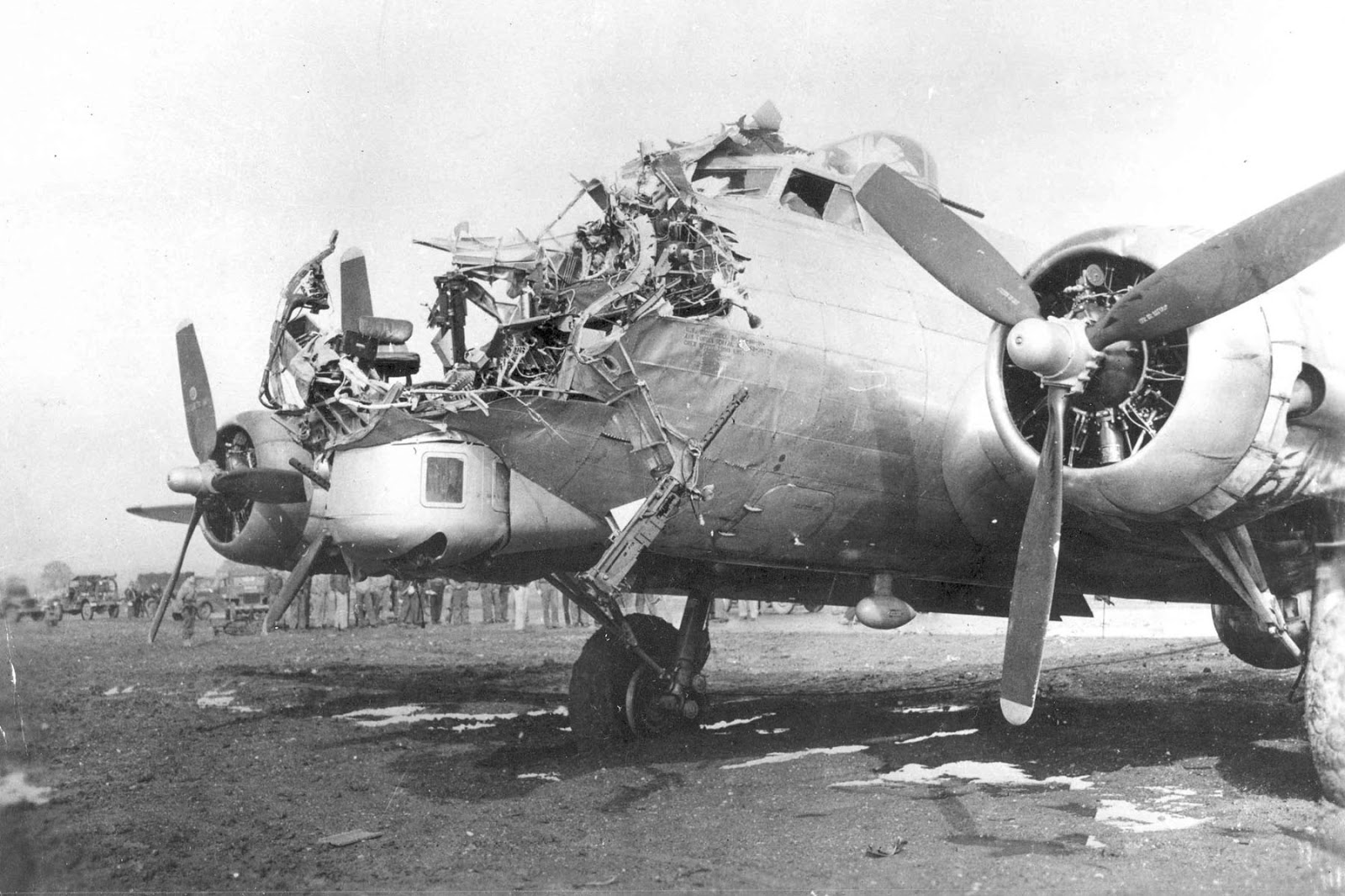
I had no idea what a fascinating subject I had chosen. The B-17 bomber was an incredible aircraft flown by amazing men. The Boeing aircraft was conscripted into service to man bombing runs into Europe to destroy Germany's industrial capabilities, including aircraft factories and ammunition depots. It became known as the Flying Fortress after a reporter upon seeing the aircraft bristling with multiple machine gun turrets remarked, "Why, it's a flying fortress!" The name stuck, not only because of the protruding guns but also because of the stability of the aircraft. The plane was capable of sustaining hits which would cripple another aircraft, but the B-17 seemed to be able to fly in spite of it.
A crew of ten young men manned the B-17 bomber: the pilot, co-pilot, navigator, flight engineer, bombardier, radio operators, and various gunners. Most of them were between 19-25 years of age. The loss of life was incomprehensible after they began the bombing raids. The German "Butcher Birds" were too fast and the B-17s were virtually sitting ducks as they flew in their static bombing formation. The crew members wrote of being able to see the faces of the German pilots grimacing as they attacked them. However, they had to maintain their formation, otherwise the bombs would go astray and miss the target.
That is until the P-51 Mustangs were brought into service. These amazing fighter planes could outmaneuver the German Butcher Birds and greatly slowed down the loss of American lives. The B-17 crews called them their "Little Friends." They breathed a sigh of relief on the bombing runs after they sighted the Mustangs on the horizon coming to their rescue.


Probably the most famous B-17 was the Memphis Belle. Two movies have
been made about the flying missions of the aircraft. She was one of the first B-17 bombers to complete 25 missions with her crew intact. The crew was subsequently sent back to the States to raise war bonds.

I read volumes on the subject of this phase of our history and watched several documentaries, fascinated by the bravery and sacrifice of the men who flew these missions. I can't even imagine what these men and their families went through. I fear we've lost that kind of valor in our country. I hope not. I salute and honor the veterans who have served our country and are now in the service
of our country. For a riveting read about this phase of our history, I highly recommend "A Higher Call" by Adam Makos. It relates the true story of both an American pilot and a German pilot and their parallel journies which collide in the sky over Germany.

Do you have a story about a war veteran in your family? Share it with us, and God bless your family for giving in service to our country. I salute my brother, Scotty Keyes, a Marine, who gave his life in combat in Vietnam.

Although a multi-published fiction author, Golden Keyes Parsons’ first published non-fiction work, Spiritual Spring Cleaning, (BoldVision Books) just released in April 2015. Her series, Darkness to Light, (Thomas Nelson) chronicled the journey of her ancestors in 17th century France and was a finalist for ACFW’s Debut Author of the Year in 2008. Her fourth novel, His Steadfast Love, a Civil War novel, was a National Readers Choice finalist. Parsons has also written a biblical fiction series entitled Hidden Faces, Portraits of Nameless Women in the Gospels (WhiteFire Publishing). Golden lives in Waco, TX, with her husband, Blaine. www.goldenkeyesparsons.com. 

Saturday, February 14, 2015

WACs SERVE IN WORLD WAR II

ANNE GREENE here:

World War II initiated vast economic and social changes, and altered the role of women in American society.

Over 150,000 American women served in the Women's Army Corps (WAC) during World War 11. WACs were the first women other than nurses to serve in the United States Army. Both the Army and the American public initially had difficulty accepting the concept of women in uniform. However, military leaders, faced with fighting a two-front war and supplying men for that war, realized women were desperately needed. Women seized the opportunity to make a major contribution to the national war effort.


In the beginning WACs were called WAACs, Women's Army Auxiliary Corps. The WAAC bill permitted women to serve overseas, but failed to provide them with the overseas pay, government life insurance, veterans medical coverage, and death benefits granted Regular Army soldiers. If WAACs were captured, they had no protection under existing international agreements covering prisoners of war.

The day the bill became law, Oveta Culp Hobby was appointed Director of the WAAC. Oveta Culp Hobby believed strongly in the idea behind the Corps. Every woman enlisted would be trained in a noncombatant military job and "free a man for combat." Hobby explained, "The gaps women will fill are those noncombatant jobs where women's hands and women's hearts fit naturally. WAACs will do the same type of work which women do in civilian life. They will bear the same relation to men of the Army that they bear to the men of the civilian organizations in which they work." WAACs were to help the Army win the war, just as women had always helped men achieve success.

On 20 July the first officer candidate training class of 440 women started a six-week course at Fort Des Moines. The average officer candidate was 25 years old, had attended college, and worked as an office administrator, executive secretary, or teacher. One out of every five enlisted because a male member of her family was in the armed forces and she wanted to help him get home sooner. Several were combat widows of Pearl Harbor and Bataan. One woman enlisted because her son, of fighting age, had been injured in an automobile accident and was unable to serve. Another joined because there were no men of fighting age in her family. All of the women desired to aid their country in time of need by "releasing a man for combat duty."

Women were assigned as weather observers and forecasters, cryptographers, radio operators and repairmen, sheet metal
workers, parachute riggers, link trainer instructors, bombsight maintenance specialists, aerial photograph analysts, and control tower operators. Over 1,000 WAACs ran the statistical control tabulating machines (the precursors of modern-day computers).  By January 1945 only 50 percent of AAF WACs held traditional assignments such as file clerk, typist, and stenographer.

Some WACS computed the velocity of bullets, measured bomb fragments, mixed gunpowder, and loaded shells. Others worked as draftsmen, mechanics, and electricians.

Many processed men for assignment overseas, handling personnel files and issuing weapons. In the words of one WAAC, "Soldiers come in here unarmed and leave with a gun. It gives me a pretty good feeling." WAACs served as boat dispatchers and classification specialists.

Near the end of 1944, women replaced men as radio operators on U.S. Army hospital ships. Female secretaries and clerical workers were assigned to hospital ships soon after.

WAACs assigned to the Chemical Warfare Service worked in laboratories as glass blowers and made test tubes for the Army's chemical laboratories. Others field tested equipment such as walkie-talkies and surveying and meteorology instruments.

Over 1,200 WAACs worked as telephone switchboard operators, radio operators, telegraph operators, cryptologists, and photograph and map analysts.

WAACs were used as laboratory, surgical, X-ray, and dental technicians freeing Army nurses for other duties.

WACs served in North Africa, the Mediterranean, Europe, the Southwest Pacific, China, India, Burma, and the Middle East. They coveted overseas assignments, even though the majority consisted of the clerical and communications jobs. Only the most highly qualified women received overseas assignments.

The first WAAC unit overseas reported on 27 January 1943 to General Eisenhower's headquarters in Algiers. They served as postal workers, clerks, typists, and switchboard operators. Nightly bombings and antiaircraft fire made sleep difficult, but the women acclimated. A WAAC signal company arrived in November to take jobs as high-speed radio operators, tele-typists, cryptographic code clerks, and tape cutters in radio rooms.

The American press reported favorably on the WAAC, sympathetic to their adjustments to military life and the job and travel opportunities for those who enlisted.

Unfortunately, a variety of social factors combined to produce a negative public image of the female soldier. Eighty four percent of letters home from enlisted men contained criticism of female soldiers.

Anti-WAAC feelings originated with enlisted soldiers who did not want to be "freed" for combat. The mothers, wives, sisters, and fiancées of these men were also not anxious to see them sent into combat. They blamed the WAACs and believed the worst rumors about them and repeated such gossip to their friends and neighbors. Thus WACs got a bad reputation.

Many of these soldiers had never seen a WAAC. But they were away from home and facing dangers. Many kept up their spirits by imagining their return to family and community. Which they wanted unchanged! Women in the military represented change.

Rumors said ninety percent of WAACs were prostitutes and forty percent were pregnant.  

Americans of the 1940s found the concept of women in uniform difficult to accept. They couldn’t believe the highly skilled office jobs which the WACs held, because such positions carried significant responsibility and people doubted women could handle such jobs.

Women in the Army broke the stereotypes which restricted them, moving into positions outside traditional roles. Overcoming slander and conservative reaction by many Americans, women contributed to the war effort. The 1943 transition from WAAC status to WAC recognized their valuable service.


General Douglas MacArthur, the Supreme Allied Commander, praised the WACs calling them “my best soldiers.” He alleged they worked harder than men, complained less and were better disciplined. . .he would take any number of the WACs the War Department would give him in any future command he might ever have.
Did any female member of your family serve during World War II? Please leave a comment and Anne will love visiting with you.


ANNE GREENE delights in writing about wounded heroes and gutsy heroines. ANGEL WITH STEEL WINGS, Anne’s WWII WASP romance about a Women’s Air Force Service Pilot, releases soon. Look for it on Amazon. Anne’s highest hope is that her stories transport the reader to awesome new worlds and touch hearts to seek a deeper spiritual relationship with the Lord Jesus. Anne makes her home in McKinney, Texas. She loves to talk with her readers. Buy Anne’s books at http://www.Amazon.com. Talk with Anne on twitter at @TheAnneGreene. View Anne’s books, travel pictures and art work at http://www.AnneGreeneAuthor.com.

Learn more about Anne as well as get tips on writing award-winning books at http://www.anneswritingupdates.blogspot.com.




Wednesday, January 14, 2015

FLY GIRLS - LADY WWII PILOTS

Anne Greene here. I’ll be doing a series of postings in the next few months on the many important roles women played during World War II. Also today I have a BOOK GIVE-AWAY, so please leave a comment for a chance to win. 

In 1942, the United States faced a severe shortage of pilots. President Roosevelt decided to train women to fly military aircraft so male pilots could be released for combat overseas. Congress named the females Women Airforce Service Pilots – WASP. The ladies surprised US Army Air Force Command General, Hap Arnold, who wasn’t sure “A slip of a girl could fight the controls of a B-17 in heavy weather.”


More than 1,100 lady civilian volunteers flew every type of military aircraft including the B-26 and B-29 bombers as part of the WASP program. They tested overhauled crippled fighter planes, they towed targets to give ground and air gunners training to shoot with live ammunition, and they ferried untested planes from factories to military bases across the country. The WASP expected to become a branch of the military. Congress never passed that bill.

WASPS weren’t granted military status until the 1970s. And now 65 years after their service, President Obama signed a bill awarding the WASP the Congressional Gold Medal. 

The women who flew had moxie and an adventurous gene. In that 1940-1944 time frame, most people had never been aboard a plane much less flown one. Short, tall, slim, wide, women came to the WASP program knowing how to fly. Since flying lessons were expensive, most women came from wealthy families. The military trained male pilots from scratch, but not the female civilian volunteers.  

Thirty-eight WASPs lost their lives serving their country. 

Jacqueline Cochran was the driving force and head of the WASP program. Jacqueline was a pioneering aviator. But the WASP program was threatened from the start and had to fight to remain in effect. Many people found the program unacceptable. Some found it hard to swallow that women could release men for combat duty and place themselves in danger. And as the war wound to an end, these voices grew louder.   

But in 1944 Commander Arnold said, “Let the record stand that women can fly as well as men, and in some cases better.” 
 

Yet, as the war seemed to draw to a close in the summer of 1944, flight training programs closed. Instructors didn’t want to lose their jobs to women, so they lobbied for the WASPs jobs saying “It’s unacceptable for women to replace men.” Men said they were heads of families and sole providers and as such needed the jobs more than women. 

My book, ANGEL WITH STEEL WINGS, about WASPs releases soon. In it you’ll discover a tumultuous romance, live though many of the adventures real American women experienced, and find the answer to what happened to the WASPs. I hold WASPs in extremely high regard! 

In coming months I’ll also be posting about the WAC, the NURSE, the WAVE, and the SPY, all brave American women who served America during the war to end all wars. So make a note to visit with me at Heroes, Heroines, and History every 14th day of every month. Some months I’ll have chances for give-aways to the lovely people who leave comments.  

This month I’m giving an autographed copy of my historical romance, MARRIAGE BY ARRANGEMENT, to a person who leaves a comment. I pick a commenter’s name from a hat. So tell me, Did you have a female relative, Grand-mother, aunt, cousin, third cousin twice removed who served in the military during World War II? Leave a comment even if you didn’t. A donut dolly, a victory garden grower, or a bond seller all filled needed niches during the war. These deserve comments as well.


BIO: ANNE GREENE delights in writing about alpha heroes who aren’t afraid to fall on their knees in prayer, and about gutsy heroines. She and her hero husband, Army Special Forces Colonel Larry Greene, visited Scotland, resulting in her award-winning Scottish historicals, Masquerade Marriage and Marriage By Arrangement. Moody Press published her first book, Trail of Tears, an American historical. A Texas Christmas Mystery also won awards. Elk Lake Publishing contracted two series. Her Women of Courage Series spotlights heroic women of World War II. The first book of the second series, Holly Garden, PI, Red Is For Rookie, releases in 2015. Anne makes her home in McKinney, Texas. Two of her four children live nearby. Tim LaHaye led her to the Lord when she was twenty-one, and Chuck Swindoll is her Pastor. Her highest hope is that her stories transport the reader to an awesome new world and touch hearts to seek a deeper spiritual relationship with the Lord Jesus. To learn more of Anne, visit her at http://www.AnneGreeneAuthor.com.  She writes a novel teaching class on her blog www.anneswritingupdates.blogspot.com