Showing posts with label gardens. Show all posts

Wednesday, October 21, 2026

Rome's Gardens of Eden: Beauty, Temptation, and Betrayal Part 2

by Liisa Eyerly

Roman gardens were designed as earthly paradises—places of beauty, tranquility, and escape. Yet some of the empire's most notorious betrayals, executions, affairs, and political conspiracies unfolded among their fountains, flowers, and shaded walkways.Artist Carl Hasenpflug (1802-1858)

Asiaticus, the wealthy owner of the Gardens of Lucullus, unluckily fell under the covetous eye of the empress Messalina, wife of the Emperor Claudius. Messalina had fallen in love with and was determined to own the immense seventeen acres of exotic plants, sumptuous buildings with large open balconies, porticos for walking, fountains, and baths. And to initiate the real estate
transaction, she convinced Claudius to condemn Asiaticus to death on charges of failing to maintain discipline amongst his soldiers and adultery. (see September blog)

The gardens were laid out by Lucius Licinius Lucullus about 60 BC. He lavishly poured the wealth and treasure acquired during his celebrated military campaign into his rural villa and its garden, filling them with marble pergolas, fountains, mosaics, paintings, and Greek sculpture, both originals and copies of “old masters”. 
Diego Delso, CC BY-SA 4.0 <https://creativecommons.org/licenses/by-sa/4.0>, via Wikimedia Commons:

It is recognized as one of the most famous gardens, known for projecting a sense of perfect harmony. One of the main characteristics was a monumental staircase linking the multiple levels to a gigantic half-circular nymphaeum, a sanctuary or temple dedicated to water nymphs. Its pools can be used for bathing or ablutions.  de:Benutzer:elinore, CC BY-SA 3.0 <http://creativecommons.org/licenses/by-sa/3.0/>, via Wikimedia Commons
The garden’s tranquility was sundered when Messalina, while still married to Emperor Claudius, married her lover, Senator Gaius Silius. She fled to her beloved sanctuary gardens with her mother. There she awaited Claudius's judgment and ultimately met her death at the hands of the Praetorian Guard. Georges Rochegrosse, Public domain, via Wikimedia Commons; https://www.maquettes-historiques.net/P43.html


Newly Released!!
Powers of Death, Book III of Secrets of Ephesus, plunges readers into murder, imperial intrigue, and unwavering faith.

In the shadowed hours after Emperor Domitian’s assassination, Sabina awakens to devastating news: her childhood friend has been found murdered in the moonlit waters of an elite bathhouse.
While Rome hunts conspirators, one dead woman matters little. But Sabina refuses to let her friend’s death go unanswered.

Her search leads from Ephesus’s fetid prison to the incense-filled Temple of Isis, where eunuch priests guard sinister secrets and midnight rites conceal dangerous truths. Soon every clue tightens Rome’s net around the clandestine church Sabina loves—and places her family, freedom, and life at risk.
To expose the killer, Sabina must confront the “powers of death” before those powers silence her forever.

Visit me at my website, on my Author Facebook page,
or purchase my books at:


Mystery, murder, and mayhem aren’t your typical Christian themes—but why should secular authors have all the fun solving crimes in ancient Rome? My love of history, scripture, and whodunits led me to blend faith with intrigue, bringing the world of the early Christians to life. Writing from my home in the woods of northern Wisconsin, I also draw inspiration from my travels to Turkey, Greece, and Italy, where I’ve walked the same streets my characters once did. Through historical mysteries, I explore a time when faith was a matter of life and death—literally

Monday, September 21, 2026

Rome's Gardens of Eden: Beauty, Temptation, and Betrayal Part 1

by Liisa Eyerly

Rome had no shortage of power-hungry, ego-maniacal emperors, but why should the men get all the notoriety? If power and wealth corrupt, the empresses were not immune.

Enter Valeria Messalina, the third wife of Roman Emperor Claudius, paternal cousin of Emperor Nero, second cousin of Emperor Caligula, great-grandniece of Emperor Augustus, and the mother of Claudia Octavia, the stepsister and first wife of Emperor Nero. There was a large amount of inbreeding in the family. 
Messalina Louvre Museum, CC BY-SA 3.0  <https://creativecommons.org/licenses/by-sa/3.0>, via Wikimedia Commons

The ideal Roman stood in sharp contrast to the luxury and excess embraced by
many emperors and aristocrats, whose vast fortunes came from Rome's conquests and the wealth of its provinces.

Romans called their cultural identity Romanitas—a commitment to shared values such as devotion to country, respect for parents and family, reverence for the gods, hard work, honesty, and self-discipline. Above all, they prized gravitas: the seriousness of character, moral virtue, and sense of duty that defined the ideals of early Republican Rome
. Claudius Sergey Sosnovskiy, CC BY-SA 4.0 <https://creativecommons.org/licenses/by-sa/4.0>, via Wikimedia Commons

Messalina enters history with a reputation as ruthless, predatory, and sexually insatiable, while her husband, the emperor Claudius, is painted as easily led by her and unaware of her many adulteries. Not exactly a Roman role model. But before we completely vilify her, remember that many records written by men of the time were "suspicious of women" and were not completely free of "scandalous gossip."
Messalina Sailko, CC BY 3.0 <https://creativecommons.org/licenses/by/3.0>, via Wikimedia Commons Messalina statue

That said, Messalina is hard to excuse. Her husband's family, especially the females, seemed to be specially targeted by Messalina. Her list of enemies was long—and often fatal.

· She persuaded Claudius to exile his niece Julia Livilla a second time on charges of adultery with the philosopher Seneca. Julia was later executed, though Seneca survived and returned from exile seven years later.

· Messalina accused another niece, Julia Livia, of immorality and incest and had her executed on Claudius's orders.

· Agripina the Younger, Claudius’s last surviving niece, was accused of leading Statilius Taurus in crimes of "magical and superstitious practices.” Taurus committed suicide, and Messalina was only prevented from further persecuting Agrippina because she was distracted by her new lover, Gaius Silius.

According to later accounts, Messalina even plotted to kill the young Nero, sending assassins to his bedchamber. Though the attempt failed, she continued trying to eliminate both Nero and his mother. 

· Poppaea Sabina the Elder, Messalina’s rival for the affection of the actor Mnester, was harassed until she took her own life.

· Marcus Vinicius was allegedly poisoned after rejecting her advances
. Painting Hans Makart, Public domain

· She arranged the execution of Polybius, one of Claudius's influential freedmen secretaries.

· She instigated the deaths of two prominent senators, Appius Silanus and Valerius Asiaticus. Silanus was married to Messalina's mother, Domitia Lepida. Messalina restricted her mother’s loyalty to herself.

· Messalina coveted a property owned by Asiaticus, the magnificent Gardens of Lucullus. He was accused of adultery and engaging in homosexual acts, and Claudius condemned him to death.

Claudius remained devoted to Messalina even after learning that she had gone 
through a marriage ceremony with her latest lover,
Senator Gaius Silius, while still legally married to the emperor. Historians speculate the union was part of a plot to overthrow Claudius and place Silius on the throne. When the conspiracy unraveled, Messalina fled with her mother to her beloved refuge, the Gardens of Lucullus.
Max Roeder, Public domain, via Wikimedia Commons

Despite the evidence against her, Claudius arranged a private meeting. Before it could take place, however, his freedman—claiming to act on the emperor's orders—sent the Praetorian Guard to execute her. At the Gardens of Lucullus, Messalina was offered the honorable choice of suicide. Unable to take her own life, she was killed by a guardsman's sword.
Italiano: Fotogramma del film muto Messalina, dir Enrico Guazzoni, prod Guazzoni Film, Roma, 1923

In next month's blog, we'll step inside the fabled Gardens of Lucullus, a place of breathtaking beauty and deadly intrigue, where Messalina reportedly entertained lovers, plotted against rivals, and spent her final hours before execution.


Step into the shadowy streets of 96 AD Ephesus, where
 danger lurks around every corner, and the line between friend and foe is razor-thin. Fortunes of Death, plunges you into a world where faith is tested, alliances are shattered, and one woman's courage could be the difference between life and death.

Sabina, a fierce young Christian widow, is thrust into a deadly game when a wealthy citizen is murdered. With her friend’s life hanging in the balance, Sabina must unravel a web of lies, deceit, and hidden motives. Every clue she uncovers brings her closer to the truth—and closer to becoming the next victim.

This isn't just a murder mystery. It's a gripping tale of faith, resilience, and the power of one woman standing against the darkness.

Visit me at my website, on my Author Facebook page,

or purchase my books at:


Mystery, murder, and mayhem aren’t your typical Christian themes—but why should secular authors have all the fun solving crimes in ancient Rome? My love of 
history, scripture, and whodunits led me to blend faith with intrigue, bringing the world of the early Christians to life. Writing from my home in the woods of northern Wisconsin, I also draw inspiration from my travels to Turkey, Greece, and Italy, where I’ve walked the same streets my characters once did. Through historical mysteries, I explore a time when faith was a matter of life and death—literally. 


Tuesday, July 21, 2026

The Most Powerful and Notorious Address on Earth - Domus Augustana Part 1

by Liisa Eyerly


by1 #1 AI image  #2 https://romeitaly.ca/images/domusaugustana.jpg

Today, the Domus Augustana is one of the most impressive ruins on the Palatine Hill, but only a fraction of the palace remains standing. Perched atop Rome's famous hill, the private residence of the emperors was one of the most powerful addresses in the ancient world. 
In 96 A.D. when my Secrets of Ephesus murder series takes place, Domus Augustana was the Heart of an Empire, and the palace would have looked vastly different than today. The first image reimagines what it could have looked like two thousand years ago.

 The first image reimagines what it could have looked like two thousand years ago.
  • White marble columns lining the peristyles
  • Pools reflecting sunlight
  • Cypress trees, roses, box hedges, and topiary
  • Colorful frescoes covering walls
  • Bronze and marble statues
  • Water flowing through fountains and channels

From the Palatine Hill, emperors ruled with seemingly unlimited power; adopting the title of Principate instead of emperor or king, to enforce the illusion that they were not dictators. During the period from Augustus in 27 BC through the reign of Marcus Aurelius in AD 180—the emperor, supported by alliances within the army, the Senate, and the Praetorian Guard, was essentially untouchable. There was no legal impeachment, voting him out, or forcing him from office. 

If an emperor became egotistical, unstable, cruel, or simply unfit to rule, Rome had only two practical remedies: a military coup or assassination. As a result, the imperial throne was both the most powerful seat in the world and one of the most dangerous. Assassination of Julius Caesar By Vincenzo Camuccini - Own work, user:Rlbberlin, Public Domain, https://commons.wikimedia.org/w/index.php?curid=145037989

The palace Domus Augustana was the perfect setting for murder. Thirty-seven emperors are documented as having been murdered—not including Nero, who died by suicide after the military turned against him. The palace’s vaulted chambers, stairways, and multi-level terraces descended the hillside, while subterranean rooms and passageways used by servants, guards, and maintenance workers still survive today. It offered countless hiding places for an assassin, escape routes for a guilty servant, or opportunities for a Praetorian bodyguard to abandon his post.
 

1. Nero's suicide, 2. Caligula assassinated, 3. Claudius poisoned, 4. Galba assassinated, 5. Domitian assassinated. As fascinating as the palace itself is, its most enduring legacy may be the assassination that occurred within its walls—an event that launches Powers of Death, the third book in the Secrets of Ephesus series.

Galba CC BY-SA 4.0 <https://creativecommons.org/licenses/by-sa/4.0>, via Wikimedia Commons
Domitian I, Sailko, CC BY-SA 3.0 <http://creativecommons.org/licenses/by-sa/3.0/>, via Wikimedia Commons
Claudius Naples National Archaeological Museum, CC BY 2.5 <https://creativecommons.org/licenses/by/2.5>, via Wikimedia Commons
Caligula Sergey Sosnovskiy from Saint-Petersburg, Russia, CC BY-SA 2.0 <https://creativecommons.org/licenses/by-sa/2.0>, via Wikimedia Commons
Nero Glyptothek, Public domain, via Wikimedia Commons


Step into the shadowy streets of 96 AD Ephesus, where danger lurks around every corner, and the line between friend and foe is razor-thin. Fortunes of Death, plunges you into a world where faith is tested, alliances are shattered, and one woman's courage could be the difference between life and death.

Sabina, a fierce young Christian widow, is thrust into a deadly game when a wealthy citizen is murdered. With her friend’s life hanging in the balance, Sabina must unravel a web of lies, deceit, and hidden motives. Every clue she uncovers brings her closer to the truth—and closer to becoming the next victim.

This isn't just a murder mystery. It's a gripping tale of faith, resilience, and the power of one woman standing against the darkness.


or purchase my books at:


Mystery, murder, and mayhem aren’t your typical Christian themes—but why should secular authors have all the fun solving crimes in ancient Rome? My love of history, scripture, and whodunits led me to blend faith with intrigue, bringing the world of the early Christians to life. Writing from my home in the woods of northern Wisconsin, I also draw inspiration from my travels to Turkey, Greece, and Italy, where I’ve walked the same streets my characters once did. Through historical mysteries, I explore a time when faith was a matter of life and death—literally.


Saturday, April 4, 2020

Butchart Gardens

by Anita Mae Draper


circa 1921, The Sunken Garden, Butchart Gardens, Victoria, BC 
Back in March 1992, I had a job opportunity to spend a week in Victoria on Vancouver Island, British Columbia. With my workday ending at 4:30 pm, I had time to explore the sights. One of my forays was to the renowned Butchart Gardens, a National Historic site of Canada located in nearby Brentwood Bay. The site of the Butchart Gardens is a depleted limestone quarry originally owned and run by Robert Butchart who, in 1904, had moved with his wife from Ontario to start a cement business on the island. By 1909, the limestone was exhausted and Robert abandoned the scarred pit, but not Benventuo, the home which he and Jennie had built on the site. 


Jennie Butchart at Benvenuto, Butchart Gardens, Victoria, BC
Jeannette Foster Kennedy was an adventurer who had flown in hot air balloons. She had graduated from Brantford Young Ladies' College and held a certificate in chemistry. She had won a scholarship to study art in Paris. Yet Jennie married for love and settled down with her cement manufacturer with an ugly pit for a view. Jennie was not a gardener, but it is said that one day as she stared at the ruined landscape of the scarred quarry, she envisioned it filled with a glorious array of color. 
March 1992, The Sunken Garden, Butchart Gardens, Victoria, BC
As someone who's lived in a Zone 1 or 2 gardening region most of my life, and an enriching five years in Zone 5, I was excited to see what was happening in Zone 8 in March, which was when I took my trip in 1992. This will explain why my photos show greenery, but not the glorious color that appears in many brochures and advertising ephemera that represents the Butchart Gardens. Regardless, the image above shows the fabulous Sunken Garden with two of the iconic Pyramidal Arborvitae, originally planted over 100 years ago. If you compare this image with the 1921 photograph at the top of this post, you will see how the conical trees were set on either side of the main path, exactly where they are today. (My image doesn't show the tree on the left of the path.)

Spring 1923, The Sunken Garden Quarry Walls, Butchart Gardens, Victoria, BC

With the help of professional gardeners, Jennie tucked plants and seedlings in every opening and crevice along quarry walls so that what looked like the above photograph in the spring of 1923, appeared in March 1992 like this...


March 1992, The Sunken Garden Quarry Walls, Butchart Gardens, Victoria, BC
Jennie left a rocky mound in the middle of the pit area and added a stunning curved stone staircase which led up to a fabulous lookout of the Sunken Garden. 

1911-1912, The Sunken Garden Staircase, Butchart Gardens, Victoria, BC
Although there are images that show the mound in full splendor, I was pleased to see the staircase surrounded in muted foliage rising from a sea of green when I took this image in March 1992...

Spring 1992, The Sunken Garden Staircase, Butchart Gardens, Victoria, BC

The Sunken Garden is only one of 5 gardens which make up the Butchart Gardens, the others being the Italian Garden, the Mediterranean Garden, the Japanese Garden, and the Rose Garden. I loved the Japanese Garden and the peace I felt as I toured that part, but it was the Rose Garden which made me pause.


1923, Rose Garden, Benventuo, Butchart Gardens, Victoria, BC

The Rose Garden was the only time I wished I had been able to tour the Gardens later in the year. Although I could visualize the trellises laden with heavy-scented boughs of roses, I missed the beauty of having them in my memory. Even yet, I dawdled as I walked beneath the arches, promising myself I'd return some day to face their emblazoned bloom. 


Spring 1992, Rose Arbor, Benventuo, Butchart Gardens Rose Garden, Victoria, BC
With fear and lock downs filling our current world, we need to think about how we will use our time when we finally have the liberty to walk free outside. I've started making a list of places I really want to see or revisit...not if I get a chance, but when I make the time. First on that list is to revisit the Butchart Gardens, this time with my husband and plant-loving daughter, unlike my solitary visit years ago. Beauty after the ugliness. That's how to brighten our world.  

Have you made a list for when you regain your liberty?


~~~~~~~~~~~~~~~~~~~~~~~~~


Anita Mae Draper lives on the Canadian prairies where she uses her experience and love of history to enhance her stories of yesteryear's romance with realism and faith. Readers can enrich their story experience with visual references by checking Anita's Pinterest boards. All links available on her website at www.anitamaedraper.com


Monday, September 2, 2019

Outside the White House: The Vegetable Garden

by Susanne Dietze

The White House in Washington, D.C. has had a vegetable garden of some type since it was completed in the year 1800. The first was planted by Abigail Adams, wife of second president John Adams, who grew the food to feed to their family.

Second President John Adams, Public Domain
Third president Thomas Jefferson added ornamental and fruit trees to the garden, but in 1825, President John Quincy Adams expanded the garden by planting herbs, vegetables, and more fruit trees to feed the household.

In 1835, President Andrew Jackson had an orangery--or glass hothouse--built on the grounds. Tropical fruit was grown here in the orangery until 1857, when larger greenhouses were built. These remained until 1902, when they was torn down to make room for the West Wing.

File:Green houses, White House, Washington, D.C. LCCN2012646240.jpg
White House Greenhouses, 1889. Johnston, Frances Benjamin, 1864-1952, photographer. Public Domain.
In 1943, World War II caused food shortages across America, and Victory Gardens were one way to combat it. First Lady Eleanor Roosevelt joined in the cause, planting a garden on the grounds of the White House. 

Something shifted in perception after the War, however, and a vegetable garden was not part of the White House for several years. President Clinton wanted a vegetable garden, but was told it was not in keeping with the formal look of the White House grounds, so he and his wife Hillary planted a garden atop the White House roof. The produce they grew was used in the White House kitchens.

In 2009, First Lady Michelle Obama began work on the largest vegetable garden at the White House: 1,100 square feet on the South Lawn (it later expanded to 1500 square feet). Until this point, Obama had not gardened, but she thought it would be a good way to teach children, including her own, to have healthier diets rich in more vegetables and fruits. Seedlings were started in the White House greenhouse.

On its first planting day, two dozen fourth and fifth graders from Bancroft Elementary and Harriet Tubman Elementary came to assist. Among the seedlings planted were lettuces, kale, collards, and cabbage. Other vegetables followed, in season. Summer crops have included corn and tomatoes, and other years new items were added, like Lincoln Oats, sea kale, peanuts, pumpkins, herbs, papaya, figs, lemongrass, and tomatillos. 

Lest history be forgot, two raised beds are devoted to heirloom varieties cultivated by earlier presidents, such as Thomas Jefferson's "early blood turnip" beets. Another bed is solely for flowering blooms that attract pollinators, like lavender, butterfly weed, goldenrod, and milkweed. The White House also keeps bees, so pollinators are always close by.

Throughout the administration, schoolchildren were invited to help with planting and harvesting. The crops were used in the White House kitchens, and any excesses were donated to homeless shelters.

Current First Lady Melania Trump joined schoolchildren in harvesting lettuce, kale, radishes, and mustard, and planting cabbage, carrots, turnips, and other vegetables in the autumn of 2017.
File:Visitors view the Kitchen Garden during the White House Fall Garden Tour, 2012.jpg
 Oct. 14, 2012. Official White House Photo by Lawrence Jackson.
Public Domain
The current garden was funded in 2016 by a $2.5 million donation by Burpee Seeds. The vegetable garden is open to tours biannually.

**
Susanne Dietze is the RITA-nominated author of over a dozen stories with Timeless Heart, including Cameo Courtships. She does not think President Jefferson's "blood turnips" sound particularly good. Learn more on her site, www.susannedietze.com.

Tuesday, July 2, 2019

Outside the White House: The Rose Garden


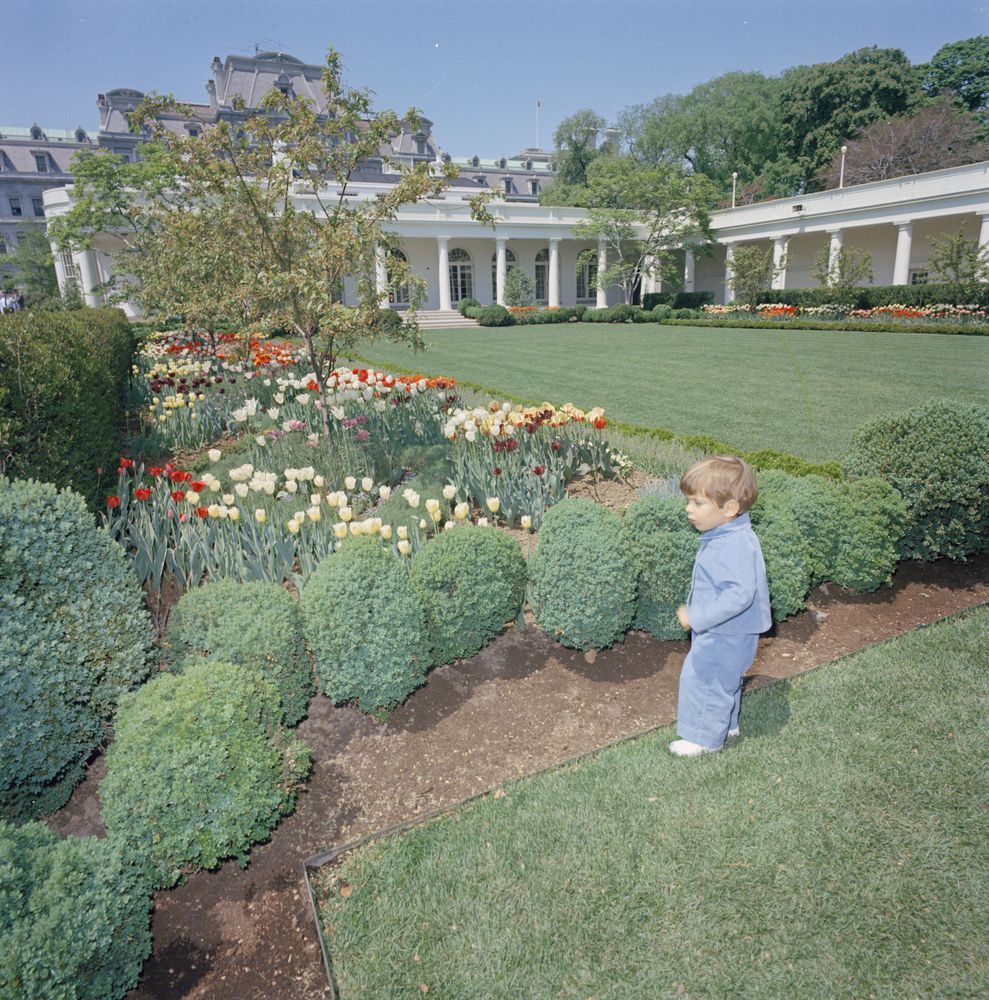
JFKWHP-ST-C112-1-63.jpg
John F. Kennedy, Jr., April 26, 1963. Cecil Stoughton. White House Photographs. John F. Kennedy Presidential Library and Museum, Boston. Public Domain
Roses have been cultivated at the White House for at least a hundred and fifty years. Before the Civil War, a complex of buildings, such as a milk house, ice house, servant quarters, and offices stood where the West Wing is today, outbuildings catering to the First Family's needs. In addition, there stood several greenhouses--growing food and flowers--including a "rose house." 

File:Green houses, White House, Washington, D.C. LCCN2012646240.jpg
White House Greenhouses, 1889. Johnston, Frances Benjamin, 1864-1952, photographer. Public Domain.
The rose house was a rectangular glass structure, and inside, roses were planted in rows, watered by pipes. The roses were utilized to decorate the White House.
JFKWHP-KN-C17851.jpg
May 20, 1961. Robert Knudsen. White House Photographs. John F. Kennedy Presidential Library and Museum, Boston. Public Domain
In 1902, the outbuildings and greenhouses were removed to make way for the West Wing, and Edith Roosevelt created a "Colonial Garden" for the First Family's personal enjoyment. She had sweet peas, quince, and black-eyed susans planted here, as well as jasmine, which she and President Theodore Roosevelt enjoyed on warm evenings as they sat in rocking chairs on the South Portico.

In 1913, First Lady Ellen Loise Axson Wilson, wife of Woodrow Wilson, established the space as an rose garden. Other presidential families altered the garden to suit their preferences, but roses have been a constant bloom here for over a hundred years, which is how it got the name, Rose Garden.

Image result for the white house rose garden
The Rose Garden of the White House covered in snow, Nov. 15, 2018 (Official White House Photo by Shealah Craighead). https://goo.gl/images/dzJqoT
In 1961, however, President Kennedy wanted the garden to be updated into something more than a private family garden. He and the First Lady had recently visited Europe, and he'd noted that the White House didn't have as quality a garden as many that he'd seen in France, England or Austria. He felt a beautiful garden at the official residence was imperative, and assigned Rachel Lambert Mellon the task of renewing the Rose Garden.
JFKWHP-KN-C22687.jpg
Aerial view of the Rose Garden, July 8, 1962. Robert Knudsen. White House Photographs. John F. Kennedy Presidential Library and Museum, Boston. Public Domain.

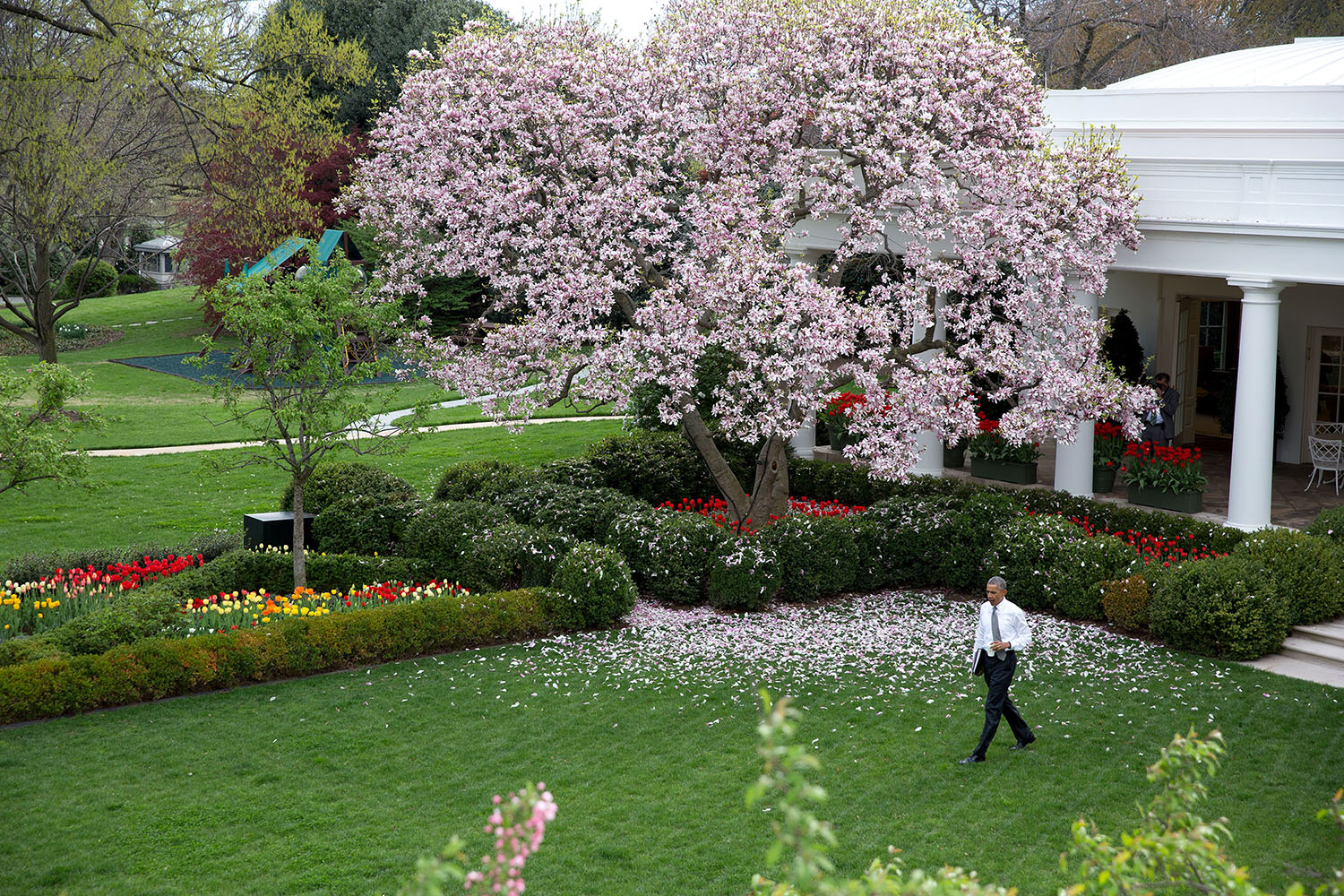
Mellon got to work, ensuring a 50-by-100 foot lawn would be central in the garden, a size large enough for a thousand people to attend receptions or ceremonies, but small enough to be covered by a tent, if necessary. The lawn was bordered by flower beds of American specimens, planted in a French style. Each flower bed is planted with Katherine crabapples, Littleleaf lindens, and thyme hedges. The garden is anchored at each of its four corners by Magnolia trees found along the banks of the Tidal Basin.
Image result for the white house rose garden
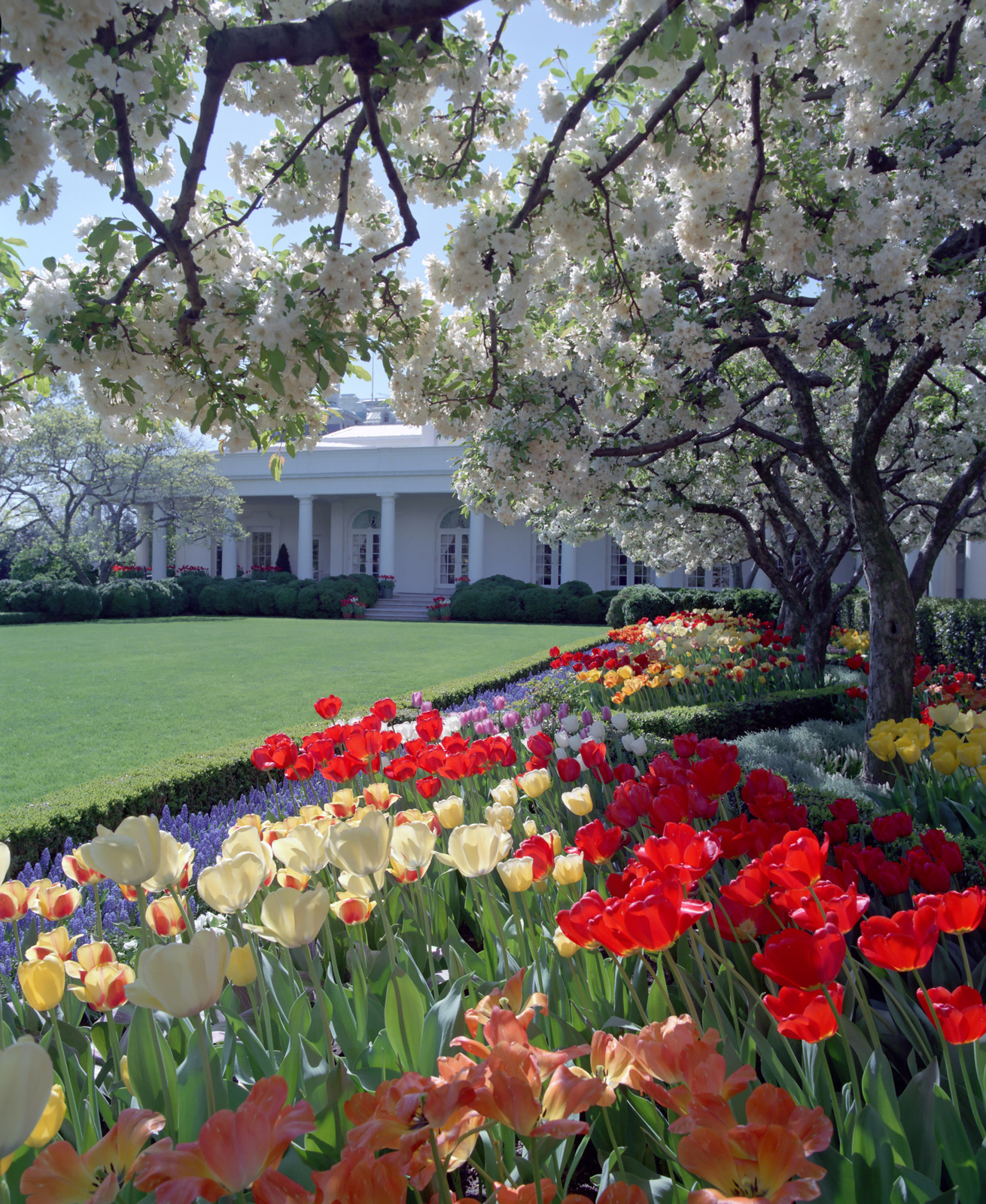
Rose Garden in Spring. Public Domain
Among the roses, seasonal flowers are added for color and variety. In the spring, jonquils, grape hyacinth, and tulips lend a cheery aspect. In the autumn, flowering kale and chrysanthemum bloom until early winter. The garden had become more formal, as well as brighter.

File:Oval Office view from Rose Garden.jpg
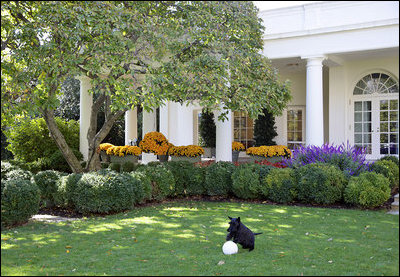
George W. Bush's dog Barney frolics in the Rose Garden, Autumn 2006. Public Domain.
In Kennedy's mind, however, the garden would no longer be simply for the First Family's enjoyment, but would serve public needs, as well. Presidents Wilson, Hoover, and Coolidge used the space to meet informally with press, to meet guests, or be photographed, but Kennedy wanted the garden to accommodate more functions. To that end, steps at the west end near the Oval Office were redesigned so they could also function as a platform or stage. Across the garden, a flagstone terrace was laid beneath one of the Magnolias where the President could hold a small luncheon or sit with guests.

To that end, Kennedy welcomed Project Mercury astronauts in the garden. Sports figures are often hosted here, including the Stanley Cup champions the Caroline Hurricanes after their victory in 2006, by George W. Bush. Numerous news conferences take place in the garden, as well as dinners and ceremonies. 

File:Mercury Astronauts Receiving the Collier Trophy - GPN-2002-000085.jpg
October 10, 1963. NASA Administrator James E. Webb (center) cites the space achievements of the Project Mercury Astronauts who received the 1963 Collier Trophy Award in a ceremony held at the White House on October 10, 1963 in the Rose Garden. President John F. Kennedy (left) and Vice President Lyndon Johnson accompanied Webb at the ceremony. Five of the Mercury Seven astronauts are visible in the row behind James Webb. They are (starting from JFK's left): Alan Shepard, Donald "Deke" Slayton, John Glenn, Virgil "Gus" Grissom, and Scott Carpenter. Public Domain.
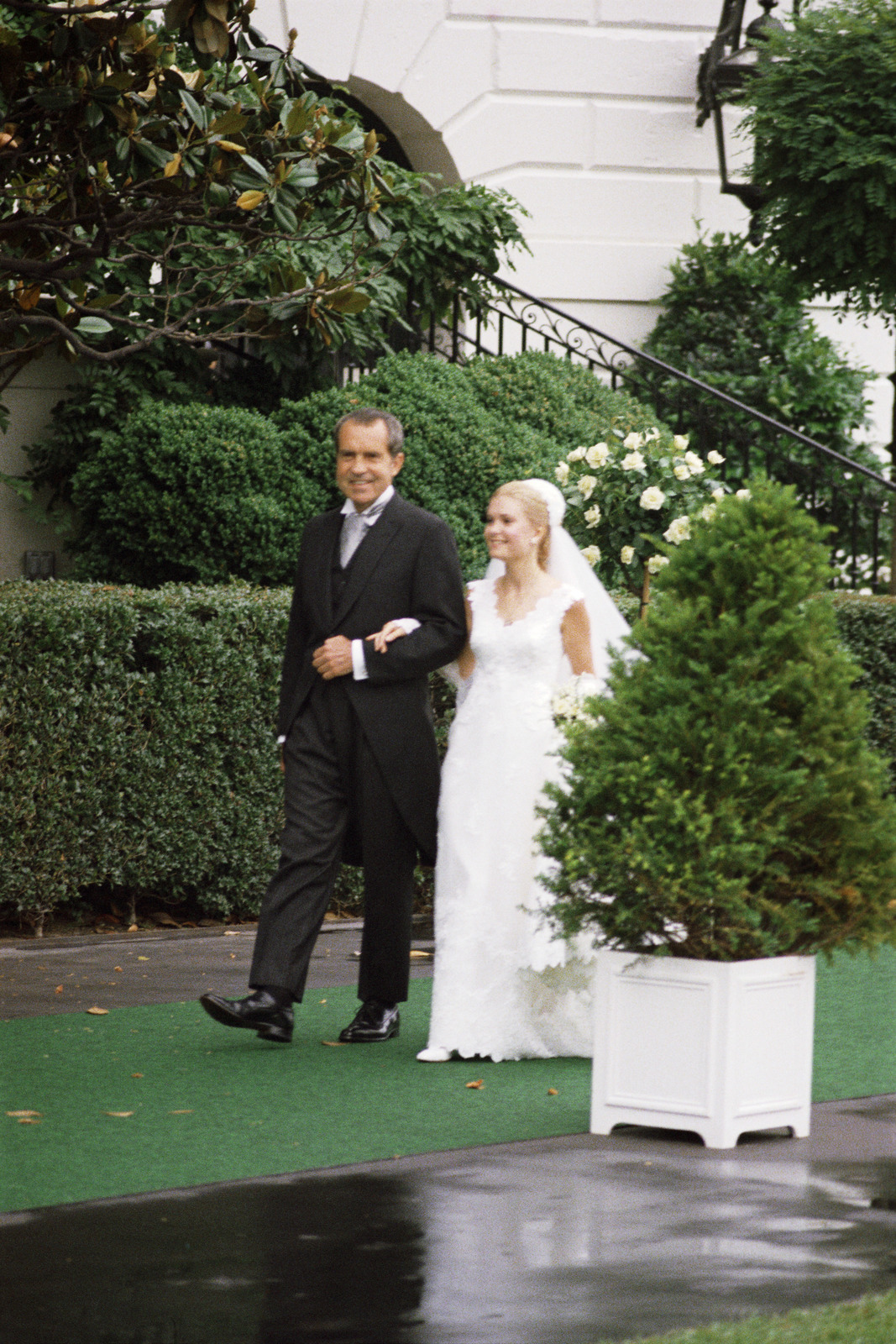
Perhaps one of the most famous uses of the Rose Garden was the 1971 marriage of Tricia Nixon to Edward F. Cox.

Image result for the white house rose garden
Public Domain. https://goo.gl/images/AWMxZ8
While the Rose Garden is often used for public events, it nevertheless remains a space of beauty, contemplation, and relaxation available for the First Family's use.
Image result for the white house rose garden
President Obama strolls through the Rose Garden. (Note: a play structure for his daughters is visible to the left of the magnolia tree.) Public Domain. https://goo.gl/images/EhG7Ew

***

Susanne Dietze is the RWA RITA-nominated author of over a dozen romances, including A Mother for His Family and the newly-released Cameo Courtships. You can learn more about her on her website, www.susannedietze.com.

Tuesday, March 19, 2019

Popular Plants in Medieval Herb Gardens

Spring colour and a profusion of scents in the replica medieval herb garden at Stafford Castle. 
Image courtesy of Simon Huguet / Herb Garden, Stafford Castle.(CC BY-SA 2.0)

Popular Plants in Medieval Herb Gardens

Engaging your senses is the best way to experience history. Watch a castle documentary (or visit one in person) and you’ll travel into the Middle Ages. Touch the rough stone of the 1831 version of London bridge and you’ll stand above the Thames despite the fact that it spans the Bridgewater Channel canal at Lake Havasu, Arizona. Smell the aroma of lavender and lace-gloved ladies will walkl through your imagination. Listen to an antique music box and travel into a bygone era. 

Escape with Janalyn Voigt into creative worlds of fiction.

One of my favorite ways of connecting with the past is through sense of taste. I love to cook and have an affinity for growing herbs. The medieval herb garden I planted has survived the intrusions of life that kept me from tending it for several years. That makes such a garden perfect for a busy author. If you have similar demands on your time but still want to enjoy gardening, planting a medieval herb garden is a good way to go.

Note: DawnSinger (Tales of Faeraven, book one) was selected for the Amazon Monthly Ebook Deal list for March 2019. This book is on special through March. Read the description and follow the link at the end of this article.

Importance of the Medieval Herb Garden


While vegetables and grains were cultivated in the fields, tending and preserving herbs fell to the lady of the manor. Herbs grown in medieval times fell into three categories: culinary, medicinal, and household. The most useful crossed categories.

Herbs were valued far more in the Middle Ages than they are today, particularly the medicinal variety. Culinary herbs enlivened the palate but weren’t eaten for taste alone. They provided necessary nutrients during the winter when greens were scarce and could also disguise rancid meats. Household herbs like lavender, rosemary, and pennyroyal were used to repel pests and freshen the air.

Medicinal herbs found in medieval gardens 

I suggest that you do your research and consult a qualified professional before growing herbs for medicinal use. With proper guidance, growing fresh herbs can be beneficial. You should know that some (such as rue) mentioned here are considered toxic in modern times. Also, it’s possible to overdose on willow bark and possibly others I’ve listed. I am not an herbalist. My goal is not to advise you on your health needs. This article is meant only to impart information about herbs in history.

Medicinal herbs popular in the Middle Ages included clary sage, chamomile, comfrey, dandelion, feverfew, hyssop, lavender, rue, sage, peppermint, goosegrass, tansy, willow bark, and garlic. Feverfew and willow bark helped with headaches. Lavender, sage, and peppermint aided the digestion. Comfrey, and goosegrass mended broken bones, cuts, and lesions. Dandelion, hyssop and rue were given as purgatives. Clary sage (also known as ‘clear eye’) found a use as an eyewash. Chamomile’s sedative effects countered sleeplessness.

Culinary herbs grown in medieval gardens.


Basil, curry, dill, cumin, lavender, coriander, rosemary, sage, savory, oregano, and tarragon made their way into the kitchen. Many were dried for winter, but others (like winter savory) flourished despite cold weather. To provide variety in drab winter months, cooks also relied upon rosehip and other herbed jams and jellies.

Household herbs popular in the Middle Ages. 


Lavender, rosemary, and sage show up again in this category. Along with citron, pennyroyal, and parsley, they sweetened the air and deterred pests.

Designing your medieval garden.

For ideas, search online for images of your ideal garden. You’ll find pictures and descriptions in Plan a Medieval Garden, a previous post I wrote on this topic.

About Janalyn Voigt


Janalyn Voigt's unique blend of adventure, romance, suspense, and whimsy creates breathtaking fictional worlds for readers. Known for her vivid writing, this multi-faceted author writes in the western historical romance, medieval epic fantasy, and romantic suspense genres.

Janalyn is represented by Wordserve Literary Agency. Her memberships include ACFW and NCWA. When she's not writing, she loves to garden and explore the great outdoors with her family.

DawnSinger

The High Queen is dying... 

At the royal summons, Shae mounts a wingabeast and soars through the air to the high hold of Faeraven, where all is not as it seems. Visions warn her of danger, and a dark soul touches hers in the night. When she encounters an attractive but disturbing musician, her wayward heart awakens. 

But then there is Kai, a guardian of Faeraven and of Shae. Secrets bind him to her, and her safety lies at the center of every decision he makes. 

On a desperate journey fraught with peril and the unknown, they battle warlike garns, waevens, ferocious raptors, and the wraiths of their own regrets. Yet, they must endure the campaign long enough to release the DawnKing and the salvation he offers into a divided land. 

To prevail, each must learn that sometimes victory comes only through surrender.

Learn More>>