Showing posts with label hotels. Show all posts

Monday, July 10, 2023

From Hotels to Motels and Back Again


By Suzanne Norquist

For centuries, hotels and coaching inns provided places for weary travelers to lay their heads. Accommodations varied from shared beds to opulent suites, depending on how much a person was willing to spend.

With the invention of the railroad and its westward expansion, an ordinary citizen could travel across the country, staying at hotels along the tracks. These centralized facilities worked because everyone took the same route with the same stops.

That all changed in the 1910s with the mass production of the automobile. Families could drive wherever the road took them and spend the night in any old place.
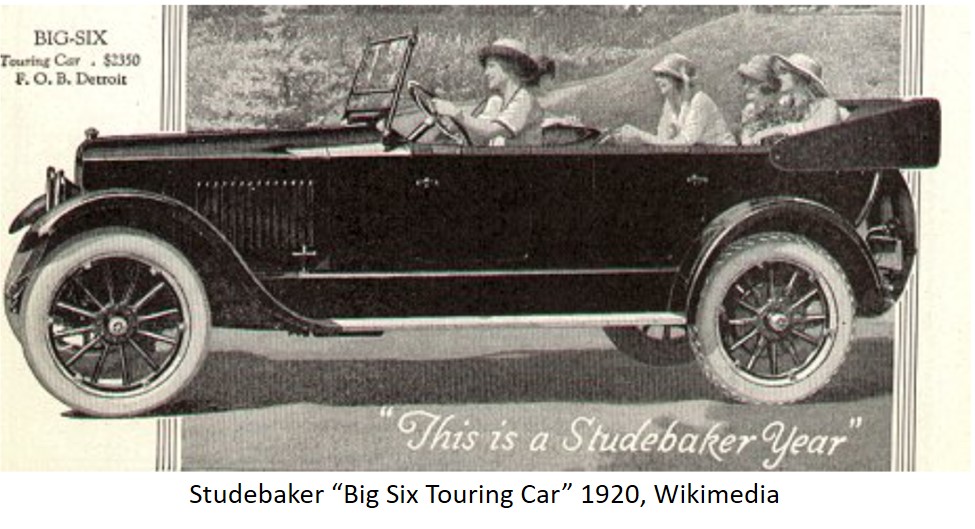

In the early days, many travelers considered themselves explorers. They brought their own tents and equipment and set up camp along the side of the road. Few concerned themselves with staying in a farmer’s fields or people’s yards.
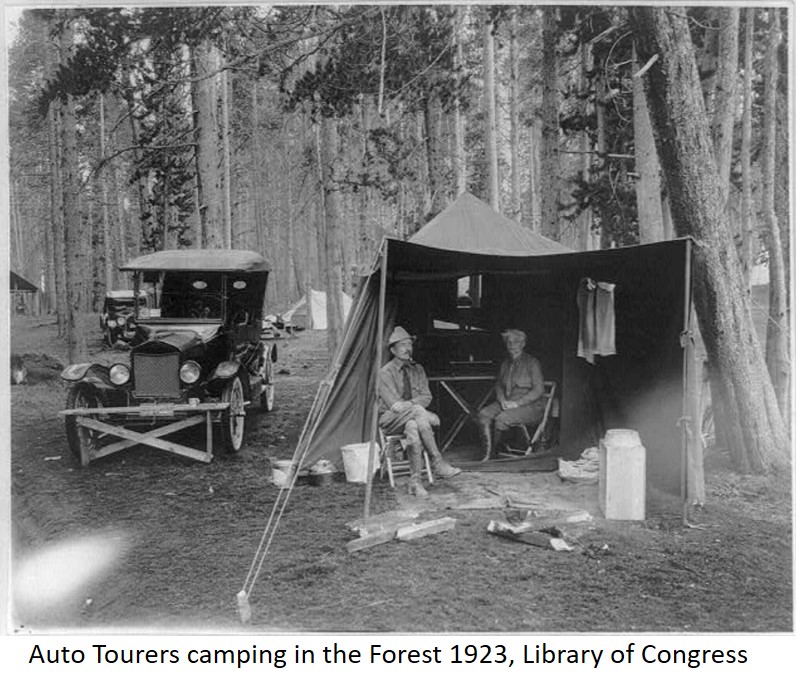

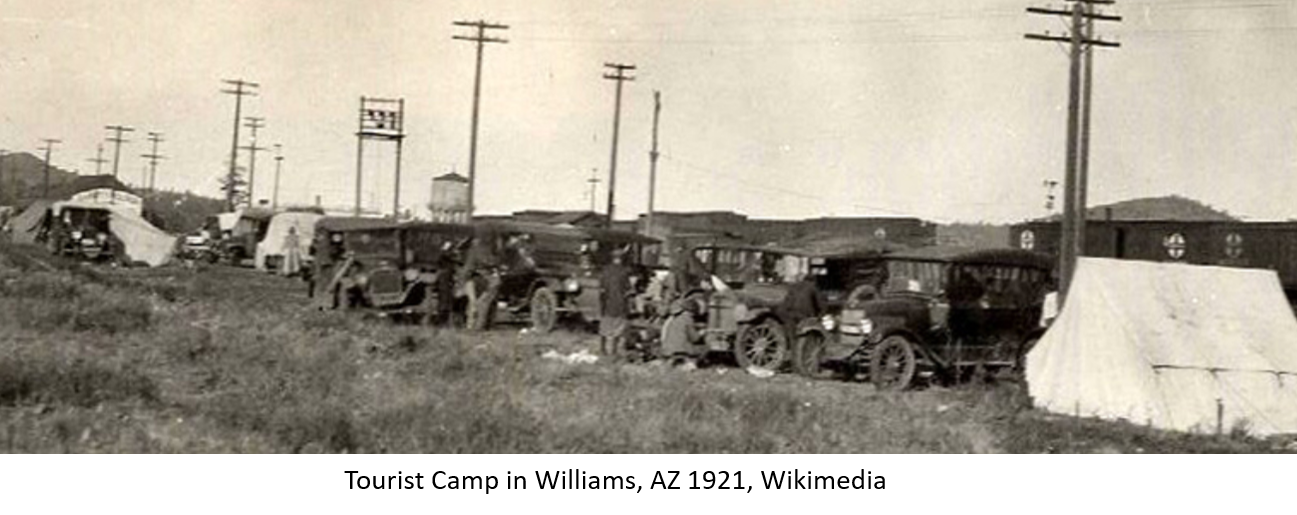
Tourist Camps (also known as auto-parks) sprouted up to solve this problem. At first, they didn’t provide much in the way of amenities, just a place to park and pitch a tent without a landowner complaining. Cities or other municipalities frequently provided the space, and often for free. By 1922, more than 1000 automobile tourist camps had sprung up along the United States byways.

By the mid-1920s, most municipalities charged to use the camps. A fee kept the tourist camps from becoming a place for tramps to live. It also helped to cover the cost of trash cans and well water.

Over time, a market for private camps with more amenities appeared. Well water with a spigot became bathrooms with sinks and toilets. Gas stations or food vendors set up near the camps in some places.

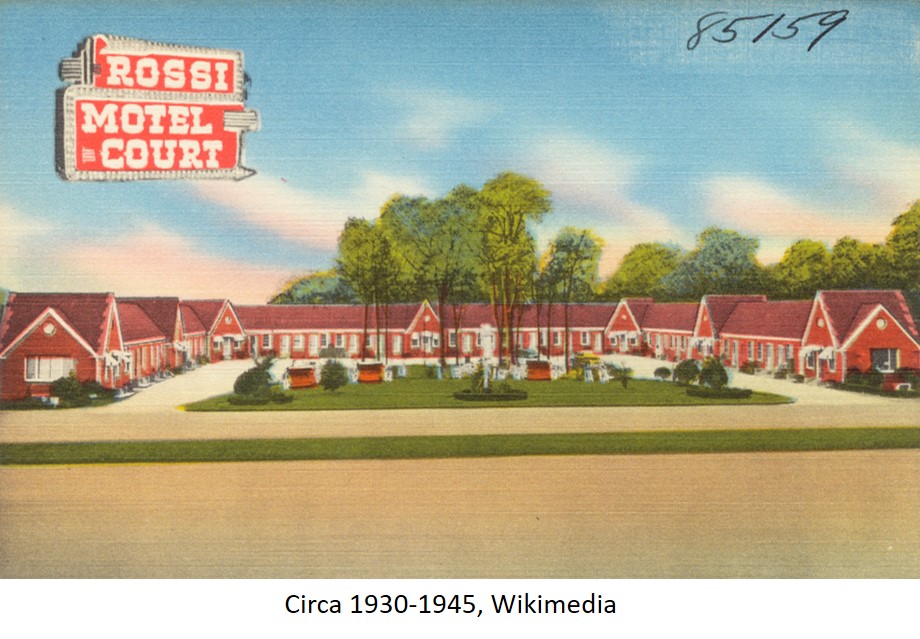
By the early 1930s cabin camps (aka cottage camps) began replacing tourist camps. Often, the cabins were arranged in a U-shape with a parking area in the center.
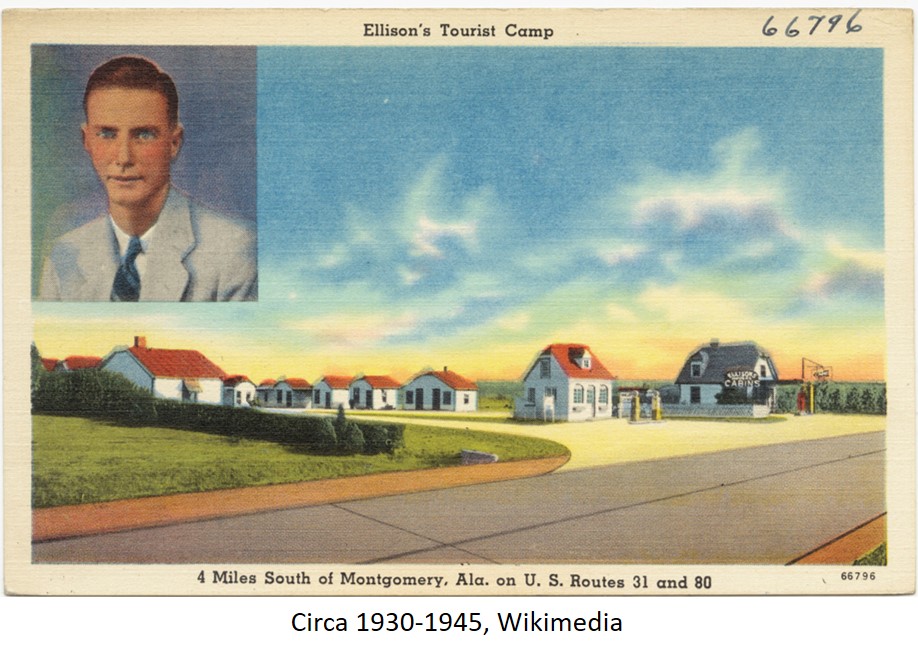

Camps ranged from simple to luxurious.
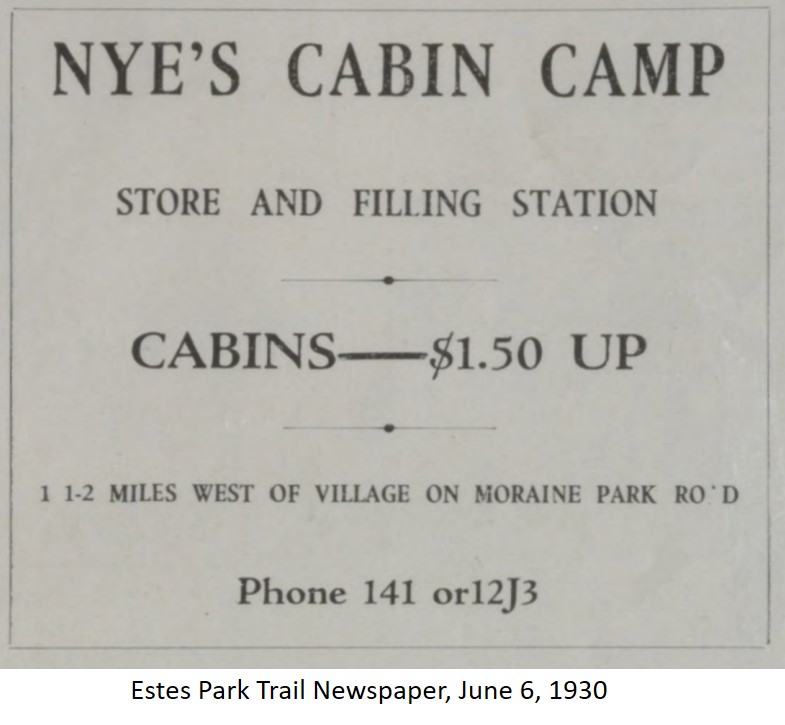

An article in the Oak Creek Times and the Yampa Leader, Oak Creek, Colorado, August 15, 1929, describes the improvements to cabin camps as follows:

“Spotless linens and shining pots, pans, and tableware await the travelers. A commissary is frequently nearby. Some cabin camps offer private garages and even a kennel for the dog. All of these accommodations are usually obtainable at nominal prices.”

In the book The Motel in America, the authors illustrate the typical visit to a “cabin camp”:

“At the U-Smile Cabin Camp…arriving guests signed the registry and then paid their money. A cabin without a mattress rented for one dollar; a mattress for two people cost an extra twenty-five cents, and blankets, sheets, and pillows another fifty cents. The manager rode the running boards to show guests to their cabins. Each guest was given a bucket of water from an outside hydrant, along with a scuttle of firewood in the winter.”

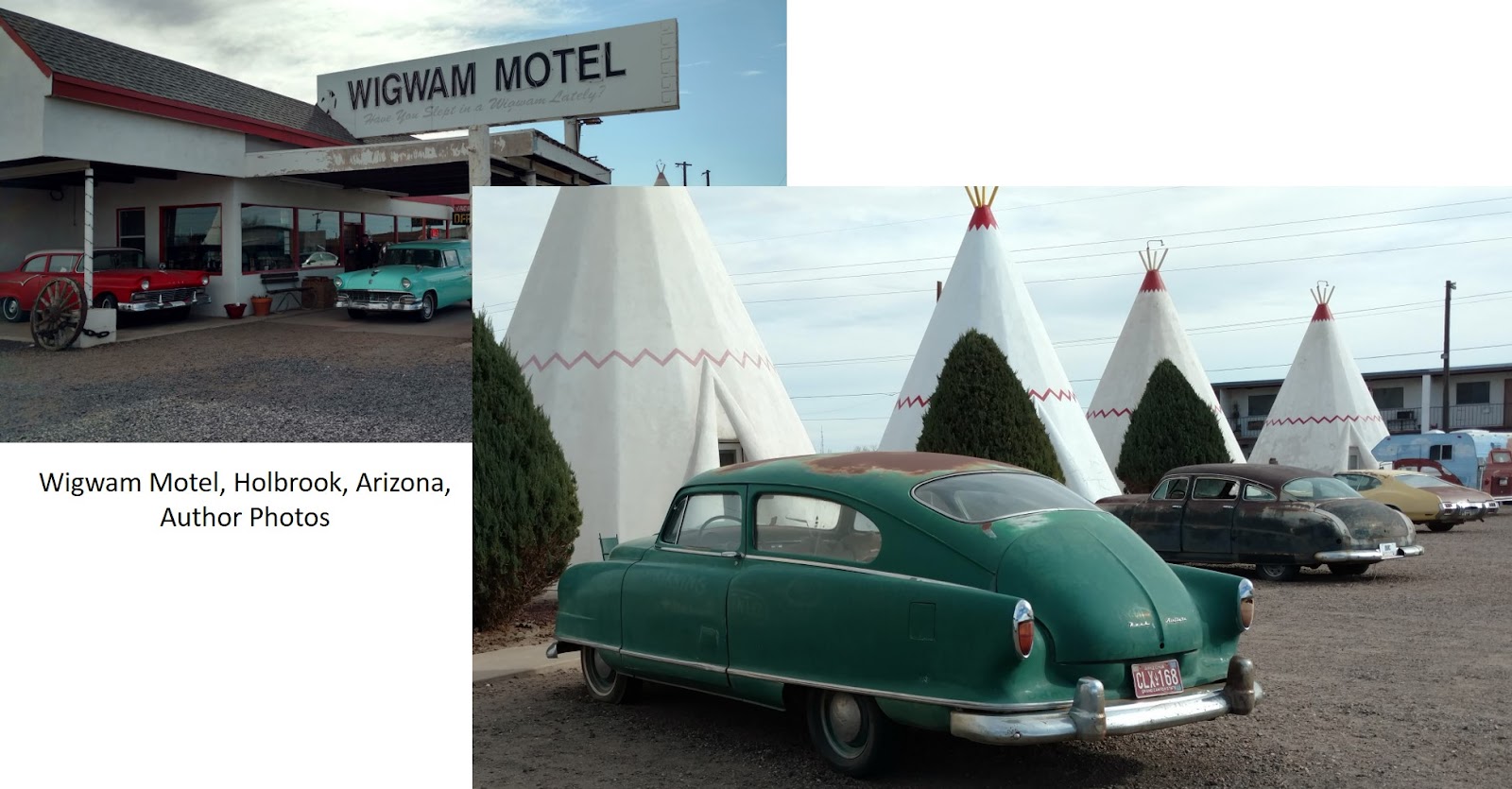
The Wigwam Motel is a fun example of a cabin camp that still operates today. The uniquely designed cabins draw visitors.

Eventually, property owners decided to put all the “cabins” under one roof, creating motor courts or hotels. The term “motel” is a combination of two words “mot” is from motor, and “tel” is from hotel. It was first used in 1925 when the builder of a motor hotel in San Luis Obispo, California, couldn’t fit “Milestone Motor Hotel” on the rooftop.

It took over ten years for the new term to catch on. I found a newspaper article from 1937 describing the word “motel.” The writer thought it sounded more dignified than cabin camp.

Most of these early motels, tourist cabins, and tourist camps were mom-and-pop operations. They provided a unique experience in American history.

At some point, people wished for the security of an interior door instead of each room opening to the outside. The change turns motels into the hotels of old.

From hotel to motel to hotel with numerous travel experiences in between.


***


”Mending Sarah’s Heart” in the Thimbles and Threads Collection

Four historical romances celebrating the arts of sewing and quilting.

Mending Sarah’s Heart by Suzanne Norquist

Rockledge, Colorado, 1884

Sarah seeks a quiet life as a seamstress. She doesn’t need anyone, especially her dead husband’s partner. If only the Emporium of Fashion would stop stealing her customers, and the local hoodlums would leave her sons alone. When she rejects her husband’s share of the mine, his partner Jack seeks to serve her through other means. But will his efforts only push her further away?



Suzanne Norquist is the author of two novellas, “A Song for Rose” in A Bouquet of Brides Collection and “Mending Sarah’s Heart” in the Thimbles and Threads Collection. Everything fascinates her. She has worked as a chemist, professor, financial analyst, and even earned a doctorate in economics. Research feeds her curiosity, and she shares the adventure with her readers. She lives in New Mexico with her mining engineer husband and has two grown children. When not writing, she explores the mountains, hikes, and attends kickboxing class.

Saturday, August 7, 2021

The History of Union Station, Nashville, TN

By Michelle Shocklee

I love historic buildings. You too? When I take a tour or wander freely (my favorite!) through an old building, my imagination goes wild, with dozens of questions filtering through my mind at the speed of light. Who walked where I walked? What's their story? What secrets do the walls hold? And on and on.

Union Station Hotel (Trip Advisor)
Hence is the case with Union Station in Nashville, Tennessee. The moment I saw this beautiful old building I knew I had to find out more about it.

Union Station, 1900. Tennessee State Library
In 1900, the first trains to roll through Union Station were operated by the Louisville & Nashville and the Nashville, Chattanooga & St. Louis railroads. Engine No. 5 of the NC&StL's was given the honor of being the first train to stop at the terminal. For the next seventy-eight years, thousands of passengers would arrive in Nashville via trains with names like Dixie Flyer, Dixieland, Floridian, and the Carolina Special. The station was also used by streetcars prior to their discontinuance in Nashville in 1941.

The striking building is built in the architectural style described as Richardson Romanesque. The entire building, designed by Richard Monfort, chief engineer for the L&N, is made of gray stone and marble from right here in Tennessee. The total cost at the turn of the century came to $300,000. I'm not good at math but even I know that would be in the millions of dollars in today's money.   

A bronze statue of Mercury, the mythical Roman god of speed, stood atop the clock tower, which housed an early version of a digital clock. Unfortunately the statue was blown off in the 1950s by a tornado. 

Leaving for war, 1943. Tennessee State Library

In 1943, Union Station served as a shipping-out point for thousands of soldiers headed to war. 

Saying goodbye, 1943. Tennessee State Library


Waiting area, 1970. Tennessee State Library
Sadly, train travel began its decline in the 1960s, forcing many stations to close. By 1978, with less than six trains per day, Union Station joined them. Preliminary plans to convert the building into a federal office complex fell through, and Union Station was eventually sold to hotelier Leon Moore of Gallatin, Tennessee. Determined to retain the original design, Mr. Moore employed local craftsmen and created a beautiful, up-to-code hotel. 

Today, Union Station is a luxury boutique hotel in the heart of downtown Nashville. The elegant lobby reminds visitors of bygone days when passengers waited for their trains. Well-appointed guest rooms now fill spaces where railroad offices were once located, and a restaurant and bar offer more than peanuts and a Coke. 

Someday I hope to splurge and stay a night or two in this lovely and fascinating place!
 
Union Station Hotel lobby. Wikipedia


Your turn. 
Have you traveled by train?
I haven't, so tell me about your experience!


Michelle Shocklee
is the author of several historical novels and is a Selah Awards finalist. Her work has been included in numerous Chicken Soup for the Soul books, magazines, and blogs. Married to her college sweetheart and the mother of two grown sons, she makes her home in Tennessee, not far from the historical sites she writes about. Visit her online at michelleshocklee.com.


UNDER THE TULIP TREE

Sixteen-year-old Lorena Leland’s dreams of a rich and fulfilling life as a writer are dashed when the stock market crashes in 1929. Seven years into the Great Depression, Rena accepts a position interviewing former slaves for the Federal Writers’ Project. There,
she meets Frankie Washington, a 101-year-old woman whose honest yet tragic past captivates Rena. Frankie’s story challenges Rena’s preconceptions about slavery, but it also connects the two women whose lives are otherwise separated by age, race, and circumstances. Will this bond of respect, admiration, and friendship be broken by a revelation neither woman sees coming?

Monday, June 19, 2017

One Night in Wilber

Traveling the Oregon Trail Backwards, a Road Trip Adventure, Part 7

This article is brought to you by Janalyn Voigt.

Two women traveling alone with our children, we arrived late at night in Wilber, Nebraska. We’d crammed a lot into the day, having toured the ranch, driven past Scotts Bluff, and visited Chimney Rock before making the rest of the journey here. Part-Czech, my traveling companion (a relative) and I had set a trip goal of sleeping in the Hotel Wilber, so we pushed past exhaustion to reach this citadel. 

We made our way inside the massive brick building with stately columns and a red heart painted in a Czech folk style on the front door. Raised voices from a nearby bar had us hurrying the last couple of steps inside the building, but what we found inside displayed a touching faith in humanity.
Hotel Wilber in Wilber, Nebraska; seen from the east. The 1895 building is listed in the National Register of Historic Places. It currently serves as a bed-and-breakfast. Image by Ammodramus (Own work) [Public domain], via Wikimedia Commons
A wallpapered lobby with original wood floors, antique furniture, and lace at the windows greeted us, but the owner was nowhere in sight. We retrieved our room keys from a pre-arranged location and made our way up the elegant staircase to the second floor. After locating our own rooms, we went down the hall, admiring the other rooms. A local family of Czech origin had decorated each one with precious antiques, and the doors had been left open to show them off. We had the place to ourselves, apparently. The pride in ownership and degree of trust the owner displayed by leaving these rooms open to view spoke well of the town.

Platted in 1873 and named for founder Charles D. Wilber, an Illinois geologist and friend of President James A. Garfield, Wilber is both a farming community and county seat. Prestigious visitors to the town include Pulitzer Prize-winning author Willa Cather; suffragette Susan B. Anthony; movie star Robert Taylor; and then-presidential candidates Robert F. Kennedy, Theodore Roosevelt, and William Howard Taft.

In 1987, President Ronald Reagan signed a decree proclaiming Wilber the Czech capital of the United States. The town celebrates its heritage every August with Czech Days, the largest ethnic festival in Nebraska. Parades, an art show, dancing, museum displays, authentic costumes, Czech food and drink, bands, and an old-world atmosphere attract 40 to 50 thousand visitors. We’d arrived too early for that event but treated ourselves to sausages at the Wilber Meat Market before leaving town.

Road-weary and with cranky children, we debated whether or not to stop at the Sod House Museum before leaving Nebraska. I’m so glad we didn’t skip it. This road trip memoir continues next month with our visit to that museum. Meanwhile, whether or not you are of Czech ancestry, I thought you might enjoy this video of the current Miss Czech America singing "Going Home" at the Miss Czech Slovak US Pagaent. The music is by Czech composer Antonín Dvořák.

https://youtu.be/EMva3fGLZTA

Note from Janalyn on this series:
I seem to approach everything backwards, and traveling the Oregon was no exception. A few years ago I set off from Washington state to a family reunion in Missouri, following the route of the Oregon Trail backwards. The trip sparked an idea for an Oregon Trail series which finally came to fruition with the release this spring of Hills of Nevermore (Montana Gold 1). My historical romance series is set in Montana during its gold rush, and each of the heroines travels part of the Oregon Trail.

Last chance to download a free ebook by award-winning author Miralee Ferrell in the 
Hills of Nevermore Launch Special.

Hills of Nevermore

Can a young widow hide her secret shame from the Irish circuit preacher bent on helping her survive? 

In an Idaho Territory boom town, America Liberty Reed overhears circuit preacher Shane Hayes try to persuade a hotel owner to close his saloon on Sunday. Shane lands face-down in the mud for his trouble, and there’s talk of shooting him. America intervenes and finds herself in an unexpectedly personal conversation with the blue-eyed preacher. Certain she has angered God in the past, she shies away from Shane.

Addie Martin, another widow, invites America to help in her cook tent in Virginia City, the new mining town. Even with Addie’s teenage son helping with America’s baby, life is hard. Shane urges America to depart for a more civilized location. Neither Shane’s persuasions nor road agents, murder, sickness, or vigilante violence can sway America. Loyalty and ambition hold her fast until dire circumstances force her to confront everything she believes about herself, Shane, and God.

Based on actual historical events during a time of unrest in America, Hills of Nevermore explores faith, love, and courage in the wild west.

Read the first two chapters free.

About Janalyn Voigt

My father instilled a love of literature in me at an early age by reading chapters from The Wonderful Wizard of Oz, Robinson Crusoe and other classics. When I grew older, and he stopped reading bedtime stories, I put myself to sleep with tales I 'wrote' in my head. My sixth-grade teacher noticed my interest in storytelling and influenced me to become a writer.

I'm what is known as a multi-genre author, but I like to think of myself as a storyteller. The same elements appear in all my novels in proportions dictated by their genre: romance, mystery, adventure, history, and whimsy. Visit http://janalynvoigt.com


Monday, January 30, 2017

The Hexagon Hotel


Once upon a time in Minerals Wells, Texas, a man named David G. Galbraith built a hexagon-shaped hotel. Construction started on the unique building located on the 700 block of N. Oak St. in 1895 and was completed in 1897. The hexagon-shaped design was utilized to create better airflow in the days before air conditioning. Another unique feature was that the building was the first hotel in town to have electricity.


The hotel was constructed of long-leaf yellow pine with cypress siding on the exterior walls. Pegs and square nails were used to hold the place together. The roof was covered with hand-split cypress shingles. The interior walls were made of "Heart of Pine" wood. All of the stonework was done by two stone masons from England. 


The beautiful indoor staircase started at the top floor and elegantly spiraled down through the other levels. The lobby floor was covered with hexagon-shaped tan, brown and blue tiles. The sleeping rooms were also hexagon-shaped with a bath between every two rooms. 

Mrs. Meriweather, who was the daughter of David G. Galbraith, lived in the house for many years. "We have an average of 40 persons a week go through the house, almost all of them from out of town," said the charming Mrs. Meriweather. "And hundreds more stop just to see the exterior. Yet we can no longer afford to keep up the 30-room, 4-story house just so tourists can look at it." Sadly, the historic building was torn down in 1959.


Mrs. Meriweather's father was a great admirer of bees, and he modeled the old house's floor plan after a honeycomb. Each room had six sides, and most had windows facing in three directions, giving them excellent ventilation. Mr. Galbraith was a forward-thinking businessman who is credited with creating the paper clip. Here's a link to his patent: https://www.google.com/patents/US957764
It's too bad that Mr. Galbraith didn't create a foundation to protect his unusual home so that we could still enjoy it today.

When this post goes live, I'll be at the hospital having my third knee replacement surgery--yep, third. I won't be able to respond to your comments right away, but I will try to get to them once I get back home. 


Bestselling author Vickie McDonough grew up wanting to marry a rancher, but instead married a computer geek who is scared of horses. She now lives out her dreams penning romance stories about ranchers, cowboys, lawmen, and others living in the Old West. Vickie is an award-winning author of more than 40 published books and novellas, with over 1.5 million copies sold. Her novels include the fun and feisty Texas Boardinghouse Brides series, and End of the Trail, winner of the OWFI 2013 Best Fiction Novel Award. Whispers on the Prairie was a Romantic Times Recommended Inspirational Book for July 2013. Song of the Prairie won the 2015 Inspirational Readers Choice Award. Gabriel’s Atonement, book 1 in the Land Rush Dreams series placed second in the 2016 Will Rogers Medallion Award. Vickie has recently stepped into independent publishing.

Vickie has been married for forty-one years to Robert. They have four grown sons, one daughter-in-law, and a precocious granddaughter. When she’s not writing, Vickie enjoys reading, antiquing, doing stained glass, watching movies, and traveling. To learn more about Vickie’s books or to sign up for her newsletter, visit her website: www.vickiemcdonough.com


Saturday, July 30, 2016

Miracle Water ~ French Lick Mineral Springs

by Ramona K. Cecil

When we think of “healing waters” or medicinal springs, our first thoughts are typically of Lourdes, France or perhaps Hot Springs, Georgia, made famous by President Franklin D. Roosevelt. There is, however, another spot where springs of “miracle water” flow and it’s found in my own state of Indiana.

In the southern most part of Indiana in Orange County sit the twin towns of French Lick and West Baden. There, tucked amid the scenic wooded Hoosier hills flow springs of mineral water once touted as “miracle water.”


Long before the arrival of the French settlers, the native people and wooded animals were already availing themselves of the area’s mineral salt “lick” deposits. The native people considered the springs a gift from the Great Spirit. 


In 1829 the land on which the mineral springs flowed were purchased by brothers Thomas and William Bowles. A physician, William not only recognized the virtues of the mineral springs, but also saw it as a business opportunity. In
French Lick Springs Hotel 1800s
the early 1840s he built a hotel and health resort touting the area’s healing waters. In 1845 Dr. Bowles leased land in West Baden, a mile from his resort in French Lick, to Dr. John A. Lane, who opened his own hotel and health resort; West Baden Springs.                                                                                                             


Both health resorts remained in business throughout the 1800s under the ownership of different physicians. 1901 ushered in not only a new century, but the heyday of the French Lick and West Baden hotel/health resorts. Tom Taggert, a business man and politician from Indianapolis bought the property and, with a group of investors, formed the French Lick Hotel Company. Besides renovating and modernizing Dr. Bowles original hotel and spa, Taggert convinced the Monon Railroad to lay a spur to the resort and run daily trains from Chicago the hotel. He also brought electricity, fresh water system, and a trolley to the town and built a new bottling facility to bottle the mineral water from what he called his “Pluto Spring” named for the mythical god of the underground. There is a scary-looking devil-like statue of “Pluto” in the French Lick museum.


Distributed nationally, French Lick’s 
Pluto Water became famous for its healthful properties, particularly as a natural laxative. It’s advertising slogan claimed “When Nature Won’t, PLUTO Will.” French Lick’s “miracle water” became wildly popular all over America. In 1907, even the famous illusionist and escape artist Harry Houdini posed in front of an advertisement for PLUTO Water in Indianapolis, Indiana.

Harry Houdini beside Pluto Water sign, Indianapolis, IN 1907


In 1901 Dr. Lane’s West Baden Springs Hotel burned, but the property was then bought by a Mr. Lee Sinclair who rebuilt the hotel in grand fashion. Opening in
Historic West Baden Springs Hotel
1902, the new West Baden Springs Hotel—a circular building with an immense dome—was billed as “The Eighth Wonder of the World.” The West Baden Hotel offered its own brand of mineral water called Sprudel Water. Besides drinking the water that claimed to cure or improve a wide array of afflictions, guests could bath in elegant spring pavilions arranged around a sunken garden.


By the Roaring Twenties, celebrities of all stripes began to flock to French Lick/West Baden, Indiana to enjoy Taggert’s and Sinclair’s magnificent resorts and spas. I’m guessing that mineral water wasn’t the only liquid refreshment sampled by visiting A List patrons during those prohibition years. Illicit gambling was also rumored to have taken place at both resorts. I’m shocked!! The stock market crash in 1929 dealt a fatal blow to the West Baden Hotel and it closed in 1932. For the next fifty years the property was a Jesuit seminary, then a private college.

FDR at French Lick Resort in 1931
Taggert’s French Lick Hotel Resort and Spa weathered the stock market crash possibly due to the addition of two world-class golf courses. The Hill Course hosted the 1924 PGA Championship. Well past the first half of the last century, the French Lick Hotel boasted a guest list that reads like a Who’s Who of the rich and famous; Joe and Rose Kennedy, Franklin D. Roosevelt, Harry Truman, Richard Nixon, the Reagans, John Barrymore, Abbot & Costello, Bing Crosby, Bob Hope, Howard Hughes, Lana Turner, Hoagy Carmichael, Duke Ellington, Louis Armstrong, and many more enjoyed the amenities including a dose of PLUTO Water at the hotel’s luxurious PLUTO Bar.


In 1971 the production of PLUTO Water halted when the FDA classified Lithium, a naturally occurring element in the water, a controlled substance.

The French Lick Hotel and Resort languished in disrepair for decades until a group of preservationists bought both the French Lick and West Baden properties in the mid 1990s with an eye toward restoring the resorts to their earlier grandeur. Once again patrons can avail themselves of the mineral waters as well as the world class golf courses and even gambling. I’m shocked!!
Present day West Baden Hotel


While bottled PLUTO Water is no more, visitors to French Lick can still view the mineral spring that started it all, now housed within the French Lick Museum and guests at the hotels can bath in the mineral water.

They called it “Miracle Water.” Was it a cure-all for myriad ailments? Probably not. But that a back-woods mineral spring could precipitate the building of world-class hotels and spas, attracting a clientele of the most rich and famous to the southern Indiana sticks. . .well, maybe it was miracle water after all.


Ramona K. Cecil is a poet and award-winning author of historical fiction for the Christian market. A proud Hoosier, she often sets her stories in her home state of Indiana.