
Showing posts with label infants. Show all posts

Sunday, January 2, 2022

Famous Infants in History: Jessica McClure

Blogger: Amber Schamel
 

Today, our next subject in the series of Famous Infants in History, many of you will remember. This baby skyrocketed to fame because of a horrible accident that left the nation in shock.You will remember her as baby Jessica. 

Jessica McClure Morales was born on March 26, 1986 to Reba and Lewis McClure. At the age of 18 months, Jessica was playing in her aunt's backyard in Midland, Texas when her curious nature lured her into a horrible situation.
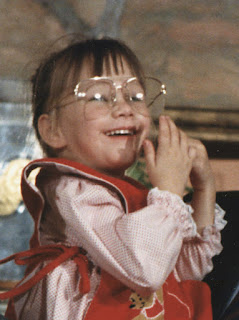
Jessica McClure, after the incident in 1989
Public Domain - Photo by By Susan Biddle


The incident captured the attention of the nation because it is every parent's worst nightmare. You turn around for a moment, and the next thing you know, something horrible threatens the life of your baby. 

Jessica's aunt ran a daycare from her home, and the infant was there with her mother who was watching the children temporarily. The backyard had a well casing that was eight inches in diameter, but it had been covered by a large rock to prevent any incident. The phone rang, and so Jessica's mother Ruby ran inside to answer it. While she was gone, the children somehow uncovered the pipe and Jessica fell down the twenty-two foot shaft. She was trapped. 

Her mother returned to the yard, only to find her baby girl missing. It didn't take long for her to discover what had happened, and she immediately called 9-1-1. However, the rescue effort would be more complex than you could imagine. 

The well shaft was too narrow and long for the emergency workers to reach Jessica, so they would have to come up with another plan. However, the shaft was surrounded by layers of rock that were harder than granite. It would take an entire community to rescue this baby girl. 

The rescue plan was to drill a hole big enough for rescue workers to enter perpendicular to the shaft, and then drill horizontally to where Jessica was. They employed a machine that was typically used to plant telephone poles to drill the vertical hole thirty inches wide, and twenty-nine feet deep. Then they began to drill the horizontal shaft. But again, complications arose. The jackhammers that the crew used were ineffective because they were designed to drill downward, rather than horizontally. It wasn't working. And every passing moment increased the danger to baby Jessica.

A mining engineer was called on the scene to help find a solution. He recommended what was cutting edge technology at the time, water-jet cutting, to get through the rock. 
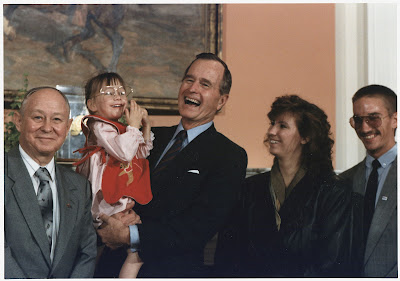
Jessica and her parents meet President H.W Bush in 1989
Public domain photo By Susan Biddle


During this time, rescue workers attempted to stay in constant communication with Jessica and pump oxygen down the pipe for her to breathe. They would talk to her, encourage her, and ask her to sing. Jessica would moan, cry, beg for her mother or her Pooh bear, and sing nursery rhymes to pass the time. One witness said he will never forget her singing of "Winnie the Pooh" echoing up the pipe. 

News networks across the world picked up on the story. CNN was the only twenty-four hour news network in the nation at the time, and for only the second time in U.S. history, the entire nation watched around the clock as this drama unfolded on live TV.

Forty-five hours after Jessica had fallen down the well casing, the tunnels were completed. Paramedic Robert O'Donnell entered the shaft and inched his way toward Jessica. He succeeded in wrestling Jessica free of the shaft, and she was passed up to the surface where she was reunited with her frantic mother and rushed off to receive badly needed medical attention. 

After three days being trapped underground in a cramped position, without food or water, baby Jessica was in serious condition. She underwent fifteen surgeries to treat all of the injuries and complications from the ordeal, however she was able to fully recover. 

Nevertheless, the incident made a permanent mark on Jessica's life. She suffers from chronic, but controllable rheumatoid arthritis, is missing the pinky toe on her right foot, and has a diagonal scar across her forehead. 

At the age of 25, Jessica received a trust fund of the donations that had been sent for her during the ordeal, and she used some of the funds to purchase a house - less than two miles away from the shaft she fell into as an infant. 

Today, Jessica is happy, with a family of her own. To find out more about how Jessica is doing today, check out this video interview on Youtube. https://youtu.be/ksZMIvHNeJ0

*****

Two-time winner of the Christian Indie Award for historical fiction, Amber Schamel writes riveting stories that bring HIStory to life. She has a passion for travel, history, books and her Savior. This combination results in what her readers call "historical fiction at its finest".  

She lives in Colorado Springs near her favorite mountain, in a small “castle” with her prince charming. Between enjoying life as a new mom, and spinning stories out of soap bubbles, Amber loves to connect with readers and hang out on Goodreads with other bookish peoples.

Amber is a proud member of the American Christian Fiction Writers Association. Visit her online at www.AmberSchamel.com/ and download a FREE story by subscribing to her Newsletter!

Friday, November 4, 2016

Coney Island Miracles: Live Infants


The first time I saw the Coney Island attraction billed as "Live Infants", I thought I was seeing things. But it was true. Premature babies in incubators were once a popular attraction of Coney Island, as well as many world expositions including the 1933 World's Fair held in Chicago, Illinois. With mixed emotions, I began my research into how it came to be that people paid hard-earned money to see a human infant.


Luna Park at Coney Island circa 1905. Courtesy of Shorpy.com

The man who created this popular sideshow attraction was Martin Arthur Couney, born in Krotoschin, Germany on the last day of 1869. He studied medicine with a specialty of pediatrics under the hand of Dr. Pierre Budin, a Frenchman who pioneered the use of the incubator for the treatment of premature infants. At that time in the late 1800's, incubators were being used for hatching poultry. Budin had a great idea, but hospitals were skeptical and lacked the vision to use this method of saving premature infants. 

To gain attention for his invention, Budin sent Couney to the 1896 Great Industrial Exposition of Berlin in the hopes that others would see the benefits. 


Baby Incubator Display at The Trans-Mississippi Exposition, 1898. Courtesy of Omahalibrary.org

Six premature babies on loan from Berlin's Charity Hospital, under the auspicies of Empress Augusta Victoria, were kept alive by artificial means, which wowed the crowds who paid money to see the infants. Three years later at the 1899 Greater Britain Exhibition, however, Couney was unable to borrow premature British infants for his exhibit and was forced to bring in three wicker baskets full of infants from Paris. (Courtesy of omahalibrary.org)
Baby Incubator on Display, Seattle World's Fair,
1909. Courtesy of Wikipedia
 

With crowds of amazed people at several world fairs and expositions gawking at the babies living in boxes, there was enough money for Couney to introduce the incubator to American hospitals. But the medical world still wasn't ready to accept the incubators. Parents, however, saw the incubators as a miracle and willingly handed over their preemies into Dr. Couney's care. He had already proved that the public was willing to pay for such an exhibit, and he knew that few parents could afford the medical bills of keeping their babies alive. Such an exhibit would also expose the public to the need for such an invention and perhaps enough people would goad the medical community into providing their own staff with incubators. 

With no shortage of preemies, Dr. Couney and his staff set up the permanent exhibit at Luna Park, Coney Island which you see in the photo at the top of this blog - the one that started me on this quest. And with trained staff ready to care for the babies on the road, and deal with the public, babies in incubators were exhibited in major fairs and expositions around the world until 1941. 


Baby Incubator Exhibit at the 1909 Seattle World's Fair. Courtesy of Wikipedia
But why would people pay to see babies? Consider this... in the early 1900s, most babies were still born at home with the aid of a midwife. If a doctor was available, he or she was only brought in for the difficult births - the ones we now call high risk. Premature babies weren't given much of a chance to survive and many were tucked into shoe boxes and placed on the oven door to keep warm, especially if the mother was fighting for her own survival. At the time, only 25% of premature babies survived. This was the reality of life. 

It didn't matter to the new parents that their baby would be on display in a sterile glass and metal box. What mattered was that their baby survived! 

In August 1901, the Scientific American Volume 85 Number 5 published the article, Baby Incubators at the Pan-American Exposition showing how the babies were fed through their nostrils with a gavage spoon. 


Pan-American Exposition in Buffalo, NY, 1901
Dr. Martin Couney closed his permanent exhibit at Coney Island and retired in 1941. At that time, New York's Cornell University had opened its own research and training center for premature infants. By the time he died in 1950, Couney had saved approx 7,000 of the 8,500 preemies brought to him for nurturing.

And what of the survivors? How did they feel about people paying to see them? That was the question asked of Lucille Horn in the interview, Babies on Display: When A Hospital Couldn't Save Them, A Sideshow Did. Lucille answered: "It's strange, but as long as they saw me and I was alive, it was all right." For the full interview including an audio version, click here. 

Another article with lots of photos is: Survivors Praise 'Incubator Doctor' Who Put Preemies on Display in Early 1900s.


Videos on the sideshow exhibit as well as the survivors are:

'Incubator Babies' Praise Doctor Who Saved Lives  (https://youtu.be/rLBTOlrrubA)


Were Premature Babies Really Displayed in Coney Island? (https://youtu.be/5DzEMRngR1Y)


Also, the History Detectives TV show broadcast an episode called Sideshow Babies (Season 7, Episode 4), where the first segment is about a woman who was born prematurely and within days of her birth, the Chicago Board of Health took her away from her parents and placed her under Couney's care, where she was put in an incubator and displayed at the 1933 Chicago World's Fair. She has in her possession a personalized souvenir cup commemorating the event. The history detective's quest is to find out if babies were really on display at this event. 


When I started the research, I was uncomfortable with the thought that anyone would make money off the exhibition of babies in a sideshow. I changed my mind however, when I read that Couney charged money so that the babies could be cared for and their parents didn't have to worry about the expense. To a Canadian, that's a big deal. The fact that all 4 of my babies were premature ranging from 4-8 weeks early helped settle it in my mind. I would have given everything I had if there was a chance to pull them through. I was blessed with doctors and nurses in NICU's that took my hand and pulled all of us through. Back in history, they did what they could as well. 

What about you? What went through your mind as you read this post? 


~~~~~~~~~~~~~~~~~~~~~~~~~


Anita Mae Draper's historical romances are woven under the western skies of the Saskatchewan prairie where her love of research and genealogy yields fascinating truths that layer her stories with rich historical details.  Anita's short story, Here We Come A-Wassailing, was a finalist for the Word Guild's 2015 Word Awards. Her novellas are included in Austen in Austin Volume 1, and The American Heiress Brides Collection. Readers can check out Anita's Pinterest boards for a visual idea of her stories to enrich their reading experience.  Discover more at: