Showing posts with label library. Show all posts

Thursday, April 18, 2019

Chicago's Cultural Center - The People's Palace

By Nancy J. Farrier


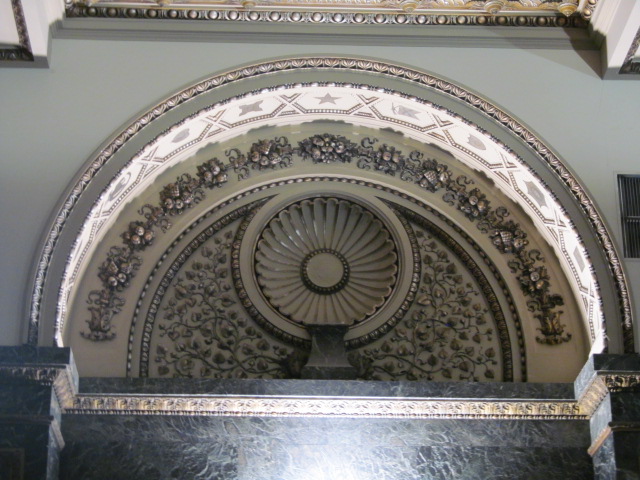
Inset in Library Wall
A few years ago I blogged about visiting Chicago Cultural Center and what a treat it was to visit there. I hope that posting this again will encourage someone to stop by on their vacation. If you're in Chicago, you will love seeing this hidden beauty.

Victor Hugo Quote
The architecture is wonderful in Chicago. The old buildings downtown are worth the trip to admire. While we were in Millennium Park, I decided it might be worthwhile to go back up the street and see if we could take a look inside the building that housed the old Chicago library. I told the kids that sometimes the inside of old buildings can be even more beautiful than the outside. Little did I know how true that statement would be.

Column Decoration Inset Glass
After the Chicago fire of 1871, the first library, also a cultural center, with a reading room containing 30,000 books, was destroyed. Not long after the devastation of the fire Chicago began to receive book donations, but had no place to house the volumes. For years, the library had only temporary places to house their collection, which grew to 120,000 books by 1891.

Civil War Room Dome
By 1893, the year of the Chicago World’s Fair, the Library Board had selected a place for the new building, Dearborn Park. Due a conflict in priorities, an unusual decision was made. The State Legislature had awarded the American Civil War veterans part of Dearborn Park for a memorial. It was decided to tax the citizens for the new building which  would house both the library and the Civil War memorial. That way the building would belong to the people of Chicago.
Civil War Memorial Architecture

The People’s Palace ended up having two different types of architecture. The north side of the building, which houses the Civil War Memorial, is inspired by Greek architecture, with military-influenced decorations. Inside there are carvings of shields, swords, helmets and flags. The designs were meant to remind the viewer of the loss that comes with war. Everything is very somber, but breathtaking at the same time.

Wall Decoration Inset Glass
The south side of the building, which housed the library, is inspired by Roman architecture. The lobby has different types of marble, white Italian Carrara marble, from the same marble used by Michelangelo for his sculpture, and green Irish Connemara marble.

Inlaid Author's Names in Arch
Throughout the hallways, staircases and rooms are decorative touches of stained glass and mosaics done by the Tiffany Glass company. Inlaid are the names of famous authors and quotes from many of them.


Tiffany Room Dome
The room we enjoyed the most is now referred to as “The Tiffany Room.” The decorations were all done by the Tiffany Glass Company and are incredible. The dome is 38 feet in diameter and made of Tiffany Favrile glass. The wall sconces and chandeliers were also made by Tiffany. The effect is dazzling, and it’s hard to imagine reading in a room where you want to take in all the surrounding beauty.


Tiffany Room Dome Center
Tiffany Room Dome Pattern


There are quotes in ten different languages around the room; Hebrew, Italian, French, German,  Greek, Chinese, Arabic, Latin, Spanish, and Egyptian hieroglyphics. The archways in the room have inlaid names of famous authors.

Tiffany Room Clock
By 1915, cultural programs were a regular feature at the library, and the building became a true landmark to Chicagoans. By the 1920’s the number of volumes and visitors began to overwhelm the space. As early as 1930, discussion began about what to do about expansion or rehousing the library.

Tiffany Room Glass Decoration
In the 1970’s the library was moved to other locations as renovations began. At one point, the building was in danger of being torn down. Due to the efforts of many people, including Mayor Richard J. Daley and his wife, Eleanor, the building was placed on the National Register of Historic Places and is now protected.

Steinway Piano in Tiffany Room
Today, there are many cultural programs held in the south end of the building that once house the library. My family and I attended a free concert held in the Tiffany Room. The acoustics were beautiful making this a highlight of our trip. There were also several art exhibits throughout the building. If you are ever in Chicago, take the time to visit this incredible historic landmark.


Have you ever visited the Chicago Cultural Center? What 1800's buildings have you been inside and what impressed you about them? Have you ever seen Tiffany glass in a ceiling like this? I would love to hear your comments.


Nancy J Farrier is an award-winning author who lives in Southern Arizona in the Sonoran Desert. She loves the Southwest with its interesting historical past. When Nancy isn’t writing, she loves to read, do needlecraft, play with her cats, and spend time with her family. Nancy is represented by Tamela Hancock Murray of The Steve Laube Literary Agency. You can read more about Nancy and her books on her website: nancyjfarrier.com.

Monday, April 9, 2018

First Public Library in the United States!

By Tiffany Amber Stockton


Last month, I shared about cowboys, tumbleweeds, and icons of the west. If you missed that post, you can read it here: http://www.hhhistory.com/2018/03/of-wind-tumbleweeds-and-cowboys.html.

I also shared about saying goodbye to our precious Roxie. We still miss her a great deal, but another sweet dog came to us in need of adoption, so we welcomed her into our home! This little gal didn't come with any history or details other than she was picked up in Las Vegas, New Mexico -- a little east of the Sante Fe National Forest -- and she's about two years old.

They documented her as a Chihuahua mix, and it quickly became clear to us that she's got some Shiba Inu in her and possibly some Basenji based on her expressions, mannerisms, and coloring. So, we're calling her a Shi-hua-nji for now. (grins)

One thing for sure, she has blessed our home abundantly, and our children are absolutely in love with her. She's about 1/4 the size of the dog we previously had, so it's been fun adjusting to a very affectionate and super-intelligent lap dog. We're thrilled to have her, though, and she truly is a God-send.

She even made her first visit inside a library yesterday, which brings us to today's post...

* * * * *

The Public Library Is Open!

This year -- and this day specifically -- marks 185 years since the very first tax-supported public library opened its doors. The American public library movement was born in 1833 when the residents of Peterborough, NH established the first free public library supported by taxation. Today there are more than 16,000 public libraries across the country, affirming that the legacy of the Peterborough Town Library is alive and well.

I have always held great esteem for the public libraries, and I spent a a lot of time there as a girl, especially when there was one just a few blocks from where I lived. So many things are learned through books at a library, and I know many professionals (jugglers, ventriloquists, lawyers, scientists, doctors, teachers, etc.) who first learned about their profession during a visit to a library.

As a former elementary teacher and a current author, books are a definite passion of mine, and I love to inspire the love of literacy and reading in children of all ages -- even adults. We never stop learning until the day we die, and the library is an amazing resource to provide us with fuel for our imaginations and minds.

Not many know about this little library in Peterborough, New Hampshire. Nearly everyone has heard of the Boston Public Library, though. It was America's first large public library, but it wasn't legally established until 1852, nineteen years after the one in New Hampshire opened. The Peterborough Town Library was founded at a town meeting on April 9, 1833. (178 years later, my son was born, so we celebrate his birthday today as well! But that's just a little side note from me.)

The person most responsible for the founding of the Peterborough Town Library was Abiel Abbot, a local Unitarian minister. Abbot was also responsible for founding several other libraries including the Juvenile Library in Peterborough and the Library Company of Peterborough. In 1965 on the bicentennial of Abbot's birth the New Hampshire State Legislature passed a resolution recognizing Abbot's role in founding the "first free public library in the world supported by taxation". The resolution also requested that the President of the United States and the Postmaster General issue a postage stamp to commemorate the bicentennial of Abbot's birth.

“The ancient manners were giving way. There grew a certain tenderness on the people, not before remarked,” wrote Ralph Waldo Emerson of this period. The 1830’s was a time of social ferment in New Hampshire, as it was throughout the Northeast.

It was a time of active improvement, of the belief that “society must direct mankind towards moral perfection.” There was the temperance movement, educational reform, the beginnings of the anti-slavery movement, labor movement, prison reform and humane treatment of the mentally ill. It was a decade which witnessed a proliferation of religious denominations and utopian movements.

It was a period of sincere belief in mankind’s innate goodness, the belief that moral perfection could be influenced by one’s environment, by exposure to good thoughts, music, and books. It was a time when Dr. Abbot’s innovative thoughts on books and education received a receptive hearing. He gave practical expression to an idea, the tax-supported public library, hardly second in importance to the public school itself.

On April 9, 1833, at Town Meeting, a proposal was made and passed “that a portion of the State Literary Fund be used for the purchase of books to establish a library, free to all the citizens of Peterborough.”

In 1873 the growing collection of books was moved to the Town Hall, a move intended to be permanent. However, by 1890, there were six thousand books and not nearly enough space for books and users. Several citizens, foreseeing this difficulty, had begun to work quietly toward the goal of giving the library collection its own building and providing land and funds for its construction. The distinguished Peterborough engineer, George S. Morison, constructed the building at the junction of Main and Concord Streets for the collection.

The Peterborough Town Library’s claim to importance is not that it was the first library to which the public had access, for such libraries had existed before 1833. Rather, its importance rests in its being created on the principle, accepted at Town Meeting, that the public library, like the public school, was deserving of maintenance by public taxation and should be owned and managed by the people of the community, who thereby ceased to be dependent upon private munificence. In this, the Peterborough Town Library was the first – and has, since its founding in 1833, been an integral element of the Peterborough community’s identity.

* * * * *

NOW IT'S YOUR TURN:

* Do you own a library card? Why or why not?

* Are you aware of the public library in your area?

* How involved have you been in the past or are you now with the events sponsored by your local library?

* What did you like most about today's post?


BIO

Tiffany Amber Stockton has been crafting and embellishing stories since childhood, when she was accused of having a very active imagination and cited with talking entirely too much. Today, she has honed those childhood skills to become an author and speaker who works in the health & wellness and personal development industry, helping others become their best from the inside out. She is also an educational consultant with Usborne Books.

She lives with her husband and fellow author, Stuart Vaughn Stockton, along with their two children and their Shiba Inu / Chihuahua mix in Colorado. She has sold twenty (21) books so far and is represented by Tamela Hancock Murray of the Steve Laube Agency. You can find her on FacebookTwitterGoodReads, and LinkedIn.

Monday, December 23, 2013

The Autograph Library


Christmas Cove, Maine

A Coastal town, a cowboy poet, an autograph library, and a giveaway!

Christmas Cove, Maine, is known for its name, of course, and it’s scenic location on the rugged Maine coast. But its history also includes a very special library.

This famous institution was started by writer William Lawrence “Larry” Chittenden, who was also known as “The Poet-Ranchman.” He lived from 1862 to 1934 and published a great many poems. The most famous is probably “The Cowboys’ Christmas Ball,” first published in 1890. 

But what does a cowboy have to do with Christmas Cove, Maine? Chittenden is one of many writers who had summer homes along the Maine coast or on the shores of its pristine lakes. They could get away from the heat of the south—in Chittenden’s case, the Anson, Texas heat—by spending summers in New England. His house on the shore at Christmas Cove was called “The Sea Birds’ Nest.” This view of Christmas Cove is from a 1906 postcard.


Like all writers, Chittenden was a lover of books and libraries. He made collecting autographed books his hobby, and his library grew. He allowed the people of Christmas Cove and the nearby town of South Bristol to borrow these books for free, and it was considered a public library. Larry Chittenden was a trusting man! But then, I think people were more conscientious about taking care of other people’s property back then.

In 1918, the Maine Library Bulletin reported that the library at the Sea Birds’ Nest contained more than 2,000 volumes, each one autographed by the author/donor. Some of the better known authors who contributed books were Theodore Roosevelt, Woodrow Wilson, Cleveland Moffett, and Lyman Abbott.

Yikes! Can you imagine going to your public library today and checking out a book written and autographed by a former president? Many of the authors’ names are not familiar to us now, but a hundred years ago some were very popular, and the people of the Maine coast were eager to get their hands on Larry Chittenden’s reading material.

Lyman Abbott, one of the authors, was an influential minister, author, lecturer, and editor. He wrote many books on theology and religion, philosophy, and a few biographies, including one of Henry Ward Beecher. Cleveland Moffett was a journalist, author, and playwright. He wrote mysteries and adventure tales, both as short stories and novels. I think I’d like to read his True Detective Stories, or his novel, Through the Wall.

Unfortunately, Larry Chittenden’s autograph library no longer exists. The people of Christmas Cove lost a treasure when the Poet-Ranchman died. Books from his library, with the authors’ signatures and bookplates or stamps for the Christmas Cove library show up occasionally at auction.


Book lover and blogger Chuck Whiting was lucky enough to find one of the books for sale recently—Rush Light Stories, by Maud H. Chapin. With his permission, I bring you his photos of the book and library inscriptions. Here’s a link to Chuck’s blog post on his blog, bibliophemera: http://bibliophemera.blogspot.com/2008/12/christmas-cove-autograph-library.html


One of Theodore Roosevelt’s lesser-known volumes, Fear God and Take Your Own Part was auctioned not so long ago at Heritage Auction Galleries in Texas and brought $1,434. That book bore a pictorial bookplate featuring photos of Christmas Cove and bore the inscription “The Christmas Cove Library (Founded by Larry Chittenden)."
Roosevelt signed the bookplate and dated it Sept. 10, 1918.

Whether your interest lies in Maine, Texas, or somewhere in between, you might want to keep an eye out for an old Christmas Cove library book—or one of Larry Chittenden’s books of poetry, such as Ranch Verses.

   This week, in Larry Chittenden’s honor, I’m giving away a Maine book and a Texas book. Two winners will be drawn and given a choice of my Maine Brides collection or Texas Trails novel Cowgirl Trail.

  
Susan Page Davis is the author of more than forty published novels. A history major, she’s always interested in the unusual happenings of the past. She’s a two-time winner of the Inspirational Readers’ Choice Award, and also a winner of the Carol Award and the Will Rogers Medallion, and a finalist in the WILLA Awards and the More Than Magic Contest. Visit her website at: www.susanpagedavis.com .


Tuesday, June 25, 2013

History of Our National Library--and a Surprise Giveaway


If you’re like me, you have fond memories of going to the library. As a child, my mother took me and my older brothers to our local branch a few times a month, and I recall racing my siblings to the shelf that contained our favorite Berenstain Bears books. Another treat was the bookmobile. Oh, the fun times I had perusing library shelves right outside my own front door. As I grew, I was so excited to start school where I could go to the library daily and walk among the stacks with all those wonderful books, each one with a different story to tell.


© J. Uhlarik
Yes, libraries hold a special place in my heart. So when my hubby, son, and I took a trip to Washington, D.C., in 2008, I had to visit the Library of Congress. It wasn’t what I would have expected. I expected to be able to get into the actual library and see the books on the shelves, but without a Library of Congress card, you can’t go into the library proper. But there was a very nice visitor’s center with access to a sampling of Thomas Jefferson’s personal collection. I was surprised to learn that, even with a LOC Library card, patrons aren’t allowed to pull or shelve their own books. Should someone want to look at a book, they put in a request, and a LOC worker pulls the book for them. The book is then sent out on a conveyor belt where the patron can pick it up. The closest I came to seeing all those beloved books housed in our national library was to peer down on the shelves and conveyor belt system from a viewing room above. Oh, to have been able to go inside and experience it for myself…

Italian Renaissance style of architecture
© J. Uhlarik
I understand why they take such precautions. Many of the volumes housed in the Library of Congress are quite old, rare, and fragile. If they allow anyone to walk around and pick through the shelves, some of those books could be lost, stolen, or damaged. So they have put safeguards in place for this national resource.

Do you know the history of the Library of Congress? The library goes back to 1800 when President John Adams established a reference library that would be for Congress’s use only, including books thought to be useful to Congress. The library was housed in the Capitol until August 1814. At this time, the United States of America was in the thick of the War of 1812, and British forces invaded Washington, D.C., and burned the city. Unfortunately, the Library of Congress went up in flames.

Thomas Jefferson's books
© J. Uhlarik
While that was a great loss, the American people benefited from the fire the destroyed the Library of Congress. How can that be? Well, a month after the fire, former President Thomas Jefferson stepped in to resurrect the ruined library. You see, Jefferson had spent 50 years collecting books in all sorts of disciplines and topics. Many of the books were rare and valuable, and he offered the bulk of those volumes to the government to replenish the Library of Congress. It was agreed that the United States government would purchase 6,487 books for a sum of $23,950. Rather than books “useful to Congress,” the new collection included books on the arts, humanities, sciences, and all manner of other topics. So the collection was greatly expanded in both number and subject matter.

Ornate ceilings at the LOC
© J. Uhlarik
The man who served as Librarian from 1864-1897, Ainsworth Rand Spofford, subscribed to Jefferson’s philosophy on diversifying the subject matter and built the Library of Congress into a national institution. In 1870, Spofford even instituted the copyright law which requires authors to submit two copies of their work to the Library of Congress, which resulted in a flood of books, pamphlets, music, and other resources to be included in the collection. The library’s holdings grew so large that a new facility to house them was needed, so in 1873, Congress gave the okay to draw up plans for a new building. It took about 1886 for Congress to agree upon the design and begin building the new structure, which is an Italian Renaissance inspired building with grand sculptures, paintings and murals. It opened to the public in 1897 as the largest, costliest, and safest library building in the world.

It’s your turn. Have you ever visited the Library of Congress? If so, what was your experience like? If not, do you have fond memories of other libraries? Leave a comment including your contact information and you’ll be entered in my drawing for this surprise Brighton item.

As always, thank you for stopping by!


Jennifer Uhlarik discovered the western genre as a pre-teen, when she swiped the only “horse” book she found on her older brother’s bookshelf. A new love was born. Across the next ten years, she devoured Louis L’Amour westerns and fell in love with the genre. In college at the University of Tampa, she began penning her own story of the Old West. Armed with a B.A. in writing, she has won the 2012 CWOW Phoenix Rattler, 2012 ACFW First Impressions, and 2013 FCWC contests, all in the historical category. She is also the winner of the 2013 Central Florida ACFW chapter's "Prompt Response" contest. In addition to writing, she has been a schoolteacher of English, literature, and history, as well as a marketing director. Jennifer is active in American Christian Fiction Writers and lifetime member of the Florida Writers Association. She lives near Tampa, Florida, with her husband, teenaged son, and four fur children.