

More accurately, mountains stood in the way—the Appalachian
and Adirondack Mountains to be exact—between the eastern coast of the United
States and the Great Lakes. A traveler spent over two weeks reaching Lake
Eerie, where Cleveland now stands, and another two weeks to reach Detroit. A
boat across the smallest of the Great Lakes would have greatly shortened this
time; however, these boats were not available to the foot and wagon traffic
that trundled across the mountains.
Something needed to be done.
In the 1760s in Great Britain, the Duke of Bridgewater sank
his entire fortune into building canals to haul coal throughout the country. He
impoverished himself with the project, but it later paid off. Why not a canal
to connect the Hudson River with Lake Eerie?
Because 600 feet of elevation created a problem.
At this time, locks could only elevate a craft a maximum of
twelve feet at a time. That meant that a minimum of 50 locks would have to be
built along a manmade waterway, a feat of engineering at any time in history,
especially in the late eighteenth and early nineteenth centuries. Difficult,
but not impossible.
Many men proposed a canal over the next few decades and,
finally, in 1808, the New York Assembly took the idea seriously, especially
Governor Clinton. He received considerable ridicule. The canal project was
called Clinton’s Folly and Clinton’s Ditch. But in 1817, the state legislature
authorized seven million dollars to fund the project.
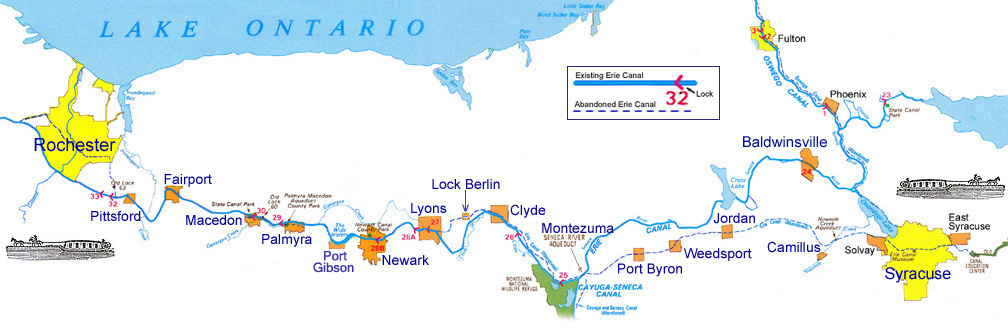
Through the over 360 mile canal from the Hudson River, to
Buffalo, New York and Lake Eerie, engineers, mostly German stone masons and
Irish laborers, had to build aqueducts, blast through limestone mountains and
dense forests. Other natural barriers included the malaria-carrying mosquitoes
that killed around 1,000 workers in the next eight years of construction.
But, at last, a water way was created. Cananarrow boats,
also known as narrow boats, were hauled
by horses and mules along a “tow” path. Grain and other produce became cheaper
to haul from the Midwest farms, to the highly occupied cities of the East.
Machinery and imported goods, as well as the migration of people from an
increasing population in the East, flowed to the west with greater ease,
speed, and lower cost.
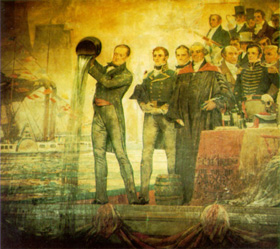
On October 26, 1825, the Eerie canal opened.
Several times since then, the canal has been widened and the
route changed a little. Nowadays, mostly only pleasure craft use the waterway
rather than commercial vessels, which take the St. Laurens Seaway from the east
coast, to the Great Lakes.
When researching the Eerie Canal for “Moonlight Promise” my
novella in Sincerely Yours (Revell Books, April 1, 2014), I discovered that
October 26, 1825 was the night of a full moon. Ah, such promise for this
romance writer’s soul. In all practicality, probably not coincidence to have
the canal open on the day of a full moon.

Purposeful or not, that full moon must have looked like a
promise to tens of thousands – the canal would make a
world of difference in their lives.


