Showing posts with label victorian age. Show all posts

Friday, September 7, 2018

Another British invasion--Victorian influence on American Christmas Traditions

by Kathleen L. Maher

In a previous post, I wrote about New York writers Washington Irving and Clement C. Moore, and how their literary works shaped modern lore surrounding Santa Claus and stockings hung by the chimney... etc. But a significant influence on the way we celebrate Christmas today came from across the pond, and cemented many traditions still practiced. From Prince Albert's trees at Buckingham Palace to the decorations that made them twinkle and shine, to Christmas greeting cards, caroling and gift giving, we owe much of our festivity and merry-making to the Victorians.


The Victorians loved their music. Before the Victorian Age, the cost of pianos and organs would have been prohibitive in the home, but among the middle and upper classes a new opportunity arose to gather around parlor instruments and sing. Both secular and sacred, a new form of song arose in carols. The ancient English custom of the waits, traveling house to house singing for one's supper, transformed into a new and lighter-hearted wassail. Secular tunes were recomposed with sacred lyrics and sung in church as Christmas hymns. Silent Night, O Little Town of Bethlehem and Away in a Manger for example, retold the story of the first Christmas in song. But just as popular were songs like Jingle Bells and O Christmas Tree which celebrate the simple joys of the season.

Queen Victoria may not have originated such iconic associations as mistletoe or Father Christmas, but there was a remarkable renaissance of these charming legends during her reign. Gone were the days of Cromwell who choked out every reference to Catholicism with an iron fist, including gift giving, holiday feasts, and reverence for Saint Nicholas. Victoria and Albert seemed to relax old taboos and usher in an era of simplicity and celebration, particularly where it concerned the joys of children. Maybe this renewal was as much due to writers such as Charles Dickens, whose Pickwick Papers and later work A Christmas Carol depicted charity, dancing, banquet tables, family gatherings, and renouncing curmudgeonly behavior. 


The Kissing Ball, an arrangement involving mistletoe, holly, ivy, and berries, symbolizes the return of pagan evergreen symbols of hope of spring and life, and made its reappearance in the Pickwick Papers. One version of this charming tradition that had its roots in fertility rites, has couples picking a berry from the arrangement each time they kissed beneath it, leaving it eventually empty of fruit. Father Christmas' return from the ban imposed during the Commonwealth period came in A Christmas Carol. The Spirit of Christmas Present would have been easily recognized by any man, woman or child of England as Father Christmas, with his wreath crown, his fur robe, and his merry persona. Between Dickens' writings in England and Moore's in New York, the idea of Santa Claus and Father Christmas started to meld. Father Christmas changed his cloak from green to red somewhere in the mid-century and started placing gifts in stockings.

Yet another Christmas tradition came during the early years of Victoria's reign. The first Christmas greeting card was ordered in 1843 by Sir Henry Cole who commissioned artist John Calcott Horsley. His work was reproduced into 1000 prints and distributed to business associates and friends to wish them good fortune. 


In my Victorian Christmas novella, "Love Brick by Brick", English traditions collide with American folklore in 1857 New York. The aristocrat and the lowborn square off. Romance emerges amid music, popular literature, charity, and leaving aside pride and the failings of the past. Two people of vastly differing backgrounds find they are drawn to build a future together, tying the threads of the old in with new possibilities.

To celebrate the launch of my first traditionally published story this month, I am offering one of Barbour Books' gorgeous paperback copies of Victorian Christmas Brides to one lucky visitor. Random (dot) org will draw one winner on Monday, Sept 10. Be sure to leave your email so I can notify you. (US residents only)

To enter, answer this question:
What is your favorite Christmas carol or song, and what memories does it evoke when you hear it?


Kathleen L. Maher has had an infatuation with books and fictional heroes ever since her preschool crush, Peter Rabbit. Her novella "Love Brick by Brick", released in the 2018 Victorian Christmas Brides Collection, featuring her hometown of Elmira, New York. She won the ACFW Genesis contest in 2012 for her Civil War story The Abolitionist’s Daughter. Kathleen shares an old farmhouse in upstate New York with her husband, children, and a small zoo of rescued animals.
Follow Kathleen:
on Facebook: https://www.facebook.com/KLMaherAuthor/
on Twitter: https://twitter.com/Mahereenie
and on Amazon: https://www.amazon.com/author/kathleenlmaher


Sunday, March 25, 2018

Arsenic Poisoning in the American Victorian Age--and a Giveaway


Well, I am celebrating again, and it’s no April Fool’s Joke, folks. On April 1, my seventh novella collection—the First Love Forever Romance Collection—will release. This collection features nine separate stories about couples who fell in love years earlier, were separated for one reason or another, then reconnect as they try to rekindle their love for each other. Hope you’ll look for it! Read on to the end of the post for a chance to win an autographed copy!

This month’s topic is about arsenic. Most of you have probably heard stories, either fictional or real, about people dying of arsenic poisoning. But did you know that it was a fairly easy thing to be poisoned by the substance in the 1800s?

Arsenic label--clearly labeled a poison
Arsenic was a by-product of the smelting process used in mining different ores, so in the various mining communities in the western states and territories of the U.S.A., it was a prevalent substance. At a time before society was aware of such concerns, this by-product sometimes seeped into the groundwater. People in the area would then draw water from wells and ingest some level of the toxic element.

Regularly, arsenic was sold in mercantiles and general stores as a rat poison. It could be sprinkled walls and in barns where the rats would walk through it, ingest some, and hopefully die from that contact. However, the arsenic came as an odorless, tasteless white powder that could often be confused with flour or sugar, so great care was necessary for how and where it was kept. There is a story I’ve read about a confectioner in the mid-1800s who accidentally used twelve pounds of arsenic in his sweets, thinking it was flour. Over two hundred people were harmed in that mix-up, and twenty died, including the confectioner himself!
around

It was also used to get rid of bed bugs. Bed bugs are no joke—my husband and I had an infestation of them several years ago after we lost his grandmother. We brought home one hand-made afghan she’d kept in the nursing home where she lived, and with it, we brought bedbugs into our house. It was a months-long battle to get rid of them. I wanted them gone—ASAP—but we were very cautious about what products we used to treat our home and beds. Knowing what we do today about arsenic, it floors me to think people in the 1800s might have sprinkled this stuff in their beds to kill those nasty parasites. How horrifying to think they were not only killing the insects but possibly themselves—or at least shortening their lives!

An old advertisement for medicated soap and other products to help with complexion.
Even more horrifying was that arsenic was sold under the guise of helpful medications, despite people knowing that this substance was poisonous. What maladies were treated with arsenic-based medicines, you ask? Everything from complexion issues and low libido to asthma, syphilis, and cancer. So long as the amount of arsenic stayed below 1/10th of a gram, it was considered “safe” in such over-the-counter applications. Oh, if they only knew!

Another common source of arsenic poisoning came from dyes used for paint and wallpapers. Particularly the green colors known as Paris or Scheele’s Green. Such colors were hugely popular in the 1800s, and the dyes used for them were arsenic-based. The paints made in these colors were touted to have “insecticidal qualities” that could keep ants, termites, and other such bugs from infesting or eating your home. Unfortunately, every time people touched their walls, they risked absorbing the arsenic through their skin.

Green dyes used in women's dresses could be deadly
due to arsenic.
Worse, these same dyes were used in fabrics for home furnishings—and even clothing. Green was quite a popular color for women’s dresses. As the women would wear these items, they would perspire (did prim, proper Victorian women actually do such a thing? LOL), which would cause the arsenic-based dye to seep into their skin and poison them.

So there were many ways in which the arsenic-laden products were able to poison unsuspecting people in the 19th century, and the government didn’t begin to regulate the use of arsenic in the various medicines and household products until the late 1800s and early 1900s.

It’s your turn: Which of the above applications of arsenic do you find most disturbing? Leave your email address along with your answer, and you’ll be entered in the drawing for an autographed copy of the First Love Forever Romance Collection.


Jennifer Uhlarik discovered the western genre as a pre-teen when she swiped the only “horse” book she found on her older brother’s bookshelf. A new love was born. Across the next ten years, she devoured Louis L’Amour westerns and fell in love with the genre. In college at the University of Tampa, she began penning her own story of the Old West. Armed with a B.A. in writing, she has finaled and won in numerous writing competitions, and been on the ECPA best-seller list numerous times. In addition to writing, she has held jobs as a private business owner, a schoolteacher, a marketing director, and her favorite—a full-time homemaker. Jennifer is active in American Christian Fiction Writers and lifetime member of the Florida Writers Association. She lives near Tampa, Florida, with her husband, college-aged son, and four fur children.


A first love is never easily forgotten...
and coming face to face with that person again can be awkward when the heartstrings are still holding on to the “what ifs.”
In settings from 1865 to 1910, nine couples are thrown back on the same path by life’s changes and challenges. A neighbor returns from law school. An heiress seeks a quick marriage. A soldier’s homecoming is painful. A family needs help. A prodigal son returns. A rogue aeronaut drops from the sky. A runaway bridegroom comes home. A letter for aid is sent. A doctor needs a nurse. Can love rekindle despite the separation of time and space?


Saturday, August 5, 2017

Victorian Literature and the Industrial Revolution: Factories, Ragged Schools, and Serial Novels


It’s August, which means school will be starting up soon for many of us, whether we are parents, teachers, or continuing students. As a high school English teacher myself, my mind is turning towards the classic literature I will be delving into with my students this year, starting off with one of my favorites, Dickens's A Tale of Two Cities.

                            Charlotte Bronte.  Courtesy of the University of Texas Libraries, The University of Texas at Austin. 
Many of us love classic Victorian novels like those of the Bronte sisters or     Charles Dickens, but did you know we have the Industrial Revolution to thank for many of these books we still enjoy today? When I had the chance to study in Oxford, England, during my college years, I found the connection between Victorian Literature and the Industrial Revolution fascinating. I thought you might enjoy hearing a bit about it too.


The Industrial Revolution began in England in the late 18th century with the development of early machines for processing textiles and producing cloth. By the 1830s, the proliferation of factories and mill towns had changed the physical and social landscape of Britain. Family structure changed as people moved from farms to cities and women and children went to work in the factories as well as men. 

Ironworks Factory. Courtesy National Library of Wales.
Poverty and squalor abounded, but the Industrial Revolution had positive impacts too.

For one thing, while many children who suffered long hours working in the factories did not go to school, ultimately education and literacy increased as a result of the Industrial Revolution. The very presence of these children in the factories eventually raised awareness of their need for schooling, and benefactors established schools to give these little ones Christian and academic education. In fact, in 1844 Parliament passed a law requiring child workers to be given six half-days for schooling per week. The so-called “Ragged Schools,” Sunday Schools, schools for girls, and other public or charity schools meant that more and more children could learn to read and write despite the hardship of their lives.

With more working class people knowing how to read, the demand for reading material naturally rose. Coupled with mechanization’s greater ability to mass-produce texts, literature began to flourish like never before, with novels and poetry for both adults and children. Many of these authors, like Charlotte, Emily, and Anne Bronte, Charles Dickens, Lewis Carroll, Robert Louis Stevenson, Alfred Lord Tennyson, and Christina Georgina Rossetti, are still beloved today.

Charles Dickens. Source: Wikimedia Commons
{{PD-1923}} – public domain in the U.S.
The darker side of the industrial revolution also fueled literature in a different way. Novelists like Charles Dickens and poets like Elizabeth Barrett Browning used their writing to shine light on the abuses of the poor, the horrible conditions of the working class, and the plight of children through books like Dickens’s Hard Times and Oliver Twist or poems like Browning’s “TheCry of the Children.” These works still stand as examples of how literature can touch people’s hearts and influence society for good.
Wikimedia Commons, Public Domain

Many of us don’t realize that most Victorian novels were published in serial form, usually a chapter at a time in newspapers or magazines, before they were released as an entire book. The industrial revolution had also produced an growing middle class, and for the first time many families had the time (and the literacy) to sit around the fire in the evenings at leisure together. And what better way to pass the time than to read a story aloud? So they would pick up a magazine or newspaper and read together the latest installment of Jane Eyre, Vanity Fair, or The Pickwick Papers

There’s even a website now that has many of these classic novels organized by the serial order in which they appeared in various English periodicals during the Victorian period. You can view original facsimiles of these early editions of these beloved stories and see how they looked, chapter by chapter, to loyal fans and families for the very first time. While the site can be a bit tricky to navigate, it’s fun to explore—here’s the link if you’d like to take a peek!


So, what are some of your favorite Victorian novels? Did any of this information about the influence of the Industrial Revolution surprise you? Would you have enjoyed reading novels in serial form, or would it frustrate you to have to wait a month to read the next chapter? I’d love to hear your thoughts!

Thursday, June 8, 2017

Greatest Novelist of Victorian Period

By Tiffany Amber Stockton


Last month, I shared about the "seven wonders of the world" both new and ancient. If you missed that post, you can read it here: http://www.hhhistory.com/2017/05/the-latest-wonder-of-world.html. Now, let's get on with the feature for the month of June. *grins*

THE GREATEST NOVELIST OF THE VICTORIAN ERA

Who comes to YOUR mind when you read that heading? Leo Tolstoy. George Orwell. G.K. Chesterton. Alexandre Dumas. Victor Hugo. Oscar Wilde. Henry James. Virginia Woolf. All of those are renowned authors and skilled literary geniuses. Although they are contemporaries of the author heralded above, none of them are in the spotlight today.

This author had a writing style marked by abundant linguistic creativity. Satire and a gift for caricature was his forte. He worked intensively to develop unique names for his characters that would reverberate with connections for his readers, giving allegorical meaning to his novels' themes. Comparing orphans to stocks and shares, people to tug boats, or dinner-party guests to furniture are just some of this man's acclaimed flights of fancy.

Want to know who it is? Of course you do.

The man's name is Charles Dickens.

Charles was an English writer and social critic. He created some of the world's best-known fictional characters and is regarded by many as the greatest novelist of the Victorian era. His works enjoyed unprecedented popularity during his lifetime, and by the twentieth century, critics and scholars had recognized him as a literary genius. His novels and short stories still enjoy lasting popularity today. I'm sure you've read at least one of them, and probably more.

Despite a lack of formal education, he edited a weekly journal for 20 years, wrote 15 novels, five novellas, hundreds of short stories and non-fiction articles, lectured and performed extensively, was a persistent and tireless letter writer, and campaigned vigorously for children's rights, education, and other social reforms. Goes to show if you have passion and a purpose, the formal training isn't always necessary.

Dickens's literary success began with the 1836 serial publication of The Pickwick Papers. Within a few years he had become an international literary celebrity, famous for his humor, satire, and keen observation of characters and society. His novels, most published in monthly or weekly installments, pioneered the serial publication of narrative fiction. This allowed Dickens to evaluate his audience's reaction, and he often modified his plot and character development based on such feedback. His plots were carefully constructed, and he often wove elements from topical events into his narratives.

Dickens was regarded as the literary colossus of his age. His 1843 novella, A Christmas Carol, remains popular and continues to inspire adaptations in every artistic genre. Oliver Twist and Great Expectations are also frequently adapted, and, like many of his novels, evoke images of early Victorian London. His 1859 novel, A Tale of Two Cities, set in London and Paris, is his best-known work of historical fiction.

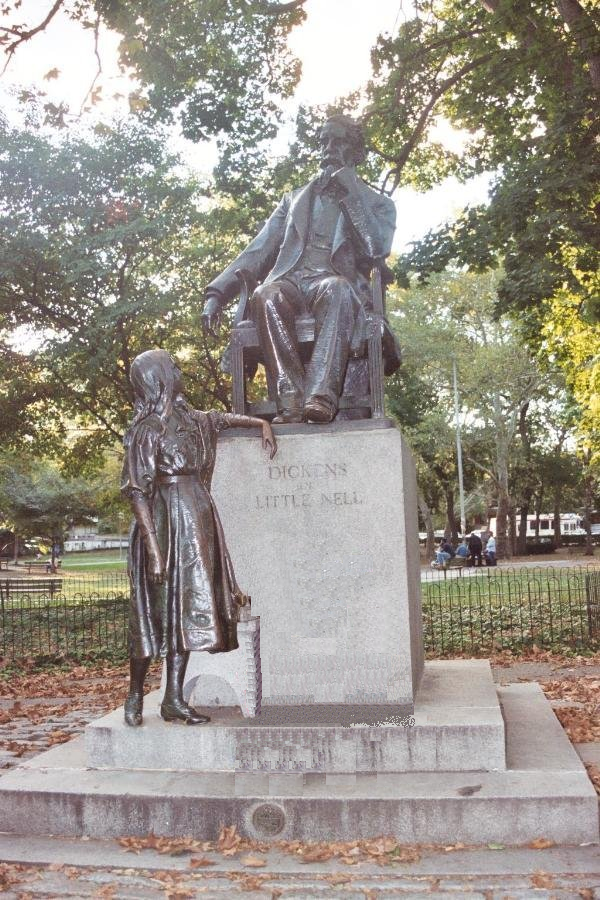
Museums and festivals celebrating Dickens's life and works exist in many places with which Dickens was associated, and several statues have been erected in his honor. He's also been featured on British currency, had a high school named after him, was #41 in a list of the 100 Greatest Britons, and 5 of his books have been named in the top 100 in the UK. He's even been featured on multiple postage stamps. I'd say he left a lasting legacy that won't disappear as long as there are readers in this world.

Published Novels:
  • The Posthumous Papers of the Pickwick Club (Known as "The Pickwick Papers")
  • The Adventures of Oliver Twist
  • The Life and Adventures of Nicholas Nickleby
  • The Old Curiosity Shop
  • Barnaby Rudge: A Tale of the Riots of Eighty
  • The Life and Adventures of Martin Chuzzlewit
  • Dombey and Son
  • David Copperfield
  • Bleak House
  • Hard Times: For These Times
  • Little Dorrit
  • A Tale of Two Cities
  • Great Expectations
  • Our Mutual Friend

NOW IT'S YOUR TURN:

* Which novel(s) have you read by Charles Dickens?

* If a novelist today published his/her book in serial form, would you read it? And how often would the installments have to be made in order to maintain your interest from start to finish? Daily? Two times a week? Weekly? Twice monthly? Monthly?

* What is 1 fascinating fact about today's post which caught your eye today?

Leave answers to these questions or any feedback on the post in the comments below. Don't forget to come back on the 9th of July for my next appearance.


BIO

Tiffany Amber Stockton has been crafting and embellishing stories since childhood, when she was accused of having a very active imagination and cited with talking entirely too much. Today, she has honed those childhood skills to become an author and speaker who has partnered with Nerium International in the anti-aging, health & wellness, and personal development industry, helping others become their best from the inside out.

She lives with her husband and fellow author, Stuart Vaughn Stockton, in Colorado. They have one girl and one boy, and a Retriever mix named Roxie. She has sold twenty (21) books so far and is represented by Tamela Hancock Murray of the Steve Laube Agency. You can also find her on FacebookTwitterPinterest, and LinkedIn.

Thursday, June 20, 2013

Public swimming--a brief history

By Kathleen L. Maher

As summer arrives and the kids begin vacation, many of us look forward to trips to the beach or pool. But public swimming hasn't always been the ritual we enjoy today. The history of public bathing has been controversial at times and dangerous at others.

Ancient Rome had public bath houses. Finland and Asia had saunas. Native Americans had sweat lodges. Japan had communal baths.  In Judaism and Islam a spiritual significance was attached to ritual cleansing, and communities often provided common pools in which to do so. Medieval Europe offered them--places where people could go to cleanse their bodies, exercise, and socialize--though the church frowned upon public bathing due to the vices often associated. Then in the Renaissance, the thought of Black Plague effectively ended communal baths as people began to believe their own dirt protected them from the disease.

The first public swimming pool in America opened in Massachusetts in 1887. As cities became overcrowded and enlightenment about sanitation and disease accompanied the progressive movement, public bath houses for the working class sprang up for the purpose of offering the unwashed masses a place to cleanse. Until municipal baths opened, rowdy young men would bathe openly in rivers and lakes, making a public spectacle for Victorian eyes, so the general thought was to provide privacy and promote decency and relegate them indoors.

 Bathers in Northern cities seemed to mingle according to race, but not gender or social status. Women bathed on alternate days from men in these public pools. For wealthy and upper middle class suburbanites, country clubs and private societies offered a more exclusive and recreational pool experience.

In the early 20th century, leisure time opened up for the laborer. As weekends and "holidays"--the non-religious version of holy days--were given, amusement parks and public beaches became popular. Coney Island and Jones Beach in New York became sensations. Sunbathing, sand and shore entered the public psyche.

Around the same time as people began to flock to the beach, public pools rose in popularity. Fairgrounds Park pool in St. Louis offered a sandy bottom and drew thousands of bathers every season. These pools gradually became co-ed, and as men and women bathed together a new wave of racism arose, white men prohibiting other races to mingle with white women. Fairgrounds Park pool erupted in a race riot when the first black swimmers were admitted.

But the Polio scare of the '30's and '40's would soon empty the pools and beaches. When FDR came down with the crippling disease after a weekend away at a lake house in New Brunswick, the public drew an instant association with swimming and the summer scourge.  Since Polio is resistant to soaps and chemicals of low pH, its spread became epidemic. But it was soon discovered that chlorine rendered the disease inactive. Old methods of pool sanitation involved frequently changing out the water and filters. Chlorine had been heavily produced during WWI, and its use in pools began in the 40's and became standard by the 1960's. Jonas Salk's vaccine brought swimmers back within a season or two as the beach beckoned and confidence rose again over fear.


Beach going is big business today. According to a study done in 2008 by James R. Houston, Ph.D., director of Research and Development, U.S. Army Corps of Engineers, "It's estimated that U.S. beaches contribute more than $320 billion annually to the national economy -- more than 25 times what national parks bring in." The movie Jaws in the 1970's played on two big fears associated with swimming: the financial implications of closing a beach during a popular holiday season, and the primal fear of what may lurk in the deep.

As summer sings it siren song and beckons you to the waters, think about how this simple pleasure has been both enjoyed and forbidden in the past, and thank the Lord for the freedom and safety to take the plunge.

For discussion: Tell us about your favorite swimming hole. Does your family go to the beach every summer, or do you own a lake cottage? Do you pack up the kids and head to the public pool? Do you have a favorite memory involving swimming? Share with us!