
 |
| Ancient Egyptian statue of Bastet Photo by Gryffindor, 2008, [cc] |
Watching them pounce on a toy mouse or a shining beam of laser light, we can observe their hunting instincts. Their rolling shoulder gait is so much like that of their distant cousins in the wild as they stalk their "prey." What caused cats to come from the wild and into human dwellings?
Evidence of cats living with people span from 5,000 years ago in China to up to 9,000 years ago in the ancient Near East. A cat’s jawbone was found on the island of Cyprus, dating back 8,000 years. This suggested that cats dwelled with humans at the time. Archaeologists also found a cat buried with a human on Cyprus that dated back even further.
In ancient China, leopard cats were domesticated to some degree. Some research suggests that domestic cats are all descended from felis sylvestris, the Middle Eastern so-called “cat of the woods,” or wildcat. More recent research of feline DNA showed that the modern house cat descended from two lineages. One was the African wildcat. The theory is that as humans began to progress in the field of agriculture (no pun intended) and stored grain, wild cats started to enter human communities to eat the mice and other rodents that invaded the granaries. Consequently, people were happy with the population control of those pesky rodents and they welcomed the feline predators.
 |
| African Wildcat by Sonelle, 2003, [cc] |
As is commonly known, cats were revered in Egypt. Their goddess, Bastet, had the head of a feline. Anyone who killed a cat in ancient Egypt could face execution. Cats were often mummified just as humans were. Wealthy families prided themselves on the colorings of their cats and sometimes exhibited them in a similar fashion to the cat shows of today. Other ancient cultures also respected them though not to such a high degree.
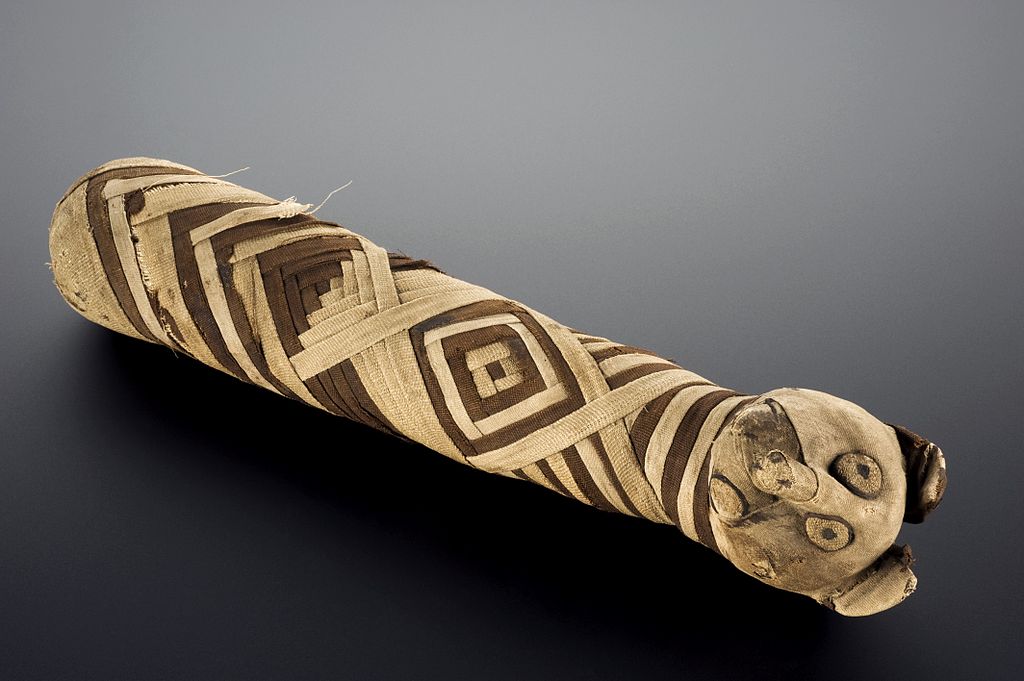 |
| Mummified Cat, 2000-100 B.C., from Welcome Images, 2014 [cc] |
How did they go from predator to pet? Clues came to light as scientists bred foxes to be friendly on a Russian fur farm in the 1950s. The resulting foxes, after a few generations, took on dog-like characteristics. Their ears grew floppier and their tails grew curlier. They grew affectionate to humans. Scientists have concluded that domesticated animals have changes in their brains that make them more likely to live peaceably with humans.
 |
| Cats in Chinese Art, Mao, 12th Century {PD} |
Similarly, cats that gravitated toward human settlements continued to breed with other cats who were less shy to human company and more motivated by reward. Eventually the solitary feline was happy to curl up in the lap of their human caretaker. This may have occurred over just a few generations.
 |
| Cat playing from Loliloli, 2008, {PD} |
The skeleton and DNA of the domestic cat show little difference compared to their wild counterparts. The one unique trait which emerged were the spots and stripes of the tabby. These didn’t appear until the Middle Ages. During the 1700s the tabby markings became more common and were identified with domestic cats. Then in the 1800s, cat enthusiasts began choosing cats for their particular characteristics such as coat markings, and produced fancy breeds.
So what is the true story of the domestication of cats? As lovable felines do today, they chose the humans they wanted to live with and are pleased to do so for as long as they so wish. The DNA studies concluded that cats basically domesticated themselves.

 |
| Lilybits, my favorite feline. |
Kathleen Rouser is the author of Rumors and Promises, her first novel about the people of fictional Stone Creek, Michigan, and the novella, The Pocket Watch. She is a longtime member of American Christian Fiction Writers.
Kathleen has loved making up stories since she was a little girl and wanted to be a writer before she could even read. She longs to create characters who resonate with readers and realize the need for a transforming Savior in their everyday lives. She lives in Michigan with her hero and husband of 35 years, and the sassy tail-less cat who found a home in their empty nest. Connect with Kathleen on her website at kathleenrouser.com, on Facebook at https://www.facebook.com/kathleenerouser/, and on Twitter @KathleenRouser.
