Showing posts with label Ancient Israel. Show all posts

Monday, February 27, 2023

Serving in Solomon's Temple


Let’s talk about serving in the temple:
Around 966 BC, King Solomon built an elaborate, permanent dwelling place for the Lord. His father, King David had already set aside all the materials and the plans, and Solomon was eager and willing to do oversee the construction.
                                                                                    Tissot Solomon Dedicates the Temple at Jerusalem. (wikimedia)


Along with the half-month dedication ceremony, Solomon appointed workers to serve in every aspect of the day-to-day running of the temple, including priests, high priests, musicians, gatekeepers, bakers, perfumers, treasurers, etc..

Those who were qualified to serve were members of the tribe of Levi (according to the delegation from the Lord back in the days of the wilderness wandering). Those from the line of Aaron were eligible to be priests (all priests were Levites, not all Levites were priests).


                                                                     Jewish Priests (wikimedia)


I don’t know about you, but when I had thought of priests and Levites serving in the temple, I guess I pictured continual service.

That would have been true of some, the High Priest (i.e. Annas and Caiaphas in Jesus time.) who served in the position for life.

But the others (i.e. Zacharias, John the Baptist’s dad) would have come in for a week at a time.

According to the instructions God gave to David as he was getting Solomon set up to build the first temple, the priests and the Levites were divided into 24 courses within their assigned duty. The length of each service was 7 days (1 Chronicles 9:25), beginning and ending on the Sabbath (2 Chronicles 23:8). These rotations occurred twice a year.

In addition, all the priests served for 3 extra weeks during the year during special feasts.(Deuteronomy 16:16).
                                                                                     Sukkot Celebration (Kotel2014sukkot Wikimedia)

Can you imagine scheduling all this? At any given time there were as many as 1,300 Levites in the temple complex. This is gatekeepers, priests, musicians, cooks, priests’ assistants and more.

In Jeremiah 20:1 Pashur is named the Chief Governor of the House of the LORD. I imagine his job description included the scheduling.

It’s been quite some time since I was in charge of making out schedules, and my (less than 15) people served in the same capacity week after week. I can’t even begin to fathom how to keep all those people straight!

In Ezekiel’s Song, I played around with this behind-the-scenes workings of the Temple. The Bible didn’t mention what capacity Ezekiel served in at the temple, but the later on in Babylon, the Lord names him a Gatekeeper for the people of Israel (and how often does the Lord prepare us for the bigger jobs, by training us in the day-to-day work? AmIright?).

I imagined that Ezekiel was a common fixture around the temple. I even have him serving as aide to the governor of the temple, scheduling and making sure everyone is in their place at the right time.
                                                     Solomon's Stables Under the Temple Platform (wikimedia)

Another aspect would be the inconsistency of the workers. If everyone rotated every seven days, how did you know who to count on? What about musicians? Can you even have a semblance of normal if you are constantly training new people? When would you even rehearse?
 
Here's an interesting tidbit about musicians and temple service: 1 Chronicles 9:33 says the musicians were free from other duties. Can’t you just see the musicians milking that? “I don’t have to do any chores. I’m a musician.” 

What part of serving in the temple was new to you? Would you be in charge of organizing the sheer volume of the workers that showed up on any given day?
                                                           

A prophet's heart broken, a woman's joy gone. What does Yahweh have planned for His people?
On the brink of Jerusalem's demise, devoted priest, Ezekiel, sees the insincerity of Judah's worship. Despite his efforts to call the people back to true worship of Yahweh, priests, artisans, valiant warriors, and royals are exiled to Babylon. When God gives him messages of continued judgment for the people in his homeland, his heart breaks. How can he minister to the people from so far away?
The presence of the Lord is tangible when Shiriel sings in the temple, and her voice prepares the hearts of many to worship. When she is exiled to Babylon, her faith is shaken. Does the Lord's presence extend beyond Jerusalem and His holy temple?
Ezekiel is struck mute and paralyzed as he begins his prophetic ministry, and Shiriel devises a plan to get the Lord's message back to the unfaithful people of Judah. Shiriel struggles with discontentment as serving the Lord looks nothing like she'd imagined. Can she provide for her family and carry out her husband's ministry when her joy is gone, and her own dreams are placed on hold?        


Friday, January 27, 2023

Religious Life in Ancient Israel's Divided Kingdom

When I first began researching the prophet Elijah for my novels Rain and Whirlwind, I was continually confused about the Divided Kingdoms of Israel and Judah, north and south, not to mention the many kings from each with similar names. Today I'll broadly touch on the reasons for and results of the split. We'll leave the kings' names for another time.

POLITICS AND RELIGION

After King Solomon's death in 931 B.C.E, ten northern tribes rebelled against heavy taxes imposed by Solomon's son, Rehoboam, and formed a separate kingdom, which retained the name Israel. The remaining tribes called themself Judah, after King David's family line.

The rebellion almost led to war. Rehoboam (southern king) mustered his far superior army to crush the rebellion. But the prophet Shemaiah received word from the Lord and stopped them. 

“Say to Rehoboam son of Solomon king of Judah, to all Judah and Benjamin, and to the rest of the people, ‘This is what the Lord says: Do not go up to fight against your brothers, the Israelites. Go home, every one of you, for this is my doing.’” So they obeyed the word of the Lord and went home again, as the Lord had ordered.  ~ 1 Kings 12:24

Despite the political advantage of lower taxes than their southern brothers, Jeroboam, the new king of Israel (north) worried the religious pull of the temple in Jerusalem would entice religious pilgrims from his territory. He even feared his people might kill him and reconcile under Judah's King Rehoboam. To keep Israelites from straying, Jeroboam instituted a form of calf worship at Dan and Bethel, the southern and northern borders of his kingdom. The politically correct explanation of these "high places" was that "the Lord rode on the backs of the calves" but in fact, calf worship was a bridge to Canaanite cults and led the way to Ba'al worship.

North and South continued to eye each other suspiciously. Israel felt they'd not been treated equally with their southern kinsmen, that they'd borne more than their fair share of taxes and forced labor for an extravagant king. Learning that Israel worshipped golden calves, Judeans eyed them as apostates.

JEZEBEL'S INFLUENCE

Jezebel - John Liston Byam Shaw
courtesy WikiCommons
When a later king of Israel, Ahab, married Princess Jezebel of Tyre, trade routes were strengthened with her Canaanite countrymen. Ahab, enamoured with the beautiful princess, built a temple to Ba'al Melqart in Samaria. Jezebel took her position not only as queen, but as leader of the Ba'al cult in Israel, contributing to even greater departure from the worship of Yahweh. 

This is supported by archeologists finding evidence of cultic worship centers in places throughout Israel such as Megiddo and Western Galilee. Votive images of children seem to indicate child sacrifice.

Not only did Jezebel support the Ba'al cult, she persecuted and killed the prophets of Yahweh. This all led up to a confrontation to between the two forces at Mount Carmel. The prophet Elijah challenged the followers of Ba'al to a contest. The winner's deity would answer by sending fire from heaven. Apparently, Ba'al was away or napping that afternoon, because only Yahweh sent fire to consume His offering.

Despite Yahweh's victory, and the execution of the Priests of Ba'al (although evidently not those of Astarte), the Ba'al cult was decimated. But though it was not as flagrant in the following years, it continued to spread. The key to the religious theme of the times is in 1 Kings 18:21, where Elijah asks, "How long will you falter between two opinions?" (Literally, limp along on two twigs.)

Israel had not totally rejected Yahweh, but attempted an adulterated worship of both Yahweh and Ba'al. If their parents had taught them anything of Moses' writings, they had to know this could only lead to their downfall.
"Fear the Lord your God, serve him only." Deuteronomy 6:13a


A SAD END

The Death of Jezebel
courtesy WikiCommons
Jehu, a later king in Israel, dealt a blow to Ba'al worship in a "sting operation." He summoned all the priests and other cult leaders into the Ba'al temple for a time of feasting and celebration. Instead he had them killed and the temple destroyed.

Still, the people did not return to God. Even Jehu did not totally turn from cult worship. Although he had destroyed Ba'al worship, thrown Jezebel to the dogs, and killed Ahab's remaining family, he continued to worship the golden calves at Bethel and Dan. Some people will never learn!

So the Lord allowed foreign nations to erode Israel's territory. Jehu lost all land east of the Jordan to Syria. Finally, the northern kingdom of Israel was taken into captivity by Assyria.


For further reading:

A History of Israel
John J. Davis, John C. Whitcomb

https://www.biblicalarchaeology.org/daily/ancient-cultures/ancient-israel/high-places-altars-and-the-bamah/

Nelson's New Illustrated Bible Manners & Customs, 
The Divided Kingdom: Life in Israel

Please visit the blog to comment on this post.

~~~~~~

WHIRLWIND ~ Whispers on the Wind, Book 2 

Purchase at ChristianBook     Purchase at Barnes&Noble      Purchase at Amazon

A king's downfall and a love that transcends war


SPURNED BY POTENTIAL SUITORS, Miriam travels to Jezreel to care for her cousin’s son. There, the precocious seven-year-old works his way into her heart. When Arameans swarm the land like locusts, Miriam focuses on the safety of her young ward but promises adventures beyond the city walls when the war ends.

Gershon, a quiet and kind vintner, is happily building a life for his wife, son, and aging parents. But when his wife dies during childbirth and war looms on the horizon, he must make a decision—will he take a new wife before his heart can mend?

Meanwhile, Dov, a young officer crosses paths with the “bird girl” he remembers from the past, now grown to womanhood. That she is a beautiful woman matters not, as he is a career soldier. Unexpectedly charged with leading Ahab’s army against the Arameans, Dov anticipates death and defeat in Samaria, but when a prophet pledges victory, Dov vows to fight to the end.

When an unlikely victory brings freedom, a bright future seems imminent. Then one afternoon Miriam witnesses a tragedy and must flee with the boy to keep them both safe. With henchmen on their trail, will they find refuge—and her heart the home she’s longed for? 

~

DANA MCNEELY writes biblical novels from an Arizona oasis, where she lives with her hubby the constant gardener, two good dogs, an antisocial cat, and myriad migrating butterflies. When not researching, writing, or struggling with the mysteries of social media, Dana can be found wandering in her personal Eden dreaming up new stories.

You may follow Dana at https://DanaMcNeely.com and receive a free eBook! The Eyes of the Lord is a prequel to the Whispers on the Wind series. Rain and Whirlwind follow. 


Sunday, November 27, 2022

Stranger Things

Dana McNeely


My children once filmed a humorous video about scary titles in my library, such as Crime Scene, All About Poisons, and Famous Villains. (I once thought I’d like to write mysteries.) Now that I’ve found the perfect genre - historical fiction set in Bible times - those books have been shuffled to back shelves. Yet as I paged through my research in preparation for this post, I found it a collection of even stranger things!


Horseback Archery in Shiraz - Image courtesy WikiMedia

Horseback Archery - from The Archer's Guide by an Old Toxophilite, 1833

"The exercise of the bow, as a pastime, is performed by [the Persians] on horseback as well as on foot. The horseman gallops away with the bow and arrow in his hand, and, when he has reached a certain point, he inclines either to the right or left, and discharges his arrow, which, to win the prize, must hit a cup fixed at the top of a pole 120 feet high."
  • I used this research for battle scenes in Whirlwind, along with other interesting historical tidbits about ancient warfare. Whirlwind is now available for preorder, releasing December 6th.


Statuary Angel blowing what appears to be an anafil - courtesy Deposit Photos

Music and War – from HistoryNet.com


"The function of music in war has always been twofold: as a means of communication and as a psychological weapon. 

Among the oldest references to the latter role appears in Chapter 6 of the Old Testament’s book of Joshua, with an exceptionally detailed description of the deployment of ram’s horns against Jericho, the oldest fortified human settlement known to archaeology.

Among the Saracen instruments adapted [during the Crusades] were the anafil, a straight, valveless trumpet; the tabor, a small drum, sometimes snared; and the naker, a small, round kettledrum, usually deployed in pairs.

In The Art of War Niccoló Machiavelli wrote that the commanding officer should issue orders by means of the [anafil] because its piercing tone and great volume enabled it to be heard above the pandemonium of combat."
  • I was familiar with the Israelite's use of the shofar, but found these additional instruments of interest. Another source noted potential use of the naker and anafil (pictured above) by the Arameans. I used anafils to terrify horses in a Whirlwind battle scene.


Image courtesy Chabad.Org


Festival of Dancing Maidens

based on the teachings of the Lubavicher Rebbe – courtesy MeaningfulLife.Org

"There were no greater festivals for Israel than the 15th of Av and Yom Kippur. On these days the daughters of Jerusalem would go out... and dance in the vineyards. And what would they say? 'Young man, raise your eyes and see which you select for yourself....'

And so it is written, 'Go out, daughters of Zion, and see King Solomon, in the crown with which his mother crowned him on his wedding day and on the day of his heart's rejoicing' (Song of Songs 3:11). 'His wedding day' — this is the Giving of the Torah; 'the day of his heart's rejoicing' — this is the building of the Holy Temple, which shall be rebuilt speedily in our days."

Talmud, Taanit 26b

  • I had so much fun using this bit of research and various other sources about men’s dances in a celebratory scene which took place in Naboth’s vineyard, in Whirlwind. This is a scene that would have been impossible without the random impact research often brings to a historical novel.


The Syrian Brown Bear – Wikipedia

The Syrian brown bear's fur is usually very light brown and straw-coloured. The hair on the withers is longer with a grey-brown base and is often a different shade from the rest of the body, seen in some individuals as a dark stripe running across the back. The lighter colors usually appear at higher altitudes. Their legs are commonly darker than the rest of their body. It is the only known bear in the world to have white claws. It is a rather small brown bear. Adult males have skulls measuring approximately 30–40 cm (12–16 inches). The Syrian brown bear weighs up to 550 lb (250 kilograms), and measures from 101–140 cm (40–55 inches) from nose to tail.
  • I am using this bear, currently endangered, in my next book, currently in progress. I'm also finding "What to do when you encounter a bear" of intense interest. Ha!


WHIRLWIND ~ Whispers on the Wind, Book 2  
Preorder ChristianBook  Preorder Barnes&Noble  Preorder Amazon

A king's downfall and a love that transcends war

SPURNED BY POTENTIAL SUITORS, Miriam travels to Jezreel to care for her cousin’s son. There, the precocious seven-year-old works his way into her heart. When Arameans swarm the land like locusts, Miriam focuses on the safety of her young ward but promises adventures beyond the city walls when the war ends.

Gershon, a quiet and kind vintner, is happily building a life for his wife, son, and aging parents. But when his wife dies during childbirth and war looms on the horizon, he must make a decision—will he take a new wife before his heart can mend?

Meanwhile, Dov, a young officer crosses paths with the “bird girl” he remembers from the past, now grown to womanhood. That she is a beautiful woman matters not, as he is a career soldier. Unexpectedly charged with leading Ahab’s army against the Arameans, Dov anticipates death and defeat in Samaria, but when a prophet pledges victory, Dov vows to fight to the end.

When an unlikely victory brings freedom, a bright future seems imminent. Then one afternoon Miriam witnesses a tragedy and must flee with the boy to keep them both safe. With henchmen on their trail, will they find refuge—and her heart the home she’s longed for?
~
DANA MCNEELY writes biblical novels from an Arizona oasis, where she lives with her hubby the constant gardener, two good dogs, an antisocial cat, and myriad migrating butterflies. When not researching, writing, or struggling with the mysteries of social media, Dana can be found wandering in her personal Eden dreaming up new stories.

You may follow Dana at https://DanaMcNeely.com and receive a free eBook. The Eyes of the Lord is a prequel to Rain.


Thursday, October 27, 2022

Chariots of Fire

Dana McNeely

In modern times, chariots evoke a poetic romanticism found in media, art, and literature. For example, the title of the film "Chariots of Fire" was inspired by a line written by English poet William Blake, “Bring me my Chariot of Fire!” The poem, in turn, was inspired by the following Bible passage, which also inspired my soon-to-be-published novel, Whirlwind.

As they were walking along and talking together, suddenly a chariot of fire and horses of fire appeared and separated the two of them, and Elijah went up in a whirlwind. Elisha saw this and cried out, “My father! My father! The chariots and horsemen of Israel!” And Elisha saw him no more. Then he took hold of his garment and tore it in two. ~ 2 Kings 2:11-12 New International Version


Giuseppi Angeli, Elijah Taken Up in a Chariot of Fire,
courtesy WikiMedia Commons

Going back in biblical history to the first mentions of chariots, the ancients probably did not associate chariots with romantic notions, but with transportation, hunting, or a nation’s strength in battle. It is to that notion of the nation's strength that Elisha compares his mentor when he calls Elijah "the chariots and horsemen of Israel."


The Earliest Chariots 

Image courtesy Wiki Commons.

The first biblical reference to a chariot referred to Joseph riding in Pharaoh's chariot in Egypt. It may have looked like the image above.
"Then Pharaoh took his signet ring from his finger and put it on Joseph’s finger. He dressed him in robes of fine linen and put a gold chain around his neck. 43 He had him ride in a chariot as his second-in-command, and people shouted before him, 'Make way!' Thus he put him in charge of the whole land of Egypt." ~ Genesis 41:42-43

Six specimens were discovered in the tomb of Tutankhamun. It seems chariots were first used for transportation and hunting, but when improvements increased their speed, mobility, and strength, they were used in warfare. They may have spread to other countries by commerce or when taken as spoils of war. 


The Armored Tanks of Ancient Times


As the Israelites moved into the Promised Land, they quickly learned that the resident's chariots lent them a marked advantage - on level ground. So when Joshua, Israel's commander, learned a coalition of Canaanites was converging on the strategic location of Merom, he watched as they camped in a narrow, presumably hidden, gorge among the hills behind the lake. 

Then Joshua sent his foot soldiers on a stealth attack down the slopes. Before the Canaanites could muster and deploy their chariots, Israel won the victory - and the chariots. But because the Israelites could not use chariots, Joshua destroyed them.

The Israelites were not quick to add chariots to their arsenal.


For twenty years during the time of the Judges, Sisera, a commander of the Canaanite army, tormented the Israelites with nine hundred iron chariots fitted with iron. The Israelites called out to God for help, which He sent in the form of a heavy out-of-season rainstorm and two women: Deborah, a prophetess and Jael, a Kenite.

Image via Wiki Commons
Jael-Sisera circa 1550
When the rainstorm's mud buried wheels in muck, Deborah sent Barak, leader of the Israelite army, in pursuit of the mired-down chariots. 


Meanwhile, Sisera knew his king, Jabin, had a trading relationship with the Kenites, but both appeared unaware of the Kenites' intermarriage with Israelites. Exhausted from his slog through the mud fleeing Israel’s army, Sisera accepted Jael, the Kenite's, offer of rest in her tent. After a drink of warm buttermilk, the enemy commander fell asleep. His nap lasted longer than expected when Jael drove a tent peg through his head. 


An article in Biblical Archaeology discusses an interesting find linking a bronze chariot linchpin to a location believed to be Haroshet Hagoyim – the Canaanite base of Sisera, as mentioned in the fourth and fifth chapters of the Book of Judges.

Under King David during the united monarchy, chariots were used, but the Lord instructed Israel not to "build up multitudes of horses and chariots," but rather to look to God for their strength. 

When the Kingdom of Israel split in two, the northern kings were in rebellion and did not feel compelled to follow the same rules as the southern kingdom. The North, referred to as "Israel" or their capital city "Samaria", often worshipped Canaanite gods and did not recognize the Temple in Jerusalem as the sanctioned place of worship. They added horses and chariots to their armies whenever they could.

Fast forward to a battle circa 853 BC. Although the Battle of Qarqar is not mentioned in the Bible, it is interesting because of a controversial archeological find, the stone Kurkh Monoliths. The stone tablets list eleven kings that fought against Assyrian King Shalmaneser III, among them Ahab of Israel.

At question are the numbers listed on the artifact of forces sent by Ahab - 2,000 chariots and 10,000 soldiers. Scholars doubt whether Ahab's army could have rivaled that of Aram Damascus, and posit that the number 2,000 is a scribal error and should have been 200.

At odds with this argument, is the Bible's account in 1 Kings 20, of Aram's siege against Samaria, which occurred a few years before the Battle of Qarqar. Aram had the upper hand, but an anonymous prophet brought word to King Ahab that the Lord intended to give the battle to Israel so that he would know the Lord was God over Israel.

The prophet laid out the plan, whereby young officers would lead the charge, quickly followed by King Ahab leading soldiers, tradesmen, and other residents of Samaria. Ben-Hadad, leader of the opposition and confident of his upper hand, was getting drunk in his tent with 32 kings of countries who had joined with him against Israel. A messenger told Ben-Hadad that young men were coming down from the city and he ordered that they be brought to him alive.

Ben-Hadad's order could not be carried out because each Israelite soldier killed his opponent, and the rag-tag army led by Ahab surprised the drunks in Ben-Hadad's tent. With no time to harness his chariot horses, the enemy king jumped on a horse and fled with what kings could commandeer a horse, leaving their armies in confusion. The surprise attack gave Israel the battle - and all the chariots of the 32 armies which fled.

Because King Ahab and his Phoenician Queen Jezebel primarily followed her gods rather than Yahweh, Ahab felt no compunction, as did King David before the kingdom was divided, about gathering horses and chariots. Ahab had many stables, as well as chariot cities, in which to house the chariots and horses that were the spoils of this battle.

These are plausible answers to the numbers questioned on Shalmaneser's Kurkh Stela.

I find it fascinating to weave together the Bible's account and what I learn from ancient history, Talmudic accounts, and archeological finds in my writing. My two novels, Rain (available now), and Whirlwind (launching December 6, 2022), cover the time the prophet Elijah spoke God's word to the northern kingdom of Israel. Two more books will follow covering the life and times of Elijah's successor, the prophet Elisha.

For further reading: Biblical Archaeology
Battles of the Bible by Chaim Herzog and Mordechai Gichon

RAIN ~ Whispers on the Wind Book 1

Aban yearns to join the priesthood of Ba'al, unlock the power of the rain god, and 
hear the deity's voice. But first, he must survive a perilous initiation ceremony.

When the mysterious prophet Elijah interrupts the rites, overturns the idol, and curses the land with drought, Aban must choose a side in Yahweh's war against the Ba'als - and it may cost him his life.


WHIRLWIND ~ Whispers on the Wind Book 2

A king's downfall and a love that transcends war. Coming December 6, 2022.


Dana McNeely dreamed of living in a world teeming with adventure, danger, and romance, but she had a problem - she also needed a lot of peace and quiet. She learned to visit that dream world by stepping into a book.


Inspired by the Bible stories of Elijah, Dana wondered about the widow of Zarephath and her son. Who were they? What was their life like before? How did the boy change after he died, saw the other world—and came back?


Those questions led to Dana writing RAIN, where she built her dream world of adventure, danger, and romance. Peace and quiet, however, have remained elusive.


No stranger to drought, Dana lives in an Arizona oasis with her hubby the constant gardener, two good dogs, an antisocial cat, and migrating butterflies.


Learn more about Dana and her books at her website: DanaMcNeely.com
Newsletter subscribers receive a FREE ebook: https://bit.ly/danasnews


Tuesday, September 27, 2022

For the Birds: Ravens Throughout History

Dana McNeely


Ravens in folklore, literature, and popular culture

Why do ravens get such a bad rap? As carrion eaters, they perform a valuable, though thankless, task in ecology. They also eat grasshoppers, scorpions, wolf and sleddog dung, and garbage, as well as mice, baby turtles, and small birds. If you're getting squeamish about now, try humming The Circle of Life.

Like seagulls, ravens are not averse to pet food or human picnic spreads. Although they inhabit such diverse natural habitats as forests, beaches, mountains, deserts, and tundra, they also prove content to live wing to shoulder with humans in rural areas and some big cities, including Los Angeles.

Their bold, clever behavior makes them fun to watch. On the ground, they strut and sidle; in the air, their acrobatics include sudden rolls, wing-tucked drops, and releasing and catching objects midair. The clever birds have been observed working together to solve complex problems. Even young ravens pick up and analyze new objects to learn what is useful and what is not. 

Image via Wikimedia Commons
Despite these admirable characters, ravens are shrouded in darkness in folklore, literature, and culture.

For example, the Celtic god Bran the Blessed, known as a guardian of Britain and a seer, had a raven as his totem. The Celts say that after Bran ordered his own decapitation, and his head was buried beneath Tower Hill at the Tower of London, it could still speak, a raven-like quality. To this day, ravens frequent the site, and another legend foretells the fall of Britain, should the ravens ever leave. Their wings are clipped to encourage their stay.

Is it surprising that George R.R. Martin named a young hero, with visions of a three-eyed raven, Bran?

Odin, the chief Norse god, employed ravens to bring him the news. Ravens appear as tricksters and guardians in the creation stories of the indigenous people of the Pacific Northwest. 

Greek mythology associated ravens with Apollo, the god of prophecy. He is said to have used a white raven to spy on his lover, Coronis. When the raven reported her infidelity, in a fit of rage Apollo threw fire that scorched the raven's feathers, turning them black for all eternity. Talk about don't kill the messenger!

Ravens can be found in genres from mystery to fantasy with similarly dark characterizations. In Edgar Allen Poe’s “The Raven,” the bird seemed a metaphor for despair, and the media giant, Alfred Hitchcock, cast ravens, among other feathered actors, in his classic thriller "The Birds." 

Hitchcock Birds Promotional Still
Courtesy Wimedia Commons


In my historical novel, Rain, Queen Jezebel attempts to use dark magic to influence a flock for her own deadly purpose - to find and kill the prophet Elijah.
A bird cawed overhead, wings beating the air like a rug … whump, whump, whump. A raven. Its black shape crossed the white circle of moon. Spreading her arms like wings, she fixed her gaze on it, focused her thoughts as her father had taught her, and whispered the ancient incantation. Then three simple commands. Follow. See. Tell.

The raven faltered with her whispers, flailing as if gripped by a current of wind, then recovered. Jezebel watched to see which way it turned when it crested the wall. Whump, whump. Another bird rose from a rooftop, then a third, and suddenly a flock of ravens careened in formation like black-cloaked soldiers scaling a mountain of sky, up and soaring west to the ridge road. Jezebel threw back her head and laughed, arms flung wide as though she soared with the ravens, flying and dipping over the moon-drenched landscape beyond the wall, looking down on the broad road that led west, cleared of obstructions for ease of trade … and for war. That man, Elijah, he couldn’t hide long on the king’s road.

Image courtesy Deposit Photos 203130100
 

Ravens in the Bible

In the Bible, ravens were listed as unclean and not fit for human consumption, and in Isaiah 34:11, the prophet spoke of them as creatures who, along with great owls would haunt the deserted land of Edom in retribution for that country's treatment of Israel.

At first glance, these seem additional negative connotations. Yet further Bible references display respect toward the birds. As the first bird sent by Noah to check on receding waters, a raven was depicted as strong and dependable.
After another forty days, Noah opened the window he had made in the boat and released a raven. The bird flew back and forth until the floodwaters on the earth had dried up. ~ Genesis 8:6-8 NLT

The psalmist spoke kindly of ravens, as recipients of God’s tender care. 
“[God] gives food to the wild animals and feeds the young ravens when they cry.” ~ Psalm 147:9. 

Young Ravens - courtesy Deposit Photos


Finally, ravens were the delivery method for the prophet Elijah’s daily bread and meat during a drought. 
Then the Lord said to Elijah, “Go to the east and hide by Kerith Brook, near where it enters the Jordan River. Drink from the brook and eat what the ravens bring you, for I have commanded them to bring you food.”
So Elijah did as the Lord told him and camped beside Kerith Brook, east of the Jordan. The ravens brought him bread and meat each morning and evening, and he drank from the brook. ~ 1 Kings 17:2-6

Another scene in my historical novel, Rain, shows Elijah befriending his clever and agile delivery birds. 

Elijah laughed when he caught the falling loaf. Over the many months, he’d been pummeled by falling loaves and raw meat, but this young raven, a newcomer, was the first to drop his meal into his hands. 

“Well done!” Swiftly he broke off a third of the loaf and tossed it into the air. 
The bird hovered above him, tail fanned and curved like a sliver of moon, blue-black wings beating the sky. She caught the bread right as it began its downward descent, soared up and out of the ravine, and headed north.

Giovani Girolamo - Elijah Fed by the Raven
courtesy Wikimedia Commons

Now it's your turn - I'd love to hear from you!

  • What do you think about ravens? Heroes or anti-heroes - or something else?
  • What book(s) have you read where ravens flew into the story?
  • What folklore, myth, book, or historical event can you share with us where ravens played a part?


RAIN ~ Whispers in the Wind Book 1

Aban yearns to join the priesthood of Ba'al, unlock the power of the rain god, and hear the deity's voice. But first, he must survive a perilous initiation ceremony.

When the mysterious prophet Elijah interrupts the rites, overturns the idol, and curses the land with drought, Aban must choose a side in Yahweh's war against the Ba'als - and it may cost him his life.
https://amzn.to/3Md7ife


WHIRLWIND ~ Whispers in the Wind Book 2

A king's downfall and a love that transcends war. Coming December 6, 2022.


Dana McNeely dreamed of living in a world teeming with adventure, danger and romance, but she had a problem - she also needed a lot of peace and quiet. She learned to visit that dream world by stepping into a book.

Inspired by the Bible stories of Elijah, Dana wondered about the widow of Zarephath and her son. Who were they? What was their life, before? How did the boy change after he died, saw the other world—and came back?

Those questions led to Dana writing RAIN, in which she built her dream world of adventure, danger, and romance. Peace and quiet, however, have remained elusive.

No stranger to drought, Dana lives in an Arizona oasis with her hubby the constant gardener, two good dogs, an antisocial cat, and migrating butterflies.

Learn more about Dana and her books at her website: DanaMcNeely.com
Newsletter subscribers receive a FREE ebook: https://bit.ly/danasnews

For more about Birds in Ancient Israel and a sneak peek at a scene in Whirlwind, coming in December, check out Birds in Ancient Israel.


Saturday, August 27, 2022

Birds in Ancient Israel

Dana McNeely

In the hot days of an Arizona summer, my husband and I enjoy hanging from the edge of the pool watching finches visit our bird feeder. They seem to have less fear of us, below them in the water, and we are close enough to see the details of their bright yellow or red plumage and dark brown or black caps. They chitter happily when there are empty perches, but when all eight are occupied, aerial arguments ensue which are equally fun to watch.

Finches aren’t the only birds that capture our interest. Because my husband, The Constant Gardener, has planted so many trees, shrubs, and flowering plants on our property, we enjoy many varieties of birds singing to us in the mornings and swooping from tree to tree. For a little over a month, we were visited daily by a pair of Cooper's Hawks, which sadly, at least for us, moved on when daytime temperatures topped 110. I don’t blame them.


Cooper's Hawk with catch
Image courtesy Tony Alter via WikiMedia

You might guess that birds take a prominent place in my writing, and thus, my research. My first biblical novel, RAIN, tells the story of a mysterious prophet, a desperate youth, and a relentless queen during the time of Israel’s great drought. Did you guess that the prophet in RAIN is Elijah? If so, you won’t be surprised I researched birds in ancient Israel to inform what I would write about Elijah’s ravens.

Clean or Unclean


The first thing I learned about ravens in ancient Israel, is they were considered ceremonially unclean. While a devout Hebrew could eat any bird designated ceremonially clean, those listed as unclean were dietary taboo. The list in Deuteronomy 14 names ravens among the unclean, along with vultures, kites, falcons, buzzards, owls, seagulls, hawks, cormorants, storks, herons, hoopoes, and bats. Interesting that bats are listed among unclean birds! Are you curious about what hoopoes look like? Here you go:

Hoopoes probe the ground for large insects, larvae, and pupae
Image courtesy Zemplin Templar via WikiCommons

What I found intriguing was that God used unclean birds, the ravens, to deliver Elijah’s bread and meat, especially since ravens are a scavenger species and would be tempted to eat the food themselves.

As I envisioned Elijah sitting beside the brook, waiting for his daily breakfast and supper deliveries, I imagined him growing fond of his messengers, the ravens.  An excerpt from RAIN follows below, where a raven first meets Elijah.
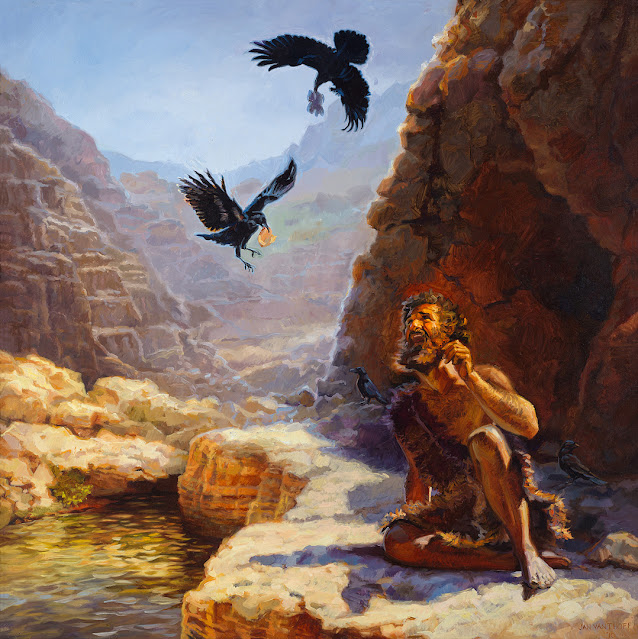
Elijah Fed By Ravens courtesy gospelimages.com

"IN A NARROW GORGE EAST OF the Jordan, a brook threaded its way past a small cave. On the cliff walls above, sure-footed nubiani leapt from stone to stone, their curved horns outlined against the sky. Eagles nested in feathered outcroppings. Along the creek banks, reeds swayed in the breeze. Vines trailed into the stream like graceful arms washing linen. Reflections of pistachio trees waded in the shallows, and moss carpeted the slope to the brook, patterned by dappled shade.

Year after year, the days of the dry season followed a pattern. On a midsummer day, with the sun baking the valley below, the brook normally grew quiet, fell deep into slumber, and sank into the earth until wakened by the early rains. But today, despite the blazing sky, the brook flowed from the mountain’s heart as if from a bottomless spring. 

Far above the sharp cliffs, a raven circled, tilting her head to peer down. The man beside the stream wore a ragged sheepskin, and though she tasted its stench in the air, the raven knew the man himself was not carrion. She had flown a long and weary time, but this was the place, this was the man. As she spiraled down, she heard him speak, though not to her. Man’s words are not for beasts or fowl to understand, but there was something like the brook’s song in his voice. Perhaps, like the brook and the raven, the man also heard the Call.

Though hungry herself, the raven swooped low and dropped bread into the man’s outstretched hands.

Elijah laughed when he caught the falling loaf. Over the many months, he’d been pummeled by falling loaves and raw meat, but this young raven, a newcomer, was the first to drop his meal into his hands. 

'Well done!' Swiftly he broke off a third of the loaf and tossed it into the air. 

The bird hovered above him, tail fanned and curved like a sliver of moon, blue-black wings beating the sky. She caught the bread right as it began its downward descent, soared up and out of the ravine, and headed north."

I enjoyed writing about the ravens so much that they appeared in several scenes, including three with Jezebel.  I began to think about birds other than ravens and how they were used. It made sense that since UNCLEAN birds could not be used for food, CLEAN birds could be eaten - and someone must catch or hunt them. 

Antique Woodcut, Bird Snare | Bird Trained for Falconry
Images courtesy WikiMedia

Are Fowlers Foul?

In researching occupations in ancient Israel, I learned that fowlers, those who snared, trapped, or hunted birds did a brisk trade selling birds for food, sacrifice, or pets. Some wealthy individuals purchased caged songbirds for their music.

So while our modern-day sensibilities might cringe at the thought of capturing birds, in Israel's agrarian culture, fowlers provided birds for meat and sacrifice at prices accessible to the poor.

Bas-reliefs on Egyptian monuments show traps, nets, and snares of various kinds being used to capture unsuspecting fowl. Decoys or bait lured a bird into the trap, at which time a net or door might drop, blocking the exit. The 'gin' was a trap consisting of a net and a stick acting as a spring.

Egyptian bas-relief showing captured cranes
Image courtesy WikiCommonsMedia


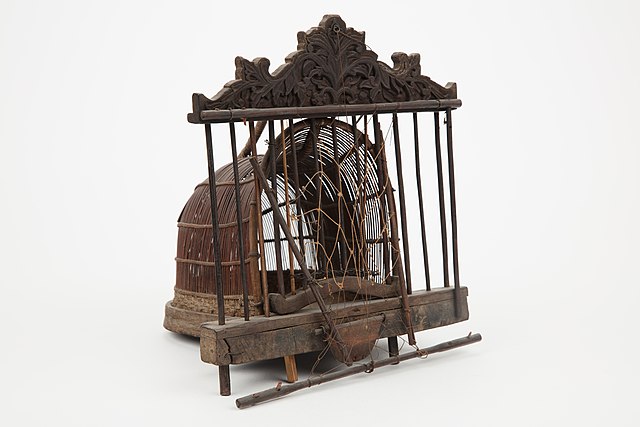
Ancient bird trap with drop-down gate. It would be propped with a stick until the bird entered.
Image courtesy WikiCommonsMedia

In RAIN, a young Israelite girl is skilled at weaving snares and building crates for the birds she captures, and Miriam's hobby grows into a second source of income for her family. In the following scene, Aban, an acolyte of Ba'al is invited to the home of an Israelite he meets after concealing Elijah's flight route from pursuing soldiers.

"Finally, they neared a small, one-story home. The murmur of sleepy birds identified the dark shapes stacked near the open door as rug-covered crates. Inside, firelight flickered from a stone hearth. Caleb pulled him across the threshold. A young girl rushed into the room and clasped the Israelite around the middle.

'Brother, how many did you sell today?' Miriam backed away, hands on hips, head tilted. Her form was slight but strong, though she couldn’t have seen more than nine years. When her eyes shifted to Aban, a dimple appeared in one cheek.

'For shame, Miriam, seeking your share of profits before I walk through the door. Where is our grandmother? Savta! I’ve brought a guest.' Leaving them, he hurried into the next room and spoke in quiet tones to someone. Miriam and Aban studied each other. He saw the moment she recognized his clothing from the sudden disapproval in her young eyes. 

For his part, he couldn’t stop looking at her face. She wasn’t beautiful, but her face was like new parchment, waiting for the quill. Her eyes softened at the corners as she made the decision to be kind. 'Did my brother tell you I weave his bird snares? All the finest catches are mine.'

'She does have a knack.' Caleb returned, leading an old woman dressed in black from head to toe. A strand of silvery hair escaped from under her head covering, which was slightly crooked, as if hastily donned. 'Now take some locusts to the houbara, sister. Your finest catch didn’t sell today.' He reached forward and gave a tug to the thick braid hanging down her back. Miriam squeaked, but rushed off."
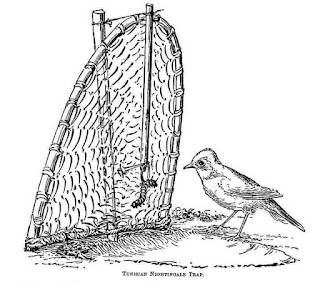
 

Baited Trap
Image courtesy Olina via WikiMedia


What the Bible says about fowlers.


Surely he will save you from the fowler’s snare and from the deadly pestilence. ~ Psalm 91:3

We have escaped like a bird from the fowler’s snare; the snare has been broken, and we have escaped. ~ Psalm 124:7

Free yourself, like a gazelle from the hand of the hunter, like a bird from the snare of the fowler. ~ Proverbs 6:5

Moreover, no one knows when their hour will come: as fish are caught in a cruel net, or birds taken in a snare, so people are trapped by evil times that fall unexpectedly upon them. ~ Ecclesiastes 9:12

Many of the Bible's references to fowlers and their various methods for capturing birds, are used as effective cautionary tales. 

For myself, I'm happy to allow the birds to remain free to sing from the trees. However, I do hope the Cooper's Hawks return when the weather cools.

Further Resources:

Birds of Lebanon and the Jordan Area by S. Vere Benson
Every Living Thing: Daily Use of Animals in Ancient Israel by Oded Borowski
All the Trades and Occupations of the Bible by Herbert Lockyer


RAIN ~ Whispers in the Wind Book 1

Aban yearns to join the priesthood of Ba'al, unlock the power of the rain god, and hear the deity's voice. But first, he must survive a perilous initiation ceremony.

When the mysterious prophet Elijah interrupts the rites, overturns the idol, and curses the land with drought, Aban must choose a side in Yahweh's war against the Ba'als - and it may cost him his life.

WHIRLWIND ~ Whispers in the Wind Book 2 
A king's downfall and a love that transcends war. December 5th, 2022.


Dana McNeely dreamed of living in a world teeming with adventure, danger and romance, but she had a problem - she also needed a lot of peace and quiet. She learned to visit that dream world by stepping into a book.

Inspired by the Bible stories of Elijah, Dana wondered about the widow of Zarephath and her son. Who were they? What was their life, before? How did the boy change after he died, saw the other world—and came back?

Those questions led to Dana writing RAIN, in which she built her dream world of adventure, danger, and romance. Peace and quiet, however, have remained elusive.

No stranger to drought, Dana lives in an Arizona oasis with her hubby the constant gardener, two good dogs, an antisocial cat, and migrating butterflies.

Learn more about Dana and her books at her website: DanaMcNeely.com
Newsletter subscribers receive a free book: https://bit.ly/danasnews


To celebrate reaching 3 Million views, HHH is hosting a HUGE giveaway of over 60 books in 18 prizes, so there are many chances to win! One grand prize will consist of 10 books, two readers will win a second prize containing 5 books, and there will be 15 winners of a third prize containing 2 books each. There are several ways to earn entries, such as following, or commenting on the HHH blog each day. Thank you for being part of the HHH community, and best wishes in the giveaway!


http://www.rafflecopter.com/rafl/display/ce16d9c612/?