Showing posts with label Ancient Judea. Show all posts

Friday, January 27, 2023

Religious Life in Ancient Israel's Divided Kingdom

When I first began researching the prophet Elijah for my novels Rain and Whirlwind, I was continually confused about the Divided Kingdoms of Israel and Judah, north and south, not to mention the many kings from each with similar names. Today I'll broadly touch on the reasons for and results of the split. We'll leave the kings' names for another time.

POLITICS AND RELIGION

After King Solomon's death in 931 B.C.E, ten northern tribes rebelled against heavy taxes imposed by Solomon's son, Rehoboam, and formed a separate kingdom, which retained the name Israel. The remaining tribes called themself Judah, after King David's family line.

The rebellion almost led to war. Rehoboam (southern king) mustered his far superior army to crush the rebellion. But the prophet Shemaiah received word from the Lord and stopped them. 

“Say to Rehoboam son of Solomon king of Judah, to all Judah and Benjamin, and to the rest of the people, ‘This is what the Lord says: Do not go up to fight against your brothers, the Israelites. Go home, every one of you, for this is my doing.’” So they obeyed the word of the Lord and went home again, as the Lord had ordered.  ~ 1 Kings 12:24

Despite the political advantage of lower taxes than their southern brothers, Jeroboam, the new king of Israel (north) worried the religious pull of the temple in Jerusalem would entice religious pilgrims from his territory. He even feared his people might kill him and reconcile under Judah's King Rehoboam. To keep Israelites from straying, Jeroboam instituted a form of calf worship at Dan and Bethel, the southern and northern borders of his kingdom. The politically correct explanation of these "high places" was that "the Lord rode on the backs of the calves" but in fact, calf worship was a bridge to Canaanite cults and led the way to Ba'al worship.

North and South continued to eye each other suspiciously. Israel felt they'd not been treated equally with their southern kinsmen, that they'd borne more than their fair share of taxes and forced labor for an extravagant king. Learning that Israel worshipped golden calves, Judeans eyed them as apostates.

JEZEBEL'S INFLUENCE

Jezebel - John Liston Byam Shaw
courtesy WikiCommons
When a later king of Israel, Ahab, married Princess Jezebel of Tyre, trade routes were strengthened with her Canaanite countrymen. Ahab, enamoured with the beautiful princess, built a temple to Ba'al Melqart in Samaria. Jezebel took her position not only as queen, but as leader of the Ba'al cult in Israel, contributing to even greater departure from the worship of Yahweh. 

This is supported by archeologists finding evidence of cultic worship centers in places throughout Israel such as Megiddo and Western Galilee. Votive images of children seem to indicate child sacrifice.

Not only did Jezebel support the Ba'al cult, she persecuted and killed the prophets of Yahweh. This all led up to a confrontation to between the two forces at Mount Carmel. The prophet Elijah challenged the followers of Ba'al to a contest. The winner's deity would answer by sending fire from heaven. Apparently, Ba'al was away or napping that afternoon, because only Yahweh sent fire to consume His offering.

Despite Yahweh's victory, and the execution of the Priests of Ba'al (although evidently not those of Astarte), the Ba'al cult was decimated. But though it was not as flagrant in the following years, it continued to spread. The key to the religious theme of the times is in 1 Kings 18:21, where Elijah asks, "How long will you falter between two opinions?" (Literally, limp along on two twigs.)

Israel had not totally rejected Yahweh, but attempted an adulterated worship of both Yahweh and Ba'al. If their parents had taught them anything of Moses' writings, they had to know this could only lead to their downfall.
"Fear the Lord your God, serve him only." Deuteronomy 6:13a


A SAD END
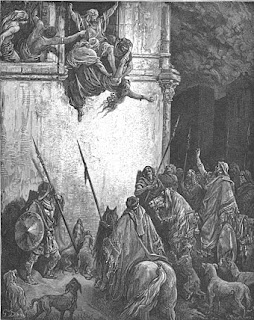
The Death of Jezebel
courtesy WikiCommons
Jehu, a later king in Israel, dealt a blow to Ba'al worship in a "sting operation." He summoned all the priests and other cult leaders into the Ba'al temple for a time of feasting and celebration. Instead he had them killed and the temple destroyed.

Still, the people did not return to God. Even Jehu did not totally turn from cult worship. Although he had destroyed Ba'al worship, thrown Jezebel to the dogs, and killed Ahab's remaining family, he continued to worship the golden calves at Bethel and Dan. Some people will never learn!

So the Lord allowed foreign nations to erode Israel's territory. Jehu lost all land east of the Jordan to Syria. Finally, the northern kingdom of Israel was taken into captivity by Assyria.


For further reading:

A History of Israel
John J. Davis, John C. Whitcomb

https://www.biblicalarchaeology.org/daily/ancient-cultures/ancient-israel/high-places-altars-and-the-bamah/

Nelson's New Illustrated Bible Manners & Customs, 
The Divided Kingdom: Life in Israel

Please visit the blog to comment on this post.

~~~~~~

WHIRLWIND ~ Whispers on the Wind, Book 2 

Purchase at ChristianBook     Purchase at Barnes&Noble      Purchase at Amazon

A king's downfall and a love that transcends war


SPURNED BY POTENTIAL SUITORS, Miriam travels to Jezreel to care for her cousin’s son. There, the precocious seven-year-old works his way into her heart. When Arameans swarm the land like locusts, Miriam focuses on the safety of her young ward but promises adventures beyond the city walls when the war ends.

Gershon, a quiet and kind vintner, is happily building a life for his wife, son, and aging parents. But when his wife dies during childbirth and war looms on the horizon, he must make a decision—will he take a new wife before his heart can mend?

Meanwhile, Dov, a young officer crosses paths with the “bird girl” he remembers from the past, now grown to womanhood. That she is a beautiful woman matters not, as he is a career soldier. Unexpectedly charged with leading Ahab’s army against the Arameans, Dov anticipates death and defeat in Samaria, but when a prophet pledges victory, Dov vows to fight to the end.

When an unlikely victory brings freedom, a bright future seems imminent. Then one afternoon Miriam witnesses a tragedy and must flee with the boy to keep them both safe. With henchmen on their trail, will they find refuge—and her heart the home she’s longed for? 

~

DANA MCNEELY writes biblical novels from an Arizona oasis, where she lives with her hubby the constant gardener, two good dogs, an antisocial cat, and myriad migrating butterflies. When not researching, writing, or struggling with the mysteries of social media, Dana can be found wandering in her personal Eden dreaming up new stories.

You may follow Dana at https://DanaMcNeely.com and receive a free eBook! The Eyes of the Lord is a prequel to the Whispers on the Wind series. Rain and Whirlwind follow. 


Monday, June 27, 2022

The Temple That Herod Built


Dana McNeely

Herod the Great was known as a ruthless king who eliminated any threat to his power. The Bible records his slaughter of all male children under the age of two after the three Magi visited the Christ child and returned to their country by another route. In my post of May 27th, I wrote how he executed members of his family, even his beloved wife Mariamne. 

The Builder


But Herod was also known for magnificent building projects such as the Greco-Roman city of Sebastos, several fortified palaces (including Masada), and the sea-side city, palace, and artificial harbor at Caesarea Maritima. His most famous project was his rebuilding of the Temple in Jerusalem, a project which faced serious opposition from the Jews.


Reconstruction of the Temple of Herod - Painting in Brooklyn Museum by James Tissot


Building a Legacy


Because of his many atrocities during his reign, Jews feared Herod would defile the temple by entering the holy places. They also worried he would raze the old temple and never rebuild it, leaving them without a temple at all. At this point wanting to both appease the Jews and improve his legacy, he took measures to reassure them on both counts. He trained over a thousand priests in building techniques so they could work in the holy places. And he assembled all necessary building materials and workers before starting the project.

A potentially confusing fact is that both Herod's temple and the temple it replaced, which was built after the Jews returned from exile, are known as the second temple. This is because the old temple was still standing when Herod began renovations, as opposed to Solomon's temple, which was merely rubble. But more than replacing the temple itself, Herod massively expanded the platform on which the temple stood.

Temple at center, Royal Stoa and Hulda Gates at left via WikimediaCommons


Innovative Engineering


Because the larger facility would not fit atop Mount Moriah's existing platform, Herod needed to adapt to the north-south slope of the bedrock. To accommodate a much larger, level platform, Herod did two things. At the top end where the bedrock was higher, he leveled it off. At the south end, he built a series of underground arches, or vaults, and enclosed the entire support structure within a wall.

Jerusalem Temple Underground Supports (AKA Solomon's Stables) via WikimediaCommons


These underground arches still support the south side of the structure. They are now called Solomon’s Stables, although they had nothing to do with Solomon, who built the first temple. The name came from the crusaders. The Knights Templars used this area for stabling their horses. Knowing the first temple was in this area, they christened the area Solomon’s Stables.


Jesus and the Moneychangers

Running around north, east, and west sides of the platform, Herod built beautiful porches with soaring columns and tiled roofs. During religious holidays and feasts, thousands of pilgrims sheltered there from the sun and rain. On the south side, he built a two-story structure called the royal stoa, a giant building similar to a basilica but open on one side, used for public meetings or business. Some historians consider this the likely location where Jesus removed the moneychangers, because they were overcharging poor devout Jews.


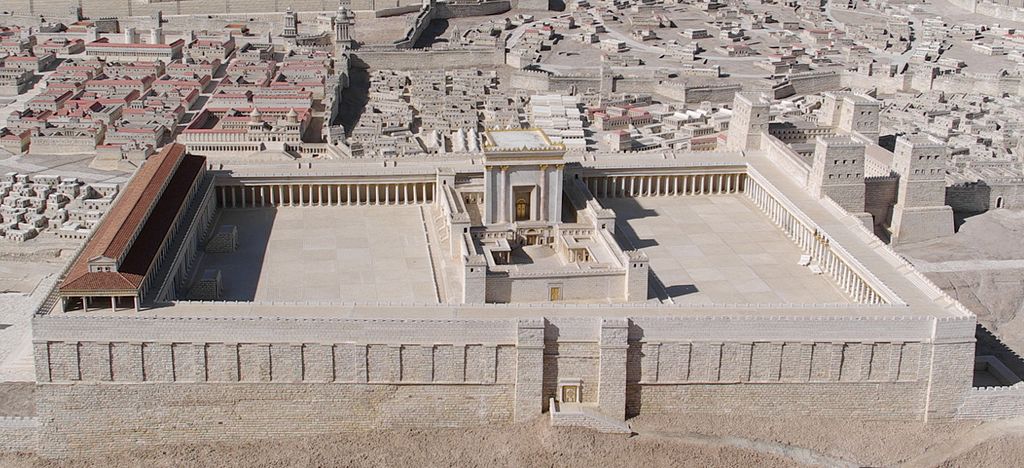
The Holyland Model of Jerusalem showing the Royal Stoa - via WikimediaCommons

The two Huldah gates, which would be at the bottom left of the image above, led from the city below and served as entrance and exit to the temple proper, which was situated in the center of the massive platform. Each gate had two massive doors and a set of steps. The right narrower set of steps led to an underground passageway decorated with carved stone and stucco that under the Royal Stoa and up into the temple mount. When emerging onto the platform, one would face the temple building in the middle of this open, paved platform. another double gate, covered with gold, that opened into the temple building itself.


By Ariely - Own work, CC BY 3.0, https://commons.wikimedia.org

Although no archeological remains exist of the temple building itself, the Holyland Model depicts a guess of what it might have looked like based on comparisons with earlier temples and historical descriptions. In front would the altar for animal sacrifices. In front of that was the open "Court of Women" which both men and women could enter. This all would be surrounded by a fortification wall. This was as far as women could go, as they could not enter where sacrifices were offered. Note the high fortification wall surrounding the temple buildings in the model.

Although there are no remains of the actual temple building, there are remains of something connected with it.


Keep Out! Under Penalty of Death

A low wall or fence surrounded the high fortification wall. A part of this fence survived, including two inscriptions on the fence prohibiting Non-Jews from entering the temple itself, although they could go onto the platform and into the public areas such as the Stoa or Basilica. The inscription reads:


"No man of another nation is to enter within the fence and enclosure around the temple. And whoever is caught will have himself to blame for his death which will follow."


The historian Josephus writes about this low stone wall and its inscriptions.


"Proceeding across this [the open court] toward the second court of the temple, one found it surrounded by a stone balustrade, three cubits high and of exquisite workmanship; in this at regular intervals stood slabs giving warning, some in Greek, others in Latin characters, of the law of purification, to wit that no foreigner was permitted to enter the holy place, for so the second enclosure of the temple was called."

Paul's Arrest 

Interestingly, the inscribed warning appears connected to Paul's arrest, recorded in Acts 21, when Paul was accused of bringing a Greek into this temple area. The Jews were aroused by this seeming sacrilege and tried to kill Paul, but the Romans intervened and took him to Caesarea, another of Herod's building projects.


Further Resources

A picture is worth a thousand blogs, so I want to include the following videos to expand upon my descriptions.

A fascinating YouTube video produced by The City of David Institute for Jerusalem Studies relates history while showing animated 3-D videos.

A well-done video by Bible History Online.

The Great Courses: Holy Land Revealed, Professor Jodi Magness, Ph.D.


RAIN ~ Whispers in the Wind Book 1

Aban yearns to join the priesthood of Ba'al, unlock the power of the rain god, and hear the deity's voice. But first, he must survive a perilous initiation ceremony.

When the mysterious prophet Elijah interrupts the rites, overturns the idol, and curses the land with drought, Aban must choose a side in Yahweh's war against the Ba'als - and it may cost him his life.

Book 2, WHIRLWIND, December 2022.


Dana McNeely dreamed of living in a world teeming with adventure, danger and romance, but she had a problem - she also needed a lot of peace and quiet. She learned to visit that dream world by stepping into a book.

Inspired by the Bible stories of Elijah, Dana wondered about the widow of Zarephath and her son. Who were they? What was their life, before? How did the boy change after he died, saw the other world—and came back?

Those questions led to Dana writing RAIN, in which she built her dream world of adventure, danger, and romance. Peace and quiet, however, have remained elusive.
No stranger to drought, Dana lives in an Arizona oasis with her hubby the constant gardener, two good dogs, an antisocial cat, and migrating butterflies.

Learn more about Dana and her books at her website: DanaMcNeely.com
Newsletter subscribers receive a free book: https://bit.ly/danasnews