Showing posts with label Camp Meetings. Show all posts

Monday, May 19, 2025

Thousand Island Park Camp Meetings


By Susan G Mathis

The Thousand Island Park Camp Meeting Association was founded by the Rev. John Ferdinand Dayan, in 1875, as a Methodist summer camp with regular meetings, sermons, and public services. They leased spots for tents or cottages and provided most of the conveniences of city living but without its vices. TI Park was called, “The Chautauqua of the North.”

In 1883, the Park moved away from the family-oriented camp and opened it to a more general public. But they still kept several of their rules like observing the Sabbath.

The Park continued to grow, so by 1894, nearly six hundred cottages plus hotels created a summer village that included a library, yacht club, golf course, roque courts, annual tennis tournaments, daily concerts, an art school, its own printer, a needlecraft shop, fishing guides and boats, a book shop, a photographer…and Sunday services.

By the turn of the century, in 1900, the Park had become a full summer community with a library and all the amenities a full-service resort would provide including insurance companies, printer, needlecraft shop, shoe store, hand-blown glass souvenirs, a china maker, hand laundress, hair and manicurist, Japanese bazaar, Persian and Turkish rugs, general store, meat market, milk, ice, plumber, contractors, barber, boat livery, fishing guides, tailor, Indian basket shop, candy store and more. Yet it still retained a tight-knit, small town warmth and vitality.

Besides hundreds of lovely Victorian cottages, the Columbian Hotel and the Wellesley Hotel (which still exists today), and smaller hotels made up of various cottages were open to the public. The smaller hotels such as the Geneva, the Pratt House, and the Rochester as well as boarding houses each had a separate function.

Today, Thousand Island Park is still a lovely summer community full of gingerbread Victorians and friendly people. The community retains its homey, small town feel and offers lots of fun things to do. It’s a great place to visit in the summertime, and it’s a wonderful place to tell the story of the 1912 fires in Mary’s Moment.

Have you been to a Christian camp? Leave your answer or comments on the post below and join me on February 19th for my next post.


ABOUT MARY’S MOMENT:

It’s 1912, and Thousand Island Park’s switchboard operator Mary Flynn is the community heroine saving dozens of homes from a terrible fire. Less than a month later, when another disastrous fire rages through the Park, Mary loses her memory as she risks her life in a neighbor's burning cottage. Widowed fireman George Flannigan is enamored by the brave raven-haired lass and takes every opportunity to connect with Mary. But he has hidden griefs of his own that cause him great heartache. When George can’t stop the destructive Columbian Hotel fire from eradicating more than a hundred businesses and homes, he is distraught. Yet George’s greater concern is Mary. Will she remember their budding relationship or be forever lost to him?


ABOUT SUSAN:

Susan G Mathis is an international award-winning, multi-published author of stories set in the beautiful Thousand Islands in upstate NY. Susan has been published more than thirty times in full-length novels, novellas, and non-fiction books. She has fourteen in her fiction line. Susan is also a published author of two premarital books, stories in a dozen compilations, and hundreds of published articles. Susan lives in Colorado Springs and enjoys traveling the world. Visit www.SusanGMathis.com/fiction for more.

Friday, August 28, 2015

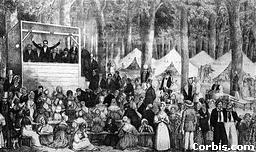
How the First Camp Meeting Ushered in the Second Great Awakening


 by Tamera Lynn Kraft
 
The year was 1800. Within the last 30 years, the United States had become a nation, adopted a Constitution, and had, within the last year, elected its second president, John Adams, when an unusual church service in Red River, Kentucky near the border of Tennessee ushered in a move of God called the Second Great Awakening that would sweep the nation for years to come.

A series of meetings was organized in June by Presbyterian minister James McGready, and many Presbyterian and Methodists ministers took part. Because many other congregations located along Muddy River and Gasper River planned to attend, it was decided the meeting would be held outside near the Red River Meeting House. This was the first “camp meeting” reportedly held in the United States.

The services were well attending and going well. On the last day of services, as William Hodge was preaching, a woman stood and started shouting praises to God. The service ended, but nobody was willing to leave. Mr. Hodge, according to an account by Methodist minister, John McGee, “felt such a power come on him that he quit his seat and sat down in the floor of the pulpit.” At that point McGee began to tremble, and the congregation started weeping. Revival broke out as people started shouting, and the floor was covered with those who had been slain in the Spirit.

A letter from McGready described the service.

"In June, the sacrament was administered at Red River. This was the greatest time we had ever seen before. On Monday multitudes were struck down under awful conviction; the cries of the distressed filled the whole house. There you might see profane swearers, and sabbath breakers pricked to the heart, and crying out, ‘what shall we do to be saved?’ There frolicers, and dancers crying for mercy. There you might see little children of ten, eleven and twelve years of age, praying and crying for redemption, in the blood of Jesus, in agonies of distress. During this sacrament, and until the Tuesday following, ten persons we believe, were savingly brought home to Christ."

After the Red River Camp Meeting, meetings where people would travel long distances and camp at the site (camp meetings) spread throughout Kentucky, Tennessee, and Southern Ohio in what became known as the Revival of 1800. McGready travelled well into October where even bad weather didn’t keep people away.

John Rankin also started camp meetings into Tennessee and North Carolina with many of the same results. Later he settled in Ripley, Ohio where he conducted an underground railroad station. He claimed over 1,000 escaped slaves that made their way to freedom went through his home.

 
In 1801, Methodist preacher Barton Stone attended one of the camp meetings near Red River. He decided to organize his own camp meeting in Cane Ridge, Kentucky in 1801. 20,000 people attended, and revival broke out. Over the next year, more than 10,000 people visited Cane Ridge services where unusual moves of God were reported.

One feature of these camp meeting revivals was the presence and conversion of blacks, many of whom were slaves. Women, children, and blacks were also allowed to participate as exhorters, lay people who preached impromptu sermons encouraging others. Many who came out of the revivals became staunch abolitionists. Because of the expanded role of women, black, and children in these revivals and because of the exuberant expressions during the services, many religious leaders came out against these revivals. But the criticism did not discourage people from attending. Before long, a Great Awakening was sweeping the nation.

Soldier's Heart

Noah Andrews, a soldier with the Ohio Seventh Regiment can’t wait to get home now that his three year enlistment is coming to an end. He plans to start a new life with his young wife. Molly was only sixteen when she married her hero husband. She prayed every day for him to return home safe and take over the burden of running a farm. But they can’t keep the war from following Noah home. Can they build a life together when his soldier’s heart comes between them?

Available online:
Amazon Paperback
Kindle
Nook


Tamera Lynn Kraft has always loved adventures and writes Christian historical fiction set in America because there are so many adventures in American history. She is married to the love of her life, has two grown children, and lives in Akron, Ohio. Soldier’s Heart and A Christmas Promise are two of her historical novellas that have been published. She has been a finalist in a number of writing contests including Frasier Award, Tara Writing Contest (3rd place), and NEOCW (2nd place). You can contact Tamera online at http://tameralynnkraft.net