Showing posts with label Second Great Awakening. Show all posts

Thursday, September 28, 2017

Phoebe Palmer - A Woman Evangelist ahead of her Time

by Tamera Lynn Kraft

Phoebe Warroll Palmer was a prominent woman evangelist in the church in the United States before women were recognized or licensed as preachers. She showed what a life devoted to God can do even when the culture and some leaders in the church came against her because she was a woman.

Phoebe was born in New York City on December 18, 1807. Her parents were devout Methodists that held family worship services twice a week. She married Dr. Walter Palmer, a homeopathic physician and devout Methodist, when she was nineteen years old. They had four children, but three died in early childhood. Phoebe was distraught and thought God was punishing her. She sought God’s guidance, and with the help of her sister, Sarah Lankford, came to a new understanding of sanctification and holiness.

Phoebe’s sister encouraged her to take a more active role in the church. In 1835, Phoebe and her sister began having church meetings for women in her home. Attendance grew to several hundred, and soon Dr. Palmer built extra space in the crowded home.

In 1839, Phoebe opened the meetings up to men as well as women. Her popularity grew, and soon, pastors, bishops, and people from other denominations attended. Phoebe and her husband began having protracted meetings (revivals) made popular by Charles Finney, and preached at camp meetings and Holiness revivals. In 1850, they toured across the United States and Canada preaching.

In 1850, Phoebe established a mission to help people in New York City because she felt sanctification required works of service for others. She spoke out against slavery and alcohol and promoted more freedom for women in the church and in society. She also wrote many books and became the editor to Guide To Holiness in 1862 when her husband bought the publication.

After the Civil War, Phoebe served as a leader of the National Camp Meeting Association for the Promotion of Holiness. In 1867, she and her husband established the National Association for the Promotion of Holiness, which encompassed much of her evangelical work. She continued holding her Tuesday meetings right up until she died in New York City on November 2, 1874.

Tamera Lynn Kraft has always loved adventures and writes Christian historical fiction set in America because there are so many adventures in American history. She has received 2nd place in the NOCW contest, 3rd place TARA writer’s contest, and was a finalist in the Frasier Writing Contest. Her Novel, Alice’s Notions and her novellas Resurrection of Hope and A Christmas Promise are available on Amazon and at Barnes and Noble.

Friday, August 28, 2015

How the First Camp Meeting Ushered in the Second Great Awakening


 by Tamera Lynn Kraft
 
The year was 1800. Within the last 30 years, the United States had become a nation, adopted a Constitution, and had, within the last year, elected its second president, John Adams, when an unusual church service in Red River, Kentucky near the border of Tennessee ushered in a move of God called the Second Great Awakening that would sweep the nation for years to come.

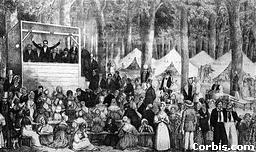
A series of meetings was organized in June by Presbyterian minister James McGready, and many Presbyterian and Methodists ministers took part. Because many other congregations located along Muddy River and Gasper River planned to attend, it was decided the meeting would be held outside near the Red River Meeting House. This was the first “camp meeting” reportedly held in the United States.

The services were well attending and going well. On the last day of services, as William Hodge was preaching, a woman stood and started shouting praises to God. The service ended, but nobody was willing to leave. Mr. Hodge, according to an account by Methodist minister, John McGee, “felt such a power come on him that he quit his seat and sat down in the floor of the pulpit.” At that point McGee began to tremble, and the congregation started weeping. Revival broke out as people started shouting, and the floor was covered with those who had been slain in the Spirit.

A letter from McGready described the service.

"In June, the sacrament was administered at Red River. This was the greatest time we had ever seen before. On Monday multitudes were struck down under awful conviction; the cries of the distressed filled the whole house. There you might see profane swearers, and sabbath breakers pricked to the heart, and crying out, ‘what shall we do to be saved?’ There frolicers, and dancers crying for mercy. There you might see little children of ten, eleven and twelve years of age, praying and crying for redemption, in the blood of Jesus, in agonies of distress. During this sacrament, and until the Tuesday following, ten persons we believe, were savingly brought home to Christ."

After the Red River Camp Meeting, meetings where people would travel long distances and camp at the site (camp meetings) spread throughout Kentucky, Tennessee, and Southern Ohio in what became known as the Revival of 1800. McGready travelled well into October where even bad weather didn’t keep people away.

John Rankin also started camp meetings into Tennessee and North Carolina with many of the same results. Later he settled in Ripley, Ohio where he conducted an underground railroad station. He claimed over 1,000 escaped slaves that made their way to freedom went through his home.

 
In 1801, Methodist preacher Barton Stone attended one of the camp meetings near Red River. He decided to organize his own camp meeting in Cane Ridge, Kentucky in 1801. 20,000 people attended, and revival broke out. Over the next year, more than 10,000 people visited Cane Ridge services where unusual moves of God were reported.

One feature of these camp meeting revivals was the presence and conversion of blacks, many of whom were slaves. Women, children, and blacks were also allowed to participate as exhorters, lay people who preached impromptu sermons encouraging others. Many who came out of the revivals became staunch abolitionists. Because of the expanded role of women, black, and children in these revivals and because of the exuberant expressions during the services, many religious leaders came out against these revivals. But the criticism did not discourage people from attending. Before long, a Great Awakening was sweeping the nation.

Soldier's Heart

Noah Andrews, a soldier with the Ohio Seventh Regiment can’t wait to get home now that his three year enlistment is coming to an end. He plans to start a new life with his young wife. Molly was only sixteen when she married her hero husband. She prayed every day for him to return home safe and take over the burden of running a farm. But they can’t keep the war from following Noah home. Can they build a life together when his soldier’s heart comes between them?

Available online:
Amazon Paperback
Kindle
Nook


Tamera Lynn Kraft has always loved adventures and writes Christian historical fiction set in America because there are so many adventures in American history. She is married to the love of her life, has two grown children, and lives in Akron, Ohio. Soldier’s Heart and A Christmas Promise are two of her historical novellas that have been published. She has been a finalist in a number of writing contests including Frasier Award, Tara Writing Contest (3rd place), and NEOCW (2nd place). You can contact Tamera online at http://tameralynnkraft.net
 

Thursday, June 25, 2015

The Second Great Awakening--and a Giveaway


I’m sure if you believe in God and have for any length of time, you’ve probably experienced the frustration of praying for something without seeing the results you are hoping for. This experience seems to be a right of passage with God, a test that one must pass in order to get to the next level. Very often, God places a promise of something in our hearts long before the promise will be fulfilled.

John Erskine
So is the case of John Erskine of Edinburgh, Scotland. Erskine felt a prompting of God to pray for revival in 1744. He asked many of his friends to join him in a “Concert of Prayer” for the next two years. They prayed every Saturday evening and Sunday morning, as well as the first Tuesday of each new quarter, that God “would appear in His glory...by an abundant effusion of His Holy Spirit...to revive true religion in all parts of Christendom...and fill the whole earth with His glory.” Dutifully, they prayed, and they saw some effect, but not the sweeping moves of God that they hoped for. After a time, the Concerts of Prayer waned, leaving many to feel they’d had no effect.

Years passed. Life carried on. Tensions between Britain and the colonies intensified until the colonies declared independence. War broke out, and people’s focus centered on the crisis at hand. At the end of that conflict, the people of America found themselves far from God and in a state of moral decline. Across the ocean, the French Revolution was in full swing, bringing with it another crisis to keep people’s focus from seeking after God fully. Infidelity and rationalism grew rampant in Europe. The world seemed to be going bad all at once.

Yet God hadn’t forgotten the promise he gave John Erskine for revival.  Once again in 1784—nearly forty years after the initial prompting—Erskine felt the stirring to pray for revival again. This time, he reprinted a call to revival prayer given by Jonathan Edwards, a key player in the Great Awakening of decades earlier. Because of Erskine’s efforts to distribute the booklet and call others to pray, many churches across all denominations, both in Britain and the U. S., agreed to institute Concerts of Prayer each Monday night. They continued this pattern for the next seven years.

In 1791, another central figure from the First Great Awakening, John Wesley, died. Even as churchgoers mourned his death, the stirrings of revival began to break out among the industrial towns of Yorkshire, England. Suddenly, church membership just among the Methodist denomination skyrocketed from 72,000 to nearly 250,000 across the next 20 years. Churches in Wales, Scotland, and Ireland became full—so full that they spilled over into open fields where more people could attend.

Isaac Backus
By 1794, America was sensing the spiritual shift, and twenty-five men in New England gathered to form a Concert of Prayer there. Led by Isaac Backus and Stephen Gano, these men distributed letters calling others to pray on the first Tuesday of each quarter. Within a year, revival broke out, and within four years, it had reached every state. Students attending colleges across the nation began to seek God in droves. In fact, Yale saw half their student body become converted to Christianity during the year of 1795.


Itinerant preachers, known as circuit-riders began to go into less populated or frontier areas and preach to those living in the distant locales. Camp meetings popped up in frontier areas, where residents of a wide region would come to a central area and camp for a week while attending meetings put on by the circuit-riding preacher. They would worship with hymns, hear sermons, and share communion.

Other outcomes of the revival were the inception of many missionary societies, both in Britain and America. Social reforms also took place. Slavery was abolished in Britain, and an abolition movement began in America. Prisons were reformed. Sunday Schools and benevolence institutions were started. Temperance societies were formed, and women’s rights and women’s suffrage became a hot topic of discussion.

By 1800, the awakening reached Switzerland, Scandinavia, and Germany, and before it waned in the 1840’s, it had reached central Europe, South Africa, India, and the Pacific Islands.


It’s your turn. Do you believe there will be another worldwide revival like either the First or Second Great awakenings? If so, do you expect to see it in your lifetime? Leave me a comment to be included in the drawing for my second release—The Convenient Bride Collection.

Jennifer Uhlarik discovered the western genre as a pre-teen, when she swiped the only “horse” book she found on her older brother’s bookshelf. A new love was born. Across the next ten years, she devoured Louis L’Amour westerns and fell in love with the genre. In college at the University of Tampa, she began penning her own story of the Old West. Armed with a B.A. in writing, she has won five writing competitions and finaled in two other competitions. In addition to writing, she has held jobs as a private business owner, a schoolteacher, a marketing director, and her favorite—a full-time homemaker. Jennifer is active in American Christian Fiction Writers and lifetime member of the Florida Writers Association. She lives near Tampa, Florida, with her husband, teenaged son, and four fur children.