Showing posts with label Red River. Show all posts

Thursday, September 10, 2026

The Business End of the Cattle Drive

By Suzanne Norquist

Nothing represents the quintessential Old West like a cattle drive. Movies and books depict the adventure, from Red River starring John Wayne to City Slickers starring Billy Crystal. There are still ranches that allow guests to pay for the privilege of driving cattle from one property to another.


However, the famous cattle drives that originated in Texas in the 1860s, 1870s, and 1880s didn’t result from dreams of excitement. They were a profitable business venture.

For centuries, herdsmen have driven animals to relocate them. They still do. But none compare to the cattle drives of that era.

A twelve-man crew would move a herd of 2,000 to 3,000 head of cattle across hundreds of miles of wilderness to sell it for a premium price. The trip took several months.

What made this venture possible?

After the Civil War, Texans were long on cattle and short on cash. Herds thrived while the ranchers served in the Confederate army. And the soldiers’ pay wasn’t worth the paper it was printed on. The cattle could be sold at a premium in northern markets. Not only that, but sturdy Texas longhorns could survive the long journey better than other types of cattle.


The land along the route hadn’t been divided up and fenced off yet. Anyone could use the open range. Railroads didn’t crisscross the country yet to offer an alternative form of transportation—the perfect environment for driving cattle.

A few business-minded cattlemen realized that moving a large herd to a high-priced market would increase their profit. No need to make the trip with only a few animals. They would contract with different ranches to transport thousands of head of cattle and put together crews that included a trail boss, a wrangler, drovers, waddies (teenaged trail hands), and a chuckwagon cook.

The wrangler managed the horses, eight to ten per drover. Drovers were divided into point riders who took the lead, swing riders in the middle, and drag riders in the rear. The chuckwagon cook not only prepared food, but also served as the doctor and dentist, offering herbal remedies as needed.

Teams followed one of several major trails. The most famous were the Chisholm Trail and the Goodnight-Lovington Trail. The Chisholm Trail started in San Antonio, Texas, and passed through Oklahoma and into Kansas. The Goodnight-Lovington Trail went from Texas to Colorado and Wyoming by way of New Mexico.

Business owners in the “cow towns” at the end of the route profited as well. They offered supplies, alcohol, and other amenities to weary crews.

The cattle drives proved successful. There were the occasional Indian attacks, cattle rustlers, swollen rivers, and stampedes, but most survived the journey. Newspapers reported their progress in the business section, including the number of head and the expected arrival date.

A problem arose when other cattle along the route contracted a disease known as “Texas fever.” This tick-borne illness didn’t bother the tough longhorns. But the ticks would drop off along the way and infect other cattle. Soon, quarantines were imposed on Texas herds. Local cattlemen formed mobs to keep them out.

To solve this problem, cattle buyer Joseph McCoy established a marketplace in the grasslands near Abilene, Kansas. No other cattle would be infected. He persuaded the Kansas Pacific Railroad to provide sidings and facilities. This established Abilene as a premier cow town. He convinced people that if the cattle “wintered” in Abilene, they no longer carried the tick.

The intercontinental railroads and a weak economy ended the twenty-year era of large cattle drives. Cattlemen no longer profited from the endeavor. The open range gave way to fenced farms and ranches.

All that remained was the lore of the cowboy pushing “doggies” up the Chisholm Trail. Hollywood glamorized it, and everyone believed the trail boss ran the show. It’s a far more interesting story than that of profit and loss.


***


Love In Bloom 4-in-one collection

“A Song for Rose” by Suzanne Norquist

Can a disillusioned tenor convince an aspiring soprano that there is more to music than fame?

“Holly & Ivy” by Mary Davis

At Christmastime, a young woman accompanies her impetuous younger sister on her trip across the country to be a mail-order bride and loses her heart to a gallant stranger.

“Periwinkle in the Park” by Kathleen E. Kovach

A female hiking guide, who is helping to commission a national park, runs into conflict with a mountain man determined to keep the government off his land.

“A Beauty in a Tansy”

Two adjacent store owners are drawn to each other, but their older relatives provide obstacles to their ever becoming close.

Republished from Bouquet of Brides

Buy links: https://books2read.com/u/bOOx8K

https://www.amazon.com/Love-Bloom-Mary-Davis/dp/B0FPLFYCXR/


Multi-published author Suzanne Norquist has worked as a chemist, professor, and financial analyst, and has even earned a doctorate in economics. Everything fascinates her. Research feeds her curiosity, and she shares the adventure with her readers. She lives in New Mexico with her mining-engineer husband and takes road trips to visit her children and grandchildren. When not writing, she hangs out with her two active Siberian Huskies, takes piano lessons, and studies the Bible with the church ladies.

Friday, August 28, 2015

How the First Camp Meeting Ushered in the Second Great Awakening


 by Tamera Lynn Kraft
 
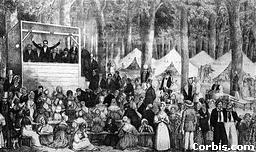
The year was 1800. Within the last 30 years, the United States had become a nation, adopted a Constitution, and had, within the last year, elected its second president, John Adams, when an unusual church service in Red River, Kentucky near the border of Tennessee ushered in a move of God called the Second Great Awakening that would sweep the nation for years to come.

A series of meetings was organized in June by Presbyterian minister James McGready, and many Presbyterian and Methodists ministers took part. Because many other congregations located along Muddy River and Gasper River planned to attend, it was decided the meeting would be held outside near the Red River Meeting House. This was the first “camp meeting” reportedly held in the United States.

The services were well attending and going well. On the last day of services, as William Hodge was preaching, a woman stood and started shouting praises to God. The service ended, but nobody was willing to leave. Mr. Hodge, according to an account by Methodist minister, John McGee, “felt such a power come on him that he quit his seat and sat down in the floor of the pulpit.” At that point McGee began to tremble, and the congregation started weeping. Revival broke out as people started shouting, and the floor was covered with those who had been slain in the Spirit.

A letter from McGready described the service.

"In June, the sacrament was administered at Red River. This was the greatest time we had ever seen before. On Monday multitudes were struck down under awful conviction; the cries of the distressed filled the whole house. There you might see profane swearers, and sabbath breakers pricked to the heart, and crying out, ‘what shall we do to be saved?’ There frolicers, and dancers crying for mercy. There you might see little children of ten, eleven and twelve years of age, praying and crying for redemption, in the blood of Jesus, in agonies of distress. During this sacrament, and until the Tuesday following, ten persons we believe, were savingly brought home to Christ."

After the Red River Camp Meeting, meetings where people would travel long distances and camp at the site (camp meetings) spread throughout Kentucky, Tennessee, and Southern Ohio in what became known as the Revival of 1800. McGready travelled well into October where even bad weather didn’t keep people away.

John Rankin also started camp meetings into Tennessee and North Carolina with many of the same results. Later he settled in Ripley, Ohio where he conducted an underground railroad station. He claimed over 1,000 escaped slaves that made their way to freedom went through his home.

 
In 1801, Methodist preacher Barton Stone attended one of the camp meetings near Red River. He decided to organize his own camp meeting in Cane Ridge, Kentucky in 1801. 20,000 people attended, and revival broke out. Over the next year, more than 10,000 people visited Cane Ridge services where unusual moves of God were reported.

One feature of these camp meeting revivals was the presence and conversion of blacks, many of whom were slaves. Women, children, and blacks were also allowed to participate as exhorters, lay people who preached impromptu sermons encouraging others. Many who came out of the revivals became staunch abolitionists. Because of the expanded role of women, black, and children in these revivals and because of the exuberant expressions during the services, many religious leaders came out against these revivals. But the criticism did not discourage people from attending. Before long, a Great Awakening was sweeping the nation.

Soldier's Heart

Noah Andrews, a soldier with the Ohio Seventh Regiment can’t wait to get home now that his three year enlistment is coming to an end. He plans to start a new life with his young wife. Molly was only sixteen when she married her hero husband. She prayed every day for him to return home safe and take over the burden of running a farm. But they can’t keep the war from following Noah home. Can they build a life together when his soldier’s heart comes between them?

Available online:
Amazon Paperback
Kindle
Nook


Tamera Lynn Kraft has always loved adventures and writes Christian historical fiction set in America because there are so many adventures in American history. She is married to the love of her life, has two grown children, and lives in Akron, Ohio. Soldier’s Heart and A Christmas Promise are two of her historical novellas that have been published. She has been a finalist in a number of writing contests including Frasier Award, Tara Writing Contest (3rd place), and NEOCW (2nd place). You can contact Tamera online at http://tameralynnkraft.net
 

Saturday, January 25, 2014

The Great Red River Raft


Hi. Winnie Griggs here. I live in a small town that’s situated near the Red River in Northwest Louisiana.  In fact my husband and I own some pasture land that borders on the river itself and the view from the riverbank is fabulous.  
I wasn't raised here, though, and from time to time I like to look into some of the local history of the area just to learn more about it. One of the things I stumbled on in one of these research forays was an interesting tidbit of Red River History, namely The Great Red River Raft.


First off, the raft in question is not a floating platform of the kind Huck Finn poled down the Mississippi River. This raft was a massive logjam, reputed to be the largest ever seen in the US. It was comprised of a series of ‘rafts’ formed by fallen trees and debris that made the Red River virtually unnavigable for hundreds of years. By the start of the nineteenth century, the lower end was about ten miles upstream from Natchitoches, LA (where I went to college incidentally) and from there it extended northward nearly one hundred and fifty miles to the point where the river crosses the Arkansas-Louisiana border. In places it was twenty five feet deep and could be safely crossed by men on horseback.


The origins of this logjam are not completely understood. Some believe it began over a thousand years ago when the Red River changed course and moved its end point from the Atchafalaya Basin to join with  the Mississippi River. According to this theory, the extreme flood stages of the Mississippi would force large amounts of debris back into the Red during the heavy rains that fell every spring. Once enough had backed up to cause the first major logjam, the obstruction began to build upon itself, growing on the back end faster than the front end eroded. 


Another theory is that the logjam was formed as the swirling waters eroded the river banks, toppling huge trees at the river’s edge that submerged and began to trap other debris in a cumulative effect that eventually resulted in the massive rafts.

Regardless of the cause, by the time Fort Towson was established in what was to become Oklahoma, and Fort Jessup was established to protect western Louisiana, it became critical to open up the river to navigation as a means of getting supplies to these garrisons. Several ideas were put forth, most of them entirely impractical.   Finally, in 1825, the Arkansas territorial legislature petitioned the U.S. Congress to handle the situation. As happens today, Congress decided to first study the matter, so it was 1832 before a solution was settled on and the funds were appropriated to actually begin the work.

Captain Henry Shreve, an army engineer who had served as the Superintendent of Western River Improvement since 1826, was tapped to lead the project. Shreve had designed ‘snag boats’ capable of clearing raft-type logjams from other rivers. These boats were actually constructed of twin 125 foot hulls connected by a series of massive beams, and were outfitted with various contraptions for either ramming through the debris or lifting troublesome logs directly from the river. Shreve brought four of these ‘snag boats’ with him along with a crew of 159 men to handle the project. The work crew started at the downstream end of the logjam, tearing out the massive logs and allowing them to float downstream. It proved to be a challenging project – a congressional report would later state: “One snag raised by the Heliopolis… contained 1600 cubic feet of timber, and could not have weighed less than sixty tons.”


The project was stopped several times as funds ran out and new monies had to be appropriated, but by March of 1838 Shreve had succeeded in clearing the channel.  So impressed were the locals with the work of Captain Shreve and his crew that when, in 1836, entrepreneurs incorporated a new town on the banks of the Red, they named it Shreveport in his honor.


Captain Shreve cautioned Congress that keeping the channel clear would be an ongoing effort. Congress chose to ignore his warning, though, and by 1839 the raft had begun to reform. During the next 32 years the government spent upwards of $630,000 funding various schemes to reclear and maintain the channel, most of which met little or no success. Finally, in the spring of 1872, Lt. E. August Woodruff, head of the Army Corps of Engineers, began a major attack on the raft. Combining Shreve’s snag boats with saw boats, crane boats and explosives, he had success within a year. In May of 1873, the 150 foot steamer R. T. Bryarly, fully laden with cargo, arrived in Shreveport – it was the first such ship to do so in 29 years.


This time, learning from prior mistakes, Congress appropriated the funds to allow for patroling the river with vessels that could keep the raft from reforming. Finally, by 1900, the great Red River raft was permanently defeated and the Red River was open to navigation from Indian territory all the way to the Mississippi.


So there you have it, the story of the Great Red River Raft.