I read something recently about the insane asylums in the 1800s and early 1900s that sparked my interest. I decided to see why women were sent to asylums. The answer shocked and saddened me for the many women who had no choice but to do what the men in their lives dictated—which included being committed for reasons beyond their control.
 |
| Bloomingdale Insane Asylum, New York City Public Domain |
In the 1800s, many doctors considered women insane because they had female reproductive organs. Being able to bear a child was a count against women already. If they disagreed with their husband and stood up for their opinion, a doctor would have no problem signing them into an asylum and putting a label such as childbirth, or overexertion.
In ancient Egypt, it was thought women had a “wandering uterus” that could attach itself to various body parts as it moved around in the body. In Greece, this was called “hysteria.” This phenomenon was thought to cause insanity in women by nature of their gender.
_(cropped).jpeg) |
| Toledo State Hospital for the Insane, 1895 Donated by Toledo-Lucas County Public Library Public domain, Wikimedia Commons |
Women who suffered from post-partum depression in today’s culture, would have been committed for “insanity from childbirth.” One woman was diagnosed insane after giving birth to her first child. She then worried too much about the safety of the baby and had an episode where she was disoriented and unable to function properly. Instead of helping, she was consigned to an institution.
The gynecologists and psychiatrists of the day had no real training in women’s issues. They didn’t know or understand the body or the mind and often trusted in old beliefs that held no truth. Most women were institutionalized for one of the following: mental excitement, domestic troubles, religious fantasy, heredity, childbirth, overexertion, and the most common, “insanity by unknown causes.”
 |
| The Interior of Bedlam, A Rake's Progress by William Hogarth Public domain, Wikimedia Commons |
It was common for women to be committed for overexertion. Those women often had 7 or 8 children and a household to keep running. They were expected to do all the meals, raise the garden, do the laundry (an all day job), make many of the domestic items used such as clothing, and many other tasks. Was it any wonder they were overly tired?
Husbands had the power to institutionalize their wives. The Law of Coverture meant that the wife’s husband had total control over her and all her goods. While a man would have to go through court to be committed, a husband simply had to show up at the asylum with his wife to have her held there against her will. She had no recourse but to obey, since this was a forced incarceration. The doctor on hand would admit her simply on the testimony of her husband. If the woman was not married, the male head of her family had the power over her. Once at the asylum, women were kept under control through sedation and other drugs that left them disoriented.
 |
| Elizabeth Packard Public Domain Wikipedia Commons |
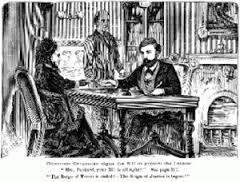
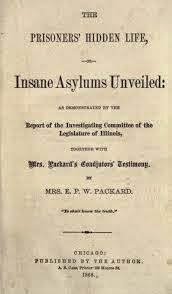
There are many famous cases of women being committed unfairly. Elizabeth Packard is one example. Her husband had her committed because she disagreed with his religious views. She was at the asylum for three years and suffered much. In the end, she had her day in court and was declared sane. She went on to fight for women’s rights and to bring light to the atrocities happening in the asylums. (You can read more about Elizabeth here in one of our earlier posts here.)
Many women have fought hard to come out from under these misbegotten beliefs. Dorothea Dix visited asylums in the 1840s, and appalled at the conditions, lobbied for years to get better regulations. Others like Elizabeth Packard brought awareness to light and did much good for the plight of those women.
 |
| Nellie Bly, 1890 Photo by H.J. Myers Public Domain, Wikimedia Commons |
In 1887, journalist Nellie Bly went undercover as a patient at a New York City asylum. Her shocking expose, titled Ten Days in a Madhouse, not only boosted Nellie’s career but also brought about important changes to institutions for mental health. Slowly, the conditions improved, although they were still deplorable.
We can be thankful that our lives are much better today. However, whenever I hear about a woman being hysterical, I have to remember what that Greek term stood for and wonder what they are saying about that person. I am thankful that doctors today are much more knowledgeable and understand women better, even if there is room for improvement.
Have you ever read anything about insane asylums in the 1800s? Have you read any of Nellie Bly’s work? You can find her book, Ten Days in a Madhouse here.
While researching this topic, I had to stop and think about which of those symptoms I might have. Overexertion? Religious fantasies? (Sometimes, this was simply having a differing opinion.) What about you? Are there any that stood out to you? I’d love to hear your thoughts.

Nancy J Farrier is an award-winning, best-selling author who lives in Southern Arizona in the Sonoran Desert. She loves the Southwest with its interesting historical past. When Nancy isn’t writing, she loves to read, do needlecraft, play with her cats and dog, and spend time with her family. You can read more about Nancy and her books on her website: nancyjfarrier.com.