Showing posts with label Nellie Bly. Show all posts

Friday, October 18, 2024

Who's Insane? By Nancy J. Farrier

 I read something recently about the insane asylums in the 1800s and early 1900s that sparked my interest. I decided to see why women were sent to asylums. The answer shocked and saddened me for the many women who had no choice but to do what the men in their lives dictated—which included being committed for reasons beyond their control.

Bloomingdale Insane Asylum, New York City
Public Domain


In the 1800s, many doctors considered women insane because they had female reproductive organs. Being able to bear a child was a count against women already. If they disagreed with their husband and stood up for their opinion, a doctor would have no problem signing them into an asylum and putting a label such as childbirth, or overexertion.


In ancient Egypt, it was thought women had a “wandering uterus” that could attach itself to various body parts as it moved around in the body. In Greece, this was called “hysteria.” This phenomenon was thought to cause insanity in women by nature of their gender.


Toledo State Hospital for the Insane, 1895
Donated by Toledo-Lucas County Public Library      
Public domain, Wikimedia Commons


Women who suffered from post-partum depression in today’s culture, would have been committed for “insanity from childbirth.” One woman was diagnosed insane after giving birth to her first child. She then worried too much about the safety of the baby and had an episode where she was disoriented and unable to function properly. Instead of helping, she was consigned to an institution.


The gynecologists and psychiatrists of the day had no real training in women’s issues. They didn’t know or understand the body or the mind and often trusted in old beliefs that held no truth. Most women were institutionalized for one of the following: mental excitement, domestic troubles, religious fantasy, heredity, childbirth, overexertion, and the most common, “insanity by unknown causes.” 


The Interior of Bedlam, A Rake's Progress              
by William Hogarth
Public domain, Wikimedia Commons

It was common for women to be committed for overexertion. Those women often had 7 or 8 children and a household to keep running. They were expected to do all the meals, raise the garden, do the laundry (an all day job), make many of the domestic items used such as clothing, and many other tasks. Was it any wonder they were overly tired?


Husbands had the power to institutionalize their wives. The Law of Coverture meant that the wife’s husband had total control over her and all her goods. While a man would have to go through court to be committed, a husband simply had to show up at the asylum with his wife to have her held there against her will. She had no recourse but to obey, since this was a forced incarceration. The doctor on hand would admit her simply on the testimony of her husband. If the woman was not married, the male head of her family had the power over her. Once at the asylum, women were kept under control through sedation and other drugs that left them disoriented. 


Elizabeth Packard
Public Domain
Wikipedia Commons


There are many famous cases of women being committed unfairly. Elizabeth Packard is one example. Her husband had her committed because she disagreed with his religious views. She was at the asylum for three years and suffered much. In the end, she had her day in court and was declared sane. She went on to fight for women’s rights and to bring light to the atrocities happening in the asylums. (You can read more about Elizabeth here in one of our earlier posts here.)


Many women have fought hard to come out from under these misbegotten beliefs. Dorothea Dix visited asylums in the 1840s, and appalled at the conditions, lobbied for years to get better regulations. Others like Elizabeth Packard brought awareness to light and did much good for the plight of those women.


Nellie Bly, 1890
Photo by H.J. Myers
Public Domain, Wikimedia Commons  


In 1887, journalist Nellie Bly went undercover as a patient at a New York City asylum. Her shocking expose, titled Ten Days in a Madhouse, not only boosted Nellie’s career but also brought about important changes to institutions for mental health. Slowly, the conditions improved, although they were still deplorable.


We can be thankful that our lives are much better today. However, whenever I hear about a woman being hysterical, I have to remember what that Greek term stood for and wonder what they are saying about that person. I am thankful that doctors today are much more knowledgeable and understand women better, even if there is room for improvement.


Have you ever read anything about insane asylums in the 1800s? Have you read any of Nellie Bly’s work? You can find her book, Ten Days in a Madhouse here


While researching this topic, I had to stop and think about which of those symptoms I might have. Overexertion? Religious fantasies? (Sometimes, this was simply having a differing opinion.) What about you? Are there any that stood out to you? I’d love to hear your thoughts.


Nancy J Farrier is an award-winning, best-selling author who lives in Southern Arizona in the Sonoran Desert. She loves the Southwest with its interesting historical past. When Nancy isn’t writing, she loves to read, do needlecraft, play with her cats and dog, and spend time with her family. You can read more about Nancy and her books on her website: nancyjfarrier.com.

Thursday, March 23, 2023

THE INCREDIBLE NELLIE BLY

By Mary Davis

“I always have a comfortable feeling that nothing is impossible if one applies a certain amount of energy in the right direction. … If you want to do it, you can do it. The question is, do you want to do it?” Nellie Bly

Elizabeth Jane Cochran—journalist, social reform activist, and inventor—was known by many names. Her most notable and long-running one was Nellie Bly. As a teen, she added an “e” to her surname, Cochrane. She is most known for her trip around the world to beat the time of the fictional character in Jules Verne’s novel Around the World in 80 Days. However, this remarkable lady did so much more.

On May 5, 1864, she was born to her father’s second wife. Her father, a landowner, mill operator, postmaster, and associate justice, died when Elizabeth was six. Because he had no will, her mother got very little from the estate and remarried. Elizabeth’s step-father was a mean drunk, so her mother eventually divorced him. This experience left Elizabeth with the idea that not all women had to marry.

She helped her mother run a boarding house in Pittsburgh. In 1885, she responded to a column in the Pittsburgh Dispatch titled “What Girls Are Good For”, which stated that girls were good for birthing children and keeping house, and to work outside the home was a monstrosity. She signed her critical response “Lonely Orphan Girl”. Editor George Madden was impressed by her passion and ran an ad, asking her to introduce herselfshe did, which secured her a job. Females who wrote for papers did so under a pseudonym. Nellie Bly was chosen after a popular Stephen Foster song.

Going undercover in various places and jobs, she wrote many exposés for them, including better jobs for women, reform of divorce laws, slum life, women working in factories, and other similar topics. When advertisers complained about her controversial articles and threatened to pull their ads, she was relegated to the “women’s pages”, that is fashion, society, and gardening. Dissatisfied with this, she became a foreign correspondent in Mexico for half a year in 1886-1887 at the age of twenty-one. The Mexican government didn’t appreciate her exposing them and ran her out of the country with threat of jail.

Nellie in Mexico
She returned to Pittsburgh but soon left for New York by herself in 1887. This bold woman talked her way into a job at the New York World, working for Joseph Pulitzer (of the Pulitzer Prize fame). One of her first assignments was to get herself committed to an insane asylum. When asked if she could act insane enough to be committed, she said she could, but she wanted to know how she would get out again. Her boss didn’t know but said he would find a way. His “I don’t know” was apparently good enough for her. (She was one brave, courageous woman!)

So, she took lodging in a women's boarding house under the name Nellie Brown, stayed up all night, and accused the other ladies of being insane. This disturbed her fellow boarders so much that the police were called to take her away. She was examined by the police, a judge, and a doctor who deemed her insane and eventually sent her to the Women’s Lunatic Asylum on Blackwell Island (now Roosevelt Island).

Her firsthand experience of the deplorable conditions of neglect and physical abuse gave her much fodder to write about.

If she ever got out. Once a woman was committed, she was usually there for life, insane or not.

Women's Lunatic Asylum on Blackwell Island

Nellie said that within a month under the horrible conditions even a sane person would go insane. Fortunately, the newspaper secured her release after ten days. She felt bad for the women she was leaving behind, knowing some of them weren’t insane at all. Her many scathing articles about the asylum helped laws to be changed and the conditions to be improved on Blackwell Island.

She went on to write first-hand exposés on poor treatment of inmates in New York jails and factories, corruption in the state legislature, and other social injustices.

What she is best known for is her trip around the world in 1889. Her boss said no woman could do this without a man to protect her, and he refused her the opportunity, saying only a man could make the trip. She told him fine, send a man around the world and have him leave the same day she would…for a rival paper. The New York World caved and gave her the assignment. She set off with a small bag and only one dress, the one she was wearing. Her goal—seventy-five days. She made it in seventy-two days, six hours, eleven minutes, and fourteen seconds, and even stopped off to visit her inspiration author Jules Verne. She later wrote a book about her adventure, and there was even a board game created about her trip.

In 1895, Nellie, age thirty-one, married millionaire industrialist Robert Seaman, over forty years her senior. When his health became poor, she gave up being a journalist and took over as president of his Iron Clad Manufacturing Co. He died in 1904. It is said they had a good marriage.

Under Nellie’s leadership, the company patented the 55-gallon oil drum that evolved into the ones used today. Though that patent wasn’t under her name, she did design and receive patents for a better milk can and stacking trash cans.

Between her not having a head for numbers and embezzlement by employees, the Iron Clad Manufacturing Company went bankrupt.

So, Nellie went back to journalism. She wrote on the suffrage movement and became the first female war correspondent on the European Eastern front.

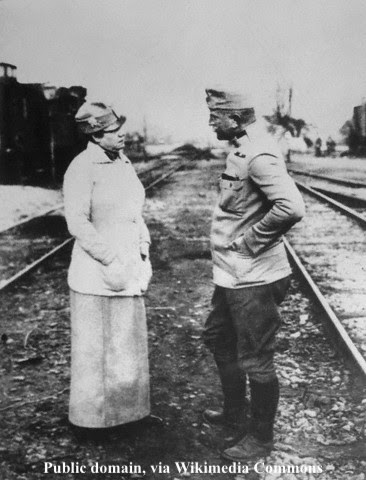
Nellie talking to an Austrian officer in Poland
There didn’t seem to be anything she couldn’t do, except beat pneumonia. On January 27, 1922, she succumbed to it at age fifty-seven.

Though best known for traveling alone around the world, that was only one small part of who she was.

“I said I could and I would. And I did.” Nellie Bly

To comment on this post, visit our blog


MRS. WITHERSPOON GOES TO WAR (Heroines of WWII series)

SELAH Award Finalist

A WASP (Women Airforce Service Pilots) flies a secret mission to rescue three soldiers held captive in Cuba.


Margaret “Peggy” Witherspoon is a thirty-four-year-old widow, mother of two daughters, an excellent pilot, and very patriotic. She joins the WASP. As she performs various tasks like ferry aircraft, transporting cargo, and being an airplane mechanic, she meets and develops feelings for her supervisor Army Air Corp Major Howie Berg. When Peggy learns of U.S. soldiers being held captive in Cuba, she, Major Berg, and two fellow WASPs devise an unsanctioned mission to rescue them. With Cuba being an ally in the war, they must be careful not to ignite an international incident.

Get it HERE!


MARY DAVIS, bestselling, award-winning novelist, has over thirty titles in both historical and contemporary themes. Her latest release is THE LADY’S MISSION. Her other novels include MRS. WITHERSPOON GOES TO WAR, THE DÉBUTANTE'S SECRET (The Quilting Circle  4), THE DAMSEL’S INTENT (The Quilting Circle  3) is a Selah Award Winner. Some of her other recent titles include; THE WIDOW'S PLIGHT (The Quilting Circle  1), THE DAUGHTER'S PREDICAMENT (The Quilting Circle  2),Zola’s Cross-Country Adventure” in The MISSAdventure Brides Collection , Prodigal Daughters Amish series, and "Bygones" in Thimbles and Threads.
Mary lives in the Pacific Northwest with her husband of thirty-seven years and one cat. She has three adult children and three incredibly adorable grandchildren.


Sources:

Who Knew?: Women in History, by Sarah Herman 

https://en.wikipedia.org/wiki/Nellie_Bly
https://www.biography.com/authors-writers/nellie-bly
https://www.britannica.com/biography/Nellie-Bly
https://www.youtube.com/watch?v=uQ1zfwtgXXE
https://www.youtube.com/watch?v=kMWrVjanWY0
https://www.youtube.com/watch?v=Rew9xz6pERU