Showing posts with label Illinois. Show all posts

Monday, August 28, 2023

History of Eating Utensils by Donna Schlachter with Giveaway

 
From the beginning of time, after humans learned to heat their food to make it more palatable, the need for tools to prepare and serve the food became obvious. After all, dismembering a wildebeest required a sharp instrument, as did turning over a hunk of meat on a hot stone in a fire pit.


https://www.pexels.com/photo/4992936/


Originally, people used whatever they had at hand. A piece of flint for what we now know as a knife. A sharp stick as a fork. A carved rock to grind grain or hold liquid. A shell or a chip of wood might be a spoon. Interestingly, the material used depended on where you lived. The ancient Greek and Latin word for spoon was cochlea, or shell, while the Anglo-Saxon word was spon, meaning a chip of wood.

Eventually, uniformity in the tools needed created craftspeople who sharpened flint and tied them to handles made from bones or antlers, or who carved indentations in rocks to use as a pestle or bowl. Various people groups perfected the forming and firing of clay pots to cook in, to hold ingredients, and to eat off of. Spoons were easy to carve from wood, and were used not only in cooking but also as a transport device to get the food from the banana leaf to the lips.

Next came the use of softer metals, such as copper and bronze, allowed for casting of utensils such as knives, forks, spoons, ladles, and more. Pots and pans were also made of these more malleable materials, and storage of foods was made easier. Eating utensils such as forks and spoons hadn’t become popular. Instead, the two-tined fork was used primarily in cooking.

Around the eighth century BC, the Romans—those masters of invention and ingenuity, expanded available kitchen and cooking tools to include meat hooks to hang meat to smoke, or to fish it out of a pot; meat mincers, to grind the meat into a form that was more easily cooked and served to tenderize what might otherwise be a tough cut of meat; spatulas for turning food over more easily in the pan; colanders to strain out water or other unwanted fluids; and ladles for serving soups, broths, and stews.
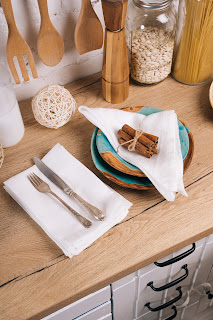


In the Middle Ages (500 AD – 1500 AD), slotted spoons became popular, as did frying pans, pepper mills, tongs and even a waffle iron. Weighing scales, roasting forks, rolling pins, and cheese graters became essential tools in modern—at least, according to medieval definition—kitchens. During this time, wealthy families, no doubt wanting to show off their wealth, used a smaller version of the cooking fork for eating. Also around this time, these same families used spoons made of precious metals. In particular, around the 1300s, pewter became popular, making spoons affordable. Forks made an appearance after a wedding in 1004, in which the bride used a golden fork at her wedding feast. Given that most people used their fingers and knives at this point, you can imagine the stir it caused. However, local clergy considered she was trying to upstage God, who had provided us with natural forks—our fingers—and when she died a few years later of the plague, asserted her death was God’s punishment.

In modern times, beginning in the 1600s, with wealth and education expanding across Europe and now into the Americas, and with increased use of servants, more specialized tools, such as apple corers, cork screws, and, within two hundred years, can openers, appeared. By this time in history, knives were also popular, both for cooking and eating. However, in 1669, King Louis XIV of France, disgusted that diners regularly used the tips of their knives to clean their teeth (other versions of this story say it was to decrease violence at table), decreed that any knife brought to the table must have a rounded tip. In 1608, an English traveler published an account of the fork in Europe. Forks were quickly adopted in England, but the Americas were slower to catch on to the practice. By the early 1700s, in Europe, four-tined forks proved easier for scooping food for quicker consumption of meals, leaving more time for other activities.

In the United States, beginning in the 1800s, labor saving devices became common in every household. Potato peelers, jelly molds, and salad spinner proliferated, long before anybody ever dreamed of Tupperware. By this time, forks were well established in the United States.

Copper utensils, which reacted with acidic foods, declined, and other metals came into common usage, such as tinned or enamel iron, and, eventually, steel, tin, and aluminum.

http://www.eatingutensils.net/history-of-cutlery/


In my upcoming release, Cooking Up Trouble, set in 1834, most of the emphasis is on utensils used in baking. At this time in history, the standardized measuring system hasn’t been established (that doesn't happen until the late 1890s with the Fanny Farmer Cookbook), so everybody’s version of a pinch, a measure, a cup, and other common forms of measuring ingredients was different. Recipes were often shared, with varying results. My heroine spends a lot of time not only testing the measure of ingredients, but in figuring out what the two missing ingredients in her grandmother’s walnut cake might be. You can check out the book that’s releases September 12th, but is available for pre-order, here: https://www.amazon.com/dp/B0CGKFS338

Leave a comment to enter a random drawing for an ebook copy of Cooking Up Trouble once it releases.

About Cooking Up Trouble:
A shameful marriage proposal to settle a debt, and a secret calling to do women’s work land Holly and Adam as opponents in a baking contest in Chicago, 1834. Can they overcome their headstrong desire to fix their own problems, or will they submit to God’s call on their lives?

About Donna:

A hybrid author, Donna writes squeaky clean historical and contemporary suspense. She has been published more than 60 times in books; is a member of several writers groups; facilitates a critique group; teaches writing classes; ghostwrites; edits; and judges in writing contests. She loves history and research, traveling extensively for both, and is an avid oil painter. She is taking all the information she’s learned along the way about the writing and publishing process, and is coaching writers at any stage of their manuscript. Learn more at https://www.donnaschlachter.com/the-purpose-full-writer-coaching-programs Check out her coaching group on FB: https://www.facebook.com/groups/604220861766651


www.DonnaSchlachter.com Stay connected so you learn about new releases, preorders, and presales, as well as check out featured authors, book reviews, and a little corner of peace. Plus: Receive 2 free ebooks simply for signing up for our free newsletter!

www.DonnaSchlachter.com/blog

Facebook: www.Facebook.com/DonnaschlachterAuthor

Twitter: www.Twitter.com/DonnaSchlachter

Books: Amazon: http://amzn.to/2ci5Xqq

Bookbub: https://www.bookbub.com/authors/donna-schlachter

Goodreads: https://www.goodreads.com/search?utf8=%E2%9C%93&query=donna+schlachter

Need a writing coach? https://www.donnaschlachter.com/the-purpose-full-writer-coaching-programs

The Purpose-Full Writer: https://www.facebook.com/groups/604220861766651


Resources:

https://blog.etundra.com/get-equipped/history-kitchen-utensils/

https://www.smithsonianmag.com/arts-culture/a-history-of-western-eating-utensils-from-the-scandalous-fork-to-the-incredible-spork-64593179/

http://www.eatingutensils.net/#google_vignette

http://www.eatingutensils.net/history-of-cutlery/

Friday, June 9, 2023

Name Origins of the Unites States Part II + giveaway

 By Tiffany Amber Stockton


In May, my children and I visited the Pine Mountain Settlement School in southeastern Kentucky. Amazing little place, nestled in the middle of the mountains, miles from any town. You can read last month's post if you missed it.

Today, it's time for the next 10 state name history stories. So, let's go!

STATE NAMES and their ORIGINS

Hawaii comes from the Polynesian word hawaiki, meaning place of the Gods. It was, however, originally named the Sandwich Islands by James Cook in the late 1700s.

Idaho has notorious roots in the Athabaskan word idaahe, meaning enemy. It was originally applied to part of Colorado before being given to the Gem State.

Illinois has a silent "s" at the end, because it's of French origin. "Illinois" means "Land of Illini," giving a nod to the Native American population. "Illini" is the Algonquin word for "man" or "warrior." This land east of the Appalachians and south of the Great Lakes became the center of significant battles.

Indiana, as you might expect, stems from the English word Indian. The Latin suffix tacked on the end roughly means "land of the." During the early years of America, many native tribes were well-established in these areas.

Iowa comes from the Dakota word yuxba, meaning sleepy ones.


Kansas references the Kansa tribe, meaning people of the south wind. Makes sense for tornado alley.

Kentucky is yet another state named for the river running through it, inspired by the Shawnee word for on the meadow.

Louisiana, like Georgia, was named for a regent of the times, specifically, Louis XIV of France.

Maine has uncertain origins. Though it's worth noting that Maine was also the name of a traditional province in France.

Maryland is a tip of the hat from King Charles I to his wife Henrietta Maria. Some husbands give jewelry; King Charles gave naming rights to an entire state.

And that's all for today. If you're like me and LOVE puzzles, download this PDF for some puzzle challenge fun. You might be able to solve it on your own without reading the rest of the blogs in this set, or you can save it and add to it in future months. :)

NOW IT'S YOUR TURN:

* Which one of these states was the most fascinating to you?

* Do you live in any of these 10 states? If so, did you know this was the origin of its name?

* What do you think might be the origin of any of the other 30 states? (You'll learn about them throughout the rest of the year.)


** This note is for our email readers. Please do not reply via email with any comments. View the blog online and scroll down to the comments section.

Leave answers to these questions or any comments you might have on this post in the comment box below. For those of you who have stuck around this far, I'm sending a FREE autographed book to one person every month from the comments left on each of my blog posts. You never know when your comment will be a winner! Subscribe to comments so you'll know if you've won and need to get me your mailing information.

Come back on the 9th of July for my next foray into historical tidbits to share.

For those interested in my "fictional" life as an author and industry news about other authors, subscribe to my quarterly newsletter. Receive a FREE omitted chapter from my book, A Grand Design, just for subscribing!


BIO
Tiffany Amber Stockton has been crafting and embellishing stories since childhood, when she was accused of having a very active imagination and cited with talking entirely too much. Today, she has honed those skills to become an award-winning, best-selling author and speaker who is also a professional copywriter/copyeditor. She loves to share life-changing products and ideas with others to help improve their lives in a variety of ways.

She lives with her husband and fellow author, Stuart Vaughn Stockton, along with their two children and four cats in southeastern Kentucky. In the 20 years she's been a professional writer, she has sold twenty-six (26) books so far and is represented by Tamela Murray of the Steve Laube Agency. You can find her on Facebook and GoodReads.

Friday, October 5, 2018

Authors from Lincoln, Illinois


by Guest Blogger Tisha Martin

It's always fun to dig into the history of the town you're writing about.

Many famous people grew up in small towns, which is really surprising. Ronald Reagan grew up in Dixon, Illinois, and Abraham Lincoln in New Salem, Illinois (and Kentucky). However, several authors who wrote famously about this small, Midwestern town grew up in the town and moved away after graduation, only to write about their towns later in life.

Reinhold Niebuhr


Renowned theologian and author
Dr. Reinhold Niebuhr
 grew up in Lincoln, Illinois.

Doing a bit of research behind the author of the famous poem, "The Serenity Prayer," I discovered that Dr. Reinhold Niebuhr grew up in Lincoln, Illinois. His father was the administrator of the state-of-the-art Deaconess Hospital in Lincoln. One of his brothers, Walter, was managing editor of the
Lincoln Daily News-Herald newspaper, until he passed away in 1946.

 
Siblings, Left to Right: H. Richard, Reinhold,
Hulda, and Walter Niebuhr
A theologian, Reinhold was Dean and Professor of Applied Christianity at the Union Theological Seminary in New York City. His photo was featured on the cover of Time magazine in 1948. He received the Presidential Medal of Freedom in 1964, and was in the top 100 most influential people in the twentieth century (Life magazine, 1990).

While he did not write much about his hometown as other authors who grew up there did, Niebuhr wrote about thought-provoking and often controversial subjects. He wrote about the spirituality of man and direction of its society shortly after WWII. Several of his titles are Moral Man and Immoral Society, The Nature and Destiny of Man, The Irony of American History, Leaves from the Notebook of a Tamed Cynic, among other titles that explored society, the human soul, and politics.

William Maxwell

William Keepers Maxwell, Jr.
William Maxwell was one of two locals who wrote extensively about their hometown. His stories and novels are often deep, exploring the social and psychological aspects of people living in a small town. According to online research, Maxwell was born in Lincoln, Illinois on August 16, 1908. His parents were William Keepers Maxwell and Eva Blossom (née Blinn) Maxwell. He attended Senn High School. He received his bachelor's degree from the University of Illinois in 1930 where he was class salutatorian, poetry editor of The Daily Illini, and a member of Sigma Pi fraternity. Maxwell earned a master's degree at Harvard University. Maxwell taught English briefly at the University of Illinois before moving to New York. 

Maxwell wrote of tough but necessary topics, such as social and psychological strains of the small town and how various events affected him. Only three of his short stories held happier moments and included people from his childhood. For example, Miss Vera Brown was a popular fifth-grade teacher, whose death devastates her male students ("Love" in All the Days and Nights 245-248). Another example is Mr. Danforth, the venerable horse veterinarian whose advice is quietly sought by many townspeople (Time Will Darken It). A third example is Lincoln College biology Professor Chris Oglevee, who ably mentors the Cub Scout troop of the First Presbyterian Church ("With Reference to an Incident at a Bridge" [For Eudora Welty] in All the Days and Nights 265-269). (D. L. Henson, Finding Lincoln Illinois.)

But one incident happened in his life that he wrote searchingly but fondly of. During the Spanish Flu of 1918, young Maxwell and his mother became ill. Maxwell recovered but his mother did not. Her death devastated the family, and his father sent the boy to live with relatives in Bloomington, a town nearly an hour away, which would have been quite a trip in 1918. He later rejoined his father in Chicago. Maxwell's story They Came Like Swallows depicts this event so vividly and shows how such a wide-spread epidemic (that spread all the way to Philadelphia) affected an eight-year-old boy from a small Midwestern town.


So, the next time you're writing historical fiction or reading historical fiction, appreciate the amount of research the author took to create even a small scene to "get the facts just right." It really adds meaning to the depth of the novel.

What interesting town research have you read about or uncovered?


Tisha Martin edits and proofreads for publishers and private clients by day and writes historical fiction set in the Midwest by night.
Her award-winning WWII short story "Puddle of Remorse" is free to readers who sign up for her quarterly newsletter.
Visit www.tishamartin.com to sign up and learn more about all things vintage, history, and books.


Sunday, January 25, 2015

Tragedy in Franklin County, Illinois


Hello, everyone. Welcome to 2015! Can you believe it? A new year, a clean slate. I’m excited for what the year will bring.

While visiting with family over the holidays, my father began reminiscing about a piece of history that I knew a bit about, but only in the most general of terms. It had, however, impacted my family greatly.

Both my parents and grandparents grew up in Franklin County, Illinois—smack in the heart of coal mine country. While my father left that area immediately after graduating from high school (and thus, never worked in the mines), both of my grandfathers were coal miners in the Orient 2 mine from the 1930’s on into the 1950’s. My dad’s father worked day shift, and my mom’s father worked nights. Many families in that area were employed by the coal mines.


December 21, 1951, was like any other day for the miners, except for being the last shift before a scheduled shut-down for the Christmas holidays. The day shift ended and came out of the mine, my dad’s father among them. Meanwhile, 252 night shift workers entered and took their places. My mom’s father had been working three jobs at the time and took an unheard-of-for-him day off. The “coincidental” choice saved his life.

At roughly 7:30 pm, just thirty minutes or so after the night shift began, an explosion ripped through the Orient 2. Miners in the far reaches told of a rush of wind whipping past them, almost as if a train had flown by. Immediately after, smoke and dust poured into their areas and power outages occurred mine-wide. They called to the surface and were told to get out by means of safe, unaffected tunnels. With the power out, they had to use the stairs, which took three or four hours. Just over 130 men escaped unharmed. The remaining 120 men were trapped below.


In the town of West Frankfort,  news of the explosion traveled quickly. At a local high school basketball game, the game’s announcer called for Dr. Barnett over the loud speaker and asked him to report to the mine for a catastrophe. Nearly 2,000 people were in attendance at the game, and nearly half left after the announcement. Everyone rushed to the mine to discover what had happened and whether their friends and family members were all right.

By midnight, brave miners from day shift donned gas masks and protective gear and descended into the mine to clear the methane gas that caused the explosion, then begin search and rescue operations. My dad’s father was among these men. Hope evaporated when they saw the carnage below ground. A locomotive weighing ten tons had been blown off its tracks. Railroad ties were torn from under the rails traversing the mine. One-foot-thick support timbers were broken clean through.

I’m sure you can imagine the rest. The recovery crews found body after burned body, many of them unrecognizable. For days, they searched and found no survivors, until…two and a half days after the explosion, they came upon a miner,  Cecil Sanders,  barely alive, lying atop a rock fall. The supposition is that he found a pocket of breathable air that lasted just long enough for the searchers to reach him. The rescuers rushed a stretcher and oxygen tank to Sanders, and the men carried him to safety. Of the 120 men hit by the explosion, he was the only survivor. Among his effects, they found a note scrawled on a box of cough drops—“May the good Lord bless and keep you, dear wife and kids. Meet me in Heaven.” Thankfully, his family wouldn’t have to face that, just then. 

But so many more did. The deceased miners left behind 109 widows and 175 fatherless children. So many lives were lost that, once the funerals began, services were performed from early in the morning until late at night with only momentary breaks between. This went on for weeks. One woman reported that the only time available to bury her husband was Christmas Eve at 8 PM. Ironically, she’d married her husband five years earlier—on Christmas Eve at 8 PM.

The explosion rocked the entire county. While the week of Christmas should have been a joyous time, the residents of West Frankfort and neighboring towns forgot the holidays. People took down their trees and decorations, feeling it not right to celebrate when so many were grieving. Yet the spirit of Christmas was never more present than in the way the community banded together. Neighbors reached out to neighbors, and strangers offered help to those affected by the blast. It truly was a testament to the close-knit communities of small-town America.

The tragedy changed people. Many could not bring themselves to return to their jobs in the mine. My mother’s father never went back, instead choosing to work as a mechanic for the rest of his days. My dad’s father—who’d fought and nearly died in Burma during WWII—would speak on occasion of his experiences during the war, but never of what he saw in the days following the Orient 2 explosion. He did return to his job at the mine for another 8 years, but he was forever changed, as so many others with him.


On a more positive note, due to this explosion, safety reforms did begin to come to the mining industry. The day after the explosion, UMWA union boss John L Lewis toured the mine, then testified before the U.S. House of Representatives Subcommittee of Mining Safety. Due in large part to this testimony, Congress passed the Federal Coal Mine Safety Act, which standardized safety practices for coal mines everywhere. It was signed into law by President Truman in 1952.

Your turn: What great tragedy in your lifetime has most affected you? How did it change you? What, if any, positives, are you able to take away from the experience?


Jennifer Uhlarik discovered the western genre as a pre-teen, when she swiped the only “horse” book she found on her older brother’s bookshelf. A new love was born. Across the next ten years, she devoured Louis L’Amour westerns and fell in love with the genre. In college at the University of Tampa, she began penning her own story of the Old West. Armed with a B.A. in writing, she has won five writing competitions and finaled in two other competitions. In addition to writing, she has held jobs as a private business owner, a schoolteacher, a marketing director, and her favorite—a full-time homemaker. Jennifer is active in American Christian Fiction Writers and lifetime member of the Florida Writers Association. She lives near Tampa, Florida, with her husband, teenaged son, and four fur children.