Showing posts with label Jamestown. Show all posts

Wednesday, January 8, 2020

Entrepreneurs Founded America!

By Tiffany Amber Stockton


Last month, I explored the origination of the cruise ship and how that transitioned into luxury cruising and then cruising for fun as many do today. If you missed that post, you can read it here: https://www.hhhistory.com/2019/12/cruise-ships-of-past.html.

Now, we're at the beginning of another new year, a year which has its fame in a well-known turn of phrase: Hindsight is always 2020. *grins* This can tie into a quote we often reference here on this blog, "Those who don't know the past are doomed to repeat it." I'm not certain "doomed" is always the case, especially when you focus on the positive side of things that happened in the past.

THE AGE OF THE ENTREPRENEUR 

There are many who say America is becoming more and more geared toward the individual entrepreneur and less on the corporate world or company-dictated economy. Economists have predicted by the year 2025, more than 50% of Americans will own a "side gig" or be an entrepreneur of some sort...even if it's only part-time.

I honestly wouldn't mind this at all! Small businesses almost always come with a personal touch that is often overlooked, neglected, or completely missing with larger companies and "big box" stores. Think about your small towns that pretty much run America. What makes them so appealing? Why are they so often the subject of novels and movies? What made small towns thrive and in some cases cause them to become bigger towns or central cities?

The answer? Entrepreneurs.

tall ships
Our nation was founded, quite literally, by entrepreneurs. In 1607 the Virginia Company sent three ships across the Atlantic and unloaded 109 passengers at what became Jamestown, Virginia. They had a goal in mind that didn't quite pan out to become successful. It was a joint-stock company, a relatively new invention that allowed people to invest in enterprises without running the risk of losing everything if the business did not succeed. By limiting liability, corporations greatly increased the number of people who could dare to become entrepreneurs by pooling their resources while avoiding the possibility of ruin.

blacksmith shop
Their attempt to establish American plantations introduced a rather new venture. Unfortunately, this venture also came with a rather steep learning curve, and the Virginia Company made almost every mistake that could be made as other industries developed and new ideas were introduced. Once John Rolfe introduced tobacco, it quickly became an export item and made Virginia rich. Other colonies followed suit, and that eventually led to cotton plantations as well.

cobbler shop
However, plantations required supplies, wagon repairs, horses, medical attention, clothing for the workers, personal grooming, dry goods, legal services, and so much more. They couldn't often get or have all of that on their plantation, so they had to go into town for it. That's where the entrepreneurs were in abundance. And that's where the long-standing tradition of trading goods and services was at its best!

apothecary
The smaller towns could be quite limited in the variety of their businesses. They would start with the basics of a blacksmith, apothecary, cobbler, mercantile, and a grain/feed shop. Some might also feature a candleshop, tailor, barber, doctor, lawyer, seamstress, library, and alehouse. The larger a town grew, the more diverse the businesses became. Whatever the need, there was a business that provided it. If the need existed and an existing business couldn't meet the need, someone would start a new one. If you couldn't afford to pay cash for goods or services, you offered your own goods or services in honest trade.

mercantile
I would love to see America return to this in a greater manner. So much in business has lost the personal touch, the relationships, and the community feel. Who knows? Maybe with this increase in "side gigs," we'll see a little bit of the small business mentality growing again. I know I wouldn't mind!

NOW IT'S YOUR TURN:

* Have you ever owned a small business or undertaken a new venture? What was it?

* What would you do if you could do anything in the world and have a guarantee that it would be profitable for you? Travel? Bake? Invent? Write? You name it!

* If you were one of those 109 passengers who settled Jamestown, what business would you have opened?

* What did you like the most about today's post? What topics would you like to see covered in future posts?

Leave answers to these questions or any comments on the post below. Come back on the 9th of
February for my next appearance.


BIO

Tiffany Amber Stockton has been crafting and embellishing stories since childhood, when she was accused of having a very active imagination and cited with talking entirely too much. Today, she has honed those childhood skills to become an award-winning and best-selling author and speaker who is also an advocate for literacy as an educational consultant with Usborne Books. She loves to share life-changing products and ideas with others to help better their lives.

She lives with her husband and fellow author, Stuart Vaughn Stockton, along with their two children and two dogs in Colorado. She has sold twenty (21) books so far and is represented by Tamela Hancock Murray of the Steve Laube Agency. You can find her on Facebook and GoodReads.

Saturday, December 15, 2018

Jamestown Struggles to Survive in 1614-1619


Last month I shared how even the gentlemen farmers in Jamestown in the 1600s had to learn to work if they intended to eat. But one crop wasn’t exactly for nourishment.

By 1614, John Rolfe’s experimentation of growing tobacco paid off when a variety of West Indian tobacco flourished in Virginia. Even those who’d spent their earlier years searching for gold started “rooting” in the ground to grow the weed, going so far as to plant tobacco in the streets of Jamestown. In those early years, tobacco was almost worth its weight in silver and was sometimes even used as currency.

From the beginning, the settlers were hired employees of the Virginia Company. They lived in company towns, bought supplies from the company store, and cultivated company ground with company supplied tools. But things began to change when Governor Dale allowed each settler three acres to grow his own crops. He also reduced the work load exacted by the company to one month a year provided the settler paid a tax of two and a half barrels of corn annually.

But even those concessions to the future of the settler’s lives didn’t negate the fact that the wilderness area of Virginia had acquired a reputation of a misery and death back in England. Few Englishmen of any means were willing to risk their lives in the “inferno” that was Jamestown since the settlers were dying faster than they could be replaced.

Governor Dale proposed to the Virginia Company that they replenish the colony by emptying the jails of England. The governor said that the felons wouldn’t be any worse than the “abandoned wretches” already in Jamestown. King James I gave his consent and gave the company permission to select 100 of the likeliest-looking convicts to send to the New World. Whether these convicts had any say in the matter is left to speculation, but it is likely they had no choice in the matter. In 1615, the king issued a proclamation ordering the transportation of the felons to Virginia. Those convicted of rape, murder, burglary or witchcraft were ineligible for transportation.

Orphaned street children were also rounded up off the streets of London to serve as apprentices in the colony. Understandably, many of the children refused to go and had to be forced to board the ship. While a new life in a new land might seem to be a good move for these street children, it’s no wonder that they were terribly frightened to cross the vast ocean on the flimsy promise of a better life.

Regardless of how they felt about the matter, inevitably the felons and the street kids were shipped to Virginia. But what the colony needed more than a horde of lonely felons and street-smart kids was … women.

Join me next month on the 16th to see how Governor Dale, the Virginia Company, and King James resolved this perplexing problem.


CBA Bestselling author PAM HILLMAN was born and raised on a dairy farm in Mississippi and spent her teenage years perched on the seat of a tractor raking hay. In those days, her daddy couldn't afford two cab tractors with air conditioning and a radio, so Pam drove an Allis Chalmers 110. Even when her daddy asked her if she wanted to bale hay, she told him she didn't mind raking. Raking hay doesn't take much thought so Pam spent her time working on her tan and making up stories in her head. Now, that's the kind of life every girl should dream of. www.pamhillman.com

Monday, May 28, 2018

Myths about Captain John Smith of Jamestown Colony

by Tamera Lynn Kraft

Captain John Smith was an explorer who led Jamestown Colony, the first permanent English settlement in North America. He was a larger than life man who captured the imagination of historians and school children alike. His life was full of adventure and intrigue, but the facts most people know about John Smith are myths and legends instead of facts.

Some of the biggest myths surrounding Captain John Smith are stories about him and Pocahontas. Pocahontas was an Indian girl, daughter of Chief Powhatan, who hung around Jamestown. According to legend, she was so in love with John Smith that when her father threatened to kill him, she begged for his life. Some even belief that John Smith and Pocahontas married. John Smith was the first to perpetuate part of this myth. He claimed that when he was captured by Indians, Pocahontas threw herself across his body to save him.

The truth is historians belief John Smith might have exaggerated the story. Soon after the incident happened, he never mentioned Pocahontas' part in the Powhatans releasing him without harm. Over ten years later, Captain Smith told the harrowing tale in a letter to Queen Anne introducing Pocahontas and asking the queen to treat her with dignity. One historian, David A. Price, believes the incident might have happened but suggested Captain Smith was in no real danger. He could have been involved in a ritual that symbolized his death and rebirth as a member of the tribe.

Whatever the case, Pocahontas and Captain Smith were not in love. When Captain Smith was captured, Pocahontas was only ten or eleven years old. It's also not true that she converted Captain Smith to the Indian religion. After spending years around the settlers at Jamestown, Pocahontas was converted to Christianity and took the name Rebecca. In 1614, she married John Rolfe, a tobacco farmer, and in 1616, she travelled to London with her husband where she died of an unknown virus.

Another myth is that Captain John Smith was highly revered by the other colonists. This also is only partially true. During the voyage to the New World, the colonists for the Virginia Company had papers that were to remain sealed until they reached the new land. Apparently Captain Smith was involved in a mutiny aboard ship, and Captain Christopher Newport and the crew planned to execute him when they landed at Cape Henry. When they did arrive at Cape Henry, the letter was opened, and the colonists found out the man they were planning to execute was appointed one of the leaders of the new colony. This saved Captain Smith from the gallows.

A year later, Captain Smith became the president of the council. He proved his leadership abilities, saving the colonists from starvation, by initiating strict policies including an order, “He that will not work shall not eat." He built the first well in the fort and repaired many of the buildings. Even though his leadership helped to save the colony, not everyone liked Smith. One night, while he was sleeping on the boat, a mysterious gunpowder explosion went off causing him to be injured. Some historians suggest it might have been an attempted assasination.

Another myth is that Captain John Smith lived in Jamestown for the rest of his life. The truth is he arrived in Jamestown in 1607, became president of the council in 1608, and sailed to England because of his injury for the gunpowder explosion in 1609. Captain Smith never returned to Jamestown. He died in 1631 in England at the age of 51.


During his years in England, John Smith encouraged colonization in America by writing accounts of his time there and giving detailed maps of the land. He was a major part of the Jamestown Colony even though he was only there for three years.


Tamera Lynn Kraft has always loved adventures and writes Christian historical fiction set in America because there are so many adventures in American history. Her Novels, Red Sky over America and Alice’s Notions and her novellas Resurrection of Hope and A Christmas Promise are available on Amazon and at Barnes and Noble.

Wednesday, May 25, 2016

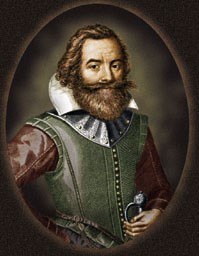
Will the Real Captain John Smith, Please, Stand Up?

Thank you for stopping by Heroes, Heroines, and History today. I’m Michele Morris, and I’d like to share with you some truths about the life of Captain
John Smith. 

Let's start by going back in time more than four-hundred years to December 19, 1606. Captain John Smith and an English expedition of 105 settlers sailed on three ships headed for The New World. They landed April 26th, 1607 on the shores of what is now Cape Henry, Virginia. King James had chartered the London Company branch of the proprietary Virginia Company for a for-profit venture, and he commissioned Captain Christopher Newport to lead the sea voyage.

The trip must have been fraught with chaos because days before they arrived,
The Virginia Company's claim in the New World
Captain Newport charged Captain John Smith with mutiny and sentenced him to the gallows. Luckily for Smith, Captain Newport read The Virginia Company’s sealed settlement orders before Captain Smith’s execution. The document appointed Captain John Smith as one of the seven leaders in the colony, thus, possibly saving his life.

On May 24, 1607, Captain Edward Maria Wingfield, head of the leader’s council, picked the Jamestown site as the location for the settlers’ new home.
Jamestown's location
Jamestown, an island in the James River, became the first permanent English settlement in North America.

After a four-month long sea voyage, the colony’s food supplies were alarmingly low. Each man was allotted only a cup or two of grain-meal per day, and due to poor water sources, Indian attacks, and diseases, at least sixty men died by September 1607. Captain John Smith wrote that for a time, one man died every day.

Though times were tough, 27-year-old John Smith began exploring the new land. While mapping Chickahominy River in December 1607, Powhatan warriors captured two colonists and Smith. At the time, the Powhatan Indian confederacy consisted of around thirty Tidewater-area tribes led by Chief Wahunsonacock, known as Chief Powhatan to the English. Smith’s companions were killed, but, according to a 1624 account by Smith, he was spared and released because of the intervention of Chief Powhatan’s 13-year-old daughter, Pocahontas.
Pochahontas saving Captain Smith


In early January 1608, Captain Newport brought nearly one hundred new settlers. After their arrival, a carelessly set fire accidently burnt most of the fledgling village, thus forcing the settlers to live in the burnt-out ruins during the remaining harsh winter months. Food supplies ran low, and although Native Americans (including Pocahontas) brought some food, Smith wrote that "more than half of us died."

After Jamestown’s disastrous first year, Smith became president of the colony.
Jamestown
Much of the past discord within Jamestown came as the result of some of the more affluent colonists believing they were above manual labor. Many constricted others to do their share of work. Captain Smith immediately imposed order by ruling everyone must work. The captain trained the settlers to farm the land and to contribute to the betterment of Jamestown, thus saving the colony from early devastation. He publicly stated, "He that will not work shall not eat."

John Smith continued to explore and map the area. In 1608, he led a team up the Chesapeake Bay. It is believed they traveled as far north as Baltimore. On their return trip, they took a turn up the Potomac River to modern-day Washington, D.C. During this trip, Captain John Smith caught a stingray. The ray stung and almost killed him. To this day, that area of the Rappahannock River is called Stingray Point.

In 1609, Smith was injured from a fire in his gunpowder bag. His injuries were severe enough to force his return to England for medical care.

John Smith returned to the New World in 1614. He did not go back to Jamestown, but instead explored the New England coast from Penobscot Bay to Cape Cod. Interestingly, that April, Pocahontas married the English planter John Rolfe in Jamestown. She eventually served as an Indian ambassador in England where she contracted smallpox and died.

In 1615, Smith was captured by pirates off the New England shoreline. He managed to escape after three months of captivity, then returned to England where he educated others about the New World and wrote of his adventures. He died in 1631.

Captain John Smith played a vital part in the settlement of Jamestown and mapping the eastern coast of the New World. His life was filled with bravery, excitement, and adventure. There have been many fictional stories told about Captain John Smith, including his relationship with the Indian princess Pocahontas. Although I love a good story, it’s important to know the truth behind the fiction.

What do you think of Captain John Smith’s adventures and the differences between fact and fiction in the stories told about him? Please, comment below, and thank you for joining me today at HHHistory.com. 


Award winning author, Michele Morris’s love for historical fiction began when she first read Laura Ingalls Wilder’s Little House book series. She grew up riding horses and spending her free time in the woods of mid-Michigan dreaming of days-gone-by and knights-in-shining-armor. Therefore, it only makes sense that she now writes historical romance with a touch of suspense. Married to her high school sweetheart, they are living happily-ever-after with their six children, three in-loves, and six grandchildren in Florida, the sunshine state. When not spending time with her large brood or writing, Michele enjoys photography, genealogy, and cooking.