Showing posts with label 1600's. Show all posts

Friday, March 1, 2024

Unexpected Legacy Series: Jeanne-Marie Bouvier

By Matthew J. Elliott


Have you ever been in a situation where it just felt like you were dealt the worst hand life could possibly have given you? I think we can all say that we’ve been there, so I won't dwell on it, but that is the kind of background Jeanne-Marie Bouvier came from. Does that name sound even remotely familiar to you? How about Madame Guyon? Well, she is known to many who have read her book “Experiencing the Depths of Jesus Christ” as one of the most influential women of faith the 1600s produced. This particular book was even publicly burned in France (more on that later), but it still found its way into the hearts and minds of thousands and thousands of Christians seeking to understand the value of experiencing a deeper faith. 

As a child, she was born into a wealthy family but dealt with childhood illnesses that kept her from living a normal life. Due to these constant ailments, her education was neglected far more than it should have been. She was even shipped off to live with nuns more than a few times as a child and never really given an opportunity just to be a kid. Her parents were devout Christians but when she was the ripe old age of 15, she was forced to accept a marriage proposal to someone 22 years older than her, whom she had never met. While he too was well endowed, Jeanne-Marie still endured long periods of neglect and a demanding home-life. Her life was not the kind of life one might imagine could belong to a person who eventually became such an advocate for the Christian faith. Everything she struggled with as a young sickly maiden could not prepare her for the struggles she faced with barring children, appeasing an overbearing spouse who gave into his demanding mother who had no interest in the woman her son married, and becoming a widow at the age of 28. Of the five children she gave birth to Jeanne-Marie outlived two of them and still had to deal with their father's mother. 

François Fénelon

Her life, while endowed, was filled with tribulation. So how does a woman with so much pain and suffering end up leaving a legacy like hers? It all comes back to her affinity for making faith a priority even amid everything she faced. In truth, she embraced the practice of Christian Quietism. This is a way of thinking that, according to those who lived by it, taught that spiritual peace and perfection were attainable through contemplating completely the ways of God, and nothing else. Those who sought a life of Quietism strived to rid themselves of human desire and become a completely passive individual, in the spiritual sense. While there is a lot of debate on these practices still today, the point I am making is that Jeanne-Marie Bouvier devoted her entire life, post-marriage, to finding ways for her to embrace a path in life that encouraged a deep and meaningful faith. This is where her legacy began to reveal itself to the world she lived in, but not in the way some may have expected.

In the late 1600s, Madame Guyon was arrested by church leaders who believed that her theology was flawed. While this was a brief imprisonment, her reputation was ruined. In an effort to find support for her beliefs, she began reaching out to others. Eventually, she found the support she was looking for through her cousin, a priest named François Fénelon. He was a French philosopher and would eventually become the archbishop of Cambrai, as well as one of her biggest advocates. Even with his support, Madame Guyon’s beliefs continued to cause her issues and she was arrested again and imprisoned from 1695-1702. Despite all this, she would eventually pick up the pen, so to speak, write everything down, and continue to pursue her beliefs, relentlessly. In her eyes, these beliefs would lead her to a complete understanding of the depths of Jesus Christ. 

Before all this, Madame Guyon had already released material in the form of a book called "A Method of Prayer." It has served many roles over the years and has constantly been a story that questions the reality of what faith is, and what it means to experience it deeply. This book caused so much opposition in France that a group of Roman Catholic priests serving in Dijorn gathered a total of 300 copies and burned them. On the other side of that coin, there was a Frenchman, who took 1500 copies and flooded his community with them. In truth, Madame Guyon is considered one of the most influential leaders of her time. In the end, she was denounced as a heretic by the religious tribunal and forced to live out the rest of her days in solitude until her death. After her eventual death,  this story found new life under the name “Experiencing the Depths of Jesus Christ” and to this day is considered one of the greatest Christian writings of all time. 

Bastille: Where Madam Guyon was imprisoned

It is a very unlikely story indeed, but this unexpected legacy has influenced believers as much, and, maybe even more, than Brother Lawrence and his short little book. The Practice of the Presence of God. While one cannot deny the simplicity of Brother Lawrence, many consider Madame Guyon’s detailed approach to quietism and devoted prayer a more unexpected legacy. A sickly child, devalued by her family, grew up and found herself in an unhappy marriage where she lost two of her children; One day became an undeniable advocate for devoted prayer and deep faith. She was rejected by so many throughout her life but always stood firm in her faith. This example of dedication has played a vital role in the lives of people across 100s of years. The results speak for themselves and it just goes to show that unexpected legacies are all around us. 

Do you believe that there are those who have a similar legacy today?


~ Biography ~

Matthew James Elliott (M.J. Elliott) is a passionate writer who loves to encourage and inspire others. He has served in various ministry roles for over 15 years, which has given him a unique perspective on people and Biblical History. Matthew holds a degree in Biblical Studies from Oklahoma Wesleyan University, with a focus on Pastoral Care, Christian Education, and Worship.

Matthew is happily married to Traci, and they have three children named Leyla, Caleb, and Hannah, who bring them immense joy and inspiration. As a writer, Matthew's goal is to share love, equip others, and edify them for the greater good. He loves connecting any amount of scripture to his stories and uses his knowledge of Biblical History to do so often.

You can find Matthew's works on Amazon, Goodreads, Facebook, and His Website. He has written Devotionals, An Episodic Series, Novellas, and even Commentaries for The Gospel Daily.


~ Highlighted Release ~

https://amzn.to/3wwp8Ht
Are you ready to dive into a captivating series that delves into the journey of a young runaway slave who discovers God in his quest for redemption? Finding Philemon is exactly that kind of series. Follow along on the unexpected journey as Onesimus embarks upon his path of faith and new beginnings.

Throughout this journey, Onesimus will encounter life-changing events that will transform the depths of his heart and aid him in discovering the redemption that only God can offer, and ultimately his way back to his former master Philemon.


----

Sources:

Guyon, J. (1997). Madame Guyon: An autobiography. Whitaker House: 1st edition.

https://www.gcu.edu/blog/theology-ministry/theology-thursday-madame-jeanne-guyon-life-transformed-through-prayer

Guyon, J. (1685). Experiencing the Depths of Jesus Christ. SeedSowers.


Thursday, February 1, 2024

Unexpected Legacy Series: Nicolas Herman

By Matthew J. Elliott


Wikipedia.com
Everyone has that one historical figure who plays a significant role in their development and understanding of the world around them. As a writer who tends to build stories around the lesser-known historical figures in scripture, most of the biblical characters who have played the more meaningful roles in who I have become were not well-known people. In truth, my inspiration came from characters others did not give a second thought. These types of characters always taught me insightful and unexpected lessons that I use even today. However, if you are reading this particular blog post, you are likely looking for the historical aspect of the story. Don’t worry; that is where we will spend the rest of today’s post.

While scripture is one of my primary resources for content; Today, I wanted to bring a little knowledge to the table about a man once called Nicolas Herman. This amazing historical figure was born in the early 1600s in France. History will tell you that this young man was nothing special when he was born, but have you ever heard the saying, “Your past defines you?” Well, the family Nicolas was born into had little wealth and even less education. Nothing about this man would have led anyone to believe who he became as an adult. One thing his parents did have going for them was their Christian heritage, and that is what they taught their son. If you can imagine a scene with me for a moment…

playgroundai.com
It is a dark and stormy evening; a young boy is looking out the window of a poorly built home, watching the rain fall from the sky.  He turns away from the window to see his father home from the fields, pulling an old looking book from the top shelf. Together, the family sits in their half-broken chairs, looking at the words written within its wrinkly and damaged pages. In the corner, a small fire, cooking an even smaller meal. Suddenly, the young boy looks at his parents with the biggest smile upon his face. “I know that one Pappa.” Then, the three of them embrace. After this, the meal is served. Moments later, they all kneel by the young boy's bed and look to the heavens.

While I will never know if something like that happened, the idea is there. Regardless of what did take place in the home Nicolas grew up in, his parents encouraged a life of faith. Was that all they gave him? Likely not, but there is not much history about that time in his life.   What is known though, is that this young man grew up, and throughout his life, he embraced the teachings his parents tried to instill in him, and he eventually became the author of a small book that has inspired millions of people, including myself.  

Before we jump into that, there is more to his story than the impact of his words on the world today. Nicolas grew into a young man whose zeal for life was inspired by a tree hibernating in winter, a sentiment that has inspired me also. When asked by a good friend why the tree inspired him so much, Nicolas would only state that even though he knew the tree was barren, what mattered was that eventually, life would blossom from it again. The friend asked a further question about why this mattered, to which Nicolas replied. ‘It gave me a profound impression of God’s providence and that knowledge has never really left me.’ Who would have thought a sleeping tree could do so much? Soon after this experience, Nicolas became a soldier and fought in the Thirty-Year War, one of the most devastating conflicts in European history. 

During this conflict, Nicolas was taken prisoner by the Germans and given the worst treatment. However, due to his patient mindset and strong will, he was eventually released. Soon after, he was forced out of the army due to an unprecedented leg injury. After recovering, he found work as a personal attendant, but his position there did not last long. His lame leg caused issues with his esteemed employer. Nicolas had many experiences like this throughout his life—all of which led him through war, poverty, and eventually to a monastery. 

pxhere.com
Here, in this monastery, Nicolas adopts a different, maybe more familiar name, Brother Lawrence. Upon joining the ranks of the other monks, Brother Lawrence spent the next 50 years of his life serving in the monastery as a cook, a shoe cobbler, and even a janitor of sorts. He struggled daily with understanding the presence of God and deeply desired to find ways to serve his faith. Eventually, Brother Lawrence found a home living within the community of his monastery. Over the years, he grew in his faith and spent many years learning how to value the presence of God in his life, and this knowledge influenced many of the other monks who lived alongside him.   

The practical way Brother Lawrence lived his life may seem meaningless, but for me, these teachings have influenced my faith in more ways than I could have ever imagined. There is only one book attributed to Brother Lawrence, and it is filled with simple sayings that have inspired many authors today. In truth, his book, The Practice of the Presence of God, even inspired me to write my first book, Ahavah Writings for the Journey. It is fascinating that such a humble man could inspire people more than 400 years after his death. This just goes to show that even the most unexpected people can inspire a legacy that stands beyond the test of time. 

Who is someone who has influenced your life's legacy?

~ Biography ~


Matthew James Elliott (M.J. Elliott) is a passionate writer who loves to encourage and inspire others. He has served in various ministry roles for over 15 years, which has given him a unique perspective on people and Biblical History. Matthew holds a degree in Biblical Studies from Oklahoma Wesleyan University, with a focus on Pastoral Care, Christian Education, and Worship.


Matthew is happily married to Traci, and they have three children named Leyla, Caleb, and Hannah, who bring them immense joy and inspiration. As a writer, Matthew's goal is to share love, equip others, and edify them for the greater good. He loves connecting any amount of scripture to his stories and uses his knowledge of Biblical History to do so often.


You can find Matthew's works on Amazon, Goodreads, Facebook, and His Blog. He has written Devotionals, An Episodic Series, Novellas, and even Commentaries for The Gospel Daily.


~ Highlighted Release ~


Are you ready to dive into a captivating series that delves into the journey of a young runaway slave who discovers God in his quest for redemption? Finding Philemon is exactly that kind of series. Follow along on the unexpected journey as Onesimus embarks upon his path of faith and new beginnings.

Throughout this journey, Onesimus will encounter life-changing events that will transform the depths of his heart and aid him in discovering the redemption that only God can offer, and ultimately his way back to his former master Philemon.


----

Sources:

*The Practice of the Presence of God - Brother Lawrence
*Soulshepherding.org/brother-lawrence-writings-story

Wednesday, July 15, 2020

Catherine of Aragon - 1st wife of King Henry VIII


Henry the VIII and his wives. 


Henry
By Hans Holbein the Younger - Galleria Nazionale d'Arte Antica, Public Domain, https://commons.wikimedia.org/w/index.php?curid=76791967

Catherine of Aragon was the youngest child of King Ferdinand and Queen Isabella, Monarchs of Spain. She was blessed with blue eyes, red hair and a fair complexion. At age three negotiations were already in the works for a betrothal to Arthur, Henry's older brother.  


Catherine at age 11
By Juan de Flandes - The Yorck Project (2002) 10.000 Meisterwerke der Malerei (DVD-ROM), distributed by DIRECTMEDIA Publishing GmbH. ISBN: 3936122202., Public Domain, https://commons.wikimedia.org/w/index.php?curid=150941
Growing up, she was well educated in several languages. She could read and speak in Latin and Spanish and spoke French and Greek. She studied math, the canon and civil law, genealogy, religion, and theology just to name a few. Along with those core subjects she also learned some of the finer domestic skills like cooking, embroidery, sewing and the list truly could go on and on. Catherine of Aragon was a well rounded young lady when she finished her studies. 

At the young age of 16 she married Arthur, Prince of Wales, 15, but the marriage was short lived and one year later he died from an unknown cause. Catherine stood firm that the marriage had never been consummated. She was a deeply religious woman, holding firm to the Catholic Church. I suppose some of that profound faith was due to her studies in the canon law, religion and theology. At the age of 24 she married Henry, now King of England. 

She and Henry were a good match as she was intelligent and a competent Regent when Henry was gone. Catherine successfully oversaw a battle with the Scots while Henry busied himself waging war against France. Though there are many speculations out there why Henry married Catherine, the romance writer in me latches on to every word I read that suggest it could have been plain and simple romance. Henry was young and Catherine was around and would have been someone he could regularly talk to. An older woman, six years his senior, I believe he fell in love with her.
l
                             By Lucas Horenbout - radikal.ruportraitsofkings.com, Public Domain, https://commons.wikimedia.org/w/index.php?curid=74534391


To support that theory, the two shared a coronation day. This was unusual for the time because if they'd gone with tradition, Catherine would have had to bear him an heir before she could share in the extravagant carriages, clothes, and celebration of coronation day. But Henry loved her and threw tradition to the wind and shared  coronation day. Henry wasn't alone in his love for Catherine. She returned the affections given to her from Henry.


And one of the things she wanted most was to give Henry the heir he much desired. Just 2 months after the wedding the first pregnancy was announced. She gave birth to a stillborn girl in January 1510. Her second child, a boy was born January 1511. He died 52 days later. September of 1513 she gave birth prematurely to a boy who did not survive. November of 1514 she gave birth to yet another son who died shortly after birth. February 18th, 1516 Catherine had a healthy baby girl she named Mary. In November of 1518 she gave birth to another girl one month early and the baby did not survive. There is some thoughts that she may have had 3 more unsuccessful pregnancies. As much as Catherine wanted to please her king with a male heir, that was not to be. 


Mary, daughter of Catherine and Henry
By Master John (floruit 1544-1545) - Scanned from the book The National Portrait Gallery History of the Kings and Queens of England by David Williamson, ISBN 1855142287., Public Domain, https://commons.wikimedia.org/w/index.php?curid=6640332
The couple's early life had been a happy one but as the years went on without that heir, Henry's eye wandered as he desired something that his wife was unable to give him. Eighteen years after his marriage to Catherine, Henry chose to divorce her. However the Catholic church was not in agreement with Henry's wishes and would not grant him his divorce. Henry desired Anne Boleyn, but she was not willing to be just his mistress for she had her eye on the throne. Henry had to get rid of his wife so he could marry Anne. When the Pope refused to annual the marriage and Henry had exhausted all efforts for a divorce, he went and married Anne, he then made himself head of the Church of England as well as annulled his marriage to Catherine, freeing himself to devote himself to Anne.

Catherine refused to recognize Anne as queen and always believed she was the rightful wife and queen. Catherine spent her later years, choosing to confine herself to one room and leaving only for mass. She died at Kimbolton Castle at the age of fifty. 


Debbie Lynne Costello is the author of Sword of Forgiveness, Amazon's #1 seller for Historical Christian Romance. She has enjoyed writing stories since she was eight years old. She raised her family and then embarked on her own career of writing the stories that had been begging to be told. She and her husband have four children and live in upstate South Carolina with their 5 horses, 3 dogs, cat and miniature donkey.

The Charleston earthquake has left destruction like nothing Doctor Andrew Warwick has ever seen. On a desperate mission to find the lady who owns his heart, he frantically searches through the rubble, where he finds her injured and lifeless. After she regains consciousness, the doctor’s hopes are quickly dashed as he realizes she doesn’t remember him. Things only get worse when he discovers she believes she’s still engaged to the abusive scoundrel, Lloyd Pratt. Now Drew is on a race with the wedding clock to either help her remember or win her heart again before she marries the wrong man.

Waking in a makeshift hospital, Olivia Macqueen finds herself recovering from a head injury. With amnesia stealing a year of her memories, she has trouble discerning between lies and truth. When her memories start returning in bits and pieces, she must keep up the charade of amnesia until she can find out the truth behind the embezzlement of her family’s business while evading the danger lurking around her. 
PURCHASE HERE

Thursday, March 19, 2020

Wild West Sayings We Use Today, Part 9

Candles, crochet, a miserly corn merchant, and a mythical French horse all come into play when considering the latest installment in Wild West Sayings We Use Today. Enjoy! 

This post is brought to you by Janalyn Voigt.

Wild West Sayings We Use Today, Part 9

Can’t hold a candle to…

This expression describes someone who doesn’t measure up to a person so superior that even a subordinate position out of the question. 

During the 1600s, an apprentice held a candle so an experienced craftsman could see to work. A truly useless person couldn’t do even that.

Historical Reference: A similar phrase, 'to hold the candle,' appeared in “The foure cardinall-vertues of a Carmelite-fryar observed by Sir Edvvard Dering, knight and baronet in 1641: "Though I be not worthy to hold the candle to Aristotle."

Example: His poor supper can’t hold a candle to the delights of Judith’s kitchen.

Crotchety


The word, 'crotchet,’ once meant "whim or fancy." This sense of the word gave rise to ‘crotchety’ as a term for an irritable older person. It’s not hard to see the connection between a person made cantankerous by vain imaginations.

Historical Reference:

Both words (crochet and crotchet) came from the Middle French word, ‘crochet.’ It has connections to ‘croche’ and ‘krokr, which mean ‘hook’ in Scandinavian and Norse, respectively.

Example: A crotchety old man stomped down the street, muttering and waving a cane.

Curmudgeon


This word to describe a disagreeable man comes to modern times courtesy of the 1500s. Various theories have suggested that it means ‘evil heart’ and a miserly corn merchant have been discarded. The word probably originated from the Gaelic ‘muigean,’ which means a disagreeable person.

Historical Reference: The origin of this term remains unknown.

Example: The curmudgeon railed at his nephew for the better part of an hour.

Curry Favor


person who uses flattery to gain an advantage is said to curry favor. Curry comes from the Old French verb conraier, meaning “to prepare' or 'put in order.' This is the same root word that gave birth to the word we use for brushing a horse with a curry-comb. The term first described using a curry-comb to groom a mythical French horse named Fauvel – to curry Fauvel.

Historical Reference: ‘Curry favor’ derived from The Romance of Fauvell, a satirical French poem written in 1310 by Gervais du Bus.

Example: She flattered the boss in a failed attempt to curry favor.

Thanks for celebrating the history of words and sayings with me. Tune in next month for the next installment in Wild West Sayings We Use Today.

About Janalyn Voigt


Janalyn Voigt fell in love with literature at an early age when her father read chapters from classics as bedtime stories. When Janalyn grew older, she put herself to sleep with tales "written" in her head. Today Janalyn is a storyteller who writes in several genres. Romance, mystery, adventure, history, and whimsy appear in all her novels in proportions dictated by their genre. Janalyn Voigt is represented by Wordserve Literary.

Learn more about Janalyn Voigt.

Discover Montana Gold


Based on actual historical events during a time of unrest in America, the Montana gold series explores faith, love, and courage in the wild west.

Find out more>>


Saturday, December 15, 2018

Jamestown Struggles to Survive in 1614-1619


Last month I shared how even the gentlemen farmers in Jamestown in the 1600s had to learn to work if they intended to eat. But one crop wasn’t exactly for nourishment.

By 1614, John Rolfe’s experimentation of growing tobacco paid off when a variety of West Indian tobacco flourished in Virginia. Even those who’d spent their earlier years searching for gold started “rooting” in the ground to grow the weed, going so far as to plant tobacco in the streets of Jamestown. In those early years, tobacco was almost worth its weight in silver and was sometimes even used as currency.

From the beginning, the settlers were hired employees of the Virginia Company. They lived in company towns, bought supplies from the company store, and cultivated company ground with company supplied tools. But things began to change when Governor Dale allowed each settler three acres to grow his own crops. He also reduced the work load exacted by the company to one month a year provided the settler paid a tax of two and a half barrels of corn annually.

But even those concessions to the future of the settler’s lives didn’t negate the fact that the wilderness area of Virginia had acquired a reputation of a misery and death back in England. Few Englishmen of any means were willing to risk their lives in the “inferno” that was Jamestown since the settlers were dying faster than they could be replaced.

Governor Dale proposed to the Virginia Company that they replenish the colony by emptying the jails of England. The governor said that the felons wouldn’t be any worse than the “abandoned wretches” already in Jamestown. King James I gave his consent and gave the company permission to select 100 of the likeliest-looking convicts to send to the New World. Whether these convicts had any say in the matter is left to speculation, but it is likely they had no choice in the matter. In 1615, the king issued a proclamation ordering the transportation of the felons to Virginia. Those convicted of rape, murder, burglary or witchcraft were ineligible for transportation.

Orphaned street children were also rounded up off the streets of London to serve as apprentices in the colony. Understandably, many of the children refused to go and had to be forced to board the ship. While a new life in a new land might seem to be a good move for these street children, it’s no wonder that they were terribly frightened to cross the vast ocean on the flimsy promise of a better life.

Regardless of how they felt about the matter, inevitably the felons and the street kids were shipped to Virginia. But what the colony needed more than a horde of lonely felons and street-smart kids was … women.

Join me next month on the 16th to see how Governor Dale, the Virginia Company, and King James resolved this perplexing problem.


CBA Bestselling author PAM HILLMAN was born and raised on a dairy farm in Mississippi and spent her teenage years perched on the seat of a tractor raking hay. In those days, her daddy couldn't afford two cab tractors with air conditioning and a radio, so Pam drove an Allis Chalmers 110. Even when her daddy asked her if she wanted to bale hay, she told him she didn't mind raking. Raking hay doesn't take much thought so Pam spent her time working on her tan and making up stories in her head. Now, that's the kind of life every girl should dream of. www.pamhillman.com

Thursday, November 15, 2018

Jamestown: He That Doesn't Work Doesn't Eat


I’ve been on an exercise spree this year, which leads to cleaning, which leads to resources for blogging. I know, that’s a stretch, isn’t it?

Well, it works like this. I enjoy long walks outside, and I don't even mind the treadmill on occasion, but then I realized that I needed to spend part of that time working, cleaning the house, washing windows… you know physical labor that burns calories and accomplishes something at the same time.


Last week I emptied a bookshelf that had books and “junk” (notice the books were NOT labeled junk…) that had been collecting dust for over 30 years. It all looks so much better now, and I’m into the clean and uncluttered mindset.

But, let’s get to the purpose of today’s post. In the process of sorting the books, I found a really old paperback titled The First Frontier: Life in Colonial America and set it aside to read since I’m writing in the late 1700s, early 1800s. I hope to do a whole series of posts with some of the most interesting facts that jump out at me from The First Frontier.


Chapter One touches on the journey of the Pilgrims to Roanoke in 1587 and how the entire colony disappeared without a trace. Then it moves on to tell that 80% of the settlers at Jamestown died of disease, starvation, and Indian attacks between 1607 and 1624.

The book shares what most of us either learned in school or have read about how The Virginia Company, a trading and colonizing company, was given exclusive rights to colonize about half of the new world in 1606. Again, most of this is familiar to any amateur historian.

What I found interesting, but not necessarily surprising, was that it was considered socially unacceptable for gentlemen to work. Don’t get me wrong, I am aware that during this time period in England, it was beneath gentlemen of the upper class to work. Somehow they managed to acquire enough wealth and prestige that they had employees, slaves, and servants to make sure things got done. It’s all very strange to me, someone who’s worked in some capacity for as far back as I can remember. But I digress…

Back to Jamestown in 1607 and The Virginia Company.

The Virginia Company and its investors were all about making money, and it was believed that the new world was peppered with riches. The Company ordered one-third of the colonists to search for gold and silver and a passage to the South Sea.

One online source states that there were 105 men who landed in Chesapeake Bay in April 1607. 40 were soldiers, 35 were “gentlemen”, and the rest were various artisans and laborers.

“Since the large number of gentlemen who accompanied the expedition were debarred by their social status from performing manual labor, they devoted themselves almost wholly to these enterprises.”

So, two-thirds of the men set about building and fortifying a fort, planting crops and trying to survive in a harsh, new land, while the remaining third were on a fool’s mission—literally. They thought they found gold, but it ended up being pyrite, “fool’s gold”.

While death stalked the settlement and relief failed to arrive from England, these gentlemen quarreled among themselves and accused each other of “raiding the hen roost” and “drinking up the brandy”. Seriously?

It seemed to me at this point that social status and traditions from back in England, and the desire for riches should have tossed aside in favor of something as basic as survival.

I’ll address several factors in the coming months that helped keep Jamestown from being wiped out completely, but the first turnaround came from an unlikely—and unliked—source.


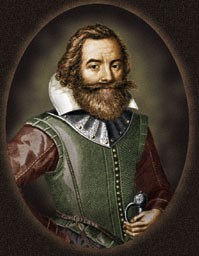
Captain John Smith

In September 1608, Captain John Smith became leader of the Jamestown Colony. He saved the few remaining colonists by making a rule that anyone who did not work did not eat. This forced all the colonists, including the so-called gentlemen, to plant food, build shelters and fences to protect themselves from attack, and to pull their weight for the betterment of the entire colony.

Bravo, Captain Smith! Bravo!

www.pamhillman.com

Monday, May 28, 2018

Myths about Captain John Smith of Jamestown Colony

by Tamera Lynn Kraft

Captain John Smith was an explorer who led Jamestown Colony, the first permanent English settlement in North America. He was a larger than life man who captured the imagination of historians and school children alike. His life was full of adventure and intrigue, but the facts most people know about John Smith are myths and legends instead of facts.

Some of the biggest myths surrounding Captain John Smith are stories about him and Pocahontas. Pocahontas was an Indian girl, daughter of Chief Powhatan, who hung around Jamestown. According to legend, she was so in love with John Smith that when her father threatened to kill him, she begged for his life. Some even belief that John Smith and Pocahontas married. John Smith was the first to perpetuate part of this myth. He claimed that when he was captured by Indians, Pocahontas threw herself across his body to save him.

The truth is historians belief John Smith might have exaggerated the story. Soon after the incident happened, he never mentioned Pocahontas' part in the Powhatans releasing him without harm. Over ten years later, Captain Smith told the harrowing tale in a letter to Queen Anne introducing Pocahontas and asking the queen to treat her with dignity. One historian, David A. Price, believes the incident might have happened but suggested Captain Smith was in no real danger. He could have been involved in a ritual that symbolized his death and rebirth as a member of the tribe.

Whatever the case, Pocahontas and Captain Smith were not in love. When Captain Smith was captured, Pocahontas was only ten or eleven years old. It's also not true that she converted Captain Smith to the Indian religion. After spending years around the settlers at Jamestown, Pocahontas was converted to Christianity and took the name Rebecca. In 1614, she married John Rolfe, a tobacco farmer, and in 1616, she travelled to London with her husband where she died of an unknown virus.

Another myth is that Captain John Smith was highly revered by the other colonists. This also is only partially true. During the voyage to the New World, the colonists for the Virginia Company had papers that were to remain sealed until they reached the new land. Apparently Captain Smith was involved in a mutiny aboard ship, and Captain Christopher Newport and the crew planned to execute him when they landed at Cape Henry. When they did arrive at Cape Henry, the letter was opened, and the colonists found out the man they were planning to execute was appointed one of the leaders of the new colony. This saved Captain Smith from the gallows.

A year later, Captain Smith became the president of the council. He proved his leadership abilities, saving the colonists from starvation, by initiating strict policies including an order, “He that will not work shall not eat." He built the first well in the fort and repaired many of the buildings. Even though his leadership helped to save the colony, not everyone liked Smith. One night, while he was sleeping on the boat, a mysterious gunpowder explosion went off causing him to be injured. Some historians suggest it might have been an attempted assasination.

Another myth is that Captain John Smith lived in Jamestown for the rest of his life. The truth is he arrived in Jamestown in 1607, became president of the council in 1608, and sailed to England because of his injury for the gunpowder explosion in 1609. Captain Smith never returned to Jamestown. He died in 1631 in England at the age of 51.


During his years in England, John Smith encouraged colonization in America by writing accounts of his time there and giving detailed maps of the land. He was a major part of the Jamestown Colony even though he was only there for three years.


Tamera Lynn Kraft has always loved adventures and writes Christian historical fiction set in America because there are so many adventures in American history. Her Novels, Red Sky over America and Alice’s Notions and her novellas Resurrection of Hope and A Christmas Promise are available on Amazon and at Barnes and Noble.

Monday, March 26, 2018

Peeling back the layers of early, historical New York City


The historical layers of New York City are rich with colorful and interesting information. Here are ten tidbits of early historical facts from the last four hundred years.

1. Before the arrival of Europeans, New York’s population was comprised of the Lenape Nation. This branch of Algonquin people fished, hunted and farmed the area between the Delaware and Hudson Rivers.

Giovanni da Verrazzano Route
2. In the early part of the 16th-Century, the Italian explorer and French sponsored buccaneer, Giovanni da Verrazzano sailed up and down the coast of New York in search of a faster route to Asia. He discovered New York Harbor, Block Island and Narragansett Bay, though never set foot on shore. His last journey was to explore an island south of Jamaica where he was captured, killed and eaten by cannibalistic natives.
3. 1610, Henry Hudson embarked on his fourth journey to the New York area. He sailed under the flag of the British. He and his crew journeyed throughout the vast Hudson Bay in search of the Northwest Passage until November 1610 when his ship became frozen in ice. The ship finally broke free in June of 1611, but Henry Hudson refused to leave. So, his crew mutinied and set Hudson, his young son, and about seven other crew members adrift,
Henry Hudson and banished crew
never to be seen again.

4. During his fourth exploration to the New World in 1613, Adrianen Block’s ship, the Tyger was moored along southern Manhattan. The ship accidentally was destroyed by fire and while building a new ship (with the help of the Lenape) Block and his crew erected the first European built dwellings on Manhattan Island.
5. It wasn’t until 1624 that the first settlement was established in Manhattan. A group of settlers sent by the Dutch West India Co came to the New York area with the intentions of launching up a permanent trade business. Most of the settlers went further upriver to the area of Albany N.Y., but a small group of men stayed on Manhattan Island. The following year they were joined by 45 additional settlers who built Fort Amsterdam to protect the new colony.
6. The governor general, Peter Minuit, was told to settle ownership of Manhattan
Island. In 1626, he and the Lenape Nation negotiated a price that has been valued at about sixty guilders worth of goods and supplies, or about $24.00.
7. New Amsterdam (New York) was incorporated as a city in the year 1653. A wooden palisade was built (where Wall is today) to mark the northern city limits. By this time, there were about 1,000 residents living the city.
8. The British seized New Amsterdam in 1664 from the Dutch. They gave the city a new name, New York City. The city quickly expands and diversifies to include immigrants from all over the world. By 1760, the city’s population tops 18,000 to become the second largest city in the Colonies. Only fifty years later, New York City is the largest in the Western Hemisphere.
9. In the 1760’s and 70’s, New Yorkers fuel the rise in patriotism and the desire to break free of the British monarchy’s strong hold on the American Colonies. The Sons of Liberty are born in in the dark taverns of New York. Their goal—to stop the encroachment of British law on American freedoms.
New York, 1773

10. The first blood drawn of the American Revolution happened at what is now known as John Street. In 1770, a skirmish between British soldiers and American Patriots resulted in a resident’s face being slashed by a bayonet and another near fatal stabbing. The Battle of Golden Hill took place six weeks before the Boston Massacre.

History of New York City is full of fascinating stories. When I walk the streets of Manhattan, I try to imagine the landscape before the concrete jungle arose. It's not easy,but a stroll through Central Park or one of the other city parks can help. I hope you enjoyed a few "bullet" points of New York City history. Have a wonderfully, blessed month, until we meet again.


Multi-award winning author, Michele Morris’s love for historical fiction began when she first read Laura Ingalls Wilder’s Little House book series. Michele loves to hear from readers on Facebook, Twitter, and through the group blog, Heroes, Heroines, and History at HHHistory.com. She is represented by Tamela Hancock Murray of the Steve Laube Agency.  


Tuesday, November 28, 2017

Plymouth: The Faith Behind the Feast


That iconic first feast at Plymouth may not have looked much like ours.

What kind of faith bears believers across oceans and sustains them through the valley of the shadow of death?
We don't know that much about the Pilgrims' feast, but we know a great deal about their faith.


Their Feast: What We Don’t Know


Our harvest being gotten in, our Governor sent four men on fowling that so we might after a more special manner rejoice together, after we had gathered the fruit of our labours.
– Edward Winslow
The truth is, we don’t know as much about the quintessential American feast as you might suppose. We don’t know the precise date, although we can narrow it down to between mid-September and mid-November of 1621. “Wild fowl” and venison are mentioned, but we don’t know what else was for dinner. 

Cranberry sauce? No. While cranberries would have been available, sugar in the quantity needed to sweeten them was not. Potatoes, white or sweet? No and no. Pie? Probably not. Dessert may have been something like this: Sweet Pudding of Indian Corn


We do know from Edward Winslow’s description that they “entertained and feasted” for three days. And we know about 140 attended. At that point, the settlement at Plymouth consisted of 52 men, women and children who’d survived the voyage and that first brutal winter—just over half the 103 who’d sailed from Plymouth. The settlers welcomed guests: the “great king”, Massasoit, “with some ninety men.” The guests contributed five deer.


Their Faith: What We Do Know


William Bradford’s 1592 Geneva Bible, on display at Pilgrim Hall Museum.
It traveled with him from England to Holland to Plymouth.

While we don’t know so much about their iconic feast, we know quite a bit about their faith. In William Bradford’s words, the Puritans “endeavored to establish the right worship of God and the discipline of Christ in the Church according to the simplicity of the gospel and without the mixture of men’s inventions.” 
This attitude put them at odds with King James and the Anglican church. 
In England, the Reformation had replaced an authoritarian and traditionalist Roman Catholic church with an Anglican church that looked… authoritarian and traditionalist. A monarch in London had taken the place of a pope in Rome. Those found “disobedient in matters of religion”—meeting in house churches to study their chosen translation of the Bible which didn’t happen to be the “authorized” one, rejecting church doctrine, straying from the Common Book of Prayer—faced fines, imprisonment under potentially deadly conditions—even the gallows. 


“Pilgrims” 


We don’t know when the Plymouth settlers were first called “pilgrims” but we think we know why. Bradford and the Puritan band escaped to Holland in 1608. But like Abraham once he’d gone out from Ur and traveled as far as Haran (Gen 11:31), they felt the Lord’s call to go further. William Bradford, the colony’s governor for some thirty-five years, wrote this about their decision to leave Holland:
So they left that good and pleasant city… but they knew they were pilgrims, and looked not much on those things, but lifted up their eyes to the heavens, their dearest country." 
- William Bradford, Of Plimouth Plantation
This is a clear reference to Hebrews 11:13-16, which in the Puritans’ favored Geneva Bible reads:
All these died in faith, and received not the promises, but saw them afar off, and believed them, and received them thankfully, and confessed that they were strangers and pilgrims on the earth…. But now they desire a better [country], that is an heavenly… (Heb 11:13-16)
The “these” in the passage are Abraham and Sarah and other patriarchs of the faith.
By faith Abraham… went out, not knowing where he was going… (Heb 11:8)
You can see where Bradford and his company would have identified. Like Abraham, the pilgrims left behind everything familiar. Many families split, sending men and older boys ahead to establish a settlement—“offering up” their Isaacs to a highly risky venture (Heb 11:17). 

“Not knowing where they were going….” They intended to settle further south but the vagaries of storm and sea drove them to Massachusetts. Like Abraham, the settlers would “live as aliens” (Heb 11:9) among tribes that already dwelt there. And like Abraham, they would have skirmishes with hostiles (Gen 14:12), but by and large would be blessed to live in peace and cooperation with their neighbors (Gen 23:6).


Tested 


Although they didn’t “live in tents,” the bitter first year could not have been more difficult. They landed too late in the season to build, so they were forced to winter on the cramped and unsanitary Mayflower. Scurvy, pneumonia and tuberculosis ravaged them, claiming nearly half their lives. Bradford wrote: 
But it pleased God to visit us then with death daily, and with a disease so disastrous that the living were scarcely able to bury the dead, and the healthy not in any measure to tend the sick.
But he also testified: 
…they had borne their sad afflictions with as much patience and contentedness as I think any people could do. But it was the Lord who upheld them, and had beforehand prepared them….


The Crux of the Story 


And here, for me, is the crux of the story. How could people who gave up everything to obey God’s callonly to face weeks of illness, the loss of wives, husbands, children—not start to question at least a little?

“God, are You really in this thing? Heavenly Father, are You there?”

But the Pilgrims' accounts give no hint of this. Instead, they
  • Accept God’s sovereign will when they experience it as adversity;
  • Thank Him when they experience it as blessing; and
  • Approach Him with an attitude of trust at all times.

They stood prepared even to “die in faith, without receiving the promises,… having confessed that they were strangers and exiles on the earth.” (Heb 11:13)

The Pilgrims' story reminds us that sometimes—many times—the rewards that come from keeping faith with God aren’t immediately visible. 

Lord, make me ready to “confess myself a stranger and pilgrim” for whom “to live is Christ and to die is gain” (Phil 1:21).


Read more in Linda's free eBook, The True Story Isn't the Turkey: TWO Holiday Stories Every Believer Should Know, or visit her at her blog, Five Stones and a Sling.
Linda's debut novel, The Plum Blooms in Winter, launches next October from Mountain Brook Ink. Inspired by a remarkable true story from World War II's pivotal Doolittle Raid, the novel follows a captured American pilot and a bereaved Japanese woman on her quest for ritual revenge.
Linda lives just outside Phoenix with her husband, a third-generation airline pilot who doubles as her Chief Military Research Officer. They share their home with two all-grown-up kids and a small platoon of housecats.