Showing posts with label art theft. Show all posts

Wednesday, September 14, 2022

The Three Thefts of Russborough House


Thieves often demand ransom for a stolen painting. But the ransom demand for today’s featured painting, Lady Writing a Letter with Her Maid, is unique.

When it was stolen in 1974, the thieves not only asked for money. They also demanded that two political prisoners be transferred from a prison in Great Britain to one in Northern Ireland.

The painting, an oil on canvas (28” x 23.8”) painted by Johannes Vermeer circa 1670-71, was stolen along with 19 other paintings from Russborough House, a classical Palladian villa built between 1741 and 1755 in County Wicklow, Ireland.

Lady Writing a Letter With Her Maid

At the time, the Washington Post called it “the most valuable art theft in history” (Coppola).

Rose Dugdale, a wealthy British heiress, and three other members of the IRA cut the paintings from the frames with screwdrivers. Fortunately, Dugdale and the paintings were found in a country cottage only eight days later.

The New York Post reported that Dugdale “pleaded ‘proudly and incorruptibly guilty’” at her June 1974 trial (Coppola).

Twelve years later, in May 1986, Lady Writing a Letter with Her Maid was stolen from Russborough House again—this time by Irish mobster Martin “The General” Cahill. He and his gang got away with eighteen paintings altogether which they tried, unsuccessfully, to ransom for 20 million Irish pounds.

Russborough House

The famous Vermeer remained missing until Scotland Yard detective Charles Hill recovered it in 1993. In an article posted on the Country Life website, Hill is quoted as saying that his greatest thrill was finding the painting.

"I put on a mid-Atlantic accent and posed as an art dealer who had Arab buyers lined up for the Vermeer. At the time, I was working in Scotland Yard’s Art Squad. I was taken to a multi-storey car park in Antwerp by a gangster and had to mask my emotions as I unwrapped the painting. It’s the greatest masterpiece I’ve had the pleasure to hold."

Lady Writing a Letter with Her Maid now hangs in the National Gallery of Ireland in Dublin.

For that reason, it wasn’t stolen when armed and masked thieves broke into Russborough House a third time twenty years ago this month.

However, this made the third time that a different painting—one stolen along with the Vermeer in 1974 and 1986—was stolen from the villa.

The Cornfield

Art curator Anne Stewart described The Cornfield as an “absolute masterpiece” and its Dutch Golden Age artist, Jacob van Ruisdael as "the finest of all the Dutch landscape painters of the 17th century” (Coppola).

Police recovered the painting a few months later. It’s now displayed—under strict surveillance—in the Ulster Museum.

Johnnie imagines inspiring stories in multiple genres. A fan of classic movies, stacks of books, and road trips, she shares a life of quiet adventure with Griff, her happy-go-lucky collie, and Rugby, her raccoon-treeing papillon. Visit her at johnnie-alexander.com.


Photo Credits ~

Lady Writing a Letter with Her Maid ~ Public Domain
The Cornfield ~ Public Domain
Russborough House ~ Dorian IG via Creative Commons

Sources ~

Coppola, Francesca. “Famous Artworks That Have Been Stolen More Than Once.” Grunge. (Posted February 16, 2021; retrieved September 7, 2022.)

“Art Detective Charles Hill.” Country Life. (Posted March 16, 2009; retrieved September 7, 2022).

Thursday, July 14, 2022

Whitworth Museum Art Theft ~ A Different Kind of Motive

For centuries, art and cultural artifacts have been stolen for the wealth they may bring from being sold on the black market or for the secret joy of “owning” a Rembrandt. 

Before and during World War II, Hitler stole innumerable artwork that he wanted for his planned Führermuseum in his hometown of Linz, Austria. Others in Hitler’s inner circle, such as Hermann Göring—the creator of the Gestapo and commander-in-chief of the Luftwaffe—stole so much art that he filled the rooms of his mansion, Carinhall, then buried the rest throughout the grounds.


Thieves sometimes steal artwork then contact the owners or the museum where it was displayed with a ransom demand. More recently, stolen art is often used as collateral in criminal enterprises. 


The thieves who stole three valuable paintings from the Whitworth Art Museum in Manchester, England on April 26, 2003, had a very different kind of motive.


Before revealing that motive, let’s take a quick look at the history of the museum and what went missing on that fateful day. 


History


Sir Joseph Whitworth, an English baronet, inventor, and philanthropist, made a donation that led to the founding of the Whitworth Institute and Park in 1889. Seventy years later, the gallery became part of the University of Manchester.


The Stolen Paintings


Van Gogh’s The Fortification of Paris with Houses


“The picture, in watercolour and gouache on paper, depicts an area of Paris which had a reputation for vice and violence” (Guardian).


Picasso’s Poverty


“The pen, ink and watercolour work dates from 1903 and is typical of his ‘blue period,’ showing a family group of man, woman, small child and baby. Experts say it has a hint of a religious parallel with suggestions of the traditional depictions of the holy family” (Guardian).


Gauguin’s Tahitian Landscape


The painting, “executed in watercolour and pencil, dates from the 1890s and offers viewers twin joys: the artist has used both sides of the paper, sketching a second scene on the reverse” (Guardian).


The Motive


When the theft was first discovered, authorities believed the art was stolen by well-organized, professional thieves. Perhaps…though it’s doubtful.


You see, the three paintings were found rolled up in a tube with a handwritten note behind a public toilet in Manchester’s Whitworth Park.


In a fun example of British humor, the outdoor bathroom was soon dubbed “The Loovre.”


The note suggests the thieves had a noble cause…to prove the museum’s need for greater security.


Unfortunately, that noble cause exacted a price. A corner of the Van Gogh was torn and all three suffered weather damage. Even so, the paintings were repaired and back on display within a few weeks.


No matter one’s motive, art should NOT be stolen!


Johnnie imagines inspiring stories in multiple genres. A fan of classic movies, stacks of books, and road trips, she shares a life of quiet adventure with Griff, her happy-go-lucky collie, and Rugby, her raccoon-treeing papillon. Visit her at johnnie-alexander.com.


Sources


Branigan, Tania; Rebecca Allison; and David Ward. “Meticulous raid on gallery sees three masterpieces vanish without trace.” The Guardian. (Article dated April 27, 2003; accessed July 4, 2022.)


“Stolen paintings can be repaired.” BBC News. (Article dated April 28, 2003; accessed July 4, 2022.)


Ward, David. “Whitworth's stolen masterpieces endure a rainy night in the Loovre.” The Guardian. (Article dated April 29, 2003; accessed July 4, 2022.)


Note ~ All photos are in the Public Domain.

Thursday, April 14, 2022

Life Imitates Art ~ Stealing Cezanne


I haven’t seen the movie
 Entrapment, starring Sean Connery and Catherine Zeta-Jones, but it’s possible the plot inspired the thief who broke into the Ashmolean Museum in Oxford, England on the night of December 31, 1999.
 

In the movie, described by renowned critic Roger Ebert as “one elaborate caper sequence after another,” the main characters pull off an $8 billion heist while the rest of the world is counting down the seconds to the 21st century.


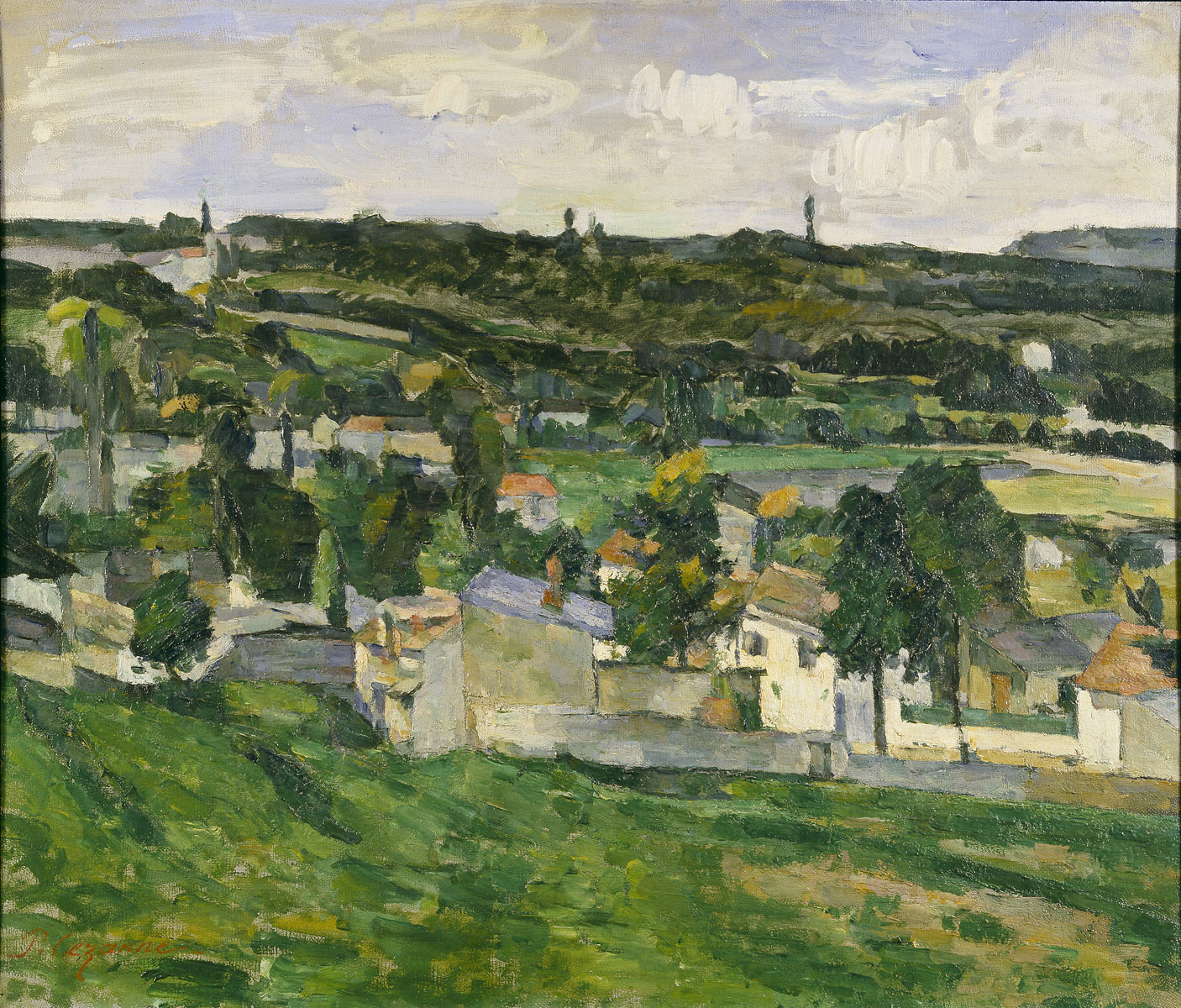
The Oxford thief took advantage of the same Millennial Eve celebration and added a distraction of his own to spirit away an uninsured Cézanne landscape that the museum valued at £3 million.


The painting, an oil on canvas dated 1879-80 and popularly known in English as “View of Auvers-sur-Oise,” depicts a village in northern France. It was displayed in the museum’s Hindley Smith Gallery. The other paintings in the gallery were ignored, including works by such famous artists as Renoir, Rodin, and Toulouse-Lautrec.


Paul Cézanne (1839-1906), a French post-impressionist artist, developed a unique style throughout his career. His growing “interest in geometric forms above realism proved hugely influential on later artists, notably Henri Matisse (1869-1954) and Pablo Picasso (1881-1973)” (Cartwright).


At the time of the theft, an extension to the museum’s library was under construction. Police believe the thief climbed the scaffolding to the roof, broke a skylight, and tossed a smoke bomb into the gallery. The thief used a rope ladder to descend into the gallery and quickly set up a fan to blow the smoke around the room.


The canvas, measuring about 18 inches x 21½ inches, was cut from the frame. The thief left the frame behind, scurried up the rope, down the scaffolding, and disappeared into the crowd.


A university porter saw the smoke and called firefighters. When they arrived, they found the smoke bomb.


From The Guardian: 


But a police source said: `It was a very clever ploy, a very professional theft. The burglar only entered the room where the Cézanne was hanging, and that appeared to be his only target. He obviously knew exactly what he was doing. He used the smoke device to prevent any security cameras or patrolling guards from seeing his face.'


For a Cézanne connoisseur, the painting holds great significance. Christopher Brown, the director of the Ashmolean Museum from 1998 to 2014, “describes the painting as important to understanding the artist’s career, showing him transitioning from his early work to the mature style he brought to well-known later works” (Ezard).


Self-Portrait with a Beret

More than twenty-two years have passed since the Millennial Eve celebration, but the thief remains anonymous, and the painting has never been recovered.


Since other invaluable paintings were left behind on that once-in-a-century party night, it’s possible a private collector arranged for the theft of this specific Cézanne painting. Or maybe the thief still has it hidden away in a place only known to him. Perhaps he gazes at it while also sipping a fine wine and watching Entrapment.


Sources:


Cartwright, Mark. “Paul Cézanne,” World History Encyclopedia (9 March 2022; accessed 7 April 2022).


Ezard, John. “Smoke bomb masks burglar's theft of £3m Cézanne,” The Guardian (2 January 2000; accessed 7 April 2022).


“Theft of Cézanne’s View of Auvers-sur-Oise,” FBI Top Ten Art Crimes (accessed 7 April 2022).


“View of Auvers-sur-Oise,” Wikipedia (accessed 7 April 2022).


Photos: Public Domain


Johnnie imagines inspiring stories in multiple genres. A fan of classic movies, stacks of books, and road trips, she shares a life of quiet adventure with Griff, her happy-go-lucky collie, and Rugby, her raccoon-treeing papillon. Visit her at johnnie-alexander.com.


Monday, March 14, 2022

Gardner Museum Heist ~ 1990


This month marks the 32nd anniversary of the unsolved theft of thirteen works of art from the historic Isabella Stewart Gardner Museum in Boston.


The empty frames still hang on the museum’s walls as a reminder of the loss. The thieves cut the canvases from these frames during their night of artistic looting.


Thanks to the guards’ testimony and the museum’s infrared motion detectors, law enforcement officials developed a timeline of the events. Here’s what happened on March 18, 1990.


The Timeline


1:20 a.m. ~ Two men, disguised as police officers, ring the buzzer on the museum’s side door. Using the intercom, they tell the guard that they are responding to a disturbance.


1:24 a.m. ~ The guard, Rick Abath, isn’t aware of a disturbance but St. Patrick’s Day revelers are still in the area. Believing the men to be police officers, he lets them in. Randy Hestand, the second guard, returns to the security desk.


The supposed police officers handcuff both guards, cover their eyes and mouths with duct tape, escort them to the basement, then handcuff them to a steam pipe and a workbench. The thieves threaten the guards and promise a reward “in about a year” if they keep quiet.


Police Sketches of Thieves

1:48 a.m. ~ The thieves enter the Dutch Room on the second floor where they smash the devices that beep when visitors get too close to a painting. They throw selected paintings to the floor to break their glass frames then cut the canvases from their stretchers.


1:51 a.m. ~ One thief enters the Short Gallery on the second floor. The second thief soon joins him. They remove a few screws from a frame displaying a Napoleonic flag but give up.


The men steal a painting from the Blue Room on the first floor, but the motion detectors in this room only recorded the movements of one of the guards who patrolled the room before the thieves entered the museum.


The thieves return to the basement to check on the guards then go to the “security director’s office where they took the video cassettes that recorded their entrance on the closed-circuit cameras, and the data print-outs from the motion detecting equipment. The movement data was still captured on a hard drive, which remained untouched” (Boser).


2:40 a.m. and 2:45 a.m. ~ The side entrance door is opened twice, presumably making two trips to remove the stolen art.


The robbery isn’t discovered until the morning guards arrived for their shift.


The Stolen Art


The thirteen stolen works of art were valued at $200 million at the time of the robbery and are estimated to be worth $600 million today. Here’s the list:


Three Rembrandts: The Storm on the Sea of Galilee, his only known seascape; A Lady and Gentleman in Black, and a self-portrait etching about the size of a postage stamp.


Landscape with Obelisk, once believed to be a Rembrandt but now attributed to Govert Flinck, one of Rembrandt’s students.


Vermeer’s The Concert, believed to be the most valuable stolen object in the world.


Chez Tortoni by French painter Édouard Manet.


Five sketches by Degas.


Program for an artistic soiree 1

A French Imperial Eagle finial from the corner of the Napoleonic flag (the one with the partially unscrewed frame).


A Chinese gu (or ku)—a bronze vessel used to serve wine—dating to the 12
th century’s Shang Dynasty.


Authorities remain puzzled by what the thieves didn’t take.


The most valuable painting in Boston, Titian’s The Rape of Europa, hangs in the museum’s third floor. Works by Raphael, Botticelli, and Michelangelo were also ignored.


Despite a huge reward, multiple tips, and diligent investigations, the thieves’ identities and the whereabouts of the stolen art remain a mystery.


However…


On March 3rd—less than two weeks ago—the Smithsonian Magazine website posted an article titled, “A Tantalizing Clue Emerges in the Unsolved Gardner Museum Art Heist” and written by Daily Correspondent Nora McGreevy.


The article’s subtitle reads: “Boston police officers tell local media that the 1991 murder of Jimmy Marks might be linked to modern history’s biggest art heist.”


According to the article, Marks, a known career criminal, “was friendly with a fellow mafia man, the late Robert ‘Bobby’ Gaurente,” a prime suspect in the theft who authorities believe transported “some of the stolen paintings from Boston to Connecticut and eventually Philadelphia.”


An anonymous tipster said that Marks bragged about hiding a few of the paintings a few days before he was shot—twice—in the back of the head. His murder hasn’t been solved, but in 2015 Gaurente’s widow told investigators that her husband had killed Marks.


Perhaps authorities are a step or two closer to solving the Gardner Museum mystery and finding the missing art. Or maybe the only ones who hold the answer to the mystery are no longer alive to tell it. <<cue spooky music>>


For a fictional solution to the theft, you might enjoy reading A Dream Within a Dream by Melissa Kosci and Mike Nappa (Revell).


This is a Robbery: The World’s Biggest Art Heist, a four-part documentary series, is available on Netflix.


~~~~~


Resource ~ Boser, Ulrich (2009). The Gardner Heist: The True Story of the World's Largest Unsolved Art Theft. New York: HarperCollins.


Photo Credits

All images are in the public domain except for the Napoleonic Flag finial and the Chinese gu. These two images are "fair use" as they "illustrate the subject in question" (Wikipedia).


Johnnie Alexander imagines inspiring stories in multiple genres. Where Treasure Hides, her debut novel, is a CBA bestseller and has been translated into Dutch and Norwegian.

A fan of classic movies, stacks of books, and road trips, she shares a life of quiet adventure with Griff, her happy-go-lucky collie, and Rugby, her raccoon-treeing papillon. Visit her at johnnie-alexander.com.

Sunday, February 13, 2022

Mona Lisa ~ Stolen in 1911


Leonardo da Vinci’s portrait of an Italian noblewoman, popularly known as Mona Lisa (which can be translated as Madam Lisa or My Lady Lisa), may be the most famous, most recognized, painting in the world.


Mona Lisa, by Leonardo da Vinci, digitally retouched to reduce the effects of aging.

I had the privilege of viewing the portrait several years ago during a once-in-a-lifetime trip to the Louvre Museum in Paris. It was the only painting at the huge museum—in fact, the only piece of art—we had to wait in line to see. I remember being surprised at how small this larger-than-life painting actually is!

The dimensions are 77cm x 53cm (approximately 30” x 20”) making the original portrait smaller than its poster-sized reproductions. The portrait was painted with oils on a white Lombardy poplar panel in the early 1500s.

You may wonder, as I have, why this painting is more special than all the other portraits of Italian nobility painted by da Vinci. Here’s what I learned:

Art historians find it significant that da Vinci painted his subject, most often identified as Lisa Gherardini, the wife of Francesco del Giocondo, in three-quarter profile with her gaze fixed on the observer. He also used a rare pyramid technique to place her “calmly and simply in the painting’s space” (UKEssays).

Da Vinci’s unusual choice to “depict the sitter in front of an imaginary landscape” and to “use aerial perspective” is also significant. He is one of the first painters to utilize these techniques (Wikipedia). 

Adding to the painting’s importance is this bit of trivia ~ the Mona Lisa is only one of four da Vinci paintings whose authenticity has not been controversial. The other three are Adoration of the Magi, Saint Jerome in the Wilderness, and the immensely popular The Last Supper.


The above image depicts "a margin note by Agostino Vespucci (visible at right) discovered in a book at Heidelberg University. Dated 1503, it states that Leonardo was working on a portrait of Lisa del Giocondo" (image caption on Wikipedia).

Another reason for the painting’s rise to world recognition has nothing to do with da Vinci and everything to do with Vincenzo Peruggia, an employee at the Louvre.

Mug shot of Vincenzo Peruggia

On August 21, 1911, Peruggia hid in a broom closet until after the museum closed then walked away with the Mona Lisa wrapped up in his white smock—a garment typically worn by museum employees at that time. 

Peruggia stored the painting in a trunk in his Paris apartment for two years before taking it to Florence and contacting the owner of a local art gallery. 

The gallery owner had the painting authenticated by the director of the Uffizi Gallery in Florence. After these two gentlemen notified law enforcement, Peruggia was arrested.

The Mona Lisa in the Uffizi Gallery, in Florence, 1913. 
Museum director Giovanni Poggi (right) inspects the painting.

Peruggia, who may have believed that Napoleon stole the Mona Lisa during the Napoleonic Wars, claimed he wanted to return the painting to Italy. However, it was da Vinci—not Napoleon—who took the painting to France. He gave it to King Francis I when he became the official painter for the French court.

Not everyone believes Peruggia was motivated by patriotism. According to the Florence gallery owner, the thief expected a reward for bringing the painting “home.” A couple of letters he wrote to his father after the theft suggest he expected a fortune to come his way.

Another theory is that Peruggia was in cahoots with a forger who planned to sell copies of the painting as the original.

Whatever the reason for his theft, Peruggia was hailed as a patriot and received a lenient sentence. He spent about six to seven months in jail. 

The Mona Lisa was exhibited throughout Italy before being returned to the Louvre in 1913. All the publicity surrounding the theft and then the recovery of the painting increased its fame with the general public.


The Mona Lisa returned at the Louvre Museum

“Considered an archetypal masterpiece of the Italian Renaissance, [the Mona Lisa] has been described as ‘the best known, the most visited, the most written about, the most sung about, the most parodied work of art in the world’” (From the Louvre).

It’s no surprise that the famous painting was at the top of Hitler’s list of paintings he wanted for his planned Führermuseum. Jacques Jaujard, director of France's National Museums, ensured Hitler didn’t get his wish. 

Jaujard protected the Mona Lisa and hundreds of other pieces of art by moving them from one hiding place to another during World War II. On October 6, 1947, the Mona Lisa returned to the Louvre. (Click here for more details on how Jaujard hid the painting.)

After another theft attempt, the Mona Lisa was placed under a glass case which was shattered when someone threw a rock at the painting. The broken glass was replaced with bulletproof glass.

Mona Lisa behind bulletproof glass at the Louvre Museum

When the painting was on display at the Tokyo National Museum in 1974, a woman sprayed it with red paint to protest the museum’s lack of suitable access for the disabled. In 2009, a Russian woman touring the Louvre purchased a ceramic teacup then threw it at the painting. The glass case protected the painting from any damage in both these incidents.

For more info about the 1911 theft, you may wish to watch the The Missing Piece: Mona Lisa, Her Thief, the True Story, which can be rented or purchased from Amazon Prime. The documentary features Peruggia’s daughter who was 84-years-old at the time of filming (2012).

Johnnie Alexander imagines inspiring stories in multiple genres. A fan of classic movies, stacks of books, and road trips, she shares a life of quiet adventure with Griff, her happy-go-lucky collie, and Rugby, her raccoon-treeing papillon.

The heroine in Johnnie's WWII novel, Where Treasure Hides, risks her life to protect her family's artistic legacy.

To learn more about Johnnie's books, her monthly novel giveaways, and the 2022 Mosaic Reading Challenge, visit johnnie-alexander.com.

Note ~ The first five photos are in Public Domain. The photo captioned "Mona Lisa behind bulletproof glass..." is used under Creative Commons with attribution to https://www.flickr.com/photos/cayetano/2170060100/.

Resource ~ UKEssays Citation: "Historical Significance of Mona Lisa Painting." ukessays.com. 11 2018. UKEssays. 02 2022 <https://www.ukessays.com/essays/arts/history-and-significance-of-the-mona-lisa-arts-essay.php?vref=1>.