Showing posts with label cattle drives. Show all posts

Monday, February 20, 2023

Western Cattle Queens: Hattie Cluck

The Wild West had a way of producing tough women, and none grittier than the cattle queens who rode, roped, and endured the privations of the trail as well as any man. Facing challenges, hardships, and perils—sometimes with children at their side—they garnered grudging respect in an era of shifting cultural roles. Some accrued wealth, while others paid with their lives. These women overcame cultural expectations to live on their terms. The halls of history must ring with applause.

This blog series celebrates the cattle queens mentioned in The Whispering Wind, the final installment in the Montana Gold western historical romance series.

"Pioneer Woman" and "Pioneer Boy" (statues of Hattie and Emmett Cluck) published courtesy of Another Believer, CC BY-SA 4.0, via Wikimedia Commons

Western Cattle Queens: Hattie Standefer Cluck

Harriet Louise Standefer entered this world on April 14, 1846 in Alabama. Her parents, James Stuart and Caroline (Randall) Standefer soon left for Williamson County, Texas, taking their young daughter with them. Her father did quite well at cattle ranching.

In 1860, Hattie started her studies at Salado College. She met George Washington Cluck at a dance. Hattie was seventeen when they married on June 25, 1863. The Civil War had begun, several of their brothers enlisted in the Confederate Army. George remained behind, most likely to run the ranch. Hattie gave birth to two daughters and a son over the next six years.

Up the Chisholm Trail


Following the War, the eastern states were in short supply of beef. Cattle that sold for $4 each in Texas fetched $40 a head when sold in Abilene. A supply route opened up in 1867 when the railway connected to Abilene Kansas. Texas ranchers could drive their cattle up the Chisholm Trail to newly-built stockyards and send their beef to eastern buyers by rail. In the spring of 1871, George Cluck decided to join forces with another rancher to drive their herds to Abilene.

Hattie accompanied George on the arduous journey. Hattie later said that George “took all he had in the world with him, and we wanted to be together no matter what happened.” However, her granddaughter stated that Hattie was the one who insisted on going along. The truth is probably lost in time. Either way, Hattie is celebrated as the first female to travel the Chisholm Trail. She accomplished this feat with her three children (ages six, four, and two) in tow and while pregnant with her fourth child.

Along the way, Hattie and her family dealt with several harrowing experiences. She and her children had to cross the swiftly-running Red River on horseback to lighten the wagon. Robbers assailed their party and had to be fended off at gunpoint.

Despite the hardships and dangers, the Clucks made it to Abilene with their herd and their family intact. Hattie was so close to her due date that she and her husband opted to remain in Kansas. This didn’t go particularly well, since Kansas farmers resented the tendency of Texas ranchers to drive their cattle through their crops. 

The Clucks returned to Texas two years later, and George registered a second cattle brand under Hattie’s name. George closed several good land deals, enjoyed success as a cattle rancher, and sold water rights to the railroad. He donated land and money for a local school. Hattie and George added six more children to their family. They also took in their nephew.

After George died in August of 1920, Hattie spent her days in simple living. She continued to run her farm, and in spare moments might be found quilting, reading popular fiction, writing poetry, daydreaming, or collecting arrowheads on her property.

The Hattie Cluck Legend

She was 84 when reporters began making much of her journey up the Chisholm Trail. They were guilty of embroidering its perils. The bandits became Indians in some accounts, and Hattie helped loade guns for the men who resisted them. One legend has it that Hattie declared herself ready to take the place of any coward who refused to fight. Whatever the truth may be, the bandits left without any cattle.

Hattie died on March 2, 1938, at the venerable age of 92, but her fame lives on. The Chisholm Trail Crossing Park in Round Rock, Texas includes a statue of Hattie Cluck with her young son, Emmet.

Hattie is much admired by Phoebe Walsh, heroine of The Whispering Wind (Montana Gold, book six). Phoebe cites Hattie Cluck as an example while trying to talk her uncle into training her to become a ranch hand. Like Hattie, Phoebe challenges limits imposed on women. Regardless of her impending spinsterhood, Phoebe determines to live a meaningful life. It would take a strong man to change her mind--someone like Will Canfield. Despite the kiss he'd stolen along with her peace of mind, Will doesn't want her. 
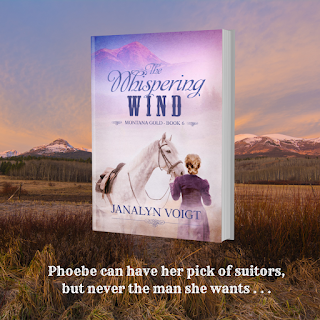
The Whispering Wind

The Whispering Wind by Janalyn Voigt
Fancy parties and embroidered fans hold little appeal for Phoebe Walsh. She would rather gallop across the open range or help her father with a wounded calf. Of her many admirers, none spark her interest. Ma seems determined to save her from becoming a spinster, but how can Phoebe accept her mother's choice of suitors when her heart belongs elsewhere?

Several years have passed since Will Canfield stole a kiss and her heart. Remembering her passionate response still curls her insides, but how she feels doesn't matter. Will's interest in her isn't serious, as he's made clear. She needs to get over the man. If Uncle Con will stop throwing them together, that could be a whole lot easier.

Will feels guilty about Phoebe, but he can't risk another heartbreak. Being left at the altar certainly changed his mind about romance. Phoebe is better off marrying someone else, even if the idea sets his teeth on edge.

Phoebe and Will must both, with God's help, conquer an old fear before they can move ahead with their lives. 

Set during a troubled time in America, the Montana Gold series explores faith, courage, and love in the Wild West.


What's New with Janalyn Voigt

Hello friends. I hope all is well with you. Have you planned any challenges for yourself lately? I'm working to improve my daily life. Recently, I came across an image of types of coffee drinks. Some I've tried and others I've thought about making. It surprised me, though, to learn how many I'd never heard of before. There were 30 pictured, meant to encourage a month of experimenting. Now, as an author, I have an affinity for coffee. 

Last Christmas, a family member gave me a tongue-in-cheek sign for my office: "I turn coffee into books. What's your superpower?" Hmmm... I wonder if consuming various coffee drinks produces different books. What do you think?  

Biography 

Janalyn Voigt's unique blend of adventure, romance, suspense, and fantasy creates worlds of beauty and danger for readers. Writing in the historical romance and medieval epic fantasy genres, Janalyn is represented by Wordserve Literary. When not writing, she loves to discover worlds of adventure in the great outdoors.
Learn more about Janalyn Voigt and her books.

Friday, October 25, 2019

The Chuckwagon--More Than Just a Mobile Kitchen


I’ve talked the last couple of months about cattle drives and the hot, dirty, and exhausting work that goes on in such an endeavor. But have you ever given much thought to how the crew of a cattle drive might have eaten along the trail? It was in the cattle owner’s best interest to keep his crew healthy and happy. A content cowboy was far more likely to protect the herd, so the boss made sure the most basic need of his men was met—with a belly full of good food!

In order to feed the crew of ten to twenty men, the outfit’s cook (often affectionately known as “Cookie”) drove a chuckwagon—a mobile kitchen—along with the herd. The chuckwagon was a fairly simple wagon, covered with a canvas cover, and improved with several upgrades. The “chuck box” was a wooden cabinet bolted to the back of the wagon. This handy invention, with its many drawers and shelves which held ingredients, spices, small utensils, and with its flat cover which folded down to create a workspace for the cook, was the brainchild of Charles Goodnight—a Texas Ranger turned cattleman. Beneath the chuck box, a “boot” held the larger items like the cast iron dutch oven and other large cooking pieces. A canvas tarpaulin slung under the wagon was called the “possum belly” and held their fuel, typically wood or cow chips, collected along the trail. A large barrel was adhered to the side to hold water as they traveled.


The interior of the chuckwagon carried all the staples—flour, salt, sugar, baking powder, baking soda, beans, rice, cornmeal, sourdough, coffee, and syrup. The main meat for meals was beef, though the cowboys would hunt and fish to add variety to their stores. And, of course, sowbelly—a type of salt pork. This was of utmost importance since everything Cookie made was fried in bacon grease. (Another thing the interior of a chuckwagon often carried was the bedrolls of the crew. They needed to travel light while driving the cattle each day, so their bedrolls were tossed into the chuckwagon as they broke camp. In smaller cattle crews, this was the case. If it was a larger crew, a second wagon just for the bedrolls and personal belongings would be provided).

Keeping the crew fed and the herd traveling at a decent pace each day required Cookie to either rise several hours earlier than the rest of the crew—or arrive at the next campsite hours before the herd. The cook would untie the canvas cover from atop the wagon and stretch it out from the last bow (the curved ribs that gave the covered wagon’s top its rounded shape) at the back of the wagon to shade his cooking area. He’d use wooden poles to prop up the other side of the tarp. Nearby, he’d build a nice fire to cook over, then put down the flat cover of the chuck box for a work table, and he’d set about his cooking.

Cattle crew gathered around the chuckwagon


Meals would include a meat main dish—most often a steak, but could also be a pot roast, ribs, or stew. Add to that beans (a.k.a. frijoles) cooked in a variety of ways, biscuits, stewed fruit or a fruit pie, and coffee to wash it all down. While the meals might not be fancy, they were hearty and filling, and after long hours in the saddle eating trail dust, the men were thankful for the simple yet tasty meals.

A set of well-known, if unwritten, rules governed the chuckwagon, cookfire, and meals.
·     A cowboy always approached the camp from downwind. This prevented dust from blowing into the food.
·     No one brought their horses too close to the wagon—for the same reason.
·     The cookfire was not the place to gather for warmth. It was for cooking only.
·     The chuckwagon’s flat workspace was not to be used as anyone’s dining table. That’s what a lap was for!
·     No one touched the cooking utensils unless and until Cookie said he could.
·     If you were dishing your food, you never set the lid of a pot or any other utensil on the ground. Again, this would keep dirt and dust from the food.
·     No one was allowed to take the last piece of anything until the whole crew had eaten their fill.
·     While refilling his coffee, if someone shouted “Man at the pot!”, the cowboy was expected to refill any other cup that was extended to him.
·     At the end of the meal, each man would scrape his scraps into the “squirrel can” and place his dirty plate and utensils into the “wreck pan” for washing.

The cook on a cattle drive wasn’t just any old hand. No siree! He was a highly respected member of the crew. In most cases, he was a seasoned cowhand with plenty of knowledge on handling the herd, navigating the trail, and ranching in general. The cook was second in command and answered only to the trail boss. As stated above, he rose hours earlier than the crew and often worked well past the final meal as he cleaned dishes and got everything put away. In addition to his duties with the food, the cook also served as the crew’s barber, banker, mediator for any interpersonal tiffs and fights, and most importantly, doctor. Cookie could administer whatever procedures the cowboys might need—from stitching minor cuts to setting broken bones. He’d keep the medicinal whiskey, a small amount of morphine or laudanum, and whatever other herbal remedies he might have for what ails you. So between the medical uses, the food, the money-handling, and the wealth of knowledge and experience of the cook, the chuckwagon was truly more than just a mobile kitchen. It was the center of life on the trail.

It’s Your Turn: While chuckwagons are mostly a thing of the past, there are some western dude ranches that still do chuckwagon dinners during a weeklong stay at their guest ranch. Have you ever eaten a chuckwagon dinner? If so, tell me about it. If not, does this type of experience sound interesting to you? Why or why not? Were there any facts or details about historic chuckwagons that surprised you? 

Jennifer Uhlarik discovered the western genre as a pre-teen when she swiped the only “horse” book she found on her older brother’s bookshelf. A new love was born. Across the next ten years, she devoured Louis L’Amour westerns and fell in love with the genre. In college at the University of Tampa, she began penning her own story of the Old West. Armed with a B.A. in writing, she has finaled and won in numerous writing competitions, and been on the ECPA best-seller list numerous times. In addition to writing, she has held jobs as a private business owner, a schoolteacher, a marketing director, and her favorite—a full-time homemaker. Jennifer is active in American Christian Fiction Writers, Women Writing the West, and is a lifetime member of the Florida Writers Association. She lives near Tampa, Florida, with her husband, college-aged son, and four fur children.

NOW AVAILABLE!


Taming the west—one heart at a time.
Becoming Brave by Jennifer Uhlarik
When Coy Whittaker stumbles upon a grisly scene littered with bodies, he wants nothing more than to get his boss’s cattle out of Indian Territory. But when a bloodstained Aimee Kaplan draws down on him, his plans—and his heart—screech to a halt.

Trail’s End by Sandra Merville Hart
Healing Hearts by Cindy Ervin Huff
Loving a Harvey Girl by Linda Yezak

Wednesday, September 25, 2019

The Most Common Dangers of Cattle Drives


Last month, I told you all about the western cattle drive, from the trails they took to the jobs on the trail. This month, we’re talking about the dangers the young men faced on the drives—and believe me, there were plenty!

Cowboy on Horseback
Riding Accidents
As I’m sure you can imagine, when one lives life on horseback, the potential for accidents is great. Taking a tumble from a horse can leave one with minor scrapes and bruises, more serious broken bones and major cuts, or it can even be deadly. If you’ve watched western movies, you’ve likely seen the old trope of someone falling from his saddle with a foot stuck in the stirrup. Unfortunately for many men, this wasn’t just a trick of the movies to add drama. It was a true hazard of saddle tramps everywhere. To have a foot caught in the stirrup and be dragged by a horse very well could lead to death. Or, if a man fell in the midst of the herd, particularly when the cattle were restless, that could lead to a trampling. I would venture to guess this was, in large part, why the least experienced riders tended to be given duty riding drag (at the back of the herd).

Nature
Of course, another huge threat to the safety of a cattle drive was nature itself. Imagine living your life for months at a time with no structure in which to take shelter. They slept under the stars, rode through rainstorms, and took shelter under their saddles if it began to hail. Should lightning strike, the men would do their best to find cover—but on the open prairie, there wasn’t much. So in those cases, they’d shuck their pistols (which could act as a lightning rod) and lie as low as possible until it passed.

River Crossings
I’m sure you can imagine the peril in trying to get several thousand head of cattle from one side of a deep river to the other. They would have to find the best spot to cross, taking into account the water’s depth, current’s speed, how steep the banks were, and how swollen from rain or snowmelt. Once a suitable crossing was found, the men of the cattle drive would have to lead the cattle into the water, watch to be sure none were swept downstream in the current, and pray they could find solid footing on the bank on the far side to get out of the river again. When cattle did get caught in the current and swept away, someone had to ride along the banks for the river to find the animal, hoping it made it out alive.

If the rivers were swollen, they might choose to delay the crossing until the water levels reached a less-threatening level, but this also presented its difficulties. The cattle trails were busy, and many drives would be traveling the same way. So in delaying a river crossing, you ran the risk of a cattle drive traffic jam, where several herds were stacked up and waiting. This led to the risk of herds becoming intermixed if the cowboys weren’t diligent to keep them separate.

The N Bar crew crossing the Powder River in 1886

Lack of Water
As dangerous as a swollen river could be, even worse was the danger of no water. In seasons of drought, known water holes might have gone dry. Some of the cattle trails had shortcuts and “cut-offs” that would shave days or weeks off the trip and perhaps avoid other dangers, but the difficulty of taking them was often the possibility of less reliable watering spots. Not only was the concern for the men and horses/cattle dying of thirst, but cattle were far more prone to grow irritable without water. This irritability led to the herd being harder to control. Even worse, cattle are purported to be able to smell water from many miles away, and if they’ve gone without a drink for a time, then get the scent of water, the potential for a stampede grew exponentially.

Stampedes

Aside from a water shortage leading a herd to stampede, other things might also rile the herd into panicked flight. Sudden loud sounds like thunder or gunfire, particularly at night, might be the catalyst. Rustlers often used this ploy to break up the herd and steal cattle in the resulting chaos. Even one ornery steer with a mind of its own could lead the herd to follow suit and run.

If a herd stampeded, the men were required to jump to action. They must get on horseback and chase down the herd, then work to turn it. If they could get the herd turned, they’d slow it, and eventually stop the charge. Of course, a night stampede was worse, since the inability to see obstacles or judge the soundness of the ground you’re racing over could lead to falls from horseback, tramplings, horses or cattle breaking legs, etc. And after the stampede was over, then came the work of combing the countryside to find any animals who broke from the main herd. The potential for losses was great in a stampede—both from the deaths of man, horse, or cow, as well as never finding the scattered herd.

Native American father teaching his son to hunt.


Indians
Almost every major cattle trail ran through Indian Territory, or…what we know as modern-day Oklahoma. The likelihood was, each drive would see Indians of one tribe/nation or another. So as they came to the border of Indian Territory, it was expected that the Trail Boss would negotiate to secure safe passage. He paid an agreed-upon price, whether he gave up a few head of cattle or he paid a small dollar amount per head. If the negotiations went well and all agreed to the price, the herd was allowed to pass without incident. But, if the negotiations faltered in any way, there could be trouble—anything from attacks, rustling, stampedes, even the men murdered in their sleep or while on night watch. It paid to have a savvy Trail Boss with lots of negotiation skills.

Rustlers
Just like today, there was always someone looking to profit by ill-gotten means. Rustlers watched the cattle trails and didn’t hesitate to steal as many cattle as they could. As mentioned above, they would often stampede the herds to collect up the strays, then either feast off their stolen spoils or sell it themselves. 

It’s your turn: Of the above dangers, which would you fear most? Least? Why?

Jennifer Uhlarik discovered the western genre as a pre-teen when she swiped the only “horse” book she found on her older brother’s bookshelf. A new love was born. Across the next ten years, she devoured Louis L’Amour westerns and fell in love with the genre. In college at the University of Tampa, she began penning her own story of the Old West. Armed with a B.A. in writing, she has finaled and won in numerous writing competitions, and been on the ECPA best-seller list several times. In addition to writing, she has held jobs as a private business owner, a schoolteacher, a marketing director, and her favorite—a full-time homemaker. Jennifer is active in American Christian Fiction Writers, Women Writing the West, and is a lifetime member of the Florida Writers Association. She lives near Tampa, Florida, with her husband, college-aged son, and four fur children.

The Cowboys

Taming the west—one heart at a time.

Healing Heart
Lonnie Holt’s external scars remind him of his failures, his internal scars torment him. Genny Collins seeks safety at the ranch once owned by Lonnie’s uncle. When Lonnie and his brother arrive, sparks fly and distrust abounds. While Lonnie and Genny fight the love growing between them, his past haunts him, and her past pays them a visit.

Becoming Brave
When Coy Whittaker stumbles upon a grisly scene littered with bodies, he wants nothing more than to get his boss’s cattle out of Indian Territory. But when a bloodstained Aimee Kaplan draws down on him, his plans—and his heart—screech to a halt.

Trail’s End
Wade Chadwick has no money until his boss’s cattle sell, so he takes a kitchen job at Abby’s Home Cooking. The beautiful and prickly owner adds spice to his workday. Abby Cox hires the down-and-out cowboy even though the word cowboy leaves a bad taste in her mouth. Just as she’s ready to trust Wade with her heart, money starts to disappear … and so does her brother.

Loving a Harvey Girl
Eva Knowles can't imagine why the local preacher doesn't like Harvey Girls—women who work serving tables instead of finding a husband and falling in love. But if Eva can get the handsome and wayward cowboy Cal Stephens to join her in church, maybe the reverend will accept the girls. Or maybe she'll forfeit her job for a husband, hearth, and home!


Sunday, August 25, 2019

Cattle Drives of the Old West--and a giveaway


One of the most enduring and iconic images of the Old West is the cattle drive—where a cowboy crew moved several thousand head of cattle a thousand miles from Texas to Kansas. There, in one of the Kansas rail towns, the herd was then sold and transported to stockyards in the east. This major undertaking happened yearly after the spring roundup, and typically, the cattle from several ranches were all pooled into one large herd for the drive (rather than each individual ranch doing its own drive).

So what happened on a cattle drive? The easy answer is that the cowboys pointed the herd north and started the longhorns moving. In reality, there was a lot more to it than just “drive the herd north, fellas!” In fact, the cowboys on the drive fell into one of several specific jobs or positions.

Cowboy during a cattle drive, circa 1903


Positions

Trail Boss—The head honcho of the outfit. This seasoned cattleman plotted the day’s course, including any breaks, watering holes, and the end-of-day campsite. He was also in charge of keeping track of the brands in the herd. Likewise, the Trail Boss’s job was to make decisions on how to handle injured animals, newborn calves, any strangers they came across along the trail, and mediate any disputes that cropped up among the crew.

Point Rider—The Point Man rode out in front of the herd, setting the pace for the day and acting to lead the herd in the direction the Trail Boss had told them to go. The Point Rider became the focal point for the herd, and everyone else followed after him. In larger drives, there might be two Point Riders. 

Swing Riders—The Swing Riders were situated about one-third of the way back in the line of cattle where the herd began to widen out. There would be one Swing Rider on either side of the herd. This position helped keep the herd bunched and also helped the Point Riders turn the herd as needed. The men riding Swing would constantly watch for any animals trying to make a break away from the herd. It was their job to catch them before they got too far away and turn them back in with the main group. If for any reason, the point rider left his position, a Swing Rider would move up to lead until the Point man returned.

Flank Riders—Similar to the Swing Riders, these cowboys rode one on either side of the herd, although about two-thirds of the way back. Their main job was to back up the Swing Riders and keep the herd from fanning out across too wide an area. 

Drag Riders—This was the least desirable position in the cattle drive, often reserved for the greenest cowboys. The Drag Rider rode behind the herd, driving the back end of the herd to stay up with the front and rounding up any stragglers or strays who break free from the tail of the herd. The Drag Riders had the unfortunate daily experience eating the dust that the thousands of cattle in the herd kicked up.

Wrangler—The Wrangler was in charge of the remuda (or horse herd). An average cattle drive would require some 100 or more horses to keep the cowboys mounted and moving each day. The Wrangler’s job was to drive the horse herd along the day’s course, doctor any sick or injured mounts, as well as help with camp chores, such as collecting fuel for the fire, washing dishes after the meal, and the like.

Cook—The cook’s job was to provide the food for the crew each day, among other things. Look for a more detailed post on this position and his mobile kitchen on October 25.

The average pay for those on the cattle drive was as follows: the Trail boss earned roughly $100-$120/month. The cook could count on about $60/month. And a typical drover (any of the other positions) would earn roughly $40/month. All were paid at the end of the trail after the herd was sold.

While western cattle were capable of covering roughly twenty-five miles a day, few if any cattle outfits moved at such a pace. Why? Because at that pace, the cattle would lose weight and thus, wouldn’t fetch as high a price when sold. Instead, the Point Man set a pace to cover roughly twelve or fifteen miles a day—whatever the Trail Boss laid out. After traveling several days in a row, the herd would be allowed to rest a day or two in a spot with lots of good grazing and water. At this rate of travel, the approximately-one-thousand-mile trek would take several months to complete.

Map provided by the National Parks Service (in the Public Domain)
Cattle Trails

There were four principal cattle trails that led from Texas to the railroads far to the north. The earliest was the Shawnee Trail, in use from the 1840s until just after the Civil War. It departed Texas and took a north-easterly course through the eastern corner of Indian Territory (modern-day Oklahoma), then ended in various places in Missouri (anywhere from St. Louis to St. Joseph and Kansas City, depending on the time in history). When disease affected the cattle along the trail in the 1850s and 1860s, farms near the route balked at the Texas cattle continuing to use this route to the rails.

The Goodnight-Loving Trail was in use in the late-1860s after the war’s end. Founded by Charles Goodnight and Oliver Loving, the trail struck west through Texas, then turned north into modern-day New Mexico. Continuing from there, it drove on into Colorado where it eventually intersected with various railroad lines such as the Atchison, Topeka, and Santa Fe at Pueblo, Colorado, or the Kansas Pacific in Denver. Some even went as far as the Union Pacific line (the Transcontinental Railroad) just over the border into Wyoming.

The next major trail was the Chisolm Trail, which traversed north from Fort Worth, through Indian Territory, and into Abilene, Kansas or Ellsworth, Kansas. Its popularity rose in 1867, but dwindled for a time in the early 1870s, only to resurge again later in the decade.

The last important trail was the Great Western Trail, which left Southern Texas, cut through the western edge of Indian Territory, through Kansas, and up into Nebraska. This trail held the greatest popularity from 1874-1885 but became harder to travel due to the implementation of barbed wire fences and farmers’ fears of the spread of Texas Tick Fever. 

It’s Your Turn: Would you have wanted to participate in a cattle drive? Why or why not? Leave your answer with an email address, and you'll be entered in a drawing for a copy of the 4-in-1 novella collection, The Cowboys.


Jennifer Uhlarikdiscovered the western genre as a pre-teen when she swiped the only “horse” book she found on her older brother’s bookshelf. A new love was born. Across the next ten years, she devoured Louis L’Amour westerns and fell in love with the genre. In college at the University of Tampa, she began penning her own story of the Old West. Armed with a B.A. in writing, she has finaled and won in numerous writing competitions, and been on the ECPA best-seller list numerous times. In addition to writing, she has held jobs as a private business owner, a schoolteacher, a marketing director, and her favorite—a full-time homemaker. Jennifer is active in American Christian Fiction Writers, Women Writing the West, and is a lifetime member of the Florida Writers Association. She lives near Tampa, Florida, with her husband, college-aged son, and four fur children.


The Cowboys

Taming the west—one heart at a time.
Healing Hearts by Cindy Ervin Huff
Lonnie Holt’s external scars remind him of his failures, his internal scars torment him. Genny Collins seeks safety at the ranch once owned by Lonnie’s uncle. When Lonnie and his brother arrive, sparks fly and distrust abounds. While Lonnie and Genny fight the love growing between them, his past haunts him, and her past pays them a visit.

Becoming Brave by Jennifer Uhlarik
When Coy Whittaker stumbles upon a grisly scene littered with bodies, he wants nothing more than to get his boss’s cattle out of Indian Territory. But when a bloodstained Aimee Kaplan draws down on him, his plans—and his heart—screech to a halt.

Trail’s End by Sandra Merville Hart
Wade Chadwick has no money until his boss’s cattle sell, so he takes a kitchen job at Abby’s Home Cooking. The beautiful and prickly owner adds spice to his workday. Abby Cox hires the down-and-out cowboy even though the word cowboy leaves a bad taste in her mouth. Just as she’s ready to trust Wade with her heart, money starts to disappear … and so does her brother.

Loving a Harvey Girl by Linda Yezak
Eva Knowles can't imagine why the local preacher doesn't like Harvey Girls—women who work serving tables instead of finding a husband and falling in love. But if Eva can get the handsome and wayward cowboy Cal Stephens to join her in church, maybe the reverend will accept the girls. Or maybe she'll forfeit her job for a husband, hearth, and home!

Thursday, May 3, 2018

Nineteenth Century Cowboys ~ Truths and Legends

This month, I'm turning my slot over to my critique partner historical novelist, Cynthia Roemer. 


Most likely the term “cowboy” dredges up images of John Wayne with his rough and ready swagger and his knack for blasting his way out of tough situations. Or perhaps it’s the glamor and romance of the singing cowboys, Roy Rogers or Gene Autry that you recall.

John Wayne (Public Domain)
Through the magic of modern media, cowboys have become larger than life, able to fight their way out of any battle to win their lady’s heart. But, while this Hollywood depiction of cowboys makes for fascinating stories, one has to wonder how much is truth and how much is legend?


Vaqueros (Public Domain)

The first cowboys were Mexicans known as vaqueros, the Spanish word for “cow”. These men were usually young and unmarried, and in need of money. Skilled with a rope, as well as in the saddle, these young men worked hard to herd cattle and train horses for well-to-do ranchers. By the 1700’s, these ranches had spread northward into what is now Texas, New Mexico, and Arizona.  Cowboys were instrumental in the Western expansion.

(Public Domain)

Being a cowboy was anything but glamorous. They often put in fifteen-hour days, much of the time in the saddle, herding cattle, rounding up strays, or breaking in horses. Pay was minimal, typically $25-$40 a month. They had the reputation of being rowdy and often spent their earnings a quickly as they made them.

Stock Photo owned by Pamela S. Meyers

On a cattle drive, their diet consisted of bacon, beans, beef jerky, canned peaches…beans and more beans! Cowboys were generally small-framed men, not the burly sort portrayed in movies. But they had to be tough, able to endure many grueling days on the trail. Within a few weeks, a dozen cattlemen could herd thousands of head of cattle hundreds of miles.
 
Typical cowboy clothes.
Stock photo owned by Pamela S. Meyers
Cowboys generally wore clothing to suit their rough conditions: heeled boots, spurs, durable shirts and pants, bandanas, and leather chaps to protect their legs. Their large broad-brimmed hats were helpful in shading them from the sun’s heat. Some of the larger hats, often referred to as 10-gallon hats for their large size, came in handy for toting water for themselves and their horses.


Cowboys loading cattle into RR cars

By the mid-1800’s, the coming of the railroad brought new marketing opportunities for cattleman. Cowboys could now round up their herds and ship them by rail from one end of the country to the other. Branding was used to distinguish one cattleman’s herd from another.


Winters were hard on the toughest cowboys.
Following the Civil War, things began to change for cowboys. The fragmented nation began to expand further west, many claiming private land and erecting fences. The range wars between farmers and ranchers made herding cattle more of a challenge. But the most devastating blow to the cattleman came in the winter of 1886-87 when a period of sub-zero temperatures blanketed the west, killing thousands of cattle. Some view this as the beginning of the end for the cowboy era.

The cowboy story will forever be an indelible part of the rich history of the United States. Perhaps that’s one of the reasons I chose a cattleman as the hero of my new novel. There’s something nostalgic about the life of a cowboy. The facts shed truth of the cowboys’ rough and rugged lifestyle. Ah, but the legends of the Silver Screen paint a picture of cowboys that leave us with a sense of wonder and romance we’ll forever delight in!

Stock photo owned by Pamela S. Meyers


Resources. 

Photo of cowboys herding cattle: Kathy Weiser, owner/editor, Legends of America. https://www.ledgendsofamerica.com

Winter herding picture: Russell Friedman, Cowboys of the Wild, Go Show; Wikepedia source.


Cynthia Roemer was raised in the cornfields of rural Illinois, She enjoys spinning tales set in the backdrop of the 1800s prairie. She writes from her family farm in central Illinois where she resides with her husband and their two college-aged sons. Her debut novel, Under This Same Sky released with Mantle Rock Publishing in April, 2017. Book 2 in her Prairie Sky Series, Under Prairie Skies just recently released April 10, 2018.
Under Prairie Skies
~ Beyond shattered dreams lies a realm of possibilities ~

Illinois prairie ~1855


Available at Amazon https://www.amazon.com/dp/1945094443
And Barnes and Noble: https://bit.ly/2HJhTBg