Showing posts with label regency dress. Show all posts

Thursday, October 22, 2026

I Knit My Regency Hero’s Scarf

By Camille Elliot/Camy Tang

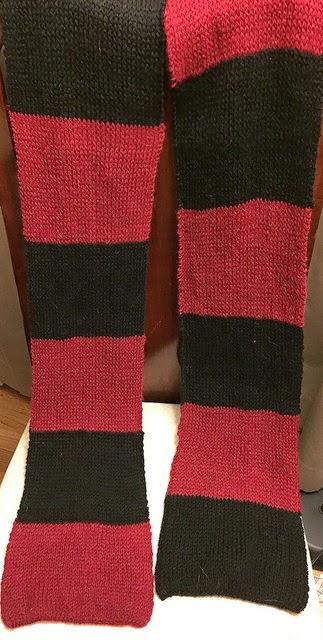
In my Christian Regency romantic suspense, The Spinster's Christmas, my hero, former naval captain Gerard Foremont, lent the heroine his red-and-black knitted scarf:

Miranda pulled her cloak more tightly around her. “I am happy the weather turned cold enough for the skating party. Ellie was quite looking forward to today.”

It was then that Gerard noticed her neck was bare. “Where is your scarf?” He remembered the gray one she’d worn during the greenery hunting party, which she’d used to staunch the blood on Ellie’s forehead.

“It was too stained.”

“Have you no other? Here.” He unwound the red and black scarf from his neck and draped it around hers.

“I cannot take your scarf.”

“My valet, like a mother hen, gave me two.” He pulled back the edge of his cloak to show the other scarf wound underneath. He then proceeded to tie it under her chin.

She had become still, as if she had stopped breathing, although she did not look at him. He was close enough to her to smell lavender and a hint of lemon. He might have taken longer than necessary to fasten the scarf, but he was reluctant to draw away from her.

He felt both rested and vibrantly alive when he touched her, even with the bulky scarf between them. It reminded him of the night of the Christmas ball, and the kiss they’d shared.

He wanted to kiss her again.

While writing the scene, I wondered: What would a gentleman’s knitted scarf actually have looked like in the early nineteenth century?

Alas, it sent me down a research hole—not a rabbit hole, no, it sent me hurtling into a black hole of antique knitting patterns from which I have not yet escaped.

I eventually found the pattern, “A Gentleman’s Comforter” in Miss Watts’s The Ladies’ Knitting and Netting Book, first published in 1837 (the link goes to the 5th edition published in 1840, which you can read for free online).

It was one of the first knitting books of its kind, although other women such as Jane Gaugain and Frances Lambert would go on to publish other such handiwork books from that year onward.

That date puts the pattern just beyond the Regency period in which my story is set. But knitting itself was hardly new.

For centuries, knitting knowledge was taught from one person to another rather than learned from books (or YouTube videos) like modern knitters. Most of the patterns were passed orally by largely illiterate rural knitters and memorized. The patterns were called “receipts” because they had been “received” from someone.

From Miss Watts’s book through the Victorian era, women began collecting and publishing knitting patterns. These books were supported by royalty and the aristocracy—partly because Queen Victoria herself knit, and partly because these patterns had never before been written and distributed in publications.

I can’t say for certain that Gerard’s scarf would have been made from this exact pattern, but it might be possible the “receipt,” passed down orally, was in use in the Regency era.

For fun, I decided to knit Gerard’s scarf from Miss Watts’s original pattern. Here it is:
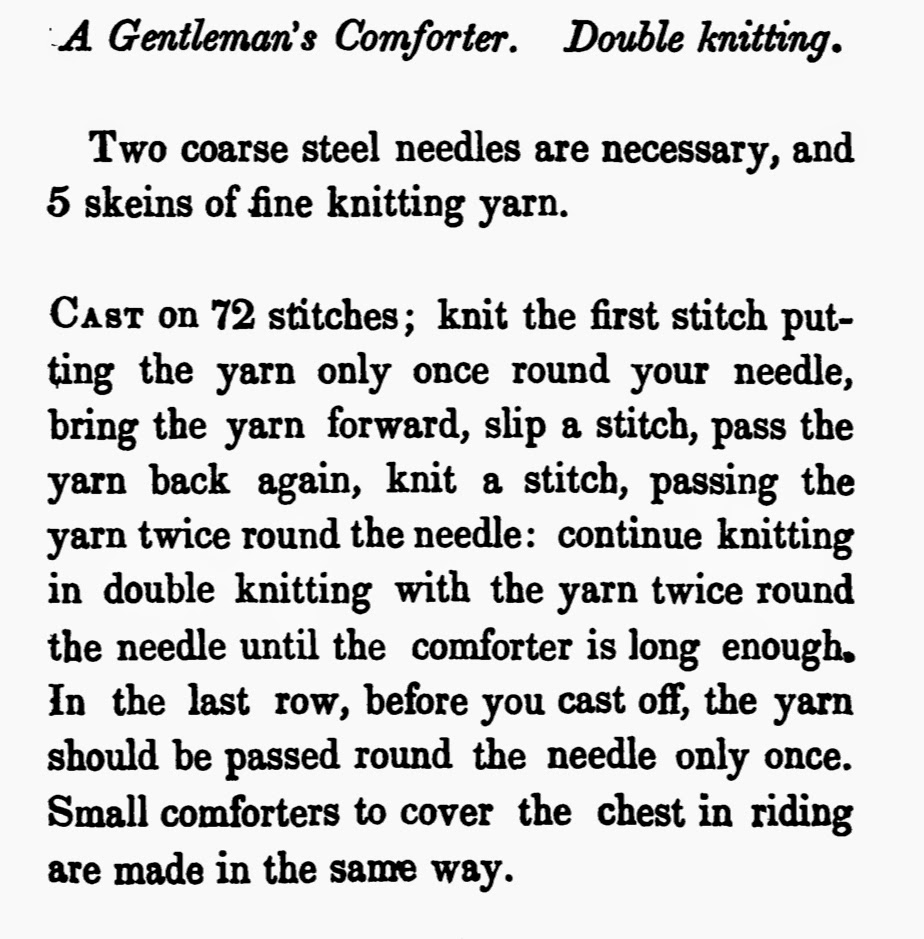

I wasn't entirely certain what “coarse steel needles” and “5 skeins of fine wool yarn” mean, so I just guessed. I used US 1 needles and fingering weight wool yarn, but you could use anything you want, including larger needles and yarn. Just cast on fewer stitches, making sure it’s an even number.

I got my yarn from KnitPicks.com, and was thrilled to find a “Hollyberry” color way. Very Christmasy!

If you’re interested, here’s my project on Ravelry.

I cast on 72 stitches. I used the same cast on I do when I make top down socks, which is the Norwegian cast on with two needles held together. However, you can use whatever cast on you want. I would suggest, however, that you cast on either with a larger needle or two needles held together.
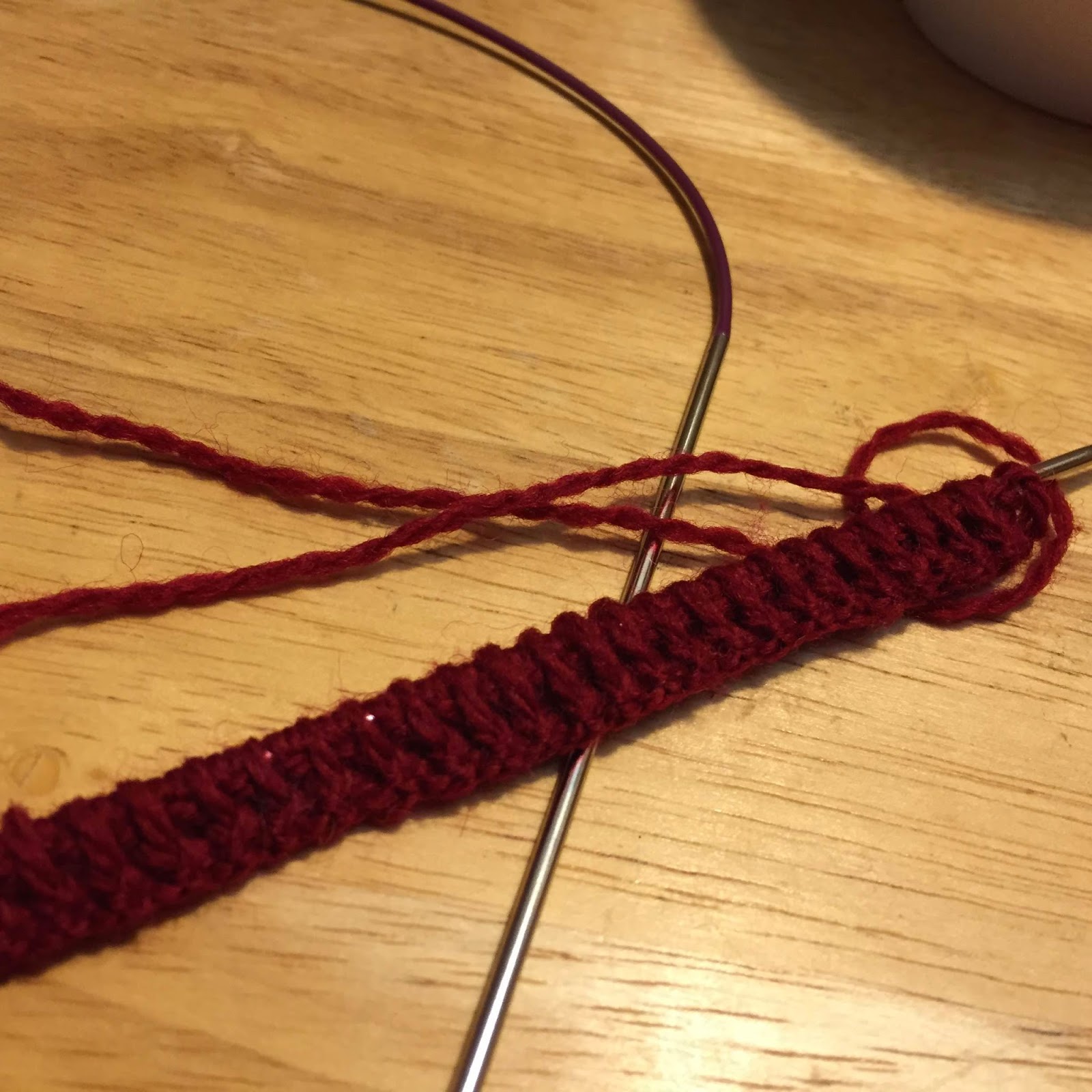
First row:

Knit 1, move the yarn to the front, slip one stitch purl wise, move yarn to the back

(knit 1 but instead of throwing the yarn once around the needle, throw it twice around before pulling the loop through, move the yarn to the front, slip one stitch purl wise, move yarn to the back) repeat to the last 2 stitches in the row,

knit 1 with the yarn twice around the needle, knit 1 with the yarn only once around the needle.

Next row:

Knit 1 (with yarn only once around needle), slip stitch purl wise with yarn in front, dropping the extra loop, (knit with the yarn twice around the needle, slip stitch purl wise with yarn in front, dropping the extra loop) repeat to the last two stitches, knit 1 with the yarn twice around the needle, knit 1 with the yarn only once around the needle.

Repeat this last row until your scarf is long enough.

It’s basic double knitting, but with a drop stitch, which makes the stitches a bit poofy and airy. It makes the scarf soft even if the wool is a bit tightly spun. A tightly spun yarn is typically more durable, and that would make the scarf durable, soft, and warm all at once.

The original pattern calls for one color, but I did 4" long red and black blocks.

And that’s how I made Gerard’s scarf! Here's a bit more about the story it's from:

In The Spinster's Christmas, naval Captain Gerard Foremont and poor relation Miranda Belmoore, old childhood friends, meet again for a large Christmas party at Wintrell Hall. However, an enemy has infiltrated the family party, bent on revenge and determined that Twelfth Night will end in someone’s death …

If you’d like to read more of Gerard and Miranda's story (and see whether Gerard ever gets that kiss), you can read The Spinster's Christmas completely free to read on my blog. Or if you’d like your own copy, the book is also available on my website.

About the Author

Camy Tang writes Christian historical and contemporary romance filled with intrigue, adventure, and faith. Under the pen name Camille Elliot, she writes the Christian Regency romantic suspense series Lady Wynwood’s Spies, set in 1811 London where secrets, espionage, and slow-burn romance unfold against the glittering backdrop of high society.

References:

The Ladies’ Knitting and Netting Book by Miss Watts, 1837

Victorian Lace Today by Jane Sowerby, 2006

An earlier version of this article, including the knitting instructions and photographs, originally appeared on my personal blog in 2015. This version has been revised and expanded with additional historical research.

Monday, October 20, 2014

Dress Like Jane Austen--Part 3--And Giveaway!

We've looked at women's and men's costume in the past two months, and now we get to zero in on a few details of the gowns. This is just a brief spotlight. For those interested, I'll leave a couple of links at the bottom of the post to books that give more in-depth details and study of Regency costume.

So, back to the JASNA Gala Ball, the source of my photos for the past three months' posts.
 I couldn't help noticing the lovely workmanship that went into the upper portion, or bodice, of a woman's gown, even the back. The Empire style (which reigned throughout the regency) certainly is a huge part of the appeal, but the fabric and craftsmanship really made the difference between a standard dress and an exquisite one, a difference which could be seen even from a rear view.

Even the back of the bodice is lovely and elegant.

A beautiful example of how lovely the bodice can be; again, even from the rear.

This is a "Wow"

Sweet and simple, though the waistline is rather low.

Doesn't appear to be an Empire waist, but sweet colors. 


If the date hadn't been given ("1815-1817"), I would not have been able to correctly date this gown--it does not have an Empire waist.   I'm not an expert, but in my opinion this is just wrong! Otherwise, the style and material are certainly fetching. 

The bonnet (an elaborate cap) that matches the above dress. In the rear: A redingote, which in this case, is like a caped pelisse. (The term 'redingote,' is actually the result of "reborrowing," in which one word or phrase--ie., riding coat, was used by the French as redingote, and then taken back in French form into English, though no longer used only to describe an actual riding coat!)  


On the right (in rear) a late Georgian style riding habit.

Forefront left: Regency; Others, Georgian.

Since the JASNA event was in October, there were a few whimsical pumpkins present (contest entries). I thought Cinderella's Coach was well done. 
Happy Harvest!
Don't forget to check out the additional photos of Regency costume on my website, here.

And here's a few links for further study: 

English Women's Clothing in the Nineteenth Century
(Do not buy the Kindle edition if your aim is to really study costume. You just can't see a full page the way you need to, and a book full of illustrations is more fun, period, in print format. Be prepared though; this is a huge book, with 459 pages. )

The History of Underclothes (Dover Fashion and Costume)

The Cut of Men's Clothes: 1600-1900 (Unlike the first two, I don't own this one, but the reviews are good.)

Empire Fashions  (I own, and love, this book.)

The above is enough to get any student of costume excited and enthralled. What about you? Do you enjoy studying period dress? Do you have a favorite go-to reference or illustrated book?

Leave a comment and a contact email and you'll be entered in a drawing to win a copy of my book*, THE COUNTRY HOUSE COURTSHIP.


(*Winner will be chosen at random using random.org)

Saturday, September 20, 2014

Dress Like Jane Austen! Part II And GIVEAWAY


In last month's post I shared pictures of Janeites, that is, Jane Austen devotees, dressed up in their Regency-era finest. I took the photos at a JASNA conference in Portland, OR, and shared those of women only. This month, as promised, I move on to pictures of men and couples. We'll see that women aren't the only ones who enjoy dressing up in the style of Jane's era. We'll also see that, in some cases, they are equally challenged in getting it right! But hey, it's all about fun. Authenticity to the period is appreciated by those of us who CAN appreciate it, but it isn't everything.  [JASNA, by the way, is the Jane Austen Society of North America.]

Don't forget to enter the drawing at the bottom of the page. In addition to possibly winning one of my books there are lots of other great prizes. 
 
 Click on a photo to see it enlarged.

There was a promenade before the dancing began. This was a great opportunity for me to get lots of shots, and people were more than happy to have their laboriously designed costumes captured for posterity!  This gentleman is smartly dressed for the occasion, with a fine pair of wintry breeches.   
The military were always present in any large assembly, as Britain was at war. The trousers are absolutely modern.   

Dignity itself on the left. (Bonnet on right: Bad, bad, bad!) 
I could see him conducting music. (Music conductors were not yet de rigeur during the Regency, however.)
"Mr. Darcy" Pillow.   Like Mr. Mornay (in, Before the Season Ends) Darcy is a model of male sartorial elegance.


Above: A jolly Georgian male ensemble.

A noble attempt. 

Masqued fun with a modern suit. Love the second couple approaching!

A well-heeled couple. 

A grand military outfit, including a bicorne hat. 


Lovely.
Comfort in costume!
What? What? The Phantom, at our ball? Why not. (So nicely done.)

And now, two examples of  well-dressed Regency gentlemen.  Lord Grantham, below, undoubtedly inspired many a female swoon. :)
Lord Grantham. He wears the popular Hessian boots, inspired by Russian military.

Can it get any better than the famous Beau Brummel? The man who popularized the wearing of pantaloons? They say his toilet took up to four hours before he was satisfied enough to leave his home and face the world. Nevertheless, he is not my idea of Regency manly perfection in dress.
For more costume fun, check out my "Illustrations of the Month" on my website. I have pictures that are just as rich and atmospheric as the above but which didn't make it into either of my posts here on the blog.
Go to this page and scroll down. Enjoy!

Next Month: Pictures of the dance in progress.  Also look for special emphasis on the exquisite care and workmanship given to the back of a ladies' gown, by the way, as I'll be featuring some close up shots of fabulous examples. 

What do you think? Aren't costume balls fun? (And, will they ever welcome me to another one now that I've taken to being the fashion police?) Leave a comment, below, and share your thoughts. And don't forget to enter the giveaway! The winner of my book gets to choose any of my regencies for themselves.
Before the Season Ends: A young woman of faith must navigate the treacherous waters of a London Regency season while fending off the efforts of her wealthy aunt to marry her off to the richest suitor.  
The House in Grosvenor Square: The continuing adventures of Ariana Forsythe in London as she comes up against evil intentions and those who want revenge--not necessarily on her, but through her. (To say more would be a spoiler!) 

The Country House Courtship: Follow Ariana and her new husband to their country estate in Middlesex, where younger sister Beatrice learns to grow up, finding her own perfect husband in the process.  


ENTER THE RAFFLECOPTER GIVEAWAY!

Giveaway | Rafflecopter :)
a Rafflecopter giveaway