Showing posts with label knitting. Show all posts

Thursday, October 22, 2026

I Knit My Regency Hero’s Scarf

By Camille Elliot/Camy Tang

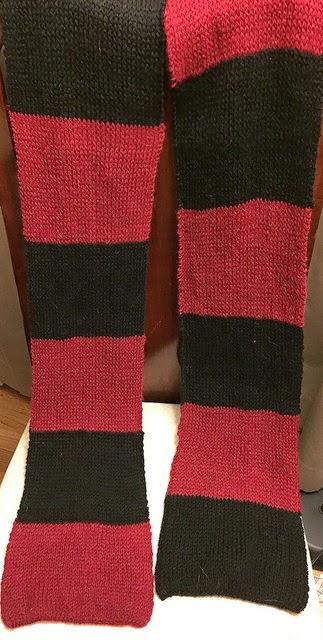
In my Christian Regency romantic suspense, The Spinster's Christmas, my hero, former naval captain Gerard Foremont, lent the heroine his red-and-black knitted scarf:

Miranda pulled her cloak more tightly around her. “I am happy the weather turned cold enough for the skating party. Ellie was quite looking forward to today.”

It was then that Gerard noticed her neck was bare. “Where is your scarf?” He remembered the gray one she’d worn during the greenery hunting party, which she’d used to staunch the blood on Ellie’s forehead.

“It was too stained.”

“Have you no other? Here.” He unwound the red and black scarf from his neck and draped it around hers.

“I cannot take your scarf.”

“My valet, like a mother hen, gave me two.” He pulled back the edge of his cloak to show the other scarf wound underneath. He then proceeded to tie it under her chin.

She had become still, as if she had stopped breathing, although she did not look at him. He was close enough to her to smell lavender and a hint of lemon. He might have taken longer than necessary to fasten the scarf, but he was reluctant to draw away from her.

He felt both rested and vibrantly alive when he touched her, even with the bulky scarf between them. It reminded him of the night of the Christmas ball, and the kiss they’d shared.

He wanted to kiss her again.

While writing the scene, I wondered: What would a gentleman’s knitted scarf actually have looked like in the early nineteenth century?

Alas, it sent me down a research hole—not a rabbit hole, no, it sent me hurtling into a black hole of antique knitting patterns from which I have not yet escaped.

I eventually found the pattern, “A Gentleman’s Comforter” in Miss Watts’s The Ladies’ Knitting and Netting Book, first published in 1837 (the link goes to the 5th edition published in 1840, which you can read for free online).

It was one of the first knitting books of its kind, although other women such as Jane Gaugain and Frances Lambert would go on to publish other such handiwork books from that year onward.

That date puts the pattern just beyond the Regency period in which my story is set. But knitting itself was hardly new.

For centuries, knitting knowledge was taught from one person to another rather than learned from books (or YouTube videos) like modern knitters. Most of the patterns were passed orally by largely illiterate rural knitters and memorized. The patterns were called “receipts” because they had been “received” from someone.

From Miss Watts’s book through the Victorian era, women began collecting and publishing knitting patterns. These books were supported by royalty and the aristocracy—partly because Queen Victoria herself knit, and partly because these patterns had never before been written and distributed in publications.

I can’t say for certain that Gerard’s scarf would have been made from this exact pattern, but it might be possible the “receipt,” passed down orally, was in use in the Regency era.

For fun, I decided to knit Gerard’s scarf from Miss Watts’s original pattern. Here it is:
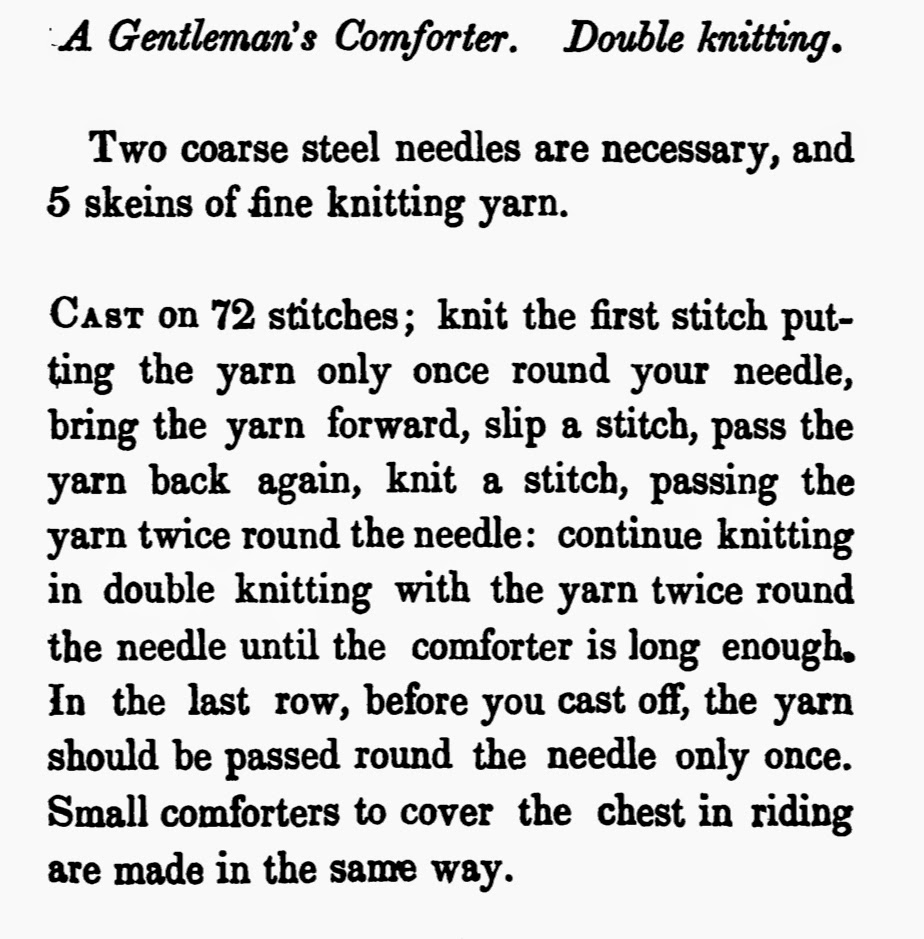

I wasn't entirely certain what “coarse steel needles” and “5 skeins of fine wool yarn” mean, so I just guessed. I used US 1 needles and fingering weight wool yarn, but you could use anything you want, including larger needles and yarn. Just cast on fewer stitches, making sure it’s an even number.

I got my yarn from KnitPicks.com, and was thrilled to find a “Hollyberry” color way. Very Christmasy!

If you’re interested, here’s my project on Ravelry.

I cast on 72 stitches. I used the same cast on I do when I make top down socks, which is the Norwegian cast on with two needles held together. However, you can use whatever cast on you want. I would suggest, however, that you cast on either with a larger needle or two needles held together.
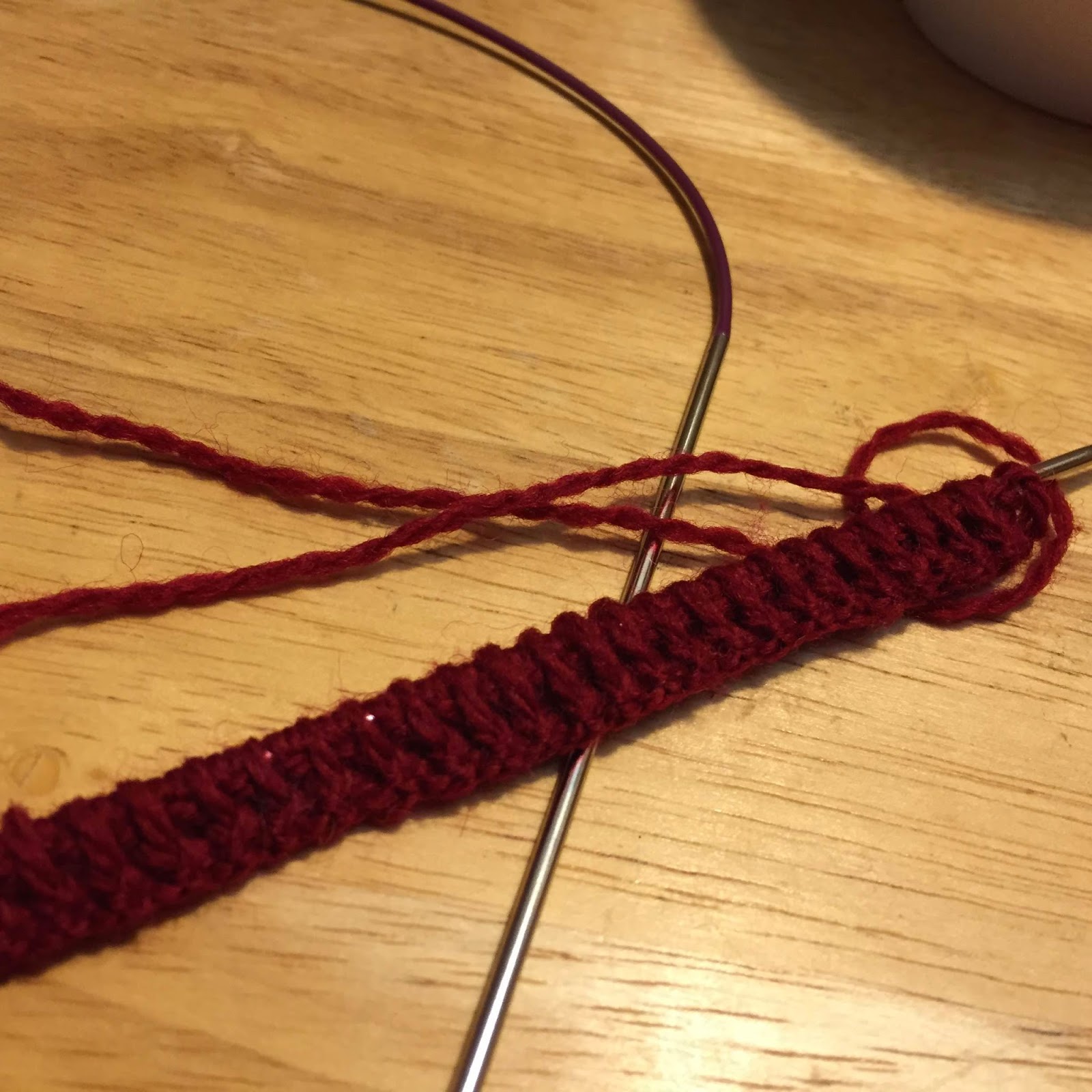
First row:

Knit 1, move the yarn to the front, slip one stitch purl wise, move yarn to the back

(knit 1 but instead of throwing the yarn once around the needle, throw it twice around before pulling the loop through, move the yarn to the front, slip one stitch purl wise, move yarn to the back) repeat to the last 2 stitches in the row,

knit 1 with the yarn twice around the needle, knit 1 with the yarn only once around the needle.

Next row:

Knit 1 (with yarn only once around needle), slip stitch purl wise with yarn in front, dropping the extra loop, (knit with the yarn twice around the needle, slip stitch purl wise with yarn in front, dropping the extra loop) repeat to the last two stitches, knit 1 with the yarn twice around the needle, knit 1 with the yarn only once around the needle.

Repeat this last row until your scarf is long enough.

It’s basic double knitting, but with a drop stitch, which makes the stitches a bit poofy and airy. It makes the scarf soft even if the wool is a bit tightly spun. A tightly spun yarn is typically more durable, and that would make the scarf durable, soft, and warm all at once.

The original pattern calls for one color, but I did 4" long red and black blocks.

And that’s how I made Gerard’s scarf! Here's a bit more about the story it's from:

In The Spinster's Christmas, naval Captain Gerard Foremont and poor relation Miranda Belmoore, old childhood friends, meet again for a large Christmas party at Wintrell Hall. However, an enemy has infiltrated the family party, bent on revenge and determined that Twelfth Night will end in someone’s death …

If you’d like to read more of Gerard and Miranda's story (and see whether Gerard ever gets that kiss), you can read The Spinster's Christmas completely free to read on my blog. Or if you’d like your own copy, the book is also available on my website.

About the Author

Camy Tang writes Christian historical and contemporary romance filled with intrigue, adventure, and faith. Under the pen name Camille Elliot, she writes the Christian Regency romantic suspense series Lady Wynwood’s Spies, set in 1811 London where secrets, espionage, and slow-burn romance unfold against the glittering backdrop of high society.

References:

The Ladies’ Knitting and Netting Book by Miss Watts, 1837

Victorian Lace Today by Jane Sowerby, 2006

An earlier version of this article, including the knitting instructions and photographs, originally appeared on my personal blog in 2015. This version has been revised and expanded with additional historical research.

Monday, March 2, 2026

Knitting and Spying by Nancy J. Farrier

 Do you like to knit? Do you have the nerve to knit in the middle of an enemy stronghold and work messages into your knitting to pass on to your country’s armed forces? That is what the women featured in today’s blog did during war time. I salute them for their bravery and determination. Let’s take a look at what they accomplished and how they alerted their forces using their needlework.


Knit/Purl Stitches by WillowW
Wikimedia Commons
First, keep in mind how knitting is done. There are two basic stitches. The knit stitch looks like a “v” and the purl stitch makes a small bump. Also, dropped stitches were used to make a hole. That means these patterns could have been read by feel in low light if needed. Plus, women were encouraged to knit and make items to help soldiers, so nothing was thought about a woman sitting in her window or in public with her knitting needles clicking away. Little did the opposition realize that she didn’t have to focus on her work, but could be watching and listening to later report conversations and movements. A perfect spy!


Phyllis Latour Doyle

Phyllis joined the RAF in 1941 after a friend was killed by Nazi soldiers. She planned to train to be an airplane mechanic but others noted her potential. Because her father was French, Phyllis grew up speaking fluent French and would be valuable as a spy behind lines. She agreed to become a spy and was trained by a cat burglar to do things like cross a roof top undetected.


1904 Picture of
Woman Knitting
At the end of her training, Phyllis parachuted into Normandy. She pretended to be a teenager to throw off suspicion. She traveled by bicycle and chatted with German soldiers. She would then go someplace secret, bring out her knitting and use one of her 2,000 codes to send a message. She would hide the knitted message by winding the strip around a knitting needle and inserting it in a hair tie. Each time she used one of the codes she’d been given she would mark the code, so she wouldn’t use it again.


Phyllis had to keep on the move. She would send her message and then go quickly before the Germans could trace the source of the message. They did not catch her. She often had to sleep on the forest floor unless she found some Allied sympathizers. She ate what food she could find and was often hungry, but she always had her knitting and her silk thread she used for her patterns.


In 2014, Phyllis was awarded the Legion of Honour, France’s highest decoration. She did not want to get this award but did it for her family. She was 93 at the time. Her family found out about her spy work in the late 1900’s when one of her sons read about her on the internet. She did not want to brag about the service she’d done for her country.

Madame Lavengle

WWI Ad for Knitting
By Marguerite Martyn
Wikimedia Commons
During WWI the Germans occupied her home putting her and her children at risk. Madame Lavengle did not quake in fear. Instead, she joined the resistance and used her knitting and her children to send coded messages right under the noses of the Germans in her home.


In an upper room, Lavengle sat at a window knitting. Every day she would sit there and knit. Such an innocent pastime, right? Meanwhile, she would tap her foot on the floor and her children below her would copy down the code she signaled with the tapping. The German Marshall in her home never suspected she was gathering and passing on information. Amazing.


Molly “Mom” Rinker

Molly Rinker owned a tavern during the Revolutionary War. She often had British soldiers in her town and in her tavern. She wanted to do something to help the Revolution, so she would go to the park and sit on a high hill or rock and knit. As she watched and listened, she would tie knots in her ball of yarn as a code. Then she would drop the yarn at a certain place for the Revolutionary soldiers to find. In this way, a woman in a lowly occupation, helped out her fledgling country. Thank you, Molly.


Binary Pattern by Kurt Pippen Fowler
Many people enjoy the art of knitting. With the onset of computer coding and languages, knitters learned to do patterns in binary language. When Morse code was invented, they used a variation of stitches to make the dot and dash for Morse code and sent messages that way. Knitting is so much more than making a pretty garment.


Do you knit? Do you do another type of needlework? Would you have been brave enough to be a spy? To be dropped behind enemy lines and send coded messages? Or to gather information right under the enemy’s noses? What a challenge and what amazing women.


Nancy J Farrier is an award-winning, best-selling author who lives in Southern Arizona in the Sonoran Desert. She loves the Southwest with its interesting historical past. When Nancy isn’t writing, she loves to read, do needlecraft, play with her cats and dog, and spend time with her family. You can read more about Nancy and her books on her website: nancyjfarrier.com.

Sunday, March 28, 2021

Crafts of Olden Days – with Giveaway By Donna Schlachter


Neolithic Gold Bead by Mark Cartwright


Crafting is a creative process that has occupied humans for many years. Depending on the social and financial situation of the crafter, they might produce an item solely for use, such as knitted socks, a clay jar to carry water, or a wooden tool or implement such as a wheelbarrow or a chisel. When societies had solved most of their day-to-day problems such as gathering or producing enough food and water, or providing sufficient clothing and shelter, they might turn their attention to producing items used more for decoration or demonstration of status, such as embroidery, decorative wood carving, and jewelry.

The earliest stage of crafting began with early man as every object needed had to be made by hand. Without automation, this could often be tedious and labor-intensive. Consider that to knit socks, they first had to raise sheep or have access to the wool. Then somebody had to spin it, perhaps dye the wool, before the knitter actually sat with needles and a pattern in hand.

Oh, wait. No patterns. At least, nothing officially published, at least not until the early 19th century. Before that, patterns were passed along and passed down by word of mouth or perhaps on scraps of papyrus or eventually paper. 
AdobeStock_337225572

 
Decorative and household items have been found as early as 6500 BC, and each culture had its own unique style and process, using raw materials readily available, such as types of clay, gemstones, wood types, and metals. By far, gold is the most widely used metal, and as metallurgy advanced, bronze (the mixing of copper and tin) became widespread.

As sea travel advanced, sailors often returned home with samples from other people groups, spreading the styles and processes all over the world. Around 1000 BC, the Phonecians brought crafts from the English isles back to the Mediterranean, while sharing their own processes with the Brits and Celts.

During the Renaissance period, crafting moved from necessity to decoration. Folks specialized in particular crafts, including metal work, jewelry-making, clay work, needlework, and the like. The wealthy often employed craftsmen and craftswomen whose sole job was to do what they were best at. Unions and groups formed that regulated what the craftspeople could do, often testing them to determine their level of skill. It is here we see apprenticeships and journeymen and master designations important in controlling the craftspeople and setting appropriate prices.
 AdobeStock_304644039

In the Industrial Revolution, machines were designed to replicate the manual skills in areas such as weaving, carving, woodworking, beadwork, in response to the increased population’s demand for products.

As mentioned before, in the early 1800s, patterns were published for common products such as knitted items, dresses, and needlework. Near the 1900s, manuals and instruction books became popular as most families no longer employed craftspeople, and producing craft items became indicative of leisure and free time.

Regardless of the reason—to produce something useful or beautiful or both—creativity is a trait we share with our ancestors, which shouldn’t surprise us, since we are made in the image of a creative God.

Giveaway: leave a comment, and I will randomly draw one winner of a tin-punch kit. Include your email in this format: email AT server DOT extension. For example, donna AT historythrutheages DOT com

About Donna:

Donna writes historical suspense under her own name, and contemporary suspense under her alter ego of Leeann Betts, and has been published more than 30 times in novellas, full-length novels, and non-fiction books. She is a member of ACFW, Writers on the Rock, SinC, Pikes Peak Writers, Capitol Christian Writers Fellowship, Christian Women Writers, and Christian Authors Network; facilitates a critique group; teaches writing classes; ghostwrites; edits; blogs regularly for Heroes, Heroines, and History; and judges in writing contests. www.HiStoryThruTheAges.com


Resources:

https://www.ancient.eu/crafts/

https://www.marthastewart.com/7839594/historical-origin-of-craft-techniques

https://www.pinterest.com/dmtamari/pioneer-crafts/


Monday, February 18, 2019

Spies and Knitting

Do you like to knit? Do you have the nerve to knit in the middle of an enemy stronghold and work messages into your knitting to pass on to your country’s armed forces? That is what the women featured in today’s blog did during war time. I salute them for their bravery and determination. Let’s take a look at what they accomplished and how they alerted their forces using their needlework.

Knit/Purl Stitches by WillowW
Wikimedia Commons
First, keep in mind how knitting is done. There are two basic stitches. The knit stitch looks like a “v” and the purl stitch makes a small bump. Also, dropped stitches were used to make a hole. That means these patterns could have been read by feel in low light if needed. Plus, women were encouraged to knit and make items to help soldiers, so nothing was thought about a woman sitting in her window or in public with her knitting needles clicking away. Little did the opposition realize that she didn’t have to focus on her work, but could be watching and listening to later report conversations and movements. A perfect spy!

Phyllis Latour Doyle

Phyllis joined the RAF in 1941 after a friend was killed by Nazi soldiers. She planned to train to be an airplane mechanic but others noted her potential. Because her father was French, Phyllis grew up speaking fluent French and would be valuable as a spy behind lines. She agreed to become a spy and was trained by a cat burglar to do things like cross a roof top undetected.

At the end of her training, Phyllis parachuted into Normandy. She pretended to
1904 Picture of
Woman Knitting
be a teenager to throw off suspicion. She traveled by bicycle and chatted with German soldiers. She would then go someplace secret, bring out her knitting and use one of her 2,000 codes to send a message. She would hide the knitted message by winding the strip around a knitting needle and inserting it in a hair tie. Each time she used one of the codes she’d been given she would mark the code, so she wouldn’t use it again.

Phyllis had to keep on the move. She would send her message and then go quickly before the Germans could trace the source of the message. They did not catch her. She often had to sleep on the forest floor unless she found some Allied sympathizers. She ate what food she could find and was often hungry, but she always had her knitting and her silk thread she used for her patterns.

In 2014, Phyllis was awarded the Legion of Honour, France’s highest decoration. She did not want to get this award but did it for her family. She was 93 at the time. Her family found out about her spy work in the late 1900’s when one of her sons read about her on the internet. She did not want to brag about the service she’d done for her country.

Madame Lavengle

WWI Ad for Knitting
By Marguerite Martyn
Wikimedia Commons
During WWI the Germans occupied her home putting her and her children at risk. Madame Lavengle did not quake in fear. Instead, she joined the resistance and used her knitting and her children to send coded messages right under the noses of the Germans in her home.

In an upper room, Lavengle sat at a window knitting. Every day she would sit there and knit. Such an innocent pastime, right? Meanwhile, she would tap her foot on the floor and her children below her would copy down the code she signaled with the tapping. The German Marshall in her home never suspected she was gathering and passing on information. Amazing.

Molly “Mom” Rinker

Molly Rinker owned a tavern during the Revolutionary War. She often had British soldiers in her town and in her tavern. She wanted to do something to help the Revolution, so she would go to the park and sit on a high hill or rock and knit. As she watched and listened, she would tie knots in her ball of yarn as a code. Then she would drop the yarn at a certain place for the Revolutionary soldiers to find. In this way, a woman in a lowly occupation, helped out her fledgling country. Thank you, Molly.

Binary Pattern by Kurt Pippen Fowler
Many people enjoy the art of knitting. With the onset of computer coding and languages, knitters learned to do patterns in binary language. When Morse code was invented, they used a variation of stitches to make the dot and dash for Morse code and sent messages that way. Knitting is so much more than making a pretty garment.

Do you knit? Do you do another type of needlework? Would you have been brave enough to be a spy? To be dropped behind enemy lines and send coded messages? Or to gather information right under the enemy’s noses? What a challenge and what amazing women.


Nancy J Farrier is an award-winning author who lives in Southern Arizona in the Sonoran Desert. She loves the Southwest with its interesting historical past. When Nancy isn’t writing, she loves to read, do needlecraft, play with her cats, and spend time with her family. Nancy is represented by Tamela Hancock Murray of The Steve Laube Literary Agency. You can read more about Nancy and her books on her website: nancyjfarrier.com.

Monday, May 11, 2015

Civil War Stitches

A footnote from history by Stephanie Grace Whitson

Neither the Union nor the Confederate governments were prepared to field armies when the Civil War first began. The most obvious need was for uniforms for the tens of thousands of volunteers. President Lincoln's first call was for 75,000 volunteers. An estimated 4.5 yards of fabric were needed per uniform. that's 337,500 yards (or 191.76 miles) of fabric just for trousers and jackets. Who made those uniforms? Well, at the outset of the war, governments contracted with factories, but they couldn't work fast enough. Women stepped up, and they did made a lot more than just uniforms.

Women made the regimental flags carried into battle. The photo below
shows a detail of one such flag presented by the ladies of St. Louis to a regiment serving with the Missouri Guard. Those bears are created with silk thread, one stitch at a time. The flag flew outside the regimental commander's tent. Other regimental flags made by women were carried into battle. 

Once war broke out, sewing circles that already existed to benefit the destitute immediately added filling soldiers' needs to their cause, providing shirts and socks, blankets and quilts, for the boys and men volunteering from their town or region.

"My dear friend, you are not my husband nor son; but you are the husband or son of some woman who undoubtedly loves you as I love mine. I have made these garments for you with a heart that aches for your sufferings ..." [note included in a Sanitary Commission shipment] 

As the war went on and hospitals began to fill with the wounded, women produced hospital shirts and bandages. One impressive statistic: by war's end, the Northwestern Sanitary Commission headquartered in Chicago had supplied 267,936 pounds of bandages, compresses, and lint (lint was used for packing wounds and created by unraveling linen towels or "scraping" other household textiles to break down the fibers). 

"My dear boy, I have knit these socks expressly for you. How do you like them? ... Write and tell me all about yourself, and how you get on in the hospitals ..." [note included in a Sanitary Commission shipment]

Women knitted socks and mittens, the latter created from a pattern developed to incorporate a trigger finger. The Western Sanitary Commission headquartered in St. Louis had, by war's end, provided 78,656 pairs of socks.

In the early stages of the war, women collected quilts and blankets. When the supply ran out, they began to make cot-sized quilts and tied comforters (15,131 comforts from the Northwestern Sanitary Commission and 40,574 blankets and comforts from the Western Sanitary Commission), along with 100,000 pillow cases. 

The numbers are a bit staggering, aren't they? In an era when we buy the textiles we need for our families, it's difficult to imagine having to make literally everything a soldier might need in the field. 

"She'd sat up half the night making Seamus his own mending kit--a replica of the one a teary-eyed Bridget Feeny had presented to Jack yesterday afternoon. The soldiers called them housewives, Bridget said. Making one for Seamus had given Maggie something productive to do last night, when sleep simply would not come." From Daughter of the Regiment

Housewife (soldier's mending kit)
Soldiers had to do their own mending in camp, and so women made mending kits referred to as "housewives." Many different examples survive in museum collections. I photographed the one at left when I visited a museum exhibit about Illinois women's efforts during the war.

"Feed the Hungry" quilt
Civil War women were very well aware of the importance of what they were doing. Some referred to their sewing groups as "needle regiments." With the conclusion of the war, they didn't stop stitching for the benefit of soldiers and their families. Raffle quilts raised funds to benefit destitute families of wounded warriors. The one at left was created and raffled by a Methodist Episcopal ladies group in Lexington, Missouri. Across the surface of the quilt, the words "feed the hungry" reminded survivors that the war might be over, but the need for women's stitches had not ended. 

The tradition of sewing for soldiers continues today. One example is Quilts of Valor, created to "cover service members and veterans touched by war with comforting and healing Quilts of Valor." 

Have you ever sent a care package to a modern-day warrior? Are you part of a contemporary "needle regiment" making Quilts of Valor? God bless you.

______________

Stephanie learned about "Civil War stitches" while researching her book Daughter of the Regiment. This fall, you'll be able to read about Civil War stitchers in her novella appearing in A Basket Brigade Christmas, a Civil War collection written with Nancy Moser and Judith Miller. Stay tuned!

http://www.amazon.com/Daughter-Regiment-Stephanie-Grace-Whitson/dp/1455529036

An inspiring story of discovering courage and friendship through tremendous adversity. Drawing on the actual histories of women who found ways to work on the battlefront during the Civil War, this outstanding historical will attract fans of Janette Oke, Lisa Wingate, and Tamera Alexander. *Starred review* Library Journal

Based on true events, this story will capture the hearts of historical fiction fans. Publishers Weekly