

This month I continue my series on historic playground equipment with one of several posts on the simple swing. Actually, I'm leaving the simple part for another post because I'm excited to show you old glass negatives and images of swings that brought raised brows when I showed my husband an image of people flying around a pole with a death-grip, and laughing as they flew.
 |
| Playgrounds, May Day, Glass negative, 1924 May. Source: Library of Congress Prints and Photographs Division Washington |
It's called the Giant Stride and for the first half of the 20th century appeared in most school and public playgrounds. This ride is one of those things that people say is the most dangerous of all those on the playground, and yet those who've taken a spin on this ride agree it's the most exciting one of all. In fact, I believe this apparatus is banned in many areas.
In 1911, Woods Hutchinson published A Handbook of Health which included an area of children's play. Along with detailing mental and running games, he included a section on the Giant Stride.

 Playground catalogs of the period show at least two types of Giant Stride with one being a pole with ladder-like chains hanging down. This is the type shown in the above image where the children are gripping with one hand higher than the other. One father has built on of these in his backyard and made a Giant Stride video. As I watched, a young lad jump away as he tired and I wondered how this can be more dangerous than children jumping off a high-flying regular swing.
The image of the Giant Stride No. D128 is from the 1922 Narragansett Machine Company catalog out of Providence, R.I.
The 1932 Fun-Ful Playground Equipment catalog shows a larger version called the Cycle Stride.
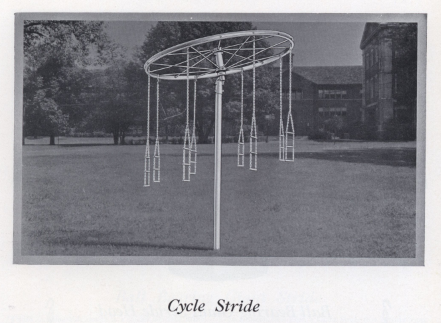
But what we now call a playground ride was used back in Victorian Britain as a physical education apparatus at the North London Collegiate School. Established in 1882, this fine college for young women promoted free and unchecked physical activity as a way to develop graceful and flowing movements.

Even that wasn't the beginning of the Giant Stride, however, because in 1847 George French Angas contributed an illustration to The New Zealanders Illustrated, of New Zealand Maori children swinging above a bank by ropes that hung from a tall pole. The morere swing was made from ropes obtained from the leaves and fibers of the cabbage tree.
 |
"Swing"
Angas, George French 1822-1886: The New Zealanders Illustrated, 1847. Source:
Wikimedia Commons
|
Doesn't it look like the children are enjoying themselves? If you love to hear the shrieks and laughter of children having fun check out this another modern video of a homemade backyard Giant Stride. This one is similar to the first, but the children are seated, and from the excited shrieks, it sounds like they're having fun. (https://youtu.be/scxM6jOnXxQ)
Like all things, however, moderation is the key and the danger heightens as people misuse these play activities at the expense of others who may be younger and weaker and unable to keep their grip.
What are your thoughts on the Giant Stride? Any experiences you'd like to share?

~~~~~~~~~~~~~~~~~~~~~~~~~~~

