Showing posts with label Playground. Show all posts

Wednesday, October 4, 2017

Wooden Playground Swings


Playground swings are found in a variety of materials and styles which I suppose are based on what's available and what the community believes it needs at the time. While some playground equipment has been deemed unsafe, swings are still around despite the danger because they can't be outlawed. The public won't stand for it and although I am not a protester by nature, I will be one of the first in line to protest the removal of the simple swing.

My grandfather built my grandmother a swing when they immigrated from Finland in 1930 and I remember summer visits watching her swing. Mamma was the only adult I ever saw who enjoyed such a pleasure and the sight of her smile as she swung taught me the lesson of finding joy in the little things of life.


As you can see from the above photo, Mamma's swing was BIG and it lasted for years. Not only did I enjoy it while growing up, but I used it whenever I visited with my own growing family. I never asked my husband for a swing, yet one day after we'd been married a dozen or so years he built one using the same principle of Mamma's and that is attaching it to the clothesline pole. As you can see from this next photo taken in the mid-80's, my husband and daughter had as much fun swinging as I did. It was the perfect way to relax after spending hours working in our garden.


We moved a few years later and I had to do my swinging with the kids in playgrounds after that. But you see in the photo how my husband is standing up? That's a lot easier to do on the wooden plank swings than on the newer plastic ones, or even those rubber ones that turn your clothes black. 

My research into old style swings dug up some amusing photos of mothers and their kids, including this one taken in 1910 with, "Mrs. Turner, holding daughter, who is standing in a swing, while looking down at her son holding a kitten." The image is from A Study of Mrs. Turner and her Children, Waban, Mass. and seems to show the mother teaching her daughter how to swing while standing. 

The swing, a study of Mrs. Turner and her children. Made at Waban, Mass., 1910. Source: Library of Congress Prints and Photographs Division Washington, D.C.

I found a similar photo in Virginia showing the Art Brown Family at the swings. This one clearly shows that this mother didn't see the danger of her son falling on his head, or if she did, didn't think it was serious enough to stop him from doing it. 


For younger children I found this undated glass negative of children in chair-like wooden swings taken at Hamilton Fish Park, New York. Does anyone want to take a guess at the year?


Children in swings, Hamilton Fish Park, New York, undated. Source: Library of Congress Prints and Photographs Division Washington, D.C.

Going back to 1910 is another glass negative showing wooden children's swings in an open-walled shelter from a N.Y. playground.


N.Y. Playground, between ca. 1910 and ca. 1915. Source: Library of Congress Prints and Photographs Division Washington, D.C.

But the joy of swinging isn't always a solitary pastime as the above image shows. If the saying, the more the merrier is any indication, then the wooden circular swing in the next image from San Augustine, Texas, should be loads of fun.


Schoolchildren on circular swing, San Augustine, Texas, Aug 1939. Source: Library of Congress Prints and Photographs Division Washington, DC

Or would it? Does a circular swing have the same back-and-forth motion like a regular pendulum-type swing? Surely you can't pump your legs for more motion--or can you? Does it turn in a circle as it swings? Has anyone memories of a circular swing that they'd like to share?

When was the last time you had a good swing? Care to share your thoughts and memories of swinging? 

For the record, my next posts (on the fifth day of each month) will be on tire-type and character swings, lawn swings, porch swings, etc, in no particular order. 


~~~~~~~~~~~~~~~~~


Anita Mae Draper's historical romances are written under the western skies of the Saskatchewan prairie where her love of research and genealogy yield fascinating truths that layer her stories with rich historical details. Anita's short story, Here We Come A-Wassailing, was a finalist for the Word Guild's 2015 Word Awards. Her novellas are included in Austen in Austin Volume 1, The American Heiress Brides Collection, and The Secret Admirer Romance Collection. Readers can check out Anita's Pinterest boards for a visual idea of her stories to enrich their reading experience. Discover more at: 
Website - www.anitamaedraper.com
Pinterest - www.pinterest.com/anitamaedraper/


Monday, September 4, 2017

Fun-Filled Danger of the Giant Stride


This month I continue my series on historic playground equipment with one of several posts on the simple swing. Actually, I'm leaving the simple part for another post because I'm excited to show you old glass negatives and images of swings that brought raised brows when I showed my husband an image of people flying around a pole with a death-grip, and laughing as they flew.


Playgrounds, May Day, Glass negative, 1924 May. Source: Library of Congress Prints and Photographs Division Washington

It's called the Giant Stride and for the first half of the 20th century appeared in most school and public playgrounds. This ride is one of those things that people say is the most dangerous of all those on the playground, and yet those who've taken a spin on this ride agree it's the most exciting one of all. In fact, I believe this apparatus is banned in many areas. 

In 1911, Woods Hutchinson published A Handbook of Health which included an area of children's play. Along with detailing mental and running games, he included a section on the Giant Stride.


Playground catalogs of the period show at least two types of Giant Stride with one being a pole with ladder-like chains hanging down. This is the type shown in the above image where the children are gripping with one hand higher than the other. One father has built on of these in his backyard and made a Giant Stride video. As I watched, a young lad jump away as he tired and I wondered how this can be more dangerous than children jumping off a high-flying regular swing.

The image of the Giant Stride No. D128 is from the 1922 Narragansett Machine Company catalog out of Providence, R.I.


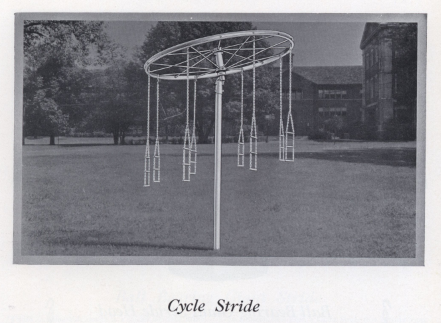
The 1932 Fun-Ful Playground Equipment catalog shows a larger version called the Cycle Stride.


But what we now call a playground ride was used back in Victorian Britain as a physical education apparatus at the North London Collegiate School. Established in 1882, this fine college for young women promoted free and unchecked physical activity as a way to develop graceful and flowing movements. 


Even that wasn't the beginning of the Giant Stride, however, because in 1847 George French Angas contributed an illustration to The New Zealanders Illustrated, of New Zealand Maori children swinging above a bank by ropes that hung from a tall pole. The morere swing was made from ropes obtained from the leaves and fibers of the cabbage tree.


"Swing" Angas, George French 1822-1886: The New Zealanders Illustrated, 1847. Source: Wikimedia Commons

Doesn't it look like the children are enjoying themselves? If you love to hear the shrieks and laughter of children having fun check out this another modern video of a homemade backyard Giant Stride. This one is similar to the first, but the children are seated, and from the excited shrieks, it sounds like they're having fun. (https://youtu.be/scxM6jOnXxQ)


Like all things, however, moderation is the key and the danger heightens as people misuse these play activities at the expense of others who may be younger and weaker and unable to keep their grip.


What are your thoughts on the Giant Stride? Any experiences you'd like to share?


~~~~~~~~~~~~~~~~~~~~~~~~~~~

Anita Mae Draper's historical romances are woven under the western skies of the Saskatchewan prairie where her love of research and genealogy yield fascinating truths that layer her stories with rich historical details. Anita's short story, Here We Come A-Wassailing, was a finalist for the Word Guild's 2015 Word Awards. Her novellas are included in Austen in Austin Volume 1, The American Heiress Brides Collection, and The Secret Admirer Romance Collection. Readers can check out Anita's Pinterest boards for a visual idea of her stories to enrich their reading experience. Discover more at: 

Friday, August 4, 2017

Early 1900 Playground Slides


Last year while researching for my post, Unique Merry-Go-Rounds, I happened upon information and fascinating images of early playground equipment. The images show the fearless freedom of children who didn't have parents or guardians watching their every move. Although yesteryear was fraught with the danger of falling off the high playground structures of the day, kids crawled, hung and swung to their heart's content - or until their mother yelled out that it was time to come home for supper, or bed. 

It's time to confess however, that I was caught royally when I read a blogpost that showed three extremely long boards with children sitting on them with the caption that, "Historians have discovered photos of what's thought to be the world's first children's slide." At first I believed them since the source was the trusted bbc.co.uk. Then the same story was published in the Daily Mail. When I checked Wikipedia, however, I discovered that the claim seemed to come from a playground manufacturing company and that the information was disputed by people who knew of existing playground slides. 

One of those earlier slides was presented in the Wikipedia article which showed this image taken in 1921 of school children on a slide at the East Texas State Normal College. Historically, Normal School/College was a training school for teachers and the children in the photograph are under the care of teachers-in-training.


Schoolchildren on a slide at the East Texas State Normal College Training School in 1921
East Texas State Normal College. Source: Wikipedia.

This next photograph was taken in March 1917 showing play-time at the Oklahoma School for the Blind in Muskogee, Oklahoma. The caption insists that the photos were not posed and that the children in their care have a great deal of freedom. Why do you think someone felt it important enough to put on the caption?


March 1917, Play-time at the Oklahoma School for the Blind. Children have a great deal of freedom (Ellis report). Photos were not posed. Location: Muskogee, Oklahoma / Lewis W. Hine. Source: Library of Congress Prints and Photographs Division

And what about this triple slide photographed in 1917 at Taylor Playground, New Orleans, Louisiana. It's another image from Wikimedia Commons and shows that playground slides must have been around for several years to show this level of expertise.


Taylor Playground, New Orleans, 1917, with triple slide. Source: Wikimedia Commons

In the first couple decades of the 20th century many large department city stores had inside, or rooftop, playgrounds featuring slides and merry-go-rounds. I wanted to show you a couple examples, but couldn't find one that wasn't copyrighted. These store playgrounds existed so that moms could shop without the distraction of children. 

On the topic of elaborate slides, I was quite surprised when my research turned up the 1932 Fun-Ful Playground Equipment catalog by Hill-Standard Co. I thought tube slides were a recent invention - probably because all the ones I've seen have been made with plastic, but the catalog says this tunnel slide was one of their recent numbers. 

Tunnel Slide from the 1932 Fun Ful Playground Equipment Catalog. Source: Archive.org


Spiral Slide from the 1932 Fun Ful Playground 
Equipment Catalog. Source: Archive.org

From the same Fun-Ful catalog comes this image of a Spiral Slide. Upon seeing it, my first thought was that if this was 8-10 yrs down the road, the steel would have gone into the making of munitions rather than playground equipment.

For those interested, the Fun-Ful catalog is available online as a PDF through archive.org.

All these pictures prove to me that the slide has been around a lot longer than 1922 as mentioned at the top of this post. It also proves that there is a lot of information on the internet and you must check several sources for accuracy. In this case, two sources were inaccurate and I stress how important it was to find that third source which opened the door to many more.

To finish off, here's a fun pic I found in the Library of Congress online Prints and Photographs Division. It's Sistie and 'Buzzie' Dall, children of Mr. and Mrs. Dall, and grandchildren of President and Mrs. Franklin D. Roosevelt, playing on equipment in the White House playground. Doesn't Sistie look like she's enjoying herself?


1933, First photograph of Roosevelt Grandchildren at play on White House grounds. Source: Library of Congress Prints and Photographs Division Washington DC

A slide can be as simple as a board, and as elaborate as those found in the biggest waterpark. Do you like to slide? Care to share?


~~~~~~~


Anita Mae Draper's historical romances are woven under the western skies of the Saskatchewan prairie where her love of research and genealogy yield fascinating truths that layer her stories with rich historical details.  Anita's short story, Here We Come A-Wassailing, was a finalist for the Word Guild's 2015 Word Awards. Her novellas are included in Austen in Austin Volume 1, The American Heiress Brides Collection, and The Secret Admirer Romance Collection. Readers can check out Anita's Pinterest boards for a visual idea of her stories to enrich their reading experience.  Discover more at: