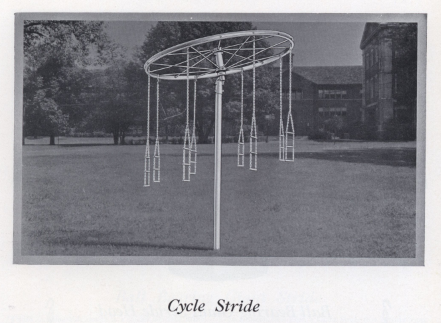
Playground swings are found in a variety of materials and styles which I suppose are based on what's available and what the community believes it needs at the time. While some playground equipment has been deemed unsafe, swings are still around despite the danger because they can't be outlawed. The public won't stand for it and although I am not a protester by nature, I will be one of the first in line to protest the removal of the simple swing.
My grandfather built my grandmother a swing when they immigrated from Finland in 1930 and I remember summer visits watching her swing. Mamma was the only adult I ever saw who enjoyed such a pleasure and the sight of her smile as she swung taught me the lesson of finding joy in the little things of life.

As you can see from the above photo, Mamma's swing was BIG and it lasted for years. Not only did I enjoy it while growing up, but I used it whenever I visited with my own growing family. I never asked my husband for a swing, yet one day after we'd been married a dozen or so years he built one using the same principle of Mamma's and that is attaching it to the clothesline pole. As you can see from this next photo taken in the mid-80's, my husband and daughter had as much fun swinging as I did. It was the perfect way to relax after spending hours working in our garden.

We moved a few years later and I had to do my swinging with the kids in playgrounds after that. But you see in the photo how my husband is standing up? That's a lot easier to do on the wooden plank swings than on the newer plastic ones, or even those rubber ones that turn your clothes black.
My research into old style swings dug up some amusing photos of mothers and their kids, including this one taken in 1910 with, "Mrs. Turner, holding daughter, who is standing in a swing, while looking down at her son holding a kitten." The image is from A Study of Mrs. Turner and her Children, Waban, Mass. and seems to show the mother teaching her daughter how to swing while standing.
 |
| The swing, a study of Mrs. Turner and her children. Made at Waban, Mass., 1910. Source: Library of Congress Prints and Photographs Division Washington, D.C. |
I found a similar photo in Virginia showing the Art Brown Family at the swings. This one clearly shows that this mother didn't see the danger of her son falling on his head, or if she did, didn't think it was serious enough to stop him from doing it.

For younger children I found this undated glass negative of children in chair-like wooden swings taken at Hamilton Fish Park, New York. Does anyone want to take a guess at the year?
 |
Children in swings,
Hamilton Fish Park, New York, undated. Source: Library of Congress Prints and
Photographs Division Washington, D.C.
|
Going back to 1910 is another glass negative showing wooden children's swings in an open-walled shelter from a N.Y. playground.
 |
| N.Y. Playground, between ca. 1910 and ca. 1915. Source: Library of Congress Prints and Photographs Division Washington, D.C. |
But the joy of swinging isn't always a solitary pastime as the above image shows. If the saying, the more the merrier is any indication, then the wooden circular swing in the next image from San Augustine, Texas, should be loads of fun.
 |
| Schoolchildren on circular swing, San Augustine, Texas, Aug 1939. Source: Library of Congress Prints and Photographs Division Washington, DC |
Or would it? Does a circular swing have the same back-and-forth motion like a regular pendulum-type swing? Surely you can't pump your legs for more motion--or can you? Does it turn in a circle as it swings? Has anyone memories of a circular swing that they'd like to share?
When was the last time you had a good swing? Care to share your thoughts and memories of swinging?
For the record, my next posts (on the fifth day of each month) will be on tire-type and character swings, lawn swings, porch swings, etc, in no particular order.
~~~~~~~~~~~~~~~~~

 Anita Mae Draper's historical romances are written under the western skies of the Saskatchewan prairie where her love of research and genealogy yield fascinating truths that layer her stories with rich historical details. Anita's short story, Here We Come A-Wassailing, was a finalist for the Word Guild's 2015 Word Awards. Her novellas are included in Austen in Austin Volume 1, The American Heiress Brides Collection, and The Secret Admirer Romance Collection. Readers can check out Anita's Pinterest boards for a visual idea of her stories to enrich their reading experience. Discover more at:
 Pinterest - www.pinterest.com/anitamaedraper/