Showing posts with label Daniel Boone. Show all posts

Friday, July 17, 2026

The Historical Origin Of The Terms Hillbilly and Redneck


My father often declared proudly he was a hillbilly. He grew up in Illinois on a farm. His siblings made the same claim. Although the media painted the hillbilly as poor white trash who lacked intelligence, that was not my family at all. Now I live in the Southwest. My pastor, who grew up in Mississippi, often declares he's a redneck, taking the insults surrounding the term to task.

That reminds me that the early believers in Jesus were first called Christians in Antioch. The new religion was so different, it was spoken as a slur. Yet the believers bore the name proudly. Look how that worked out.

Today, I want to share with you the historical origins of Hillbilly and Redneck. Both terms have taken on a negative connotation thanks to journalists and cartoonists who portray a group of farmers as ignorant buffoons. The entertainment value has evolved through the twentieth century with Lil Abner and the silly Mountain Dew commercials containing the tagline "Yahoo Mountain Dew", delivered by a bunch of bare-footed, poorly dressed men guzzling the soft drink as if it were moonshine.


As a lover of history and my family, I filtered through all the hype that created this image of poor white trash. I found some interesting facts dating back to the 1600s. The Scots coined the term "Billy Boys," a name given to Scottish followers of King William III. Billy being a slang term for fellow. Anthony Harkiness Hillbilly: A Cultural History of an American Icon, claims the term's origin is the link between two old Scottish expressions "hill-folk" and "Billie" another word for fellow, or guy. These people lived in the hill country on the border of Scotland and England.

It is said that Scottish and Scots-Irish people, the Scottish Low-land and Ulster Presbyterians who immigrated en masse to America during the 1700's brought their traditional music with them to the New World. Many of the songs dealt with William, Prince of Orange, who defeated the Catholic King James II of the Stuart family at the Battle of Boyne, Ireland in 1690. They preserved their history through their music.

The Scots-Irish went from the hills of Scotland and Ireland to the Appalachian and Ozark hill country.

They maintained their tight-knit, clannish social structure. We all recall the famous Hatfield and McCoy feud that lasted for years. Mark Twain had a scene in The Adventures of Huckleberry Finn depicting a hillbilly feud.

These sorts of altercations are the background for our modern-day stereotype.

The Scots-Irish were often encouraged to settle in the harsh lands between the civilized areas and the wilderness. They were a buffer between the burgeoning colonies and the Natives who hated the white man encroaching on their lands. These hillbillies understood the native tribal hierarchy as it was similar to clan life, and they often existed peacefully with the Natives. Hillbillies adapted well to the rough lands in the mountains. There were many noted Americans who lived in those hills, Daniel Boone and Davey Crockett to name just two.


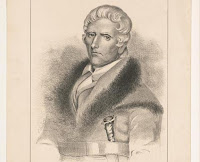
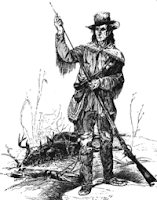
Daniel Boone &Davey Crockett
 

 On to the origin of Redneck

In Scotland in the 1640s the Covenanters rejected rule by bishops, often signing manifestos using their own blood. Some wore red cloth around their necks to show their position. The Scottish ruling class called them rednecks, recognizing them as rebels in what was later called The Bishop's War that preceded the rise of Oliver Cromwell as ruler of Britain after deposing Charles I.


Over time, the term came to refer to Presbyterians, especially those along the Scottish border. Some believe because of the large number of Scottish immigrants in pre-revolutionary American South, this may be the origin of the term redneck in America.

Authors Jospeh Flora and Lucinda MacKethan, noted professors of Southern culture and literature, give this stereotype description:

Redneck is a derogatory term currently applied to some lower class and working class southerners. The term, which came into common usage in the 1930s, is derived from the redneck beginnings as a "Yeoman farmer" whose neck would burn as he toiled in the fields. These yeomen farmers settled along the Virginia, North Carolina and South Carolina coasts.

Here is another possible origin story.

There are those who believe the term redneck originated during the West Virginia Mine Wars in the early 1920s. Workers who wanted laborers' rights wore red bandanas around their necks and marched up Blair Mountain during the confrontation for workers' rights. Sounds like they followed the ancestors' example from the Bishops' War.

By 1900, "redneck" was used to refer to political factions within the Democratic party, setting apart the poor white farmers in the south.

As you can see, hillbilly and redneck have both evolved through the centuries. Yet, many Americans, like the early followers of Christ, wear the derogatory label proudly.

Country Music has its roots in the hillbilly culture of the Appalachian and Ozark mountains. The rednecks showed themselves as more than poor folks under the thumb of big business when they boldly fought for workers' rights.

Most Scots-Irish in American, no matter where they live geographically can trace their lineage back to those same "Billy Boys" who supported King William III for their religious freedom from James 1. Yep, my father's people were Presbyterian farmers who proudly claimed the name hillbilly.

Did you know the origin of these derogatory terms?


Cindy Ervin Huff, is a multi-published award-winning author in Historical and Contemporary Romance. She’s a 2018 Selah Finalist. Many of her Historical books have Scots-Irish characters as a nod to her ancestry.

Cindy has a passion for encouraging other writers on their journey. When she isn’t writing, she feeds her reading addiction and enjoys her retirement with her husband of 50 plus years, Charles. Visit her at www.cindyervinhuff.com. You can find all her books there.


Rescuing Her Heart

As her husband’s evil deeds haunt a mail-order bride from the grave, can she learn to trust again and open her heart to true love?

On visitation rounds as a lay preacher, the last thing rancher Jed Holt expects is to be shot at from the barn next to a burned-down homestead. But the soot-covered woman hiding inside needs protecting, and Jed is the man to do it whether she likes it or not.

Delilah James’s nightmares began when she came to Kansas as a mail-order bride. Her husband was nothing like his letters. Now that he is dead, she can’t shake his abuse from her heart. Trusting men tops her never-again list and taking a job on the Holt ranch as a housekeeper is a means to save money and bring her parents west. But her attraction to the compassionate former chaplain both angers and confuses her.

Jed has his own nightmares from a POW camp and understands Delilah better than she knows herself Can two broken people form a forever bond? Click here to buy.


Wednesday, February 9, 2022

Kentucky - First State West of the Appalachians

   By Tiffany Amber Stockton


Last month, I began a new series on Kentucky history and the pioneers who established the state. If you missed that post, you can read it here. This month, we're delving a bit more into Daniel Boone and his forays into the Kentucky frontier.

DANIEL BOONE - KENTUCKY PIONEER


Kentucky was granted statehood in 1792, becoming the first U.S. state west of the Appalachian Mountains. I spent 25 years of my life in Delaware, the First State of U.S., so it's ironic I now live in another "first state." While the original thirteen colonies were engaging in small battles with England over governorship, taxes, political representation, and various freedoms, many residents of those colonies decided to strike out on their own and start exploring the frontier to the west.


Frontiersman Daniel Boone was one of Kentucky’s most prominent explorers, and many immigrants followed the trail he blazed through the Cumberland Gap, known as the Wilderness Road. His story doesn't begin there, though. He was born in 1734 in a small township northwest of Philadelphia, and at age 15 left Pennsylvania with his family. They headed to the Shenandoah Valley of Virginia, but Daniel left not long after and settled along the Yadkin River near the western edge of North Carolina.


Instead of farming, Boone became a marker or long hunter and made his living selling deerskins from long hunting expeditions out in the wilderness. He was gone for months or years at a time with that trade. In 1755, while serving as a wagoner for General Braddock back in Pennsylvania, he met a trader who regaled him with stories of the abundant wildlife and financial opportunities west of the Appalachian Mountains. But that exploration was put on hold when Daniel married and started a family. He continued to hunt throughout the Carolinas and even down to what became Florida.

In early 1769, that trader (John Findley) found Daniel again and relit the spark in Boone's wanderlust nature. He spent the next four years exploring that wilderness area, and in 1773 began escorting settlers with the intention of permanently settling Kentucky. In 1775, a judge enlisted Boone's help to negotiate with Cherokee tribes and purchase their claims, then he cut a path through southwestern Virginia and northeastern Tennessee that would become the Cumberland Gap Road.

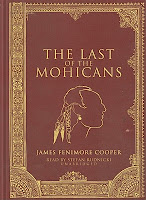
Despite ownership of the land, the settlement of Kentucky was fraught with a great deal of conflict, as England secured the support of the natives to attack settlers during and even after the Revolutionary War. Many were captured and forced to live among the Cherokee or Shawnee. Boone was one of them, although he only lived among the Shawnee for a few months before escaping. His daughter had been captured the year before, but immediately rescued by Boone and his men. That story was eventually immortalized by James Fennimore Cooper in The Last of the Mohicans.

For the next seven or eight years, raids continued and casualties increased. So many battles, and so many deaths among the British, the American settlers, and the natives, all over who would ultimately own the land. By 1787, the British were completely run out and in 1792, statehood was granted. Nearly thirty years of exploration, settlement, and defense had ultimately produced a new state for the U.S., and Daniel Boone became immortalized in American history.


NOW IT'S YOUR TURN:

* Have you ever left your family to move or settle in a completely different region?

* What famous settlers or pioneers are known where you live?

Leave answers to these questions or any comments you might have on this post in the box below. Come back on the 9th of March to learn some fun facts pertaining to Kentucky.


For those interested in my "fictional" life as an author and industry news about other authors, subscribe to my newsletter. Receive a FREE omitted chapter from my book, A Grand Design, just for subscribing!


BIO
Tiffany Amber Stockton has been crafting and embellishing stories since childhood, when she was accused of having a very active imagination and cited with talking entirely too much. Today, she has honed those skills to become an award-winning, best-selling author and speaker who is also an advocate for literacy as an educational consultant with Usborne Books. She loves to share life-changing products and ideas with others to help improve their lives in a variety of ways.

She lives with her husband and fellow author, Stuart Vaughn Stockton, along with their two children and two cats in Kentucky. She has sold twenty-four (24) books so far and is represented by Tamela Murray of the Steve Laube Agency. You can find her on Facebook and GoodReads.

Sunday, January 9, 2022

Horse Racing & Kentucky Pioneers - William Whitley

  By Tiffany Amber Stockton


Last month, in the spirit of Christmas, we learned about some of the island traditions surrounding this special holiday on Chincoteague Island. If you missed that post, you can read it here. This month, I'm beginning a new series featuring facts and people who discovered and settled what is now southeastern Kentucky.


With all the past research I have on my personal family history, and since we have recently moved to Kentucky after 15 years living in Colorado, I needed a new focus as I work on the books coming from my previous research. I'm not sure what will come of what I discover this year, but I'll be keeping my readers informed on my FB Page and VIP  readers group.

You can also stay current on my "fictional" life as an author and receive industry news every 3 months by subscribing to my newsletter. Receive a FREE omitted chapter from my book, A Grand Design, just for subscribing!

WILLIAM WHITLEY - KENTUCKY PIONEER


My family now lives in Whitley County in Kentucky, and as I was driving up the interstate, I saw signs for the William Whitley Historical House. That set me off on a rabbit trail of research looking up who this man was and why he was so important to the state, or commonwealth of Kentucky. I've only just begun to scratch the surface, but here is what I've learned so far.

William Whitley was born in Virginia, and his parents were immigrants from Ireland. Just before the onset of the Revolutionary War, Whitley suggested to his wife that they leave Virginia and move a little west across the Appalachians into the uncharted territory there. Following a scouting expedition, Whitley laid claim to a parcel of land and planted ten acres of corn as proof of ownership. Unfortunately, the local Shawnee and Cherokee tribes weren't too happy with Colonial settlers encroaching on the land the British had promised would be theirs, and they responded with escalated hostility.

William was quite the adventurer, though, and he wasn't one to give up easily. Although he and the other family who scouted with him sought safety inside a nearby fort, Whitley continued to fight for his land. He spent a little time after the Revolutionary War in the Northwest Territory fighting Indians, but when he returned, he again set forth with building his home.

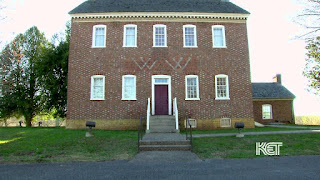
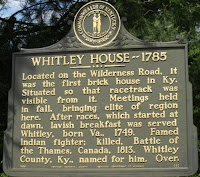
There are a lot of amazing features about the home William built. It was the first brick home west of the Allegheny Mountains, built somewhere between 1787 and 1794. The brick he used was two feet thick!  He did that to help protect his family from Indian attack. He also put the windows high above the ground so attackers couldn't shoot straight through at him, and he didn't have a porch or patio or anywhere around the home where attackers could hide. Rather ingenious of him, I'd say.

One feature I found endearing is that in addition to his own lighter bricks bearing his WW initials, he also had brick initials of EW placed in honor of his wife, Esther, to the rear of the house. He might be a famed Indian hunter, but his wife was known for being a sharpshooter herself. Guess they made quite the pair together!

Although he called his home "Sportsman Hill," friends and area residents considered it the "Guardian of Wilderness Road," so it also holds that name. It actually became a popular meeting and gathering place for other Kentucky settlers like George Rogers Clark and Daniel Boone.

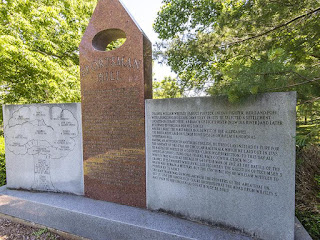
Whitley County and its county seat of Williamsburg were both named after William Whitley. One of his grandsons was William L. Sublette, a fur trader who became co-owner of the Rocky Mountain Fur Company with Jedediah Smith. There's even Whitley City named after Colonel Whitley.

Another fun fact is how important William Whitley was to the establishment of horse racing in the United States. He was an avid fan of the sport, but he didn't care much for how the British designed their tracks. So, he built a track out of clay instead of turf, and he designed the track to be raced in counter-clockwise fashion instead of clockwise as it's done in England. It's why Kentucky is now world-famous for its horse-racing venue and is an integral location for the sport.

My daughter has been bitten by the horse-loving gene that flows down from my mother's side of the family, so we've already made plans to attend the Kentucky Derby and check out the various breeding farms and racing venues throughout the state, as well as the Derby Museum. She even wants to attend a summer horse camp, but we'll have to see about that. *grins*


NOW IT'S YOUR TURN:

* Have you researched anything about the area where YOU live? Are there any interesting facts or people from history who were pioneers in your area?

* What kind of person do you think you would have been had your birthday been in the 1600's or 1700's instead of the 1900's?

Leave answers to these questions or any comments you  might have on this post in the box below. Come back on the 9th of February to learn more about Daniel Boone and his trek across the Cumberland Gap.


BIO
Tiffany Amber Stockton has been crafting and embellishing stories since childhood, when she was accused of having a very active imagination and cited with talking entirely too much. Today, she has honed those skills to become an award-winning, best-selling author and speaker who is also an advocate for literacy as an educational consultant with Usborne Books. She loves to share life-changing products and ideas with others to help improve their lives in a variety of ways.

She lives with her husband and fellow author, Stuart Vaughn Stockton, along with their two children, two dogs, and two cats in Kentucky. She has sold twenty-four (24) books so far and is represented by Tamela Murray of the Steve Laube Agency. You can find her on Facebook and GoodReads.

Saturday, November 14, 2020

Daniel Boone’s Baby Brother ~ Squire Jr.

By Johnnie Alexander

You may be familiar with the famous exploits of Daniel Boone, one of our nation’s first folk heroes thanks to his blazing of the Wilderness Road through Cumberland Gap, his military exploits in the Revolutionary War, and his legendary heroism as a frontiersman. Daniel’s adventures made him a household name during the last quarter of the 18th century and into the early years of the 19th century.

[Caption: 1820 Painting by Chester Harding (only known portrait of Daniel Boone)]


But Daniel wasn’t the only Boone who was popular at that time. So was his younger brother ~ Squire Maugridge Boone, Jr.

Daniel (1734-1820) was the sixth of eleven children born to Squire Boone, a weaver and blacksmith who immigrated from England, and Sarah Morgan. Her family were Quakers from Wales.

Squire Jr. (1744-1814) was the tenth child born to the couple. During his lifetime, he was as well-known as his older brother. He was also a frontiersman, an explorer, and a politican. Both brothers served in the Virginia Legislature.


[Caption: Squire Boone Crossing the Mountains with Stores for His Brother Daniel, Encamped in the Wilds of Kentucky, by William Title Ranney (1852)]

Squire accompanied Daniel through the Cumberland Gap in 1775 and helped to settle Boone’s Station, known today as Boonesborough, Kentucky. Later he moved to other settlements and eventually ended up in southern Indiana where years before he and Daniel evaded Indians by hiding in a local cave.


Squire believed the cave was sacred and wanted to be buried there. Instead he was buried in a cave on his property until the mid-20th century when relic-hunters looted the coffin. Now he's buried at Squire Boone Caverns, an attraction near Mauckport, Indiana.

The grist mill which Squire built is listed on the Indiana Register of Historic Sites and Structures.


Visitors can tour the grist mill, caverns, and the nearby pioneer village. For more information visit the Squire Boone Caverns official website.

Squire may not be as famous today as his older brother, but they shared similar experiences and contributed to the settling of our country. Both were born in a 1 1/2 story log house built by their father near what is now Reading, Pennsylvania. The farm is now a museum with interactive displays and hiking trails known as the Daniel Boone Homestead. But perhaps it should be known as the Daniel and Squire Boone Homestead!

Where Treasure Hides


While British officer Ian Devlin fights for freedom on the battlefield, artist Alison Schuyler works with the Dutch Underground to find a safe haven for Jewish children and priceless pieces of art alike. Will Alison and Ian have the faith to fight for their love, or is it their fate to be separated forever?


Friday, November 1, 2019

Happy Birthday Daniel Boone


Blogger: Amber Schamel
Daniel Boone Age 84
Today marks what would have been the birthday of one of America's greatest heroes, Daniel Boone. A dedicated frontiersman and explorer, Daniel Boone became one of the most celebrated men in American literature and inspired boys and girls around the nation long after his death. 

Daniel Boone was born on November 2, 1734 to Sarah Morgan and Squire Boone in a log cabin in Pennsylvania. He was the sixth born of eleven children. He had a love of the outdoors and even as a young adult, he supplemented his family's income by hunting and trapping. 

Daniel's father, Squire Boone, had emigrated to Pennsylvania because he was persecuted in England for his Quaker faith. However, this faith benefited Daniel and his pursuit of hunting and exploration. The area where Daniel was raised was, at the time, the edge of the frontier. The Lenape Indian tribes resided nearby, and because the Quakers were pacifists, they enjoyed good relations with the tribe. The Lenape contributed to Daniel's knowledge of the wilderness. At the age of twelve, Daniel received his first rifle. 


Since Daniel's education was informal, at best, many expressed concern over his illiteracy. Boone's spelling was....unconventional. However his father defended him by saying, "Let the girls do the spelling. Dan will do the shooting." However, Daniel did possess enough education to accomplish his calling in life. While the majority of his time was spent as an outdoors man and frontiersman, he also went on to become a politician. Daniel Boone was an avid reader. He often took reading material with him on hunts and excursions, and he would often entertain his companions by reading to them. His favorites were the Holy Bible and Gulliver's Travels. 

Since Boone grew up as a Quaker, it is interesting that he volunteered for the French and Indian war, and also served during the Revolutionary War. However, his family was expelled from the Quaker fellowship when he was a young man, and he identified as a Christian, but not as a Quaker. It could be that the experience of excommunication caused him to renounce his family's Quaker beliefs. 

Despite the obstacles that Daniel Boone faced throughout his life, he is an inspiring example of courage and what one person can accomplish in a lifetime. These qualities make him an outstanding man and icon in American history and literature. It is men like him that make us proud to be Americans.

Happy Birthday, Mr. Daniel Boone! 


*****
Two-time winner of the Christian Indie Award for historical fiction, Amber Schamel writes riveting stories that bring HIStory to life. She has a passion for travel, history, books and her Savior. This combination results in what her readers call "historical fiction at its finest". She lives in Colorado and spends half her time volunteering in the Ozarks. Amber is a proud member of the American Christian Fiction Writers Association. Visit her online at www.AmberSchamel.com/ and download a FREE story by subscribing to her Newsletter!