Showing posts with label Dime Novels. Show all posts

Tuesday, March 25, 2025

Dime Novels of the Old West—and a Giveaway


By Jennifer Uhlarik


Howdy, readers! I’m back to share another interesting tidbit of my research from my upcoming release, Love and Order: A Three-Part Old West Romantic Mystery. This month, I thought I’d share about the research I did for the character of Lucinda Peters. This spunky heroine is a dime novelist and aspiring newspaper reporter. Have you heard of dime novels? If not, let me share what these were.


Around the time of the American Civil War, the literacy rate in this country began to grow. In response to the uptick of readers in America, people began looking for easily accessible material to read. Publishers Erastrus and Irwin Beadle met that need when, in 1860, they began releasing a new series of fiction novels, printed in inexpensive paperback formats, and sold for ten cents each. The topics of these novels most often centered around America’s western frontier—stories about the Gold Rush and/or mining camps; building of the railroad; lawmen, outlaws, and other notable characters of the frontier; and many other such topics.


The first Dime Novel,
published in 1860.
Note the lack of cover artwork.


The first of these “dime novels” was a reprint of a serialized story written by Ann S. Stephens (who went on to author many of Beadle’s dime novels), titled Malaeska, the Indian Wife of the White Hunter. This serialized story first appeared some twentyish years earlier in the Ladies’ Companion magazine, so the material was old enough that most people wouldn’t immediately recognize it as a reprinted story. It came wrapped in a salmon-colored paper, with no artwork on the cover—only the title. However, in its new format as a dime novel, this story of roughly 100 pages sold around 65,000 copies in its first several months. It was a hit!


Another early example of a
dime novel, this time with 
cover artwork.


Because of this early success, Beadle, along with Ann Stephens, went on to reprint more of her older, serialized stories. And as this new series grew in popularity, the publisher had Stephens write new, original material for their novels as well. With the quick success of the Beadle’s Dime Novel series, particularly with the younger readers, other publishers followed in their footsteps. By the end of the Civil War, there were all manner of publishers putting out their own versions of the dime novels. Each publisher had their own style—the dimensions of their books might be a little different, and one company’s covers might have black-and-white artwork while another company’s cover sported only the title. At first, each was sold with a colored outer wrapping—a different color for each publisher, but as time went on and printing technology became better, the covers changed to color printing on white paper. Also, the topics covered began to grow. Not only were they stories of the American frontier—but also historical romances, science fiction, mysteries, war stories, adventure stories, and more. Interestingly, dime novels were often authored by women.

Dime novel with a color cover.


Dime novels quickly developed a reputation as not being of the greatest literary quality. In fact, many in polite society frowned on this form of cheap entertainment. The stories were churned out quickly, and the writing wasn’t always of the highest quality. Within the stories themselves, the exploits of the characters were often exaggerated, making the lawmen sound more righteous or the outlaws more villainous than they truly were. Often, the storylines covered only the most superficial aspects without getting to the true depths of the real story. So many of the highbrow folks in society took the view that these cheap novels contributed to the degradation of their society.   


Despite the poor view many held of this literary form, dime novels endured in popularity for decades. The original dime novel series from Beadle was published from 1860 until sometime in the 1920s. The company published 321 issues in its sixtyish-year run. The many other publishers also continued into the first few decades of the 1900s, but the fad finally died out around 1925.


A later version of the
dime novel.


A resurgence of interest in these early novels came in the 1940s and lasted into the 1950s. People began buying up old copies to add to collections they—or their parents and grandparents—had saved. Because of the very cheap paper these stories were printed on, they were often in fragile condition. Today, in 2025, there are still thousands in existence—but most are held in the Library of Congress, in collections at various universities around the country, or sometimes in the collections of museums or historical centers. Because of the fading quality of the papers, some collections have been digitized and are available online. To see one such collection, check out Nickels & Dimes.


It's Your Turn: Had you heard of dime novels? If you had lived in the time when they were popular, do you suppose you would have read them—or would you have seen them as bad for society? Leave your answer with your email address to be entered in a giveaway of a paperback copy of Love and Order: A Three-Part Old West Romantic Mystery. (U.S. Residents only, please).


Jennifer Uhlarik
 discovered western novels at twelve when she swiped the only “horse” book from her brother’s bookshelf. Across the next decade, she devoured westerns and fell in love with the genre. While attaining a B.A. in writing from the University of Tampa, she began penning her own story of the Old West. She has finaled in and won numerous writing competitions and appeared on various best-seller lists. Besides writing, she’s been a business owner, a schoolteacher, a marketing director, a historical researcher, a publisher, and a full-time homemaker. She lives near Tampa, Florida, with her husband and fur children.
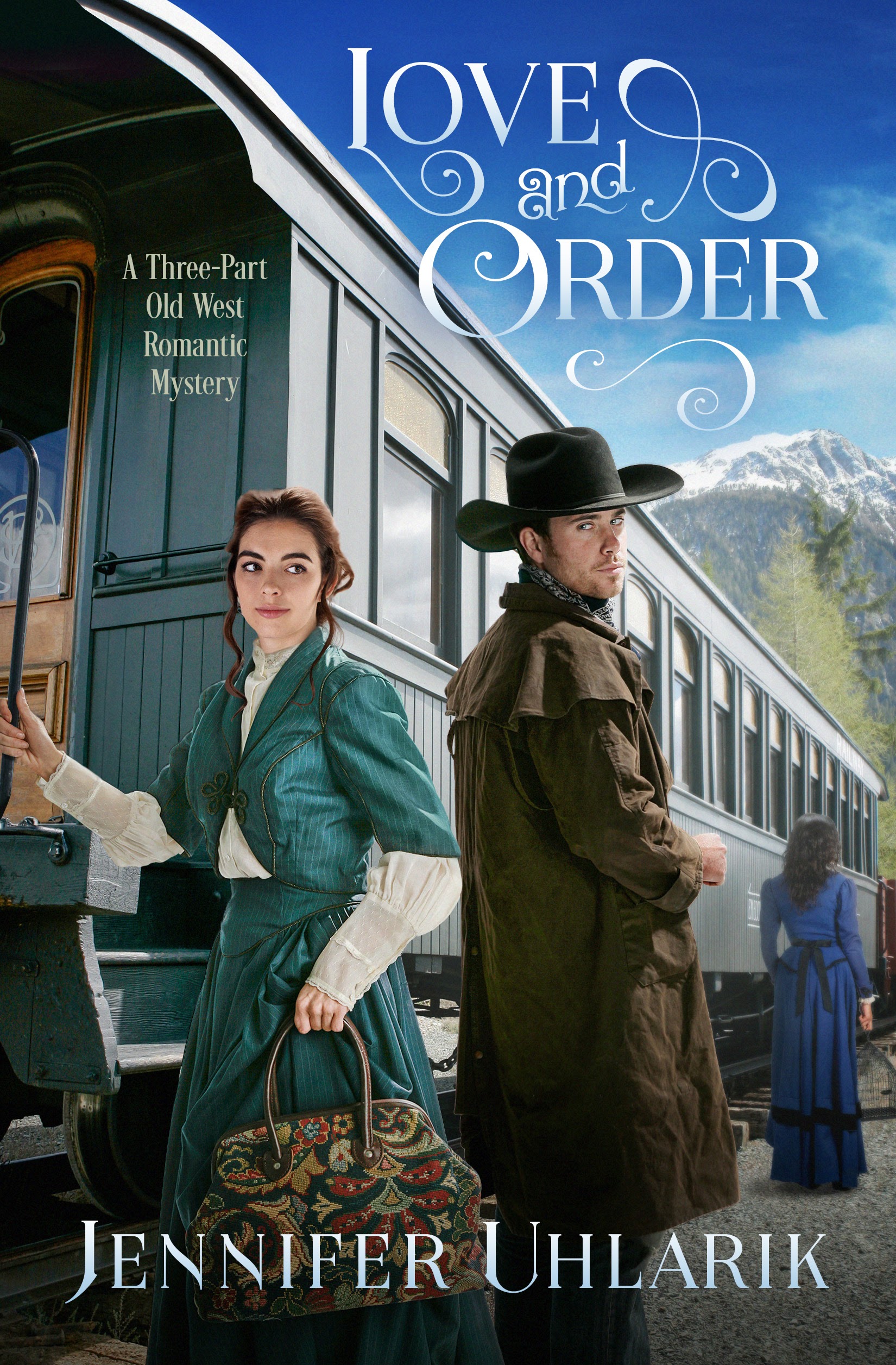


Love and Order: A Three-Part Old West Romantic Mystery (coming April 1, 2025)


Wanted: Family, Love, and Justice


One Old West Mystery Solved Throughout Three Short Romantic Stories


Separated as children when they were adopted out to different families from an orphan train, the Braddock siblings have each grown up and taken on various jobs within law enforcement and criminal justice.


Youngest child, Callie, has pushed past her insecurities to pursue a career as a Pinkerton agent. Middle child, Andi, has spent years studying law under her adoptive father’s tutelage. And the eldest and only son, Rion, is a rough-and-tumble bounty hunter. 


When the hunt for a serial killer with a long history of murders reunites the brother and sisters in Cambria Springs, Colorado, they find themselves not only in a fight for justice, but also a fight to keep their newly reunited family intact. How will they navigate these challenges when further complicated by unexpected romances?


Tuesday, August 10, 2021

A Dime for Your Stories


By Suzanne Norquist

I write dime novels—or I would have in the mid-1800s. They provided cheap, fun entertainment to the masses, unlike more expensive, serious literary works. I would have been in good company with the likes of Louisa May Alcott, Henry Wadsworth Longfellow, Robert Louis Stevenson, and Alfred Lord Tennyson. Many lesser-known and part-time authors also contributed to the genre. Financial compensation was attractive to a prolific author who could write one story after another quickly.
Erastus F. Beadle is considered the father of the dime novel. He had this to say about his project:

"The idea occurred to me in '59, and I began publishing in '60. The state of the book market was then peculiar. Everyone was publishing books with thick paper and wide margins—trying to see how little they could give their readers for a dollar or a dollar and a half. . .Everyone said [the dime novel] would fail, but it didn't."
A couple of factors contributed to the industry's success. One was the development of lighter, cheaper paper along with improved printing processes. Another was the literacy of the masses. Railroads aided in national distribution of the novels. Soldiers in the Civil War used the stories to stave off boredom as they waited in camp, and factory workers needed a diversion in their off time.

Many of the early stories centered around Indians. They branched out to include western adventures and romance. Detective stories followed later.

Dime novels weaved tales of dramatic adventures, ones that were too over-the-top to be true. They followed basic formulas, and virtue always won out. The exaggerated nature of the stories caused many to criticize the novels and the people who read them.
According to an 1885 newspaper article in the Pueblo Chieftain, a trustee of a library in Boston attempted to "cure" small boys from reading the novels. It's a "disease with its own poison." He created a scrapbook of boys who read the novels. Presumably, these boys performed stunts they’d read about and suffered the consequences. After studying the scrapbook, "[The boy] asks the person in charge of the reading room for a better class of books."

Lower-class Americans openly read dime novels. Those in the middle class read them too but were embarrassed to admit they enjoyed the mindless entertainment.

Women purchased romance and adventure stories. Though the majority of the authors were men, a number of them were female.
Authors wrote detective stories before the heyday of dime novels, but these books undoubtedly contributed to the budding genre. Dime novel detective Frank Reade was the first to use the word sleuth to denote a detective. Before that, the term referred to a bloodhound trained in tracking.

In the early 1900s, pulp magazines (made from inexpensive paper pulp) slowly replaced dime novels. The stories didn't really change, but the medium for sharing them did.

Like in the days of the dime novel, everyone longs for a good story. Since I write fun stories for the masses, I would have been a dime novel author in the mid-1800s.

***

”Mending Sarah’s Heart” in the Thimbles and Threads Collection

Four historical romances celebrating the arts of sewing and quilting.

Mending Sarah’s Heart by Suzanne Norquist

Rockledge, Colorado, 1884

Sarah seeks a quiet life as a seamstress. She doesn’t need anyone, especially her dead husband’s partner. If only the Emporium of Fashion would stop stealing her customers, and the local hoodlums would leave her sons alone. When she rejects her husband’s share of the mine, his partner Jack seeks to serve her through other means. But will his efforts only push her further away?

For a Free Preview, click here: http://a.co/1ZtSRkK

Suzanne Norquist is the author of two novellas, “A Song for Rose” in A Bouquet of Brides Collection and “Mending Sarah’s Heart” in the Thimbles and Threads Collection. Everything fascinates her. She has worked as a chemist, professor, financial analyst, and even earned a doctorate in economics. Research feeds her curiosity, and she shares the adventure with her readers. She lives in New Mexico with her mining engineer husband and has two grown children. When not writing, she explores the mountains, hikes, and attends kickboxing class.

She authors a blog entitled, Ponderings of a BBQ Ph.D.

Saturday, June 12, 2021

Part Calamity - All Jane

By Kathy Kovach


The other day, I walked through the room as my husband had the Western Channel on. Some of the TV shows and movies in the western genre are, shall we say, less than accurate. I mean, come on. Playing cards with numbers on them? The wrong train whistles? Rough and tumble women with coral lipstick, false eyelashes, and pearls?

Yep, that last one really got to me. The actress was Judi Meridith in The Raiders (1963) and she was playing Calamity Jane.


Of course, when it comes to unlikely actresses taking on the iconic role, Doris Day and her tiny waist comes to mind. Other bombshell actresses to play the frontier woman include Jane Russell in The Pale Face, Yvonne de Carlo (The Munsters) in Calamity Jane and Sam Bass, and Anjelica Huston in Buffalo Girls. The latter played her closer to the vest.

With all the singing, hair flipping, and doe eyes for Bill Hickok, it made me wonder who the real Calamity Jane was.


Much of her life is shrouded in mystery and tall tales, some told by the woman herself. Let me be clear. Any truths about Calamity Jane have been blowing like ash from a long dormant campfire and many “experts” disagree on certain points. One seemingly accurate researcher tackled the subject and believes he was able to separate the truth from the myth. James D. McLaird refutes just about everything you’ve ever heard. But the larger-than-life legend is so much more interesting. If you wish to learn what he found, I suggest you visit Calamity Jane and Wild Bill Hickok (historynet.com)

Born Martha Jane Canary on May 1, 1856 in Princeton, Missouri, she died on August 1, 1903 at the age of 47. It’s said she looked twice her age at 30 due to a hard life.

That hard life started with her father who was a farmer (or gambler. . .or perhaps a gambler turned farmer,) and her mother, a prostitute. Both died leaving pre-teen Martha, the oldest of six, to take care of her siblings. It was on the wagon train with her family that Martha learned how to be a teamster, driving a team of oxen, using a 30-foot bullwhip to spur them on.


Much of the rest of her story is filled with adventure as she is said to have fought Native Americans, worked on the railroad, and according to her, rode for the pony express, though one or more of these accomplishments are probably just sensational tall tales. At one point, she became a scout at Fort Russell in Wyoming, something McLaird refutes. She also worked in saloons, and for a brief time followed the family business (the world’s oldest profession.) She did anything needed to take care of her brothers and sisters. Again, McLaird believes her siblings were farmed out to family. He also claims that she often wore dresses and did women’s work. But, of course, we also know that besides the mundane, she also dressed like a man, shot like a man, and rode a horse like a man. Not to mention her penchant for alcohol, smoking, and, shall we say, colorful words.


Calamity and Bill Hickok rode into Deadwood in June of 1876 in the same wagon train party. They became friends, but probably not lovers. A woman claiming to be their daughter surfaced, but it was proven fraudulent. Later, Jane supposedly married a man named Burke around 1885 and they did have a daughter. . .some think, others say no. Calamity Jane's history is so sketchy! Hickok and Calamity shared similar interests as both were dime novel celebrities and no doubt drank together. They’re buried near one another in the Deadwood cemetery, which fuels the imagination as to their relationship. If one were to weed through the sensational stories, one would find that the two only knew each other for a couple of months. Hickok was murdered while playing poker on August 1, 1876 by a man who was avenging his brother's death. Apparently, the lawman killed him in another town. Hickok was holding two pair: black aces and eights. This has been dubbed the dead man’s hand as a result. Twenty-seven years later, Jane was on a train and became ill. She made it to the Calloway Hotel in Terry, near Deadwood where she died on August 1, 1903, on the anniversary of Hickok's death. Her demise was most likely from her life of hard drinking.


At the grave of Bill Hickok in the 1890's
Deadwood, Dakota Territory

Somewhere along the way, she earned the name Calamity Jane and embraced the fitting moniker, even writing her own dime novel of her (ahem) true exploits. No doubt most of it was a work of fiction, but she read it aloud to eager audiences, I imagine performing some of the action.


To capitalize her notoriety, by 1893 she became employed in Buffalo Bill’s Wild West Show run by Bill Cody. In 1901, she traveled with the troupe to Buffalo, New York and the World’s Fair Pan-American Exposition.

In her kitchen with a cigar
Livingston, Montana 1901

Among the wild tales, Martha Jane had a heart of gold. It's been said that she exhibited compassion to the sick and needy. She worked as a nurse during a smallpox outbreak in Deadwood, volunteering to work where the fainthearted dare not go. 

Tall tales aside, Martha Jane Canary turned out to be a colorful character in our nation’s history. She may not have been your run-of-the-mill pioneer woman, but if she had been, she never would have carved her name, Calamity Jane, into our hearts.


MissAdventure Brides Collection
Seven daring damsels don’t let the norms of their eras hold them back. Along the way these women attract the attention of men who admire their bravery and determination, but will they let love grow out of the adventures? Includes:
"Riders of the Painted Star" by Kathleen E. Kovach

1936 Arizona
Zadie Fitzpatrick, an artist from New York, is commissioned to go on location in Arizona to paint illustrations for an author of western novels and falls for the male model.

Kathleen E. Kovach is a Christian romance author published traditionally through Barbour Publishing, Inc. as well as indie. Kathleen and her husband, Jim, raised two sons while living the nomadic lifestyle for over twenty years in the Air Force. Now planted in northeast Colorado, she's a grandmother, though much too young for that. Kathleen is a longstanding member of American Christian Fiction Writers. An award-winning author, she presents spiritual truths with a giggle, proving herself as one of God's peculiar people.


Monday, September 9, 2019

Dime Novels & Short Stories

By Tiffany Amber Stockton


Last month, we finished a summer foray into ghost towns around the US. If you missed that post, you can read it here: https://www.hhhistory.com/2019/08/boo-haunting-towns.html.

This month, as we are into the new school year and the return to established routines, I realize time spent on my writing career has taken a significant back seat position in my current season in life. Over the summer, my daughter was diagnosed with Asperger's (officially just a shade below the cutoff for Autism due to her social-emotional development), and we also discovered my husband has it too. This has had a drastic effect on my writing.

When I began my career, I was writing 3 books every year. Now? I'm lucky if I complete 1, and for the past 3-4 years, the ones I've managed to complete have been short stories or novellas rather than full-length novels. This certainly isn't the way I envisioned my life or my career would go. I'm definitely in a period of acceptance, new discoveries, and figuring out how all of this is going to fit together.

I'm not the only author to spend time penning short stories, though. So, let's delve into them for a bit right now.

THE NECESSITY OF THE DIME NOVEL AND SHORT STORIES


Image result for dime novels of the old westDime novels were short works of fiction, usually focused on the dramatic exploits of a single heroic character. As evidenced by their name, dime novels were sold for a dime (sometimes a nickel), and featured colorful cover illustrations. They were bound in paper, making them light, portable, and somewhat ephemeral.

Publishers issued dime novels in series, numbering each novel individually. Dime novels were read by literate adults of all ages, although over time young men and boys became the primary audience.

Image result for dime novelsIn 1860, the publishers Erastus and Irwin Beadle released a new series of cheap paperbacks, Beadle's Dime Novels. The first book in the Beadle series was Malaeska, the Indian Wife of the White Hunter, by Ann S. Stephens, dated June 9, 1860. The novel was essentially a reprint of Stephens's earlier serial, which had appeared in the Ladies' Companion magazine in February, March and April 1839. It sold more than 65,000 copies in the first few months after its publication as a dime novel.

Dime novels varied in size, even in the first Beadle series, but were mostly about 6.5 by 4.25 inches (16.5 by 10.8 cm), with 100 pages. The first 28 were published without a cover illustration, in a salmon-colored paper wrapper. A woodblock print was added in issue 29, and the first 28 were reprinted with illustrated covers. The books were priced, of course, at ten cents.

This series ran for 321 issues and established almost all the conventions of the genre, from the lurid and outlandish story to the melodramatic double titling used throughout the series, which ended in the 1920s. Most of the stories were frontier tales reprinted from the numerous serials in the story papers and other sources, but many were original stories.

As the popularity of dime novels increased, original stories became the norm. The books were reprinted many times, sometimes with different covers, and the stories were often further reprinted in different series and by different publishers. This would be a fantastic income-generating source for a lot of budding and established authors! I know I've gotten repeat royalties from reprints of my own short stories or novellas. *grins*

The literacy rate increased around the time of the American Civil War, and Beadle's Dime Novels were immediately popular among young, working-class readers. By the end of the war, numerous competitors, such as George Munro and Robert DeWitt, were crowding the field, distinguishing their product only by title and the color of the paper wrappers. Beadle & Adams had their own alternate "brands", such as the Frank Starr line. As a whole, the quality of the fiction was derided by highbrow critics, and the term dime novel came to refer to any form of cheap, sensational fiction, rather than the specific format. You could almost say this of critics today when describing the "mass market paperbacks" so readily available in the marketplace.

SHORT STORIES

Short stories date back to oral storytelling traditions which originally produced epics such as Homer's Iliad and Odyssey. Oral narratives were often told in the form of rhyming or rhythmic verse, often including recurring sections or, in the case of Homer, Homeric epithets. Such stylistic devices often acted as mnemonics for easier recall, rendition and adaptation of the story. Short sections of verse might focus on individual narratives that could be told at one sitting. The overall arc of the tale would emerge only through the telling of multiple such sections.

The other ancient form of short story, the anecdote, was popular under the Roman Empire. Anecdotes functioned as a sort of parable, a brief realistic narrative that embodies a point. Many surviving Roman anecdotes were collected in the 13th or 14th century as the Gesta Romanorum. Anecdotes remained popular in Europe well into the 18th century, when the fictional anecdotal letters of Sir Roger de Coverley were published.

Image result for arabian nightsIn Europe, the oral story-telling tradition began to develop into written stories in the early 14th century, most notably with Geoffrey Chaucer's Canterbury Tales and Giovanni Boccaccio's Decameron. Both of these books are composed of individual short stories (which range from farce or humorous anecdotes to well-crafted literary fictions) set within a larger narrative story (a frame story), although the frame-tale device was not adopted by all writers. At the end of the 16th century, some of the most popular short stories in Europe were the darkly tragic "novella" of Matteo Bandello (especially in their French translation).

The mid 17th century in France saw the development of a refined short novel, the "nouvelle", by such authors as Madame de Lafayette. In the 1690s, traditional fairy tales began to be published (one of the most famous collections was by Charles Perrault). The appearance of Antoine Galland's first modern translation of the Thousand and One Nights (or Arabian Nights) would have an enormous influence on the 18th-century European short stories of Voltaire, Diderot and others.

For a thorough and well-documented description of Short Stories, I recommend you check out the article available at Brittanica.com.


NOW IT'S YOUR TURN:

* Have you ever read a dime novel or short story? What is your favorite and why?

* Do you prefer to read short stories or full-length novels? Why?

* If you were to write, would you want to write a short story or a full novel? Why?

Leave answers to these questions or any comments on the post below. Come back on the 9th of February for my next appearance.


BIO

Tiffany Amber Stockton has been crafting and embellishing stories since childhood, when she was accused of having a very active imagination and cited with talking entirely too much. Today, she has honed those childhood skills to become an award-winning and best-selling author and speaker who is also an advocate for literacy as an educational consultant with Usborne Books. Through personal development, she strives to help others become their best from the inside out.

She lives with her husband and fellow author, Stuart Vaughn Stockton, along with their two children and three dogs in Colorado. She has sold twenty (21) books so far and is represented by Tamela Hancock Murray of the Steve Laube Agency. You can find her on Facebook and GoodReads.

Tuesday, June 25, 2019

The History of Collecting Autographs


One of the interesting aspects of being a published author that I’m still getting used to is when your name appears on the cover of a book, people ask for autographs. Don’t get me wrong. It’s a thrill, for sure. But the first time (or fifty), it felt really strange, too—probably because I know just what a goofball I am, how scatterbrained I tend to be half the time, and how very mundane my life is. I’ve been told some readers see their favorite authors as “rock stars”, but in my experience, most of us still struggle with the same silly things like what we are going to make for dinner, forgetting to buy toilet paper while at the store, or arriving late to pick our kids up from school. In other words, we’re normal people. We just happen to write stories that sometimes strike a chord with certain readers.

In my newest release, Taming Petra(part of the Cameo Courtshipsnovella collection), my heroine has had a series of Dime Novels written about her. In a couple different scenes, she is asked to autograph the tattered, well-read copies for her fans. While autographing books and memorabilia is a common request today, it occurred to me that I needed to check on when and how requesting an autograph came to be in history—just to be sure it was done in 1875, when the story takes place.


A Dime Novel about Calamity Jane

Apparently, it has long been a hobby of readers to collect the manuscripts of those authors they admire. So long that the custom goes back to at least 322 B.C. when Aristotle died and left all his writings to a successor, who then willed them to a disciple of his, and so on. Alexander the Great created a legendary library in Alexandria to house the writings of many literary greats. But it was with the Roman statesman and philosopher, Cicero (106 B.C.-43 B.C.), that we first saw anyone collecting the signatures of writers of his time. So autographs go back all the way to antiquity. 

The practice continued on, growing and morphing into other forms. By 1466, people began assembling books of their friends’ signatures in order to show the vastness of one’s acquaintances. A few hundred years later, these books took on a new form to benefit travelers. Those traveling would collect notes and signatures from each place they stopped as “letters of introduction” for their future stops on each journey. Often, this would lead to the traveler receiving aid and supplies along their way. 

Of course, eventually, people became wise to the monetary value of famous signatures. In the first half of the 1800’s in England, auctions began cropping where famous people’s signatures were sold at hefty prices.

But just because ancient Romans collected autographs of their literary heroes—or later civilizations found uses for books of autographs or ways to make money from them—that didn’t mean that it was a common practice in my story’s time frame. So when did the practice of collecting autographs on writings or memorabilia come to America?


William B. Sprague, one of the earliest
collectors of autographs in America.

The answer to that would be around 1815 with a man by the name of William Sprague. Sprague had some connection to the family of George Washington, and through that connection, he was given permission to take and keep as many of the first U.S. President’s writings as he wanted, so long as he made a copy of each to leave with the Washington family. Sprague ended up with roughly 1500 pieces of George Washington’s writings.

Signature of 1st President of the United States--George Washington

For a long time, America was too new to have many famous fiction authors—at least those writing fictionalized accounts about America’s history. Some of the early greats who wrote tales of the life in Colonial America or beyond were James Fennimore Cooper and Nathaniel Hawthorne, who both wrote in the mid-1800s. These men became favorites to request signatures from. Along with them were politicians, men like Zachary Taylor and Abraham Lincoln. It’s said that Lincoln had so many written requests for his signature that he employed certain staff members just to write the return correspondence to which he would sign his name.

Autograph of Abraham Lincoln
Across a span of 50+ years, early Americans collected and enjoyed a great many notable signatures, but by the 1870s and into the 1880s, those collectors began aging and dying off. This led to a lot of “homeless” autograph collections. And this, in turn, led to the American market for selling autographs. Autograph shops were created, as well as auction rooms where individual signatures or whole collections could be sold to the highest bidder.

And the practices of obtaining and buying/selling famous signatures continues even today.

It’s your turn: If you could request any historical figure’s autograph, who would you ask? Why?

Jennifer Uhlarik discovered the western genre as a pre-teen when she swiped the only “horse” book she found on her older brother’s bookshelf. A new love was born. Across the next ten years, she devoured Louis L’Amour westerns and fell in love with the genre. In college at the University of Tampa, she began penning her own story of the Old West. Armed with a B.A. in writing, she has finaled and won in numerous writing competitions, and been on the ECPA best-seller list numerous times. In addition to writing, she has held jobs as a private business owner, a schoolteacher, a marketing director, and her favorite—a full-time homemaker. Jennifer is active in American Christian Fiction Writers, Women Writing the West, and is a lifetime member of the Florida Writers Association. She lives near Tampa, Florida, with her husband, college-aged son, and four fur children.

Social Media Links:


Cameo Courtships—available now


A Family Heirloom Inspires Romance
In 1851, a special cameo is gifted by Queen Victoria to Letitia Newton, who though considered an old maid, meets the perfect gentleman minutes after donning. Told by the Queen the cameo is to be shared, Letitia gifts the "Victoria Cameo" to a woman in her family, hoping adventure and romance will follow each of its subsequent wearers.


Monday, January 9, 2017

Dime Novels and Short Stories

By Tiffany Amber Stockton


Last month, we finished a year-long spotlight on Chincoteague Island, and the unique facets of small-town island life. If you missed that post, you can read it here: http://www.hhhistory.com/2016/12/christmas-on-chincoteague-island.html.

This month, it's a new year, so it's time to start something new. However, I have come to realize my current season in life has had a drastic effect on my writing career. So, while I would love to begin a new series on my current research, it's time for a confession. I'm actually not researching anything specific at the moment, and my career has become a series of short stories or novellas rather than full-length novels.

With a full-time job, commitments outside the home, and the demands of raising two little ones (almost 8 and almost 6) plus caring for my marriage, my writing career had to shift a bit. It's still growing and still taking me on exciting journeys, but at this particular time, it's taken on a different life than I envisioned.

But I'm not the only author to spend time penning short stories. So, let's delve into them for a bit right now.

THE NECESSITY OF THE DIME NOVEL AND SHORT STORIES

Image result for dime novels of the old west
Dime novels were short works of fiction, usually focused on the dramatic exploits of a single heroic character. As evidenced by their name, dime novels were sold for a dime (sometimes a nickel), and featured colorful cover illustrations. They were bound in paper, making them light, portable, and somewhat ephemeral.

Image result for dime novelsPublishers issued dime novels in series, numbering each novel individually. Dime novels were read by literate adults of all ages, although over time young men and boys became the primary audience.

In 1860, the publishers Erastus and Irwin Beadle released a new series of cheap paperbacks, Beadle's Dime Novels. The first book in the Beadle series was Malaeska, the Indian Wife of the White Hunter, by Ann S. Stephens, dated June 9, 1860. The novel was essentially a reprint of Stephens's earlier serial, which had appeared in the Ladies' Companion magazine in February, March and April 1839. It sold more than 65,000 copies in the first few months after its publication as a dime novel.

Dime novels varied in size, even in the first Beadle series, but were mostly about 6.5 by 4.25 inches (16.5 by 10.8 cm), with 100 pages. The first 28 were published without a cover illustration, in a salmon-colored paper wrapper. A woodblock print was added in issue 29, and the first 28 were reprinted with illustrated covers. The books were priced, of course, at ten cents.

This series ran for 321 issues and established almost all the conventions of the genre, from the lurid and outlandish story to the melodramatic double titling used throughout the series, which ended in the 1920s. Most of the stories were frontier tales reprinted from the numerous serials in the story papers and other sources, but many were original stories.

As the popularity of dime novels increased, original stories became the norm. The books were reprinted many times, sometimes with different covers, and the stories were often further reprinted in different series and by different publishers. This would be a fantastic income-generating source for a lot of budding and established authors! I know I've gotten repeat royalties from reprints of my own short stories or novellas. *grins*

The literacy rate increased around the time of the American Civil War, and Beadle's Dime Novels were immediately popular among young, working-class readers. By the end of the war, numerous competitors, such as George Munro and Robert DeWitt, were crowding the field, distinguishing their product only by title and the color of the paper wrappers. Beadle & Adams had their own alternate "brands", such as the Frank Starr line. As a whole, the quality of the fiction was derided by highbrow critics, and the term dime novel came to refer to any form of cheap, sensational fiction, rather than the specific format. You could almost say this of critics today when describing the "mass market paperbacks" so readily available in the marketplace.

Image result for short stories

Short stories date back to oral storytelling traditions which originally produced epics such as Homer's Iliad and Odyssey. Oral narratives were often told in the form of rhyming or rhythmic verse, often including recurring sections or, in the case of Homer, Homeric epithets. Such stylistic devices often acted as mnemonics for easier recall, rendition and adaptation of the story. Short sections of verse might focus on individual narratives that could be told at one sitting. The overall arc of the tale would emerge only through the telling of multiple such sections.

Image result for chaucer's canterbury talesThe other ancient form of short story, the anecdote, was popular under the Roman Empire. Anecdotes functioned as a sort of parable, a brief realistic narrative that embodies a point. Many surviving Roman anecdotes were collected in the 13th or 14th century as the Gesta Romanorum. Anecdotes remained popular in Europe well into the 18th century, when the fictional anecdotal letters of Sir Roger de Coverley were published.

Image result for arabian nightsIn Europe, the oral story-telling tradition began to develop into written stories in the early 14th century, most notably with Geoffrey Chaucer's Canterbury Tales and Giovanni Boccaccio's Decameron. Both of these books are composed of individual short stories (which range from farce or humorous anecdotes to well-crafted literary fictions) set within a larger narrative story (a frame story), although the frame-tale device was not adopted by all writers. At the end of the 16th century, some of the most popular short stories in Europe were the darkly tragic "novella" of Matteo Bandello (especially in their French translation).

The mid 17th century in France saw the development of a refined short novel, the "nouvelle", by such authors as Madame de Lafayette. In the 1690s, traditional fairy tales began to be published (one of the most famous collections was by Charles Perrault). The appearance of Antoine Galland's first modern translation of the Thousand and One Nights (or Arabian Nights) would have an enormous influence on the 18th-century European short stories of Voltaire, Diderot and others.

For a thorough and well-documented description of Short Stories, I recommend you check out the article available at Brittanica.com.


NOW IT'S YOUR TURN:

* Have you ever read a dime novel?

* What is your favorite short story and why?

* If you had a choice, would you want to write a short story or a full novel? Why?

Leave answers to these questions or any comments on the post below. Come back on the 9th of February for my next appearance.


BIO

Tiffany Amber Stockton has been crafting and embellishing stories since childhood, when she was accused of having a very active imagination and cited with talking entirely too much. Today, she has honed those childhood skills to become an author and speaker who has partnered with Nerium International in the anti-aging, wellness, and personal development industry, helping others become their best from the inside out.

She lives with her husband and fellow author, Stuart Vaughn Stockton, in Colorado. They have one girl and one boy, and a Retriever mix named Roxie. She has sold twenty (21) books so far and is represented by Tamela Hancock Murray of the Steve Laube Agency. You can also find her on Facebook, Twitter, Pinterest, and LinkedIn.