Showing posts sorted by date for query william the conqueror. Sort by relevance Show all posts

Monday, April 3, 2023

The Garmo Stave Church at Maihaugen


by: Rebecca May Davie


Stave churches in all their wooden glory, were constructed from the early 12th century through nearly 1350 A.D. You can read a portion of their history in Stave Churches of Norway.

The Garmo Stave church at Maihaugen is the topic of discussion here. Maihaugen is an open air museum located in Lillehammer, Norway. Anders Sandvig, an ambitious young dentist wanted to preserve Norway’s history. He compiled a host of structures to allow visitors to peek into Norwegian life of former eras. One of these buildings is Garmo. A lovely church, built around 1200, it was dismantled in 1880 and rebuilt in 1921, where it stands today.
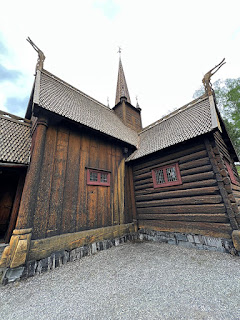


As the tale goes, the Viking King Olav Haraldson gave Tesse - a fishing lake, to Torgeir Gamle as payment for building a church in Garmo on farmland in 1021. To give a frame of reference for the time, William the Conqueror, was born around 1028.


Garmo Stave church replaced the initial church Torgeir built. This church has columns, known as staves, which serve as the supports. It has planks that fill the corner posts. See photo at right.
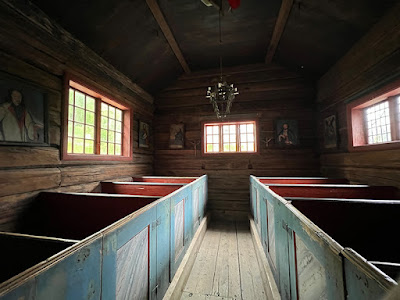


The original Stave churches did not have windows. Notice the dark interior even with the few added windows. The services must have required copious candles over the years. Imagine sitting in a pew box listening to a message. Packed in among your family and neighbors in the stuffy and dim interior, you would sit for an extended period. If I remember correctly, the guide explained that services lasted nearly three hours, sometimes longer. For this very reason, the wealthy parishioners purchased raised private boxes so they could nap if it became too lengthy. Interesting concept.


Why are there dragons at the roofline of the church? Norwegians believed these dragons and the crosses served as protection. You might recall similar dragons on their notorious ships. We saw multiple buildings, even houses with this symbol while visiting various regions of Norway.


Another aspect of Stave churches is that they could be expanded over time because of their design. Garmo was no exception to additions over the years. The bell tower in 1690 and a reworking in the cruciform style in 1730 are a few of the notable changes.

The pulpit at left depicts the life of Jesus in carvings. I shot this photo and the others in this post on a research trip to Norway in 2022. Also from this journey we learned the story of Anders Sandvig. Read more about Maihaugen next month.

Have you visited a Stave church in Norway or in another country? What were your impressions? 


As a child, Rebecca loved to write. She nurtured this skill as an educator and later as an editor for an
online magazine. Rebecca then joined the Cru Ministry - NBS2GO/Neighbor Bible Studies 2GO, at its inception. She serves as the YouVersion Content Creator, with over 75 Plans on the Bible.com app.

Rebecca lives in the mountains with her husband and a rescued dog named Ranger. If it were up to her, she would be traveling - right now. As a member of ACFW and FHLCW, Rebecca learns the craft of fiction while networking with a host of generous writers. She is working on her first fiction novel. This story unfolds from the 1830s in Northern Georgia.

Connect with Rebecca:
Clubhouse Facebook Goodreads Instagram Pinterest Twitter


Wednesday, November 2, 2022

Bayeux Cathedral


Bayeux, in Northwest France, is in the Calvados department of the Normandy region. Once an important Roman city, it was captured in 880 by Rollo the Viking, who became the first duke of Normandy in 911. Bayeux was a Norman stronghold. The people spoke the Norse language.

A descendant of Rollo, William the Conqueror was born in this area and his castle exists to this day. Other medieval structures also line the cobblestoned streets from as early as the 13th century. Stone was not as prevalent as in other regions of France and construction depended upon available materials. Half-timbered was the method employed.


This term refers to the wood timbers on the inside and outside of the buildings. In between the timbers are materials such as plaster, cob, or wattle and daub. To provide space on the narrow streets, the base consumes less space. The next floors may expand outward with each floor as they climb in height. Often timbers were not the same length or width, which provided unique designs. The appearance was not as important as the strength.

Another medieval structure present in Bayeux is the Notre Dame Cathedral. Norman-Romanesque in style, the cathedral hails to the 11th century. William, Duke of Normandy and King of England, was present for the consecration in 1077. Over the years the cathedral suffered damage. The first restoration resulted in the Gothic style evident on the upper levels and capped towers.


Visitors enter through one of the smaller doors at the front. In the middle of the front façade, two massive wood doors stake their claim under a rose window. Sadly, very little original stained glass remains in the cathedral.


A 180-degree turn provides a view of the nave. The bottom level is the original Romanesque presentation. The Gothic addition towers above. Historians believe that the Bayeux Tapestry hung within the nave. Imagine the 224-foot tapestry lining these stone walls. Observe the ornate pulpit on the left of the nave.


The crypt (beneath the altar) stored relics. It is one of the only remaining portions of the 11th century cathedral. The others are the towers at the western end and the first level of the nave.


Considering a trip to Bayeux? Which place would you visit first? Learn more in other Heroes, Heroines, and History posts: William the Conqueror, The Bayeux Lacemakers, The Bayeux Tapestry, and Liberty Trees. 


As a child, Rebecca loved to write. She nurtured this skill as an educator and later as an editor for an online magazine. Rebecca then joined the Cru Ministry - NBS2GO/Neighbor Bible Studies 2GO, at its inception. She serves as the YouVersion Content Creator, with over 75 Plans on the Bible.com app.

Rebecca lives in the mountains with her husband, the youngest of their two sons, and a rescued dog named Ranger. If it were up to her, she would be traveling - right now. As a member of ACFW, FHLCW, Jerry’s Guild, and Hope*Writers, Rebecca learns the craft of fiction while networking with a host of generous writers. She is working on her first fiction novel. This story unfolds from the 1830s in Northern Georgia.


Sunday, October 2, 2022

William the Conqueror's Birthplace

 by Rebecca May Davie


Welcome to the birthplace of William the Conqueror. This is the Calvados department of Normandy, France. The area is now known as the city of Caen.

Who was William the Conqueror? He became the first Norman
King of England. He was born in 1027 to Duke Robert the Magnificent and a Falaise tanner’s daughter, Arlette. Duke Robert died when William was a mere eight years old. William then began adding on to Le Chateau de Falaise (his family’s castle) and in addition, ordered the construction of two churches. His early years were turbulent with the deaths of many of his teachers and aids. King Henry I of France helped him navigate and knighted William in his teens.
The King of England, Edward the Confessor, did not have children and promised William succession. He died and William expected to secede. Yet, Harold Godwin was placed on the throne even though he
himself swore fealty to William just two years before. After, they met at the Battle of Hastings on October 14, 1066. Harold was fatally wounded with an arrow. William was “The Conqueror.” Just ten weeks later, on Christmas day, William was crowned the King of England at Westminster Abbey.

Immediately following his coronation, he began to invade England. He built castles with fortifications, installed allies, and squelched revolts with bloody battles. Life for the English changed without delay. He overhauled their language, religion, and other facets of daily life. King William built over 700 motte and bailey castles including the notable Tower of London and Windsor Castle. The structures began in wood that was replaced with stone. He required a census of people and property that was compiled into the Domesday Book. He died at the age of 60.


There are many methods to learn about life of William the Conqueror. A visit to Bayeux and The Bayeux Tapestry on display at the museum give a glimpse into his timeline. This embroidered fabric is 70 meters long and shows William’s conquest. Susan Page Davis wrote a post  on Heroes, Heroines, and History, The Bayeux Tapestry. 
While in Caen, visitors can experience where William lived. Tour Le Chateau de Falaise. Tablets available at check in, point to emblems throughout the building. These enable scenes to appear as the rooms were in William’s time. Imagine walking into a large Bed Chamber (half the square footage of a basketball gym) with a similarly high ceiling. Surrounded by stone walls, a fireplace camps along the side. A solitary bed adorns one wall. Two chairs flank the bed. This is all that is visible to the naked eye. Yet with the tablet, there are tapestries, rugs, curtains, and chairs. This volume of fabric assisted in keeping the immense, stone rooms warm. Heat also radiated from fireplaces and small braziers set in the middle of the spaces.


Wander up and down tight, steep stone staircases to see other open rooms. The Great Hall, Chapel, and apartments all offer virtual tours via touch tablet. In most rooms there is a film featuring a member of the Anglo-Norman court describing their daily life. These snippets give visitors an opportunity to learn about trades, clothing, food, and other features of the 11th century. In some halls there are protected etchings and carvings from the knights of the time – medieval graffiti, so to speak. Outside the Keep walls, viewing machines enable visitors to envision village life.
 

See the church of William’s youth at the base of the castle. L'église de la Trinité à Falaise, visible in the photo at right, was constructed in 840. It suffered damage and was rebuilt in 1204 in the gothic style.
  
Whatever the source, it is possible to learn a small measure about living in the 11th century. After visiting, the life of William the Conqueror may seem rife with strife. Opinions do continue to vary on his rule. Until a visit is possible, YouTube offers videos about his years and peeks inside the castle. Take a look…


As a child, Rebecca loved to write. She nurtured this skill as an educator and later as an editor for an online magazine. Rebecca then joined the Cru Ministry - NBS2GO/Neighbor Bible Studies 2GO, at its inception. She serves as the YouVersion Content Creator, with over 75 Plans on the Bible.com app.

Rebecca lives in the mountains with her husband, the youngest of their two sons, and a rescued dog
named Ranger. If it were up to her, she would be traveling - right now. As a member of ACFW, FHLCW, Jerry’s Guild, and Hope*Writers, Rebecca learns the craft of fiction while networking with a host of generous writers. She is working on her first fiction novel. This story unfolds from the 1830s in Northern Georgia.


Connect with Rebecca:

Tuesday, May 23, 2017

The Bayeux Tapestry

by Susan Page Davis


The Bayeux Tapestry is one of the world’s most curious art objects and historical records. It’s probably the most detailed and most complete existing account of the conquest of England by the Normans in 1066, and also gives an overview of life in England and France during the eleventh century. Although a few minor historical errors have been discovered in its content, it is extremely accurate as far as can be told, and therefore is generally accepted by historians.
This work of art has always been referred to as a tapestry, despite the fact that it is not really one at all. Tapestry is cloth made on a loom, with the design woven in. 

Photo—Norman Cavalry in tapestry: By Myrabella - Own work, Public Domain, https://commons.wikimedia.org/w/index.php?curid=25450703
However, the Bayeux Tapestry is actually embroidery. On long strips of bleached linen, the story was stitched using the method known as crewel embroidery, in which woolen thread or yarn is used instead of floss.

The pictures were probably drawn lightly on the linen first. It was then given to teams of craftsmen (or women) who did the actual embroidery. The work is made of eight long strips of linen, which were probably worked separately and sewn together after the embroidery was completed. Done in eight bright colors, the finished tapestry is 230 feet long by 20 inches wide. It depicts fifty scenes.

The theme of the piece is Harold’s downfall and William the Conqueror’s subjection of England. The most important and detailed scenes are Harold’s sacred oath to support William in succession to the throne of England, the death and burial of Edward the Confessor, Harold’s coronation, the preparation of William’s invasion fleet, and the vast, finely detailed battle scenes with which the tapestry ends.
Captions in Latin help to explain some of the scenes and to identify some of the more important characters.
 
This scene shows Harold taking his oath on relics to William the Conqueror. Public domain photo.

For many years, the tapestry’s origin was shrouded in legend and romanticism. Many believed it was created by William’s wife Matilda and her ladies while their husbands were off conquering England. As her personal gift to her husband, Matilda had a special ship built and outfitted to carry William across the English Channel. This ship was called the Mora. It is depicted in the tapestry as the finest in the fleet of seven hundred or more vessels that transported the soldiers, armor, supplies, and horses to England.

After the Conquest, Matilda became Queen of England. Although it is now almost certain that she had nothing to do with the making of the tapestry, many people continue to believe the legend. In France, it is still referred to as La Tapisserie de la Reine Mathilde, or “Queen Matilda’s Tapestry.”

Permission to use granted under the GNU free documentation license: Copyright (C) 2000,2001,2002 Free Software Foundation, Inc., 51 Franklin St, Fifth Floor, Boston, MA 02110-1301 USA

The prevalent belief today is that Bishop Odo, half-brother of William, ordered the tapestry made for display in his new cathedral at Bayeux, a small town near the sea in Normandy. Nothing is known about the designer, except that he or she was highly gifted and skilled and probably a Norman, since the entire story is told from the Norman point of view, with Harold’s breach of his sacred oath emphasized. Also, a great deal of Nordic detail and mythology is seen throughout the tapestry.

Strangely enough, most historians now believe the tapestry was constructed by English needle workers at the School of Embroidery at Canterbury, in Kent. One reason for this is that Bishop Odo was made Earl of Kent after the Battle of Hastings. The promise of lands for all was the main incentive used by William in raising his army.

The tapestry was completed after the Norman Conquest, probably between 1070 and 1080. Much of the truth about the events portrayed may have been lost, since the work was probably based on the reports, rumors, and gossip that followed the invasion.
 This portion of the tapestry portrays Harold as he arrives to inform William that he is the successor to King Edward. Public Domain.
 
After its completion, the tapestry was taken to Bayeux, where it was hung around the nave of Bishop Odo’s new cathedral, which was consecrated in 1077. There, all could see Harold’s sin and downfall, followed by the glorious triumph of the Normans. A treasured item at Bayeux Cathedral, the tapestry was displayed mainly on feast days and holidays. For hundreds of years, it was reverently cared for and cherished there, with little notice taken of it by the outside world. 
During the French Revolution, it received some damage, but was saved from destruction. It was carefully and meticulously restored. Later it was exhibited in Paris, and after that it was moved many times and incurred damages which again had to be repaired. It is now permanently on display at the former Palace of the Bishops of Bayeux, in a special hall.

Bishop Odo himself is depicted a number of times in the tapestry. It is assumed that, since he commissioned the work, it was considered polite to mention him as often as possible.

Susan Page Davis is the author of more than seventy published novels. A Maine native, she lived for a while in Oregon and now lives in western Kentucky. Visit her website at: www.susanpagedavis.com , where you can sign up for her occasional newsletter, enter a monthly drawing for free books, and read a short story on her romance page.


Saturday, December 7, 2013

The Origin of the Nativity Scene By Debbie Lynne Costello PLUS GIVEAWAY! Ends 12/13

Debbie Lynne here today. Wow can you believe that there are only eighteen days until Christmas? Yikes! Where did the summer go? Well with Christmas right around the corner, have you ever wondered where and when the origin of the Nativity came from? I sure have. So I decided to do a little digging and here is what I found out. 

But first we will take a commercial break. :o)

I'm giving away a copy of A Home for my Heart and a Madam Alexander Christmas ornament.
Be sure to leave a comment and tell me what you learned new, if you knew this information, or just ask me a question to be entered to win.


PUBLIC DOMAIN sconosciuto

 St. Francis of Assisi is credited with the very first nativity scene.


There seems to be two different stories why St. Francis devised the first Christmas crib (Nativity scene). One says St Francis, concerned that people were losing the real meaning of Christmas and were more interested in all the gift giving (sounds familiar doesn't it?), gained permission from the sovereign Pontiff to hold a live nativity in the town of Greccio, Italy.


The second story tells that St. Francis worried for all the would-be pilgrims that wanted to take a pilgrimage to Bethlehem. The trip was dangerous because the Holy Land was under the control of the Turks. So St. Francis, remembering his trip to Bethlehem, decided to recreate what he saw there. 

Regardless of his reason, St. Francis chose a cave on the mountainside in Greccio and gathered his crib, hay, ox and ass. There he gave a sermon. It is said he stood before the manger overwhelmed with love and filled with happiness. 


There are references to presepe ('Nativity scene' in Italian) in Rome in 1272 and in Naples in 1343. The practice spread to other parts of Europe throughout the later Middle Ages. The presepe consisted of three figures up to the sixteenth century – the babe in the crib and two animals who kept him warm. Mass was celebrated and these three figures were placed next to the altar. 


By the end of the Middle Ages the figures of Mary and Joseph were added, and gradually the nativity scene became more complex by adding shepherds, some moveable figures, and music. As the years passed the nativity evolved until it is what we have today. It's sad that our government wants to take the nativity scene from all public areas. Our country would do well to take from the nativity what St. Francis had originally planned.


A few fun Christmas facts:


The first use of the word Christmas was recorded in a book  from Saxon England in 1038. The words used were Cristes Maesses. However, it wasn't until the fourteenth century that it became one word, Christesmaesse (Christmas).

In A.D. 350, Pope Julius I, bishop of Rome, proclaimed December 25 the official celebration date for the birthday of Christ.


William the Conqueror was crowned on Christmas Day 1066 in Westminster Abbey.

And one non-historical fact:
All the gifts in the Twelve Days of Christmas would equal 364 gifts.


My Christmas gift to a lucky winner. Ends 12/13