Showing posts with label Louisiana Purchase. Show all posts

Friday, February 25, 2022

The Castillo de San Marcos, Part 3


By Jennifer Uhlarik


Hello, readers! We are just days away from my fourteenth published story being released. Love’s Fortress is coming March 1, 2022, and leading up to that, I’ve been telling you some of the interesting history of the Castillo de San Marcos, St. Augustine’s old Spanish fort which is the historical landmark where about half the story takes place. If you want to see past postings on the fort, you can find them at the following links:

The Castillo de San Marcos--Part 1

The Castillo de San Marcos--Part 2


So last month, we left off with the fort being returned by the British to Spain during the Treaty of Paris that ended the American Revolution. Britain traded control of Florida to Spain in exchange for the Bahamas. So in 1783, the treaty was signed and by mid-1874, Spanish troops re-entered La Florida


However, the second Spanish period was not all that Spain might have hoped it to be. When the Spanish regained control, those Spanish residents who had once lived here during the first Spanish period were largely gone—long ago returned to Spain or elsewhere. In their place lived many British subjects who saw no need to vacate the new Spanish holding. It would become a costly prospect to bring more Spanish subjects to Florida to set up residence and make a noticeable presence, in addition to the cost of soldiers to keep them safe from various threats.
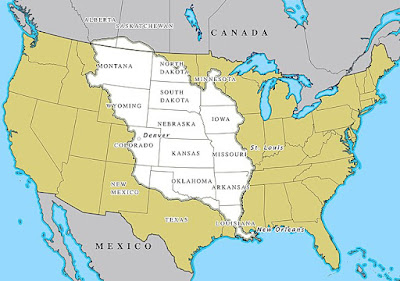

Map of the Louisiana Purchase (in white) overlaid on the
Present Day United States. Note that the Panhandle of 
Florida was not included.


What were those threats? For one, the border of Spanish Florida and the United States was at the southern border of Georgia. With Spanish Florida surrounded by water on three sides, and American land immediately to its north, Florida was cut off from quick help across the land.  Add to that the American neighbors feeling crowded in the southern portions of the fledgling nation, and so wanting to cross the border and set up residence in Florida as well. When the Louisiana Purchase came about in 1803, Napoleonic France sold 828,000 square miles to the United States, and Americans flooded west. Uncaring of the details, some Americans claimed that the panhandle of Florida was part of the Louisiana Purchase. In honesty, it wasn’t, but Americans flooded into that portion of Spain’s holdings during the 1810-1813 time frame. During that same time, the War of 1812 broke out, leading General James Wilkinson to take Mobile, lending strength to the Americans’ position in annexing western Florida. Spain didn’t put up a fight for the area.
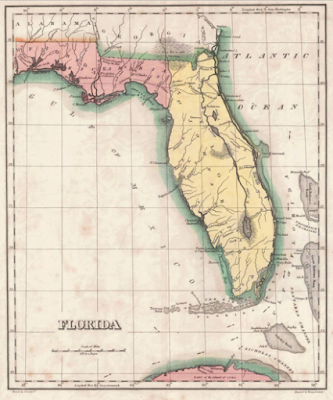

Florida once the Americans annexed 
Western Florida between 1810-1813


In addition to the Americans to their north, there were the Seminole Indians living throughout Florida. The Seminoles would often cross the border into American territory and raid American citizens. It was expected that Spain would stop them, since these Native populations lived in Spanish Florida, but with minimal amounts of troops, they struggled to subdue them.


Similarly, slaves from the American plantations crossed the border between American and Spanish territory and sought refuge in Florida, throwing themselves on the mercy of Spain to keep them safe from slave hunters and plantation owners who sought to recapture them. The lack of soldiers again left this growing population vulnerable in Spanish Florida.


The simple answer would’ve been to send more troops to Castillo de San Marcos and other Florida military outposts, but aside from the prohibitive cost, there were other worldwide issues at play. Political tensions were heating up around the world. From 1807 to 1814, Spain waged a seven-year war against Napoleon in Europe, which took manpower and attention away from Florida’s Spanish settlements. Starting in 1810 in Central and South America, people were fighting for independence from Spain as well, further dividing military forces.
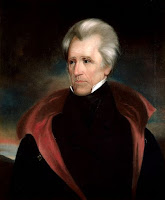
 

Andrew Jackson
So by 1818 or so, all of these factors converged. Spain’s troop count were very low in Florida due to all the other international issues, and the Seminoles, runaway slaves, and outlaws banded together to wreak havoc in the southern portions of the United States. So the American general, Andrew Jackson, pursued the Seminoles (et al.) into Spanish Florida in what became known as the First Seminole War. Jackson’s incursion angered both Great Britain and Spain, so Spain’s leadership sought help from the British in negotiating the international incident. When Britain declined to do more than express their outrage, Spain once again realized it was on its own to negotiate the turbid waters of Spanish-American relations in Florida. It was time to get out.


Spain finally approached the United States with the offer of a treaty. Spain would give up Florida if the United States would, in turn, better define the borders of New Spain—an area that comprised much of Mexico, what we know today as the American Southwest, and California. The United States, long desiring to have Florida for its own, quickly agreed, and U.S. Secretary of State John Quincy Adams and Spanish Minister Luis de Onis hammered out the Adams-Onis Treaty of 1819. Florida—and the languishing Castillo de San Marcos—were now the property of the United States of America.
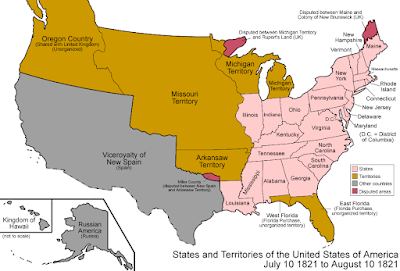

Map showing Adams-Onis Treaty lands. Florida became 
a United States possession while the gray area was
firmly established as "New Spain".


Tune in next month for the interesting history of the fort since becoming an American possession.



Award-winning, best-selling novelist Jennifer Uhlarik has loved the western genre since she read her first Louis L’Amour novel. She penned her first western while earning a writing degree from University of Tampa. Jennifer lives near Tampa with her husband, son, and furbabies. www.jenniferuhlarik.com



COMING MARCH 1, 2022


Love’s Fortress by Jennifer Uhlarik


A Friendship From the Past Brings Closure to Dani’s Fractured Family


When Dani Sango’s art forger father passes away, Dani inherits his home. There, she finds a book of Native American drawings, which leads her to seek museum curator Brad Osgood’s help to decipher the ledger art. Why would her father have this book? Is it another forgery?


Brad Osgood longs to provide his four-year-old niece, Brynn, the safe home she desperately deserves. The last thing he needs is more drama, especially from a forger’s daughter. But when the two meet “accidentally” at St. Augustine’s 350-year-old Spanish fort, he can’t refuse the intriguing woman.


Broken Bow is among seventy-three Plains Indians transported to Florida in 1875 for incarceration at ancient Fort Marion. Sally Jo Harris and Luke Worthing dream of serving on a foreign mission field, but when the Indians reach St. Augustine, God changes their plans. However, when Sally Jo’s friendship with Broken Bow leads to false accusations, it could cost them their lives.


Can Dani discover how Broken Bow and Sally Jo’s story ends and how it impacted her father’s life?

Wednesday, December 9, 2020

First Christmas in Colorado

 By Tiffany Amber Stockton


Last month, I shared about the only place in the United States where four states meet at a single point. It's a national monument called Four Corners. If you missed that post, you can read it here: https://www.hhhistory.com/2020/11/four-states-four-tribes-four-corners.html.

Today, since it's December, and we're nearing Christmas, I wanted to share about a historical marker honoring the very first Christmas in Colorado. 

CHAFFEE COUNTY CHRISTMAS


So, almost everyone knows about the Louisiana Purchase that occurred in 1803. Well, with that purchase came the need to explore and map out the land. Lewis and Clark were already doing some exploration of the area, but they were primarily traveling to the northwest. President Thomas Jefferson wanted greater detail covered, so he commissioned Army Lieutenant Zebulon Pike to explore the Great Plains and the Rocky Mountains into present-day Colorado. Pike was promoted to Captain during his expedition.

Pike contacted several Native American tribes during his travels and informed them the United States now claimed their territory. Thankfully, he and his men didn't run into too much opposition from the Ute, Cheyenne, Navajo, and Arapahoe, but they were just exploring at the time.

Zebulon Pike's story is frequently told at various museums through Colorado. When you live here, you learn a lot about him, namely his attempt to hike to the top of what is today known as Pike's Peak, named after the Captain. When the Ute Indians settled the area, the peak was called Tava, which is the Ute word for "sun." Throughout its history, Europeans have called the mountain El Capitán, Grand Peak, Great Peak, James Peak, Long Mountain, and Pike's Peak.''

Unfortunately, arriving at the base of the peak in late November resulted in too much snow at the higher elevations of the mountains. Pike and his men saw the peak from the area known as Pueblo, Colorado today. They never made it to the top, as the deep snow and frigid temperatures forced them to turn around. However, they changed course slightly in an attempt to find the headwaters of the Red River (the southern boundary of the Louisiana Purchase), only to end up encountering the Arkansas River at a time when their food supply was perilously low.

After crossing Trout Creek Pass on Christmas Eve, two hunting parties shot eight buffalo, and Christmas Day was spent near the mouth of Squaw Creek (one-half mile to the south) feasting on Buffalo and repairing equipment. Not exactly a "traditional" Christmas meal, but when you're out on an expedition or traveling in mostly unknown areas, sometimes you have to improvise.

This event became so famous from Pike's journals, they erected a historical marker at the site many years later, and it's still there today.

* * * * * *

NOW, IT'S YOUR TURN

* Have you ever spent Christmas somewhere unexpected? Where was it and why was it unexpected?
* What is the most unusual meal you have eaten on an otherwise traditional day?
* Have you ever been to the top of Pike's Peak?


BIO

Tiffany Amber Stockton has been crafting and embellishing stories since childhood, when she was accused of having a very active imagination and cited with talking entirely too much. Today, she has honed those childhood skills to become an award-winning and best-selling author and speaker who is also an advocate for literacy as an educational consultant with Usborne Books. She loves to share life-changing products and ideas with others to help better their lives.

She lives with her husband and fellow author, Stuart Vaughn Stockton, along with their two children and two dogs in Colorado. She has sold twenty (24) books so far and is represented by Tamela Hancock Murray of the Steve Laube Agency. You can find her on Facebook and GoodReads.

Sunday, March 8, 2020

Little Known Details of the Lewis and Clark Expedition

by Misty M. Beller

I'm excited to join the blogging team on the Heroes, Heroines, and History blog! My books are frontier westerns set in the Rocky Mountains during the 1800s, so I'll be sharing with you lots of fun historical details I learn through my research. I can't wait! 

My newest series follows much of the trail Lewis and Clark's expedition took across what would become Montana and into Idaho. I have to confess that I couldn't remember many details from when I learned about the expedition in school. As I began to research, I've been amazed at how fascinating their journey was. 

The expedition was known as the Corps of Discovery and consisted of 38 capable enlisted men, in addition to the leaders, Captains Merriweather Lewis and William Clark. I love what Captain Clark wrote in his journal on March 31, 1805: With such men, I feel every confidence necessary to insure success.

As I've read and re-read the journals of the captains and sergeants from those two adventurous years, I've been surprised by so many details. Here are a few of my favorite facts!

Only one person died throughout the entire journey
Sgt. Charles Floyd died of appendicitis on the westward trip in what is now Floyd’s Bluff, Iowa. Throughout the entire journey from St. Louis to the Oregon coast and back, over land no white man had ever trod, while meeting hundreds of Native American tribes, none of the party died through violent means. 
Sergeant Charles Floyd, photo by Benjamin Trott - images.metmuseum.org

Sometimes talks with the Native Americans had to go through five different interpretations
Lewis and Clark hired two interpreters to travel with them, but speaking with the natives still wasn't easy. In one council with a Salish tribe (Nez Perce), the conversation had to flow from English to French to Hidatsa to Shoshone to Salish. Then back. 

Salish Village. Courtesy Northwestern University Library, Edward S. Curtis's 'The North American Indian': the Photographic Images.


Finding a water route to the Pacific Ocean was only one of the goals of the expedition
They were also tasked by President Jefferson with establishing peaceful relations between Native American tribes and their "Great White Father" back in the States, as well as classifying the flora and fauna of the new lands now owned by the United States through the Louisiana Purchase. 
Map showing lands that were part of the Louisiana Purchase in white. By William Morris. Wikimedia, Public Domain.

Those are just a few interesting tidbits I've learned, and I'll be sharing more in future posts. 

In the meantime, are you a history buff about the Lewis and Clark expedition? If so, share some facts we may not know! Or are you like I was, with only a vague memory of what the Corps of Discovery actually did? 

***

Misty M. Beller is a USA Today bestselling author of romantic mountain stories, set on the 1800s frontier and woven with the truth of God’s love.

Her latest release, Freedom in the Mountain Wind, is an epic journey along the path taken by the Lewis and Clark expedition—an epic journey through breathless landscapes and adventure so intense, lives will never be the same.

For a limited time, you can get one of Misty's bestselling novels free here: https://www.subscribepage.com/s8n2o1